
Manually searching through the Harmonized Tariff Schedule (HTS) can take hours and lead to errors. Our free digital lookup tool simplifies this by:
Every HS code follows the same global framework. The first six digits are standardized worldwide under the World Customs Organization’s Harmonized System, and individual countries add further digits for their own tariff and statistical needs.
Here are common products and their HS codes, showing how everyday goods map to the Harmonized System:
| Product | HS Code | Category |
|---|---|---|
| Roasted coffee | 0901.21 | Food & beverage |
| Cotton T-shirts | 6109.10 | Apparel |
| Laptop computers | 8471.30 | Electronics |
| Lithium-ion batteries | 8507.60 | Electronics |
| Olive oil (extra virgin) | 1509.20 | Food & beverage |
| Leather footwear | 6403.99 | Footwear |
| Wooden furniture | 9403.60 | Furniture |
| Plastic toys | 9503.00 | Toys |
| Packaged medicaments | 3004.90 | Healthcare |
Codes shown are common subheadings for illustration. Always confirm the exact code for your product, as small differences in material or use can change the classification.
The HS code you assign directly determines the duty rate, taxes, and trade rules applied to your shipment. An incorrect code can mean overpaying duties, unexpected charges, or customs delays and penalties. Once you have your code, check the applicable rate with our Global Tariff Lookup tool, and our team can support accurate classification through our Customs Compliance services.
Three code systems get called “the HS code”, and they are not the same thing. Which one you need depends on whether goods are moving in or out of the country.
The International Trade Administration explains it simply: the Harmonized System sets the first six digits, and those six are the same everywhere in the world. Countries then add their own digits on the end.
| Code | Digits | Used for | Who runs it |
|---|---|---|---|
| HS code | 6 | The global base. Recognised in every member country. | World Customs Organization |
| HTS code | 10 | US imports. Sets the duty rate you pay. | US International Trade Commission |
| Schedule B | 10 | US exports. Used for filing and trade statistics. | US Census Bureau |
A useful detail from the same source: a product’s full 10-digit Schedule B number and its 10-digit HTS number may differ, but the first six digits will always match. Get the six right and the rest is a country-level decision.
Outside the US the pattern repeats. The European Union adds two digits to make an eight-digit Combined Nomenclature code, then two more for TARIC. The tool above returns the international six, which is the part that travels.
Classification is a process, not a guess. Work through it in order and the answer is usually defensible.
Write down the material, the function and the form. “Cotton” is not enough. “Men’s knitted T-shirt, 100% cotton, short sleeve” is.
Customs classifies goods, not marketing names. Search the tool above for what the item is made of and what it does.
Codes work top down. The first two digits give the chapter, the next two the heading, the last two the subheading. Each step should feel like a narrower version of the step before.
Section and chapter notes decide borderline cases, and they override what a heading looks like it says. This is where most disputed classifications are settled.
Take the six-digit result and extend it to the 10 digits your destination requires. For US imports that is the HTS; for US exports it is Schedule B.
Check the final code against the official schedule or with your customs broker. Our customs compliance team can review classifications before they go on a filing.
Most classification problems are not exotic. They are the same handful of errors, repeated.
Any one of these can mean overpaid duty, a delayed clearance, or a penalty. All five are cheaper to prevent than to unwind.
The Harmonized System is revised on a cycle, not continuously. The World Customs Organization’s current version is the HS 2022 edition, the seventh, and the WCO has already published the HS 2028 edition as the next one.
Revisions add codes for goods that did not exist before and retire codes nobody uses any more. Countries then fold the changes into their own schedules, and they do not all do it on the same day.
The practical effect for an importer is small but real: re-check your codes when a new edition lands, especially on anything technical or environmental, where most of the churn happens.
Take 6109.10, the code for a cotton T-shirt used in the table above, and read it from the left. Each pair of digits narrows the last one.
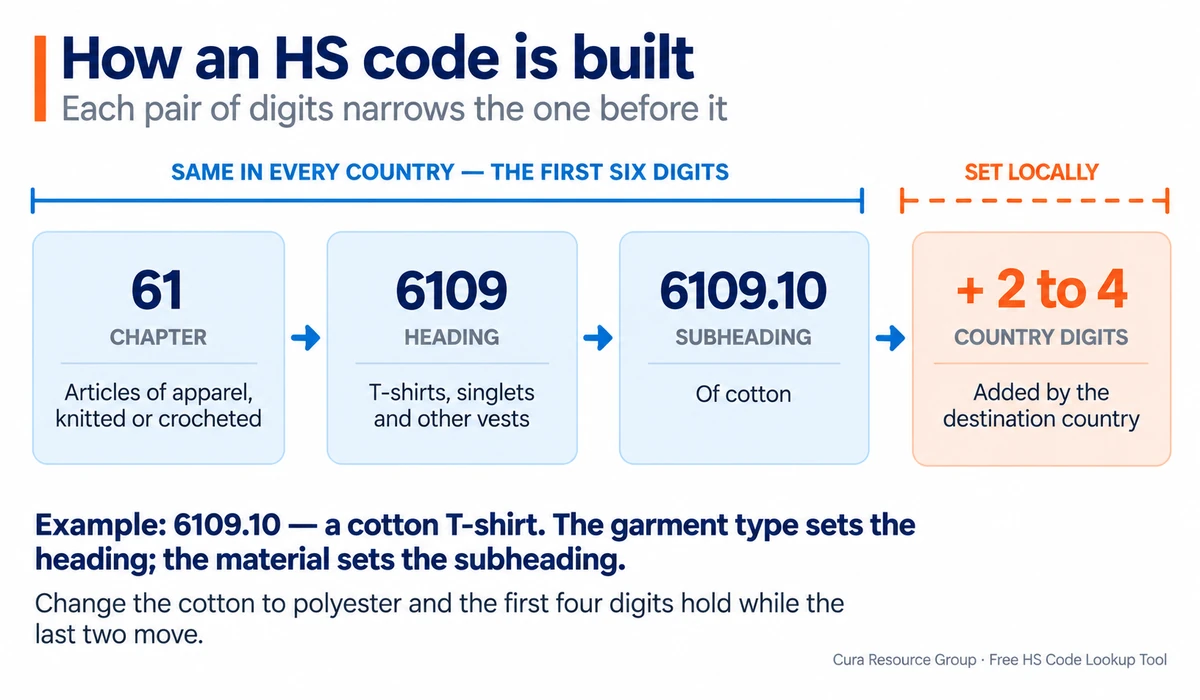
| Digits | What it is | In this example |
|---|---|---|
| 61 | Chapter | Articles of apparel, knitted or crocheted |
| 6109 | Heading | T-shirts, singlets and other vests |
| 6109.10 | Subheading | Of cotton |
| + 2 to 4 more | Country digits | Added by the destination country |
Notice what decided the code: the garment type set the heading, and the material set the subheading. Change the cotton to polyester and the first four digits hold while the last two move.
That is the pattern to expect across the schedule. Broad category first, then form, then material or use. If your search result feels too broad, you are usually one level short.
Clear expectations save rework, so here is the honest scope.
It does: return the international six-digit HS classification from a plain-language product description, in seconds, with no account. That is the part of the code that is the same in every country, and it is the part most people are missing.
It does not: give you a duty rate, file anything, or hand you a legally binding classification. It also will not add the country digits for you.
For the duty rate, use our free Global Tariff Lookup. For a binding ruling, the customs authority in the destination country is the only body that can issue one. For anything in between, that is what a customs broker or our compliance team is for.
Treat the result as a strong starting point that still needs confirming. That is how classification works even when a licensed broker does it.