Cura Resource Group
Our ecommerce fulfillment services store your stock, pick and pack your online orders and ship them to your customers. You keep selling, and the warehouse work stops being yours to run.
Cura Resource Group has run third-party logistics since 2008, with warehouses in Riverside, California; Memphis, Tennessee; and Carolina, Puerto Rico.
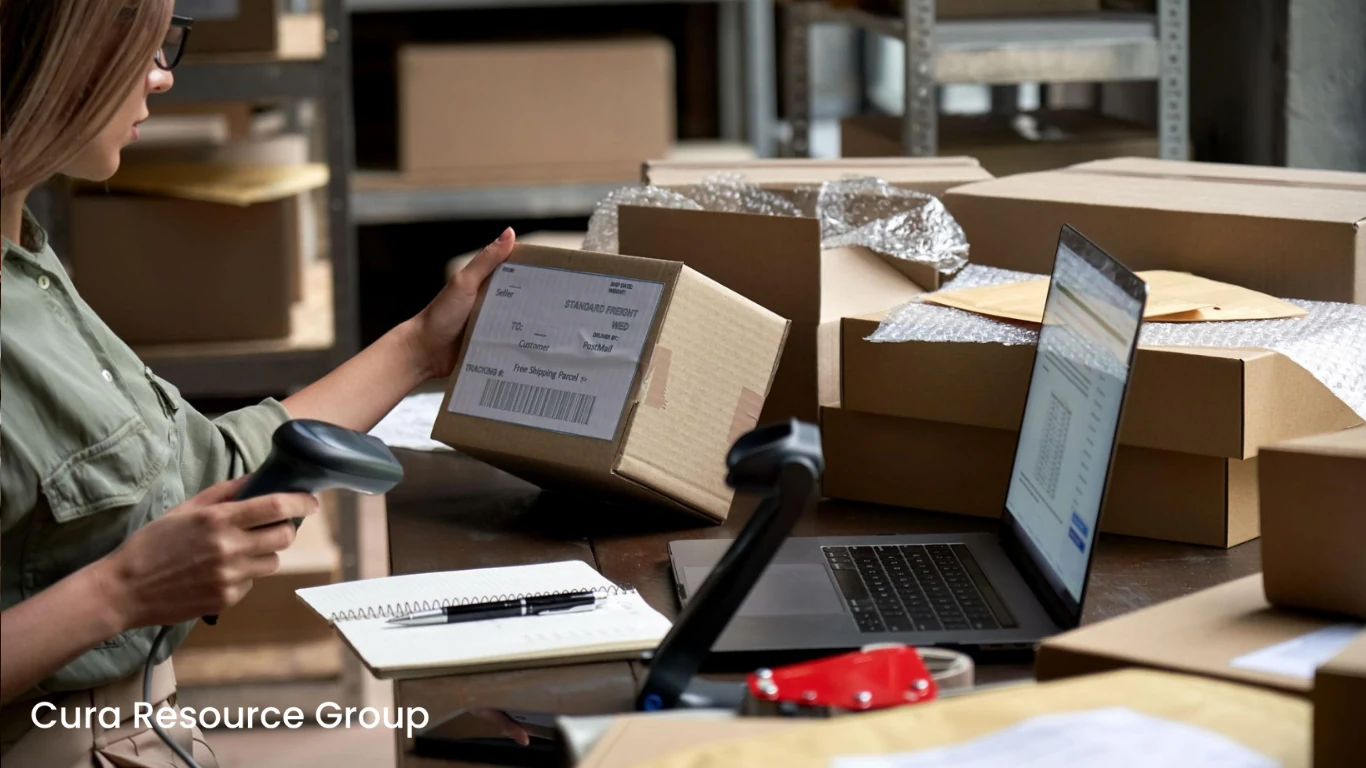
We handle every step an online order needs after your customer pays, from the day your stock arrives to the day a return comes back.
Those steps form the core of the order fulfillment process. Our wider order fulfillment services apply the same steps to wholesale and retail orders.
Online brands that have outgrown their own space or packing bench get the most from outsourced ecommerce fulfillment. We work with businesses of all sizes, from startups scaling their first fulfillment operation to enterprises managing multi-country supply chains.
Our clients include Herbalife. The usual signs are order volume that has passed what your team can pack, stock that has outgrown the space, or a second sales channel. Any one of those is a good reason to ask for a quote.
Four steps take you from your first call to your first shipped order.
You tell us your order volume, average order size and how much stock you need to hold. We reply within 24 to 48 business hours with a quote built on that profile.
We connect to your sales channels and systems during onboarding. We agree your daily order cut-off at the same stage, so everyone knows which orders go out that day.
Your stock arrives and we count it against your paperwork. We log every SKU into our system with a location, so it is ready to pick as soon as orders start.
Orders arrive from your channels, we pick and pack them, and they leave the building. You can watch your inventory change in real time rather than waiting for a report.
We connect to the sales channels and systems you already use, so your orders reach the warehouse from the place you sell.
You also get a real-time view of your inventory. That view comes from the warehouse management system our team works in, so your numbers and the warehouse numbers match.
That same stock data feeds our ecommerce demand planning, which flags what to reorder before it runs out.
Your customer gets a parcel that looks like it came from you. You can supply your own packing slip design, with your logo and wording.
We can also put a returns slip or RMA form in the box on request, which makes a return easier for your customer to start.
Packing follows your specification. When an order needs several items brought together, kitting and assembly builds them into a single product before it ships. When you sell on a recurring plan, subscription box fulfillment runs each cycle as its own release.
Carriers charge for the space a parcel takes up as well as what it weighs. FedEx bills the dimensional weight or the actual weight, whichever is greater, and it finds the dimensional figure by dividing cubic inches by 139.
Take a 16 by 12 by 10 inch box. It holds 1,920 cubic inches, which divides out to about 14 pounds. If the product inside weighs 5 pounds, you still pay to ship about 14.
That makes carton size a real cost line on an ecommerce account. When you compare fulfillment companies, ask how each one chooses the box for your products.
Returns run through the same account as your outbound orders. We receive, inspect, grade and route each one, and sellable items go back into available inventory.
Keeping returns management where the stock already lives means you work from one inventory count instead of two.
We ship from Riverside, Memphis and Carolina, Puerto Rico. Distance matters because parcel carriers price by zone, so stock held nearer the buyer usually costs less to deliver.
Storage and fulfillment run in the same buildings. If part of your stock only needs a home, warehouse storage is available at every site.
You can run wholesale and online orders from one operation. Our omnichannel 3PL services handle retail cases and pallets alongside direct-to-consumer parcels.
We work to retailer routing guides and labeling rules, which helps you keep chargebacks away from a wholesale account. If you also sell on a marketplace, our FBA prep services get your stock ready for its fulfillment centers.
The cost depends on your order profile, so we quote it rather than publish a list.
Across the industry, a fulfillment quote usually has three parts. Storage covers the stock you hold, fulfillment covers the work done on each order, and shipping sits on top.
Account minimums and long-term storage charges are also common across the industry. Ask any provider for the full rate card rather than a headline per-order number.
We set the pricing model to fit your order profile. A storage minimum applies, so ask for it with your quote.
Four details let us quote properly: monthly order volume, average order size, the stock you need to hold and the channels you sell through.
Request a quote and we will reply within 24 to 48 business hours. You can also call us on +1 (800) 813-7155.
Ecommerce fulfillment services are the storage, picking, packing and shipping of online orders by a third party. You keep selling and the provider runs the warehouse work.
We also handle your returns, so the whole order cycle sits in one operation.
It depends on your order volume, order size and the stock you hold. Quotes usually split into storage, the work done per order and shipping.
We quote the pricing model to your profile. A storage minimum applies, so ask for it with your quote.
Yes. We work with businesses of all sizes, from startups scaling their first fulfillment operation to enterprises managing multi-country supply chains.
A storage minimum applies, so ask for it when you request a quote. Tell us your volumes and we will build the quote around them.
Yes. We connect to clients’ sales channels and systems, and we set up the connection during onboarding.
Tell us what you sell on and which systems you use when you ask for a quote. We will then confirm how your orders reach the warehouse.
Yes. You can supply your own packing slip design, with your logo and wording. We can also print a retailer’s required format from its routing guide.
If you want a returns slip or RMA form in the box, we can include that on request.
It puts your stock closer to your customers. Parcel carriers price by zone, and a shorter trip usually costs less and arrives sooner.
Holding inventory in Riverside, Memphis or Carolina, Puerto Rico shortens the trip for the customers each site is nearest to.
Online brands that ship parcels to consumers use them most, from a first warehouse move to a multi-site network. Brands that also sell to retailers or on marketplaces use them too. One provider can then run store orders, FBA prep and online orders from the same stock.
Match the provider to your orders first: where your customers live, which channels you sell on, and what you ship. Then send real test orders, get accuracy and receiving times in writing, and read the exit terms. Our list of the best fulfillment companies groups eight providers by order type.
We log every SKU into our WMS and give you a real-time view of stock. We run counts, track lots, serial numbers and expiry dates, and pick FIFO or FEFO. Low-stock and reorder alerts flag what to replenish, and our inventory management services can move stock between sites.
Outsource when packing orders takes time you should spend on selling, or when your stock has outgrown your space. An ecommerce fulfillment warehouse gives you room and labor without a lease.
Compare what it costs to run this yourself against a quote before you decide.
Our Ecommerce Fulfillment Services:
Product Picking & Packing |
Shipping & Delivery |
Subscription Box Fulfillment |
Omnichannel Fulfillment Services |
Contract Logistics
Get a Free Ecommerce Fulfillment Quote →
Ready to improve your ecommerce fulfillment? Send us your order profile and we will reply within 24 to 48 business hours.