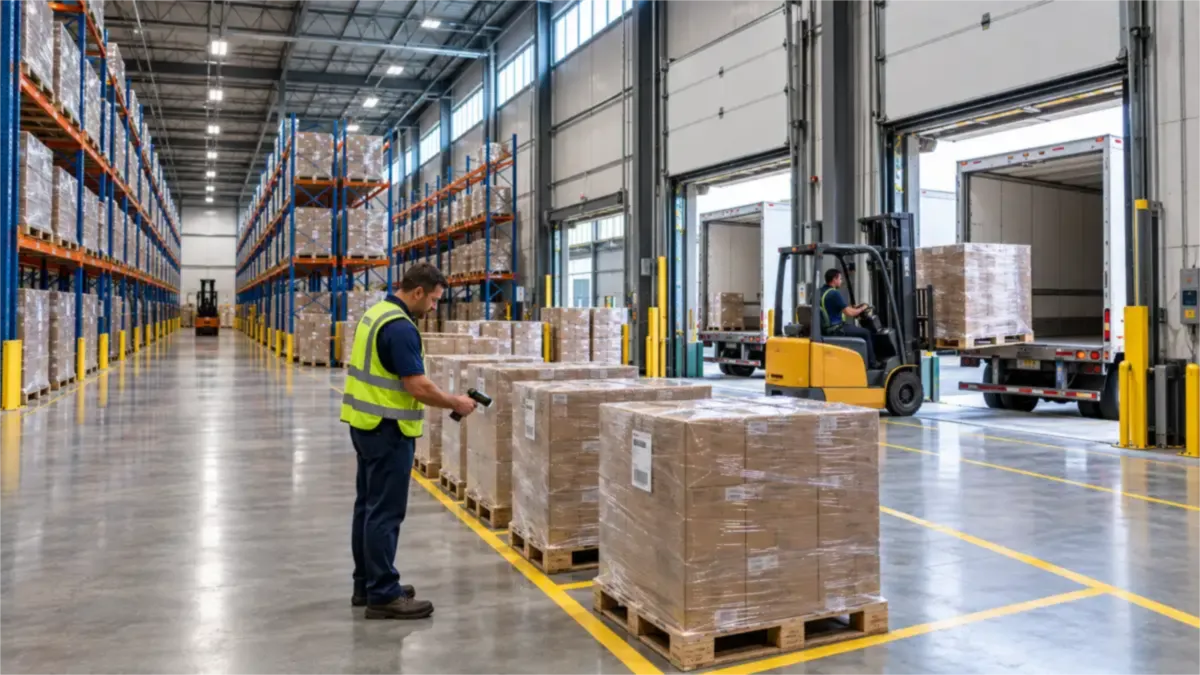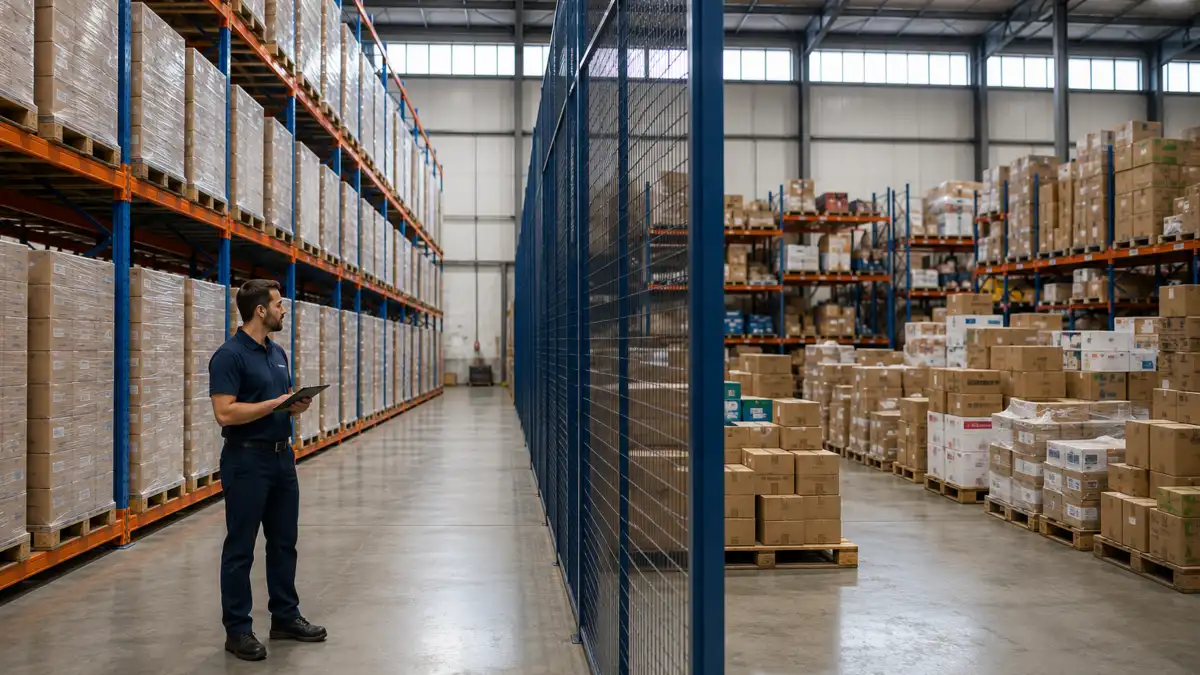



Warehousing best practices are the operational methods that keep a growing brand’s warehouse fast, accurate, and cost-efficient as order volume climbs. They cover how you lay out the space, receive and store inventory, pick and pack orders, track stock, and manage labor and safety.
Get them right and the warehouse supports growth; get them wrong and it becomes the bottleneck that slows shipping, raises costs, and frustrates customers.
This guide walks through the warehousing best practices that matter most for growing and ecommerce brands, plus the technology, metrics, and mistakes to watch — and when it makes sense to hand warehousing to a 3PL.
The common thread is that small inefficiencies multiply as you scale: a few extra seconds per pick or a one-percent error rate barely registers at 50 orders a day, but it quietly drains time and money at 5,000.
Fixing the fundamentals early is what lets a brand grow order volume without a matching rise in cost or chaos.
Why Does Warehousing Matter for Growth?
Ecommerce warehousing is far more than storage. It directly shapes order accuracy, delivery speed, customer satisfaction and profit margin, because in ecommerce every one of those is visible to the customer within days.
As demand rises, a poorly run warehouse produces delays, mis-picks, and stockouts that cost sales and repeat business.
A well-run one does the opposite: it ships orders quickly and correctly, keeps inventory accurate, and holds costs steady even as volume grows. For a scaling brand, warehousing is the operational foundation that everything else depends on.
It also shapes the customer experience more than most founders expect. Delivery speed, order accuracy, and the condition products arrive in are all decided on the warehouse floor — not in marketing.
A great product can still earn a one-star review if it ships late, arrives damaged, or turns out to be the wrong item. That is why brands that treat warehousing as a growth lever, rather than a back-office cost, tend to keep customers longer and spend less winning them back.
8 Warehouse Best Practices for Growing Brands
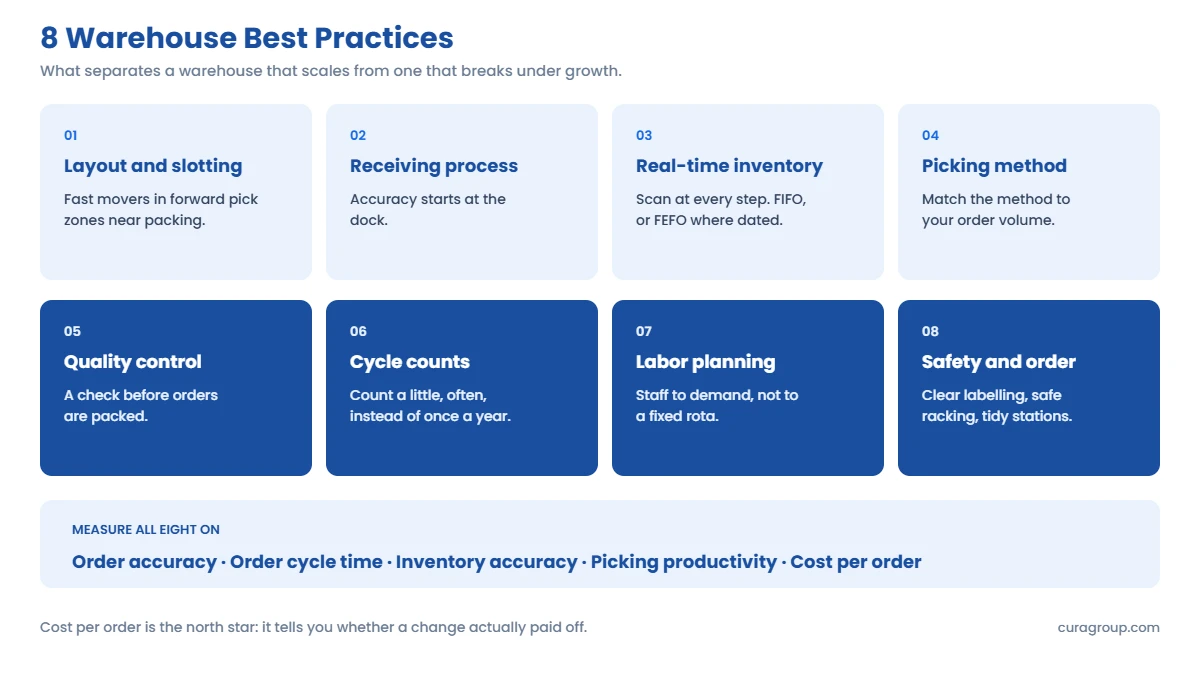
The eight warehouse best practices below are layout and slotting, a standardised receiving process, real-time inventory accuracy and the right picking method. The other four are built-in quality control, regular cycle counts, labour planned around demand, and safety and organisation.
Together they separate a warehouse that scales from one that breaks under growth.
1. Optimize your warehouse layout and slotting
Design the floor around how orders actually move. Place fast-moving SKUs in easy-to-reach “forward pick” zones near packing stations to cut walking time, group related items together, and keep clear, logical aisles.
Smart slotting is one of the cheapest ways to speed up picking, which is usually the most labor-intensive part of the operation.
2. Standardize your receiving process
Accuracy starts at the dock. Verify every inbound shipment against the purchase order, inspect for damage, and log each SKU into your system before it moves to storage. If receiving is sloppy, every downstream count and order inherits the error.
3. Keep inventory accurate in real time
A single, real-time view of stock prevents overselling and stockouts. Use barcode or RFID scanning at every step — receiving, put-away, picking, and shipping — so the system always reflects what is physically on the shelf.
Set a rotation rule at the same time. Use FIFO (first in, first out) for most goods and FEFO (first expired, first out) where anything carries a use-by date. Enforce it in the system, not by whoever happens to be picking. Real-time accuracy is the backbone of reliable order fulfillment.
4. Use the right picking method for your volume
Match your picking strategy to order volume: single-order picking works at low volume, while batch, zone, and wave picking scale to higher throughput. Efficient pick and pack processes cut labor cost per order and speed up shipping.
5. Build quality control into the flow
Add a quick accuracy check before orders are packed — confirming the right items, quantities, and condition. Catching errors inside the warehouse is far cheaper than a return, a refund, and a lost customer.
6. Run regular cycle counts
Instead of shutting down for one big annual inventory count, count a small portion of SKUs continuously. Cycle counting keeps inventory accurate year-round and surfaces problems early, without disrupting operations.
7. Plan labor around demand
Staffing is one of the largest warehouse costs. Use order data to forecast busy periods and schedule labor to match, so you are not overstaffed in slow weeks or overwhelmed during peak season.
8. Prioritize safety and organization
A clean, well-marked, safe warehouse is also a productive one. OSHA’s warehousing guidance covers the recurring causes — forklift traffic, unsafe racking, blocked exits and manual handling — and is the reference to design the floor against.
Clear labeling, safe racking, and tidy workstations reduce accidents and help staff move faster and make fewer mistakes.
What Does a Warehouse Management System Do?
A warehouse management system (WMS) is the technology that ties these practices together: it is the system of record every other practice depends on, which is why warehouse management best practices start there.
It tracks every unit in real time, directs put-away and picking, prevents overselling, and gives managers live visibility into inventory and order status.
Warehouse management system best practices are unglamorous: one system of record, event-driven updates, and no spreadsheet running alongside it. For a growing brand, a WMS that integrates with your ecommerce platform is what turns manual, error-prone warehousing into a repeatable, scalable operation.
Increasingly, automation — barcode scanning, pick-to-light, conveyors, and robotics — layers on top of the WMS to handle higher volume without a matching rise in labor.
When Is Warehouse Automation Worth It?
Warehouse automation pays off selectively for a growing brand, at the point where order volume justifies the spend. It is often pitched as the answer to every warehouse problem, and it is not. Start with the low-cost, high-impact tools: barcode scanning and a WMS eliminate most manual errors for a modest outlay.
As volume climbs, pick-to-light systems, conveyors, and print-and-apply labeling speed up the busiest stations.
Full robotics and automated storage make sense only at high, sustained volume. The rule of thumb: automate the step that is your biggest bottleneck first, prove the return, then expand.
A brand that is not ready to buy automation can still access it by working with a 3PL whose warehouses already run it.
Which Warehouse KPIs Should You Track?
Track five: order accuracy, order cycle time, inventory accuracy, picking productivity, and cost per order.
Cost per order is the one to treat as a north star. Use it to judge whether a new tool, layout change or process actually pays off. Watch that labor cost grows more slowly than order volume as you scale.
Formulas, benchmarks and the full set of metrics are in our guide to warehouse KPIs.
What Are the Most Common Warehousing Mistakes?
Most warehousing problems in a growing brand come from a few avoidable habits:
- No real-time inventory: relying on manual counts leads to overselling and stockouts.
- Poor slotting: storing fast movers far from packing wastes hours of picker travel.
- Skipping quality checks: shipping errors turn into costly returns and bad reviews.
- Ignoring data: not tracking KPIs means problems grow unseen until they are expensive.
- Waiting too long to scale: outgrowing your space and process without a plan caps growth.
When Should You Outsource Warehousing to a 3PL?
Outsource when peak capacity, systems, and cost shape start working against you. A 3PL converts fixed warehouse cost into variable cost.
| Factor | Keep In-House | Outsource to a 3PL |
|---|---|---|
| Cost shape | Fixed lease and headcount | Variable, per order and per pallet |
| Peak capacity | You carry the overstaffing risk | Absorbed within the agreement |
| Systems | You buy and implement the WMS | Inherited on day one |
| Control | Total, hands-on | Through SLAs and reporting |
| Carrier rates | Your volume only | Pooled across the provider’s book |
| Best fit | Specialised handling, steady volume | Growth, seasonality, multi-channel |
At some point, running your own warehouse stops making sense. When order volume outgrows your space and labor, when shipping costs climb, or when warehousing pulls your attention away from product and marketing, a 3PL becomes the better option.
A third-party logistics provider runs a purpose-built ecommerce fulfillment warehouse with an integrated WMS, trained staff, and discounted shipping — applying all of these best practices for you, and scaling up or down with demand.
For many growing brands, outsourcing to a fulfillment center delivers enterprise-level warehousing without the capital and management burden of building it in-house.
Most of these practices are easier to inherit than to build. Cura Resource Group already operates to them — slotting by velocity, cycle counting on a schedule, documented put-away rules — which is often why brands outsource before they have finished writing their own procedures.
Final Word
Warehousing best practices are what keep growth from breaking fulfillment. Optimize your layout, standardize receiving, keep inventory accurate in real time, pick efficiently, check quality, count continuously, and plan labor around demand — all supported by a WMS and measured with the right KPIs.
Whether you run the warehouse yourself or partner with a 3PL, disciplined warehousing turns a potential bottleneck into a real competitive advantage as you scale.
Start with the fundamentals that cost little and pay off fast — accurate receiving, real-time inventory, and smart slotting — then add technology and outside help as your order volume earns it.
Ready to scale your warehousing without breaking fulfillment?
Most of these practices come back to one dependency: knowing what you actually hold. That is the remit of inventory control — cycle counts, location discipline, and reconciliation that catches a variance while it is still small.
Frequently Asked Questions
What are warehousing best practices?
The core practices are slotting stock by picking velocity, cycle counting on a schedule instead of one annual count, documented receiving and put-away rules, clear aisle and location labelling, and tracking a small set of KPIs consistently. Most gains come from doing a few of these reliably rather than all of them occasionally.
How can a growing brand improve warehouse efficiency?
Start with layout: move fast-moving SKUs closest to pack-out so pickers walk less, since travel time is the largest component of picking labour. Then remove the guesswork — labelled locations, a scannable put-away process, and a rule for where new stock goes when its home bin is full.
What is a warehouse management system (WMS)?
A WMS is software that directs and records warehouse work: it tracks inventory to bin level, generates pick paths, controls receiving and put-away, and feeds live stock counts back to your sales channels. Without one, accuracy degrades quickly as SKU count and order volume rise.
What warehouse KPIs should I track?
Start with five: order accuracy, order cycle time, inventory accuracy, picking productivity and cost per order. Those cover whether the right items ship, how long each order takes, whether stock is where the system says, how much a picker gets done, and what the whole thing costs. Add more only once those five are stable and trusted.
When should a brand outsource warehousing to a 3PL?
When peaks force overstaffing you cannot justify year-round, when a WMS purchase is on the table purely to fix accuracy, or when warehouse management is consuming founder time. Outsourcing rarely pays below a few hundred orders a month with simple handling.
How much warehouse space does a growing brand need?
Less than most first estimates, because height is usually cheaper than floor area. Racking, narrower aisles and slotting by velocity often defer a move entirely. Model space against peak stock rather than average, but do not lease for a peak that lasts six weeks a year.
What is the difference between warehousing and fulfillment?
Warehousing is storing inventory; fulfillment is picking, packing and shipping individual customer orders out of it. A building can do both, but they are optimised differently — storage is measured on cost per pallet position, fulfillment on speed and order accuracy.
What is the 5S rule in warehousing?
The 5S rule is a lean method for keeping a warehouse orderly enough to work fast in: Sort, removing what is not needed; Set in order, giving everything a marked home; Shine, cleaning and inspecting as routine; Standardize, writing the first three down as procedure; and Sustain, auditing so the habit holds.
What is 7S in a warehouse?
7S adds two steps to the 5S method: Safety and Security. Safety covers hazard control, forklift traffic rules and PPE. Security covers access control and stock loss. Warehouses handling regulated or high-value goods usually run 7S rather than plain 5S, because those two areas need their own checks.