


Supply chain technology is the integrated stack of software, hardware, and AI systems that orchestrates the movement of goods, data, and capital across a logistics network.
Its role in logistics is to replace fragmented, manual decision-making with predictive, automated workflows—reducing dwell time, lowering carrying costs, and giving operators real-time control over inventory, transportation, and supplier risk.
That definition matters because the gap between leaders and laggards in 2026 is no longer about whether a company has a TMS or WMS. It’s about how deeply technology in supply chain management is woven into daily decisions—and whether the underlying data is clean enough to trust.
This guide walks through the evolution, the current AI-driven core, the transparency layer, the integration challenge, and the single biggest reason most digital transformations stall: dirty data.
How Has Supply Chain Technology Evolved?
Supply chain technology evolved in three stages: paper and phone calls, then siloed software, then connected platforms that share one record. For most of the 20th century it ran on clipboards, fax machines and tribal knowledge.
The shift to digital supply chain technologies happened in three distinct waves, and understanding where your organization sits on this curve dictates which investments actually move the needle.
| Era | Time Period | Defining Technology | Primary Limitation |
|---|---|---|---|
| Manual | Pre-1990s | Paper, phone, fax | No visibility beyond Tier 1 |
| ERP-Centric | 1990s–2010s | SAP, Oracle, basic EDI | Backward-looking, batch-processed |
| Cloud & API | 2010s–2020s | SaaS WMS/TMS, IoT sensors | Siloed data, integration debt |
| Intelligent | 2024–Present | Agentic AI, real-time twins | Requires clean, unified data |
The technological advancements in supply chain management over the past five years have compressed decision cycles from weeks to seconds. A procurement manager who once waited for a Monday-morning report now receives an automated reroute recommendation the moment a port congestion event is detected.
This isn’t incremental—it’s a structural change in how logistics organizations compete.
The companies still operating on spreadsheets layered over a 2008-vintage ERP are not behind by a generation. They’re behind by a paradigm.
What Does AI Actually Do in Logistics?
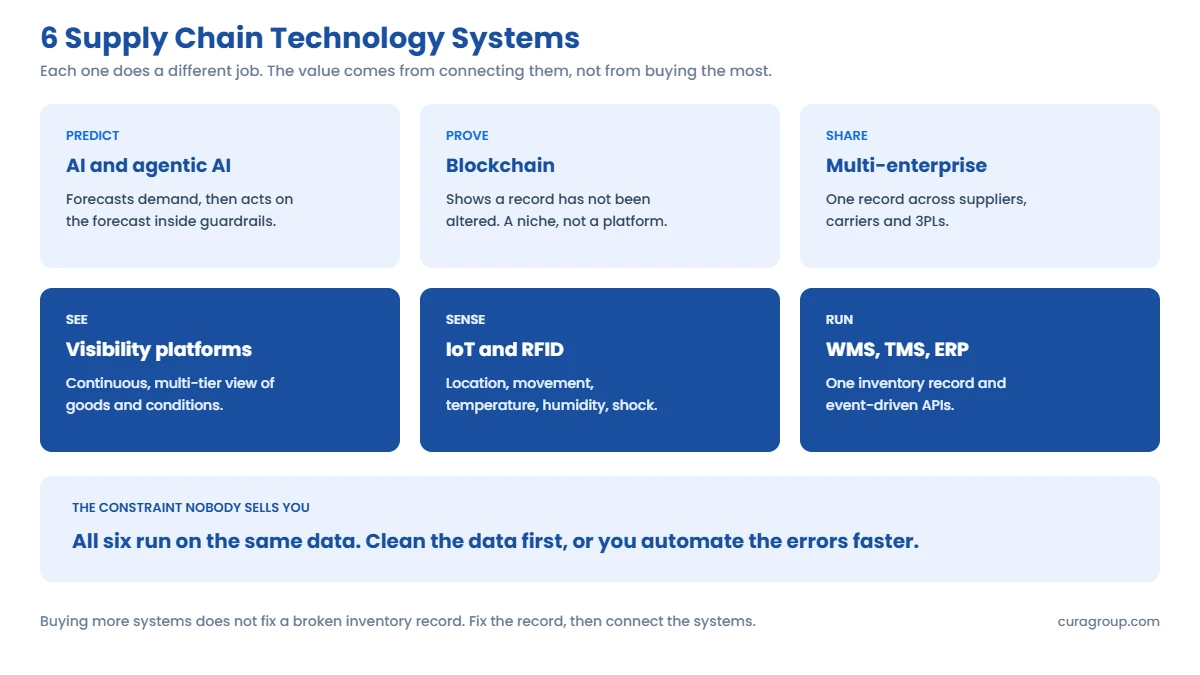
AI does two jobs in logistics: it forecasts demand, and it acts on the forecast. If integration was the connective tissue of the last decade, artificial intelligence supply chain technology is the nervous system of this one. Two capabilities deserve specific attention: predictive analytics and agentic AI.
Predictive Analytics: Forecasting That Actually Forecasts
Predictive analytics replaces the historical average with a probabilistic forecast that updates as conditions change. Traditional demand planning relied on historical averages and a planner’s gut. Predictive Analytics ingests weather data, macroeconomic indicators, social sentiment, point-of-sale velocity, and supplier lead-time variability—then produces probabilistic forecasts that update continuously.
McKinsey’s 2021 study of AI-enabled supply chains put numbers on two of the gains:
- Forecast error falls by 20–50% when AI-driven forecasting replaces statistical models alone (McKinsey, 2021)
- Lost sales and product unavailability fall by up to 65% as a result (McKinsey, 2021)
- Inventory comes down too, because a tighter forecast needs less buffer — size the reduction against your own service levels rather than a published range
Machine learning supply chain technology doesn’t eliminate human judgment. It removes the noise so planners can spend their attention on the minority of decisions that genuinely need a human.
Agentic AI: From Recommendation to Action
The 2026 frontier is Agentic AI—systems that don’t just suggest actions but execute them within defined guardrails. An agentic procurement system detects a supplier delay. It then evaluates alternates against contract terms, place a backup order, notify affected downstream nodes, and update the production schedule—all before a human logs in.
This is the operational shift behind every serious ai supply chain technology investment in 2026. The ROI calculation is no longer just labor savings; it’s the compounding value of decisions made faster than competitors can react.
How Do Blockchain and Real-Time Visibility Work?
Blockchain proves a record has not been altered; real-time visibility platforms show where goods are right now. You cannot optimize what you cannot see, and supply chain visibility technology has matured from periodic check-ins to continuous, multi-tier observation of goods, conditions, and chain-of-custody.
Blockchain’s Practical Niche
The hype cycle around blockchain technology in supply chain management has cooled, and that’s healthy. The technology has settled into specific, defensible use cases:
- Provenance verification for high-value goods (pharmaceuticals, luxury, aerospace components)
- Customs and trade documentation to reduce border friction
- Multi-party reconciliation where trust between counterparties is genuinely low
- Sustainability and ESG reporting with auditable, tamper-evident records
Blockchain is not a universal solution. For most domestic logistics operations, a well-architected cloud database with proper access controls delivers identical functional value at a fraction of the complexity.
Multi-Enterprise Networks and Control Towers
Supply chain and technology stop being an internal question once suppliers, carriers and 3PLs need the same picture. Multi-enterprise networks give every party one shared record instead of a chain of emails, and a control tower puts alerting and exception handling on top of it.
Real-Time Visibility Platforms
The more impactful emerging supply chain technologies in the visibility space are real-time transportation visibility platforms (RTTVPs), digital twins, and IoT-instrumented assets. These tools answer three questions continuously:
- Where is my inventory right now?
- What condition is it in?
- When will it actually arrive—not when it was scheduled to?
The third question is where machine learning earns its keep. Predicted ETAs built from live telematics, weather and historical lane performance are generally sharper than carrier-provided estimates, because they price in the conditions on the day.
What Do IoT and RFID Sensors Track? Technology in Logistics at the Edge
IoT and RFID sensors track location, movement, temperature, humidity and shock. Every forecast and every visibility dashboard depends on that data coming off the warehouse floor and the road.
The Internet of Things (IoT) links sensors, scanners, and equipment so they report status automatically instead of waiting on a manual count.
In practice that means three things. RFID tags and smart shelves track inventory in real time, while GPS and condition sensors on shipments that report location and temperature in transit, and equipment that flags its own maintenance needs.
For a logistics operation, IoT and RFID are what make real-time visibility real. They cut manual scanning, catch problems such as a stalled shipment or a cold-chain excursion as they happen, and feed the AI and forecasting tools with accurate, current data.
How Do WMS, TMS and ERP Connect?
A WMS, a TMS and an ERP connect through a shared inventory record and event-driven APIs, not through nightly file drops. The most expensive mistake in supply chain technology adoption is buying best-of-breed tools that refuse to talk to each other. A WMS (Warehouse Management System) optimizes within four walls.
A TMS (Transportation Management System) optimizes between facilities. An ERP governs the financial and master-data backbone. None of them, alone, optimizes the supply chain.
What Integration Actually Means in 2026
Real integration is no longer point-to-point EDI feeds running overnight. It’s API-first architecture with event-driven messaging, a unified data layer, and AI orchestration sitting above the operational systems.
| System | Optimizes | Critical Integration Points |
|---|---|---|
| WMS | Inbound, putaway, picking, outbound | Inventory sync to ERP; ASN feeds to TMS |
| TMS | Carrier selection, routing, freight audit | Shipment status to WMS; freight cost to ERP |
| ERP | Financials, master data, procurement | Demand signal to WMS/TMS; cost data back |
| AI Layer | Cross-system decisions | Reads all three; writes recommended actions |
This stack is what people mean when they reference supply chain optimization technologies as a strategic capability rather than a tool category. Supply chain logistics technology investments fail when companies treat them as IT projects. They succeed when treated as operating-model redesigns.
Strategic Adoption and the ‘Dirty Data’ Warning
Technology adoption fails on data quality far more often than on the technology itself. Here is the section most vendors will not write. Every meaningful supply chain technology trends report points to AI, automation, and visibility as the future. Almost none of them lead with the prerequisite: Data Hygiene.
Why Most Digital Transformations Underdeliver
Digital transformations underdeliver because the data underneath them is wrong, not because the software is. The most sophisticated supply chain technology solutions on the market will produce confident, well-formatted, completely wrong outputs if fed dirty data. Common failure modes include:
- Duplicate SKUs with inconsistent dimensions across systems
- Supplier master records with three different spellings of the same vendor
- Location codes that don’t reconcile between WMS and TMS
- Unit-of-measure mismatches that quietly corrupt every forecast
- Stale lead-time data baked into ERP records nobody has audited in five years
An AI model trained on this data will not flag the problem. It will confidently recommend a reorder of 12,000 units when 1,200 was correct, because the UoM field said “case” in one system and “each” in another.
The Pre-Adoption Checklist
Before any major investment in supply chain management technology, run this audit:
- Master data ownership — Is there a named owner for item, supplier, and location master data?
- Data quality SLAs — Are there measurable thresholds for completeness, accuracy, and timeliness?
- Single source of truth — Which system is authoritative for each data domain, and is that documented?
- Reconciliation cadence — How often are cross-system mismatches detected and resolved?
- Governance structure — Who has authority to fix data issues without a six-week change request?
Skipping this work is the single biggest reason how technology has improved supply chain outcomes in some organizations and quietly degraded them in others.
What Are the Real Benefits of Logistics Technologies?
Done correctly, the benefits of technology in supply chain management compound across three dimensions:
- Cost — lower logistics spend through better routing, consolidation and inventory positioning
- Service — higher fill rates, with predictive ETAs that customers actually trust. Agree the target rate with your provider rather than assuming an industry figure
- Resilience — The ability to detect, simulate, and reroute around disruptions before they hit P&L
The organizations capturing these gains in 2026 share a common pattern: they invested in clean data first, integration second, and AI third—not the reverse.
Future-Proofing with Cura Resource Group
Future-proofing is a data and integration problem, not a shopping problem: get the record clean and the systems connected, and new capabilities become months of work rather than years. The technology in supply chain landscape will continue to accelerate. New capabilities in agentic AI, autonomous fulfillment, and predictive risk modeling will arrive faster than most internal teams can evaluate them.
The winners will be the organizations that built the foundation correctly—clean data, integrated systems, and a clear governance model—so they can adopt new capabilities in months rather than years.
Cura Resource Group partners with logistics and supply chain leaders to design exactly that foundation. From data hygiene audits and WMS/TMS integration roadmaps to predictive analytics deployment and agentic AI pilots, our work is grounded in operational reality, not vendor slideware.
Ready to assess where your supply chain technology stack actually stands?
Schedule a strategic readiness audit with Cura Resource Group and get a clear, prioritized roadmap built around your data, your systems, and your 2026 objectives. The cost of waiting is no longer measured in missed efficiencies—it’s measured in market position.
Two of these layers have guides of their own: what the equipment actually costs and returns is in warehouse automation, and the metrics that prove any of it worked are in warehouse KPIs.
Frequently Asked Questions
What technologies are used in modern logistics?
The core stack is three systems. A warehouse management system directs floor work, a transport management system routing and rating freight, barcode or RFID scanning feeding both, and an ERP tying inventory to finance. AI sits on top, mostly forecasting demand and optimising pick paths rather than replacing any of it.
How does technology improve logistics operations?
Mainly by removing guesswork. Scanning replaces memory at receiving and picking, live stock counts stop overselling, and routing software picks the cheapest qualifying carrier per order rather than defaulting to one. The gain compounds because each system feeds better data to the next.
What is a warehouse management system?
A WMS is software that directs and records work inside the warehouse. It tracks inventory down to bin level, generates pick paths, controls receiving and put-away, and reports live stock back to your sales channels. It is the system of record for where everything physically is.
What is the difference between a WMS and an ERP?
A WMS runs the warehouse floor — locations, pick paths, put-away, cycle counts. An ERP runs the business — finance, purchasing, orders, reporting. They overlap on inventory, which is why the integration between them is usually where accuracy problems start.
What is dirty data in logistics?
Dirty data is inaccurate or incomplete records — wrong dimensions, stale stock counts, duplicated SKUs — fed into systems that assume they are correct. It matters more with automation and AI, because those systems act on the data at speed instead of pausing to notice it looks wrong.
Do small businesses need logistics technology?
Not the full stack. Most small operations get the largest share of the benefit from scanning and accurate stock counts alone. The heavier systems earn their cost at the point where SKU count, order volume or multiple channels make spreadsheets unreliable rather than merely tedious.