


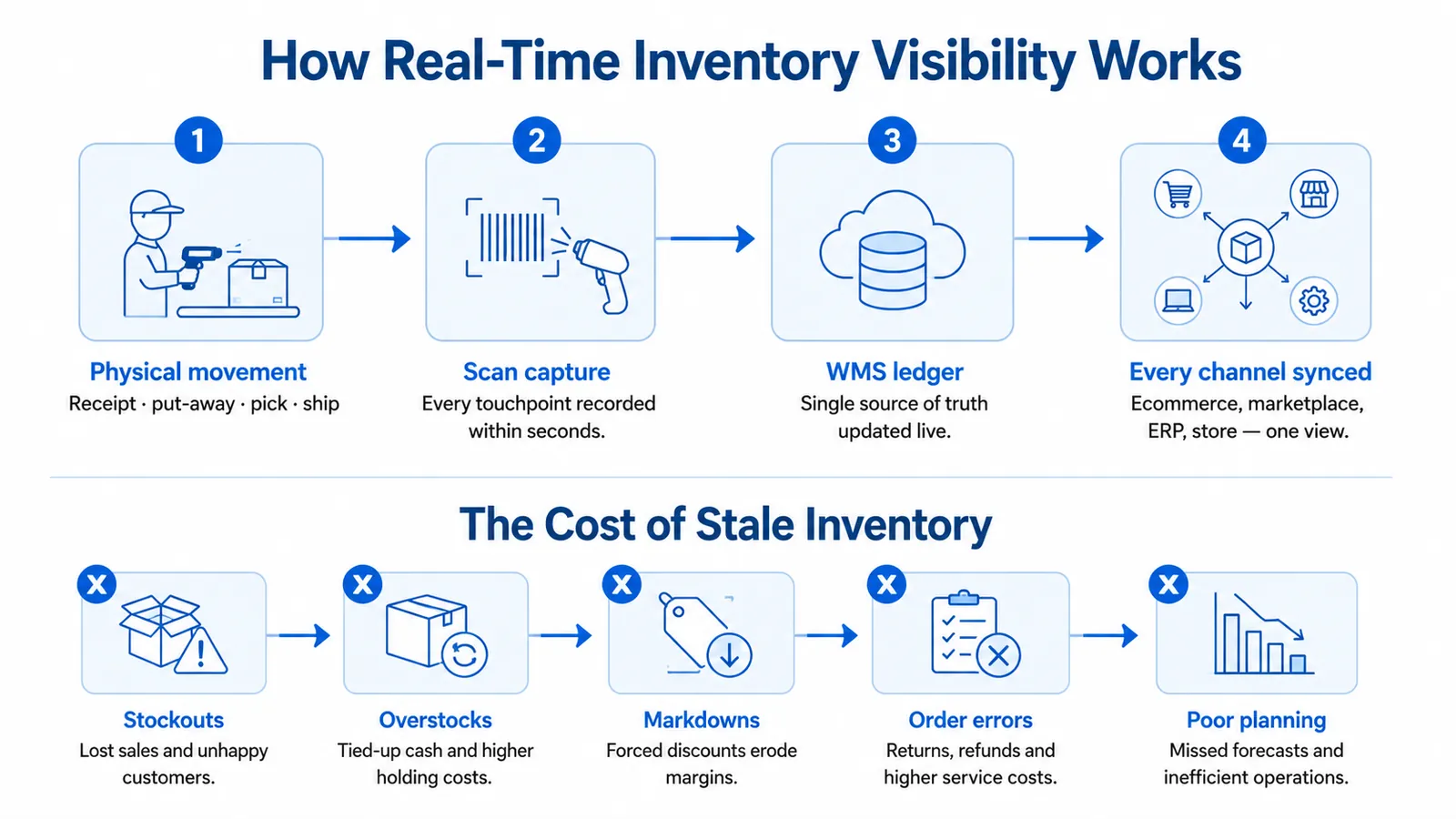
Real-time inventory visibility is stock information that updates as movements happen — every receipt, put-away, pick and ship reflected in the master record within seconds, and pushed to every sales channel by live API.
It matters because the two most expensive supply chain failure modes — overselling and over-ordering — both trace back to stale counts. This guide explains how to achieve it and how a 3PL provides it without your own tech stack.
A single hour of inaccurate stock data can cost a growing brand thousands.
IHL Group’s 2025 inventory distortion study put global retail losses at $1.77 trillion for the year. That splits into $1.2 trillion from out-of-stocks and $572 billion from overstocks. The brands hit hardest are the ones scaling fastest — and the brands hit hardest are the ones scaling fastest, selling across the most channels, and operating from the most locations.
If your warehouse system says you have 80 units of a SKU and your Shopify store has already sold 95 of them, you’re not running a business. You’re running a refund queue.
Real-time inventory visibility is the ability to see exact stock counts, by SKU and by location, updated the instant a transaction happens — across every warehouse, channel, and order touchpoint. It’s the difference between making decisions on yesterday’s data and making decisions on right now.
This post covers what real-time visibility actually means and why it stops being optional past a certain scale. It then works through the four best practices for multiple warehouses, the three tool categories that deliver visibility, and how a 3PL gives you the infrastructure without the in-house build.
What Is Real-Time Inventory Visibility?
Real-time inventory visibility is an inventory management capability where stock levels update continuously as units move through your supply chain — not in nightly batches, not on a 4-hour delay, but at the moment of the transaction.
Definition and Core Components
A real-time inventory system needs a capture layer underneath it: barcode scanners, RFID readers or IoT sensors recording each movement. The network has to be fast enough that the write lands before the next person looks. On top of that, the system tracks three things at once:
- Exact stock counts that update on transaction. Every pick, pack, ship, return, receipt, and transfer triggers an immediate write to your inventory record.
- Coverage across all locations. Warehouse on-hand, in-transit between facilities, store-level stock, units sitting at a 3PL, and inbound POs all roll into a single view.
- Sync across every sales channel. When a unit sells on Amazon, it disappears from your Shopify available count within seconds.
Inventory management systems with real-time visibility unify these three layers. Without all three, you have partial visibility — which is often worse than none, because it gives you false confidence.
Real-Time vs. Periodic Inventory Tracking
Periodic tracking updates inventory on a schedule — usually a nightly batch process or a weekly cycle count. It works fine if you’re a single-location brand moving a hundred orders a day.
It breaks the moment you add a second warehouse, a second sales channel, or your tenth thousand orders a month.
The lag between the real stock position and the system stock position becomes the gap where overselling, stockouts, and bad purchasing decisions live. Cycle counting, barcode scanning, and RFID can support either model — but only real-time architecture eliminates the gap entirely.
Why Is Real-Time Inventory Visibility Critical for Growing Brands?
Stale inventory data costs money in four ways: overselling, safety-stock padding, emergency freight, and sales you never see.
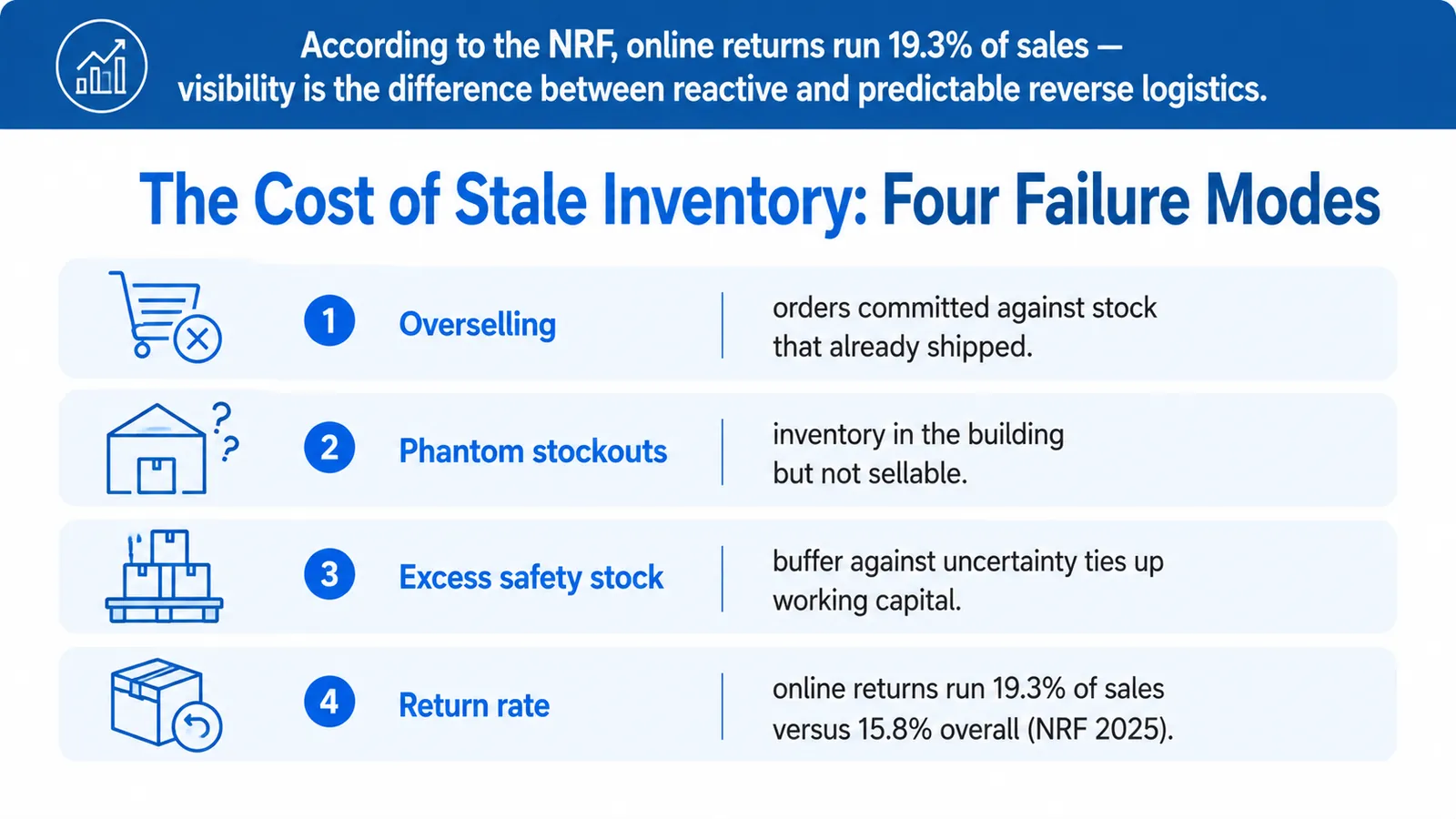
The importance of real-time inventory visibility scales with your operational complexity. The more SKUs, channels, and locations you run, the more revenue lives or dies on how accurate your stock data is at any given second.
Prevents Stockouts That Kill Conversions
Stockouts don’t just lose you the immediate sale. They train customers to buy elsewhere.
The reference study here is old but still the one everyone cites. Corsten and Gruen, writing in Harvard Business Review in 2004, found roughly 31% of shoppers facing a stockout bought the item from another store. Another 9% abandoned the purchase entirely.
Real-time data feeds automated reorder point logic. The moment stock drops below your safety stock threshold for a SKU, a purchase order triggers. No spreadsheet, no Monday-morning review, no oversight gap.
Eliminates Overstock and Reduces Holding Costs
Dead stock costs you twice: once when you bought it, and again every month it sits in a rack you’re paying rent on.
Carrying cost is the number to model here: storage, insurance, depreciation and the opportunity cost of capital sitting in a rack. Work out your own figure rather than accepting a rule of thumb.
Tools for reducing overstock with real-time inventory visibility flag slow-moving SKUs early, expose inventory turnover by location, and let you reallocate or markdown before product becomes a write-off rather than after.
Improves Order Accuracy and On-Time Delivery
Pick errors fall sharply when warehouse staff are working from live data tied to barcode scans. Fulfillment accuracy improves, on-time delivery rate climbs, and the cascading cost of returns, replacements, and support tickets drops with it.
Powers Smarter Demand Forecasting
Live SKU-level velocity data is the foundation of any forecasting model worth running. Without it, you’re forecasting off monthly summaries — which smooth out the exact signals (weekend spikes, channel-specific surges, regional demand shifts) you need to see.
Real-time data feeds demand forecasting models that actually predict what you should buy next quarter. Accurate live data matters most when volume spikes — see our guide to preparing your supply chain for peak-season demand.
What Are the Best Practices for Real-Time Inventory Visibility Across Warehouses?
Four practices hold up across multiple warehouses. Centralize all inventory data in one system, automate stock updates at every touchpoint, set threshold alerts by location, and sync inventory across all sales channels.
1. Centralize All Inventory Data in One System
Pick a single source of truth. Whether it lives in your ERP, your WMS, or an inventory hub layered on top, every location, channel, and integration must read from and write to the same record.
Cloud-based inventory platforms with ERP and WMS integration are the standard answer — local databases per warehouse stop working the moment you transfer stock between facilities.
2. Automate Stock Updates at Every Touchpoint
Every meaningful event in the warehouse should trigger an inventory write: receiving, putaway, pick, pack, ship, return, transfer, and cycle count adjustment. Barcode scanning and RFID are the input mechanisms; the warehouse management system is what turns each scan into a stock-level change in real time.
If a step in your fulfillment flow is still manual — someone updating a spreadsheet at end of shift — that’s where your real-time accuracy breaks.
3. Set Threshold Alerts by Location
National reorder points are blunt. A SKU might be flush in your East Coast warehouse and critically low in your West Coast facility, and a single global threshold won’t see it. Location-specific safety stock and reorder points prevent one warehouse from cannibalizing another’s allocated stock.
4. Sync Inventory Across All Sales Channels
Multichannel selling without real-time channel sync is a guaranteed oversell. When a unit sells on Amazon, your Shopify, Walmart, wholesale portal, and DTC site must all reflect the decrement within seconds.
Real-time inventory visibility across sales channels is the single most important guardrail for any brand selling on more than one platform. It is one part of the wider case for supply chain visibility.
What Are the Best Solutions for Real-Time Inventory Visibility in Warehouses?
Inventory visibility solutions fall into three categories: warehouse management systems, order management systems and AI-led forecasting tools. The right one depends on where the gap sits in your stack. Here is how they compare.
| Tool Category | Primary Function | Best For | What It Doesn’t Do Alone |
|---|---|---|---|
| WMS (Warehouse Management System) | Tracks stock movement inside the four walls | Brands with one or more warehouses needing live floor-level data | Channel-level allocation |
| OMS (Order Management System) | Orchestrates orders across channels and routes them to fulfillment | Multichannel brands managing complex routing | Physical warehouse operations |
| AI-Powered Inventory Tools | Predictive restocking, anomaly detection, demand forecasting | Brands with enough historical data to model | Replacing core WMS/OMS infrastructure |
| 3PL Platform | All of the above, managed | Brands that want visibility without the build | In-house control over every workflow |
Warehouse Management Systems (WMS)
A WMS is the operational backbone — it tracks inventory by bin, by lot, by serial number, and updates as workers scan.
Leading ecommerce WMS tools for real-time inventory visibility offer cloud-based dashboards, multi-location support, and open APIs into your other systems. Look for sub-minute sync frequency, native barcode and RFID support, and reporting that drills to the SKU and location level.
Order Management Systems (OMS)
An OMS sits above the WMS and handles channel-level routing. When an Amazon order comes in, the OMS decides which warehouse fulfills it based on live stock, shipping cost, and delivery promise — then passes the pick to that warehouse’s WMS.
An order management system with real-time inventory visibility is what stops the overselling problem at the channel layer.
AI-Powered Inventory Tools
AI platforms sit on top of your operational systems and turn live data into forward-looking signals. That means predictive restocking, anomaly detection on receiving variances, and demand forecasting at the SKU-week-location grain. They are additive, not replacements.
What to Look for in Any Tool
Real-time inventory visibility software is only as good as its weakest integration. Evaluate:
- Sync frequency — sub-minute, ideally event-driven rather than polled
- API integrations with Shopify, Amazon Seller Central, your ERP, and your shipping carriers
- Reporting and alerting at the SKU, location, and channel level
- User-level access controls so warehouse staff, ops leaders, and execs see what’s relevant
How Does a 3PL Give You Real-Time Inventory Visibility Without the Tech Stack?
A 3PL gives you the WMS, the scanners, the integrations and the customer portal on day one, because the provider already owns all of it. Building this infrastructure in-house yourself is a multi-quarter, multi-six-figure project.
What a Modern 3PL Provides
The best 3PL companies for real-time inventory visibility in 2025 give clients a live, browser-based dashboard showing stock by SKU and location, updated as fulfillment happens.
Beyond the dashboard, expect automated low-stock alerts pushed to email or Slack, SKU-level reporting filterable by date range and location, and full supply chain visibility from inbound PO to delivered order.
3PL vs. In-House: The Visibility Tradeoff
Building visibility in-house means paying for the technology and the time to deploy it. A 3PL brings it ready-made, but you give up some control.
| Factor | In-House | 3PL |
|---|---|---|
| Tech investment | High — WMS, OMS, integrations, IT staff | None — included |
| Time to live visibility | 6–18 months | Days |
| Operational control | Full | Defined by SLA |
| Ongoing cost | Fixed (staff, licenses, infra) | Variable (per order / per pallet) |
| Scaling complexity | Linear with your team | Absorbed by the 3PL |
The benefits of real-time inventory visibility for brands that go the 3PL route show up immediately: live data from day one, no integration project, no internal IT overhead.
What to Ask a 3PL About Their Visibility Tools
Before signing, get answers to:
- How often does stock sync to my sales channels? Event-driven is the answer you want.
- Do I get a real-time dashboard, or just scheduled reports? Dashboards win.
- Can it integrate with my existing systems — Shopify, NetSuite, Amazon Seller Central? Native integrations beat custom builds.
- What’s the SLA on alerts and reporting accuracy? Get it in writing.
These are the questions that separate a true best 3PL for real-time inventory visibility and reporting in 2025 from a warehouse that bolted a portal onto an old WMS.
Multichannel Inventory Visibility: Managing Stock Across Platforms
Selling across several channels means one pool of stock feeding many storefronts, which is exactly where overselling starts.
The Overselling Problem
You list 50 units of a hero SKU on both Amazon and Shopify. A Black Friday rush hits. Both channels sell 40 units in the same hour. Without real-time multichannel inventory sync, you’ve now committed to shipping 80 units of a product you have 50 of.
You’re choosing between cancelling 30 orders, paying expedited freight on emergency restocks, or eating a multi-day backorder. None of those are good options. SKU-level tracking with sub-minute channel sync is what prevents the scenario entirely.
Buffer Stock Strategy for Multichannel Brands
For brands that can’t sync sub-minute (some legacy integrations can’t), the workaround is channel-specific allocation. Reserve 70% of available stock for your highest-margin or highest-velocity channel and allocate the rest across the others.
Safety stock buffers per channel give you a margin of error against sync lag. It’s a workaround, not a solution — but it’s the right move while you migrate to true real-time multichannel inventory, which is the foundation omnichannel fulfillment is built on.
How do I manage inventory visibility across multiple warehouses?
Best practices for real-time inventory visibility across multiple warehouses include centralizing all stock data in a single system of record, automating updates at every fulfillment touchpoint via barcode or RFID scanning, setting location-specific reorder thresholds, and syncing all sales channels to the same inventory source to prevent cross-warehouse cannibalization or overselling.
Final Takeaway
Real-time inventory visibility stops being optional somewhere between your second sales channel and your second warehouse. Past that threshold, the cost of operating blind — in lost sales, overstock writedowns, support tickets, and bad purchasing — outruns the cost of fixing it.
Whether you build the infrastructure in-house with a WMS, OMS, and integration layer, or partner with a 3PL that gives you the dashboard on day one, the question isn’t whether to invest in visibility.
It’s how fast you can get it live before the next revenue leak. The benefits of real-time inventory visibility for brands compound — every month of accurate data sharpens the next quarter’s decisions.
Cura Resource Group gives clients a real-time inventory dashboard from the day they go live — with SKU-level reporting, automated low-stock alerts, and native integrations into Shopify, Amazon, and major ERPs.
If you’re evaluating the best 3PL companies for real-time inventory visibility in 2026, see how our 3PL solutions work, read our warehousing best practices guide, or explore our take on supply chain technology. Get a dashboard demo and see your inventory the way your business actually needs to see it.
Want real-time visibility without building the stack yourself?
Frequently Asked Questions
What does inventory visibility mean?
Inventory visibility means having accurate, timely knowledge of what stock you hold, where it sits, and how it is moving. It spans every location and every channel — one shared record that inventory, fulfilment, sales and finance can trust to make the same decisions from the same numbers.
How is real-time visibility different from periodic stock updates?
Real-time inventory visibility is stock information updated as movements happen rather than batched overnight. Every receipt, put-away, pick and ship changes the master record within seconds, so orders never commit against stock that has already left the building and reorder points never trigger on stale counts.
What is a real-time inventory tracking system?
A real-time inventory tracking system is the combination of hardware, software and integrations that records stock changes as they happen — barcode or RFID scans at the pick face, a warehouse management system holding the ledger, and API connections that push updates to every sales channel within seconds.
How do you achieve real-time inventory visibility?
Combine a warehouse management system that captures every movement at the point it occurs, scanning hardware at receiving and picking, and live integrations to every sales channel. Add cycle counting to keep the ledger honest. Without all four, one late signal makes the whole picture stale.
How does real-time inventory visibility improve supply chain efficiency?
It removes the two failure modes that generate the most rework: committing orders against stock that is not really there, and reordering against counts that are already outdated. Both create expensive downstream work — cancellations, expediting, safety stock buffers — that live visibility eliminates upstream.
How does real-time inventory visibility reduce overstock?
Overstock is the buffer businesses hold against uncertainty. When you know exactly what you have across every location within seconds, that uncertainty shrinks and so does the buffer. Once visibility is trustworthy, safety stock can usually come down, which frees working capital tied up in slow-moving inventory.
How do you choose inventory management software with real-time visibility?
Ask three questions of every shortlisted system. Does it update the master record within seconds of a physical movement, not overnight? Does it push those updates to every sales channel via live API? And does it support cycle counting rather than just annual counts? If any answer is no, keep looking.
What should you look for in a 3PL for real-time inventory visibility?
A 3PL should provide a customer portal showing live stock across every facility, API integration into your ecommerce and ERP platforms, documented inventory accuracy above 99%, and a defined cycle counting programme. Ask to see the actual portal in use rather than a demo prepared for the sales call.