

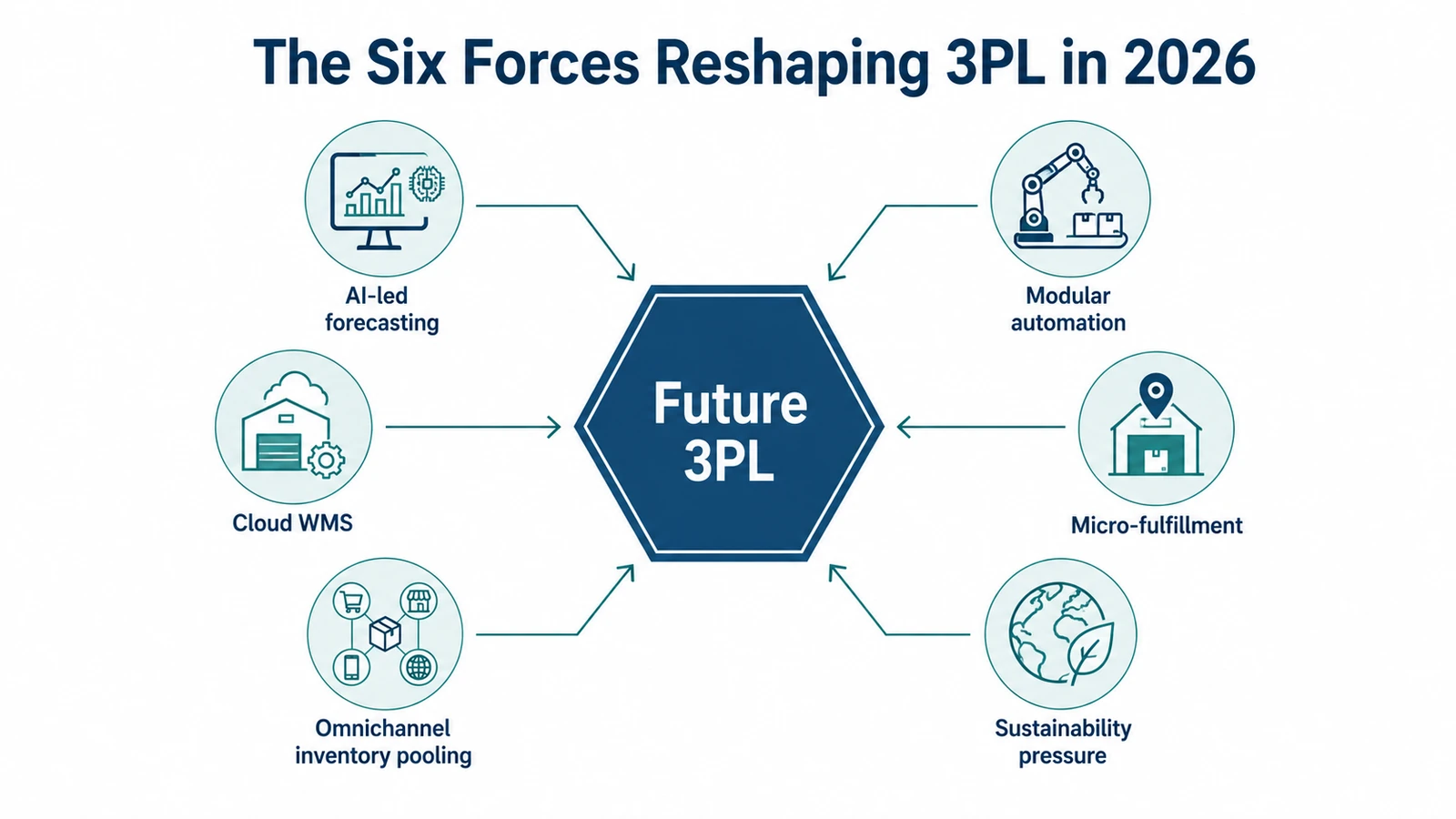
The future of 3PL is the shift from outsourced storage and transport toward integrated technology, data and network flexibility — providers competing on real-time visibility, forecasting accuracy and distributed capacity rather than warehouse space alone. Six forces are driving it: AI-led forecasting, modular automation, micro-fulfillment close to demand, sustainability pressure on transport emissions, cloud-based warehouse management, and omnichannel inventory pooling.
Same-day delivery is no longer a differentiator—it’s the baseline. Across every sector, from consumer goods to industrial manufacturing, the pressure on supply chains has never been more intense. Labor shortages, surging e-commerce volumes, geopolitical disruptions, and relentless cost scrutiny are forcing companies to fundamentally rethink how they manage logistics.
The future of 3PL is not simply about storing goods and shipping boxes. It’s about building intelligent, integrated, and adaptable supply chain ecosystems that can respond to real-time demand signals, absorb disruption, and scale smoothly across channels.
For Directors of Operations, Supply Chain Managers, and CEOs of manufacturing enterprises, understanding where third-party logistics is headed isn’t optional—it’s a strategic imperative. This article breaks down the most consequential smart warehousing trends and warehousing solutions shaping 2026, and what your organization needs to do to stay ahead.
The Evolution of 3PL: From Traditional to Tech-Driven
Not long ago, a third-party logistics provider was essentially a contracted storage-and-shipping operation. You handed off inventory, they picked and packed, and you paid per pallet. The relationship was transactional, the data was sparse, and strategic input was minimal.
That model is obsolete.
Today’s 3PL industry evolution is being driven by a convergence of forces: rising consumer expectations, technology democratization, and the hard lessons of supply chain fragility exposed during the COVID-19 era. The modern 3PL is no longer a vendor—it’s a strategic partner embedded in your end-to-end supply chain architecture.
From cost center to value driver. The legacy pitch was cost savings through outsourced labor and shared infrastructure. The new value proposition is supply chain resilience—the ability to absorb demand volatility, re-route around disruption, and flex capacity up or down without capital investment. For enterprise manufacturers, this translates directly to margin protection and competitive agility.
Strategic partnerships over transactional contracts. High-performance 3PLs now co-invest in technology with their clients. They provide dedicated account management, participate in S&OP (Sales & Operations Planning) cycles, and deliver analytics that inform procurement decisions. This is next-gen logistics outsourcing in practice.
The rise of 4PL integration. Some enterprises are moving beyond traditional 3PL arrangements toward 4PL (Fourth-Party Logistics) models, where a single orchestrator manages multiple 3PLs, carriers, and fulfillment partners across a global network. This shift reflects the growing complexity of omnichannel supply chains and the need for unified visibility from factory floor to customer doorstep.
The companies gaining ground right now are those that treat 3PL selection not as a procurement exercise, but as a strategic architecture decision.
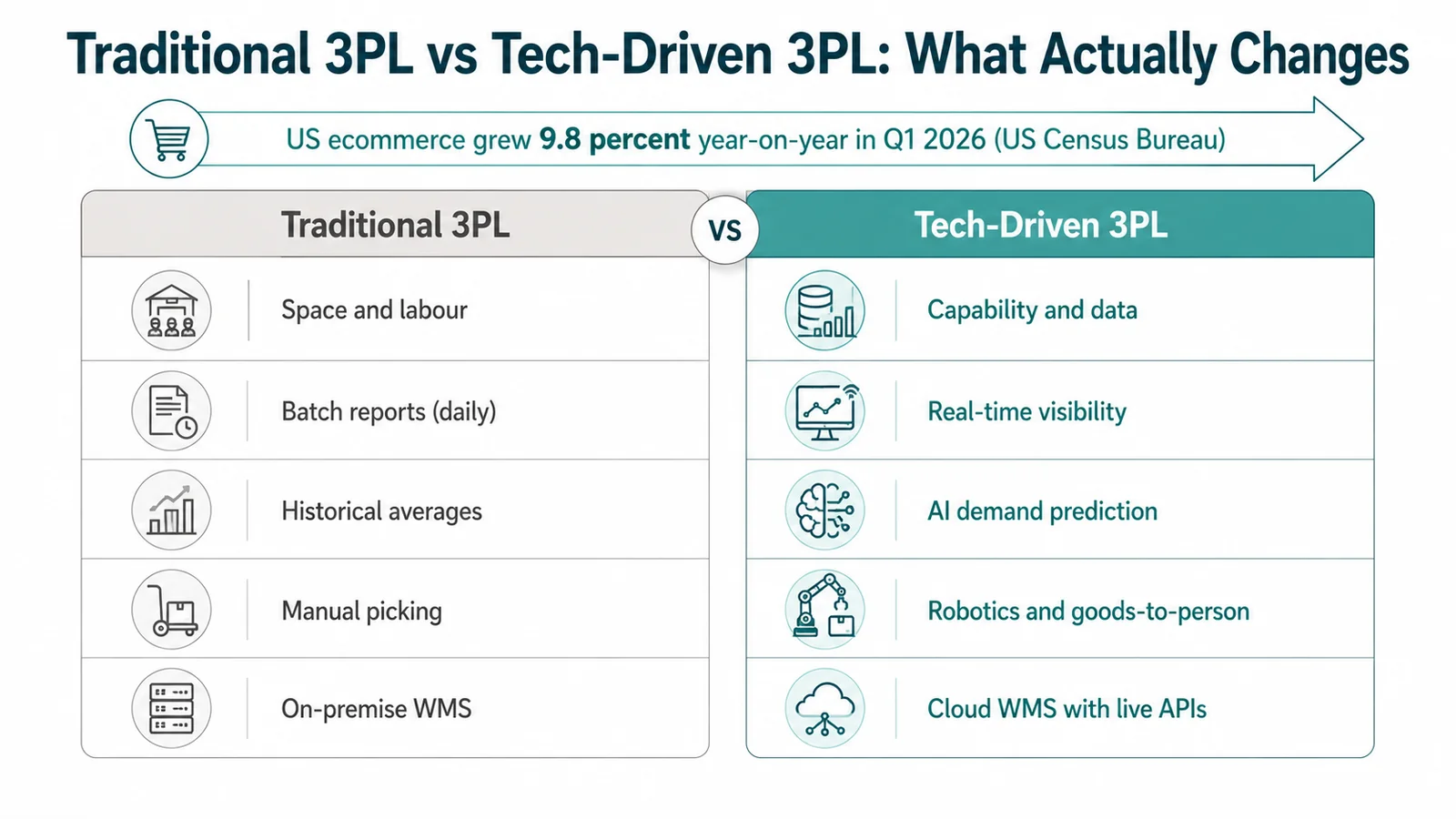
The practical differences between the two models look like this:
| Dimension | Traditional 3PL | Tech-Driven 3PL |
|---|---|---|
| What you buy | Space, labour and transport | Capability, visibility and data |
| Inventory view | Batch reports, often daily | Real-time across every site |
| Forecasting | Historical averages | AI-led demand prediction |
| Picking | Manual, paper or handheld | Robotics and goods-to-person |
| Systems | On-premise WMS, file transfers | Cloud WMS with live API integration |
| Network | One or two large facilities | Distributed, including micro-fulfillment |
| Returns | Handled after the fact | Designed into the flow |
| Reporting | Monthly review | Continuous KPI dashboards |
What Are the Smart Warehousing Trends in 2026?
The warehouse of 2025 looks nothing like the warehouse of 2015. Where once rows of static shelving and manual pick carts were the norm, today’s high-performance distribution centers are instrumented, automated, and deeply connected to broader supply chain systems.
Real-Time Inventory Visibility
One of the most transformative shifts in warehousing solutions 2025 is the deployment of pervasive IoT sensors and RFID tracking across warehouse environments. Every SKU, every bin location, every inbound shipment is tracked in real time—not batch-updated at the end of a shift.
For enterprise operations managing hundreds of thousands of SKUs across multiple facilities, this level of granularity is major. Inventory accuracy rates that once hovered around 92–95% are now exceeding 99.5% in technology-enabled warehouses. That delta matters enormously when you’re calculating fill rates, planning replenishment, or making allocation decisions across channels.
Real-time reporting dashboards give supply chain managers instant visibility into stock positions, order status, and exception alerts—without waiting for a morning WMS report. Decision latency collapses. The ability to catch a pick error, a receiving discrepancy, or a low-stock alert in seconds rather than hours is a meaningful operational advantage.
Hyper-Local Fulfillment
Consumer expectations for speed have outpaced what traditional hub-and-spoke logistics networks can deliver economically. The response? Hyper-local fulfillment—positioning inventory closer to end customers through a distributed network of smaller, strategically located nodes.
Rather than relying on one or two mega-DCs to serve an entire region, forward-thinking brands are seeding inventory across a constellation of regional and micro-facilities. This architecture enables next-day or same-day delivery to a far larger percentage of the customer base without paying premium carrier rates.
For manufacturers selling direct-to-consumer or through e-commerce channels, this isn’t a future consideration—it’s a present competitive requirement.
Which Warehouse Automation Technologies Are Leading the Change?
Labor is the largest controllable cost in most warehouse operations—and it’s under intense pressure. Chronic labor shortages in logistics markets across North America, accelerating wage inflation, and high turnover rates in manual fulfillment roles are driving a surge in warehouse automation technologies adoption. This section covers which technologies are gaining ground and why; for what each one is, what it costs, and how to build the business case, see what warehouse automation costs and what it returns.
The economics have also shifted. As hardware costs decline and Robotics-as-a-Service (RaaS) models make automation accessible without large upfront capital expenditure, the ROI case for automation is now compelling at much lower volume thresholds than it was five years ago.
Autonomous Mobile Robots (AMRs)
AMRs represent one of the most practical and rapidly scalable automation technologies available today. Unlike fixed conveyor systems that require extensive facility modification, AMRs navigate dynamically using sensors and machine vision, adapting to changes in floor layout and inventory positioning.
In pick operations, AMRs dramatically reduce the “travel time” that consumes 60–70% of a picker’s shift in traditional walking-pick environments. By bringing goods to stationary pick stations, they enable labor optimization at scale—the same number of associates can process significantly higher order volumes.
AMR fleets can also be scaled incrementally. Start with 10 robots, add 20 more as volume grows. This elasticity is particularly valuable for operations with pronounced seasonality.
Automated Storage and Retrieval Systems (ASRS)
ASRS technologies—from vertical lift modules (VLMs) to shuttle-based cube storage systems—compress the storage footprint dramatically while improving pick accuracy. A well-designed ASRS implementation can achieve storage density 3–5x greater than conventional racking, effectively expanding a facility’s effective capacity without adding square footage.
For high-SKU, high-velocity operations, ASRS combined with intelligent slotting logic delivers order throughput rates that manual operations simply cannot match.
Cobots and Goods-to-Person Systems
Collaborative robots (cobots) work alongside human associates on tasks like palletizing, packing, and sorting—augmenting human capability rather than replacing it wholesale. Goods-to-person (G2P) systems route the right items to the right associate at the right time, eliminating search time and reducing pick errors.
Together, these technologies form the backbone of the modern automated fulfillment center—a facility where human judgment and dexterity are applied where they add the most value, and repetitive physical tasks are handled by machines.
What Is the Role of AI in Supply Chain Management?
Automation handles the physical; artificial intelligence governs the decisions. AI in supply chain management is no longer experimental—it is actively reshaping how enterprises plan, execute, and optimize their logistics operations.
Predictive analytics and demand forecasting. Traditional demand planning relied on historical sales data with simple statistical models. AI-driven forecasting incorporates hundreds of variables—weather patterns, social trends, promotional calendars, competitor pricing, macroeconomic signals—to generate significantly more accurate demand signals. The result is better inventory positioning, fewer stockouts, and reduced excess inventory carrying costs.
For a manufacturing enterprise with $100M+ in revenue, a 2–3% improvement in forecast accuracy can translate to millions of dollars in working capital released from safety stock.
Digital twins. A digital twin is a virtual replica of a physical supply chain network—a simulation environment where scenario planning can be conducted without real-world risk. AI-powered digital twins allow supply chain teams to model the impact of a facility disruption, a carrier capacity shortage, or a demand spike before it happens, and pre-position responses accordingly.
Risk mitigation and disruption handling. AI systems continuously monitor supply chain risk signals—port congestion data, weather forecasts, supplier financial health indicators—and trigger alerts or automated rerouting recommendations before disruptions escalate.
Decision-making automation. Routine decisions—replenishment triggers, carrier selection, order routing—are increasingly being automated via AI-driven rules engines that optimize against multiple constraints simultaneously. This frees supply chain teams to focus on strategic decisions rather than operational noise.
Rise of Micro-Fulfillment & On-Demand Warehousing
The micro-fulfillment center (MFC) model is one of the most significant structural shifts in logistics infrastructure in a generation. Positioned within dense urban areas—sometimes inside or adjacent to retail footprints—MFCs put inventory within 2–5 miles of a substantial consumer population.
The economics are compelling: last-mile delivery costs drop sharply when origin points are closer to destination addresses. Same-day and sub-4-hour delivery windows become economically viable. And the customer experience improves in ways that drive loyalty and repeat purchase behavior.
On-demand warehousing complements MFCs by giving brands access to flexible, pay-as-you-go storage capacity without long-term lease commitments. During peak seasons, a brand can rapidly activate additional space across a provider’s network. In off-peak periods, they release it—paying only for what they use.
For e-commerce brands scaling rapidly or entering new geographies, this model eliminates the warehouse infrastructure barrier to market entry. It’s scalability as a service.
The combination of MFCs and on-demand warehousing is also enabling new fulfillment models for traditional manufacturers—particularly those adding direct-to-consumer channels alongside their existing retail and wholesale businesses. The infrastructure now exists to support omnichannel fulfillment strategies without requiring massive capital investment.
Sustainable Logistics and Green Warehousing
Environmental sustainability has moved from a CSR footnote to a board-level business priority. Regulatory pressure—including SEC climate disclosure rules, EU supply chain due diligence legislation, and evolving carbon reporting mandates—is increasing sharply. Simultaneously, large enterprise customers and end consumers are demanding credible sustainability commitments from their supply chain partners.
For 3PLs and their enterprise clients, sustainable logistics solutions are no longer optional.
Green warehousing encompasses a range of infrastructure and operational improvements: solar panel installations on warehouse rooftops (which can offset 40–60% of facility energy consumption), LED lighting with intelligent occupancy sensing, electric forklifts and dock equipment, and EV-ready loading docks to support electrification of last-mile fleets.
Sustainable packaging and reverse logistics are equally critical. Eliminating single-use plastics, right-sizing packaging to reduce dimensional weight charges, and designing return flows that recover and reuse materials all contribute to carbon footprint reduction.
3PLs pursuing net-zero goals are also deploying sophisticated carbon accounting tools that give shipper clients SKU-level emissions data—enabling truly informed decisions about transportation mode, routing, and packaging choices.
Cloud-Based WMS and Digital Integration
The warehouse management system (WMS) is the operational nerve center of any fulfillment operation. But a WMS that operates as an isolated system—disconnected from ERP, TMS, OMS, and trading partner systems—creates exactly the kind of visibility gaps that lead to errors, delays, and customer dissatisfaction.
Cloud-based WMS platforms solve this by providing a continuously updated, scalable system of record that integrates across the full technology stack via modern API architecture. Updates deploy automatically, data is accessible in real time from anywhere, and integration with third-party systems is far more flexible than legacy on-premise solutions allowed.
API integration and EDI (Electronic Data Interchange) capabilities allow 3PLs to connect smoothly with client ERPs (SAP, Oracle, Microsoft Dynamics), e-commerce platforms (Shopify, Magento, BigCommerce), and carrier networks—creating a continuous flow of data from order creation through final delivery confirmation.
Blockchain transparency is an emerging capability being piloted by leading 3PLs for high-value or highly regulated goods—providing an immutable audit trail of custody, handling conditions, and chain of title that is particularly valuable in pharmaceutical, food, and electronics logistics.
Omnichannel Fulfillment Strategies
Today’s enterprise manufacturer doesn’t serve one channel—it serves many: wholesale, retail, marketplace, direct-to-consumer, and potentially B2B e-commerce. Each channel has different fulfillment requirements: pallet-level for retail DC replenishment, unit-level for DTC, case-level for marketplace. Managing these simultaneously against a unified inventory pool is one of the defining operational challenges of 2026.
Omnichannel fulfillment strategies require a WMS and operational model that can segment inventory intelligently, process orders across channels without conflict, and adapt pick-pack workflows dynamically based on order type.
Cross-docking capabilities allow 3PLs to accelerate flow-through for time-sensitive orders—bypassing putaway entirely and moving goods directly from inbound to outbound staging. For retail replenishment and perishable goods flows, this can shave days from the fulfillment cycle.
Unified inventory visibility ensures that available-to-promise calculations reflect real-time stock positions across all storage locations—preventing overselling, enabling intelligent order routing, and supporting accurate delivery promise windows at point of sale.
Reverse logistics management—handling returns efficiently across channels—is equally critical. A smooth returns experience has become a purchase driver for consumers, and the speed with which returned goods are inspected, re-graded, and returned to sellable inventory directly impacts working capital.
The Numbers Behind the Shift
Two published figures explain most of the investment. According to the U.S. Census Bureau, US ecommerce reached $340.2 billion in the second quarter of 2026 — 17.1% of all retail sales and 12.2% above the same quarter a year earlier. That growth lands directly on fulfilment capacity. At the same time the National Retail Federation reports an overall retail return rate of 15.8% of sales but 19.3% for online orders, which is why reverse logistics has moved from an afterthought to a design requirement.
The move toward tech-driven logistics is real, though the growth is steadier than the headlines suggest. Interact Analysis recorded a 3% decline in warehouse automation order intake in 2024 and projects a 9% compound annual growth rate between 2026 and 2030, against 8% across 2024 to 2030. Surveys of warehouse operators find that a large majority plan to deploy some form of robotics within the next few years, and adoption is moving faster at 3PL facilities than at company-owned ones. In the annual Third-Party Logistics Study, technology and AI capability now rank among the reasons shippers stay with, or switch away from, a provider, and sustainability has become a real decision factor in a growing share of selections. The takeaway for businesses: the providers investing in automation and data today are the ones that will offer better speed and cost tomorrow.
What Are the Challenges of Adopting Next-Gen 3PL Solutions?
Awareness of these technologies and models is widespread. Adoption, however, is uneven—and for good reason. The barriers are real.
High upfront investment. Even with RaaS and cloud-based OpEx models, the transition to technology-enabled logistics requires capital for integration, implementation, and change management. The business case must be built carefully, and payback periods need to be credible.
Integration complexity. Connecting a 3PL’s WMS to a manufacturer’s ERP and e-commerce stack is rarely plug-and-play. Legacy systems, custom integrations, and data governance challenges can significantly extend implementation timelines.
Workforce adaptation. Automation doesn’t eliminate the need for skilled labor—it changes what skills are needed. Retraining associates to work alongside AMRs, manage automated systems, and interpret data dashboards requires sustained investment in human capital.
Data security concerns. Sharing operational data with a 3PL partner—inventory levels, demand forecasts, customer data—introduces information security considerations that must be addressed through strong contractual protections and technical controls.
Future Outlook: What Businesses Should Do Now
The window for proactive positioning is open, but it won’t stay open indefinitely. Companies that move now to build technology-enabled, flexible supply chain capabilities will hold a structural cost and speed advantage over those that delay.
Partner with tech-enabled 3PLs. Evaluate potential 3PL partners not just on price and geographic footprint, but on their technology stack, integration capabilities, and willingness to co-invest in your success.
Invest in scalable solutions. Prioritize platforms and partnerships that grow with your business—cloud-based WMS, modular automation, on-demand warehousing—rather than locking into rigid infrastructure.
Prioritize data and automation. The single highest-ROI investment most manufacturers can make right now is improving supply chain data quality and visibility. Everything else—AI forecasting, automated decision-making, dynamic routing—depends on reliable, real-time data.
Build supply chain resilience. Diversify fulfillment nodes, develop relationships with multiple carrier partners, and design inventory strategies that can absorb demand volatility without stockouts or write-offs.
Conclusion
The logistics industry is in the midst of a structural transformation that will reshape competitive dynamics across virtually every product category. The future of 3PL is defined by intelligence, flexibility, and integration—providers that combine advanced technology, real-time data, and strategic partnership capabilities to deliver outcomes that static, transactional logistics models cannot.
For enterprise manufacturers, the strategic imperative is clear: the supply chain is a competitive weapon, and the partners you choose to build it with will directly influence your ability to grow, serve customers, and protect margins in an increasingly demanding market.
Smart warehousing trends, AI-driven decision-making, micro-fulfillment networks, and sustainable operations are not future considerations—they are present-day differentiators.
The question is whether your logistics infrastructure is positioned to capture the advantage, or ceding it to competitors who acted sooner.
Ready to Build a Future-Ready Supply Chain?
Cura Resource Group partners with enterprise manufacturers to design and operate technology-enabled logistics networks that scale with your business.
If your current 3PL relationship is transactional rather than strategic—or if you’re evaluating whether your supply chain infrastructure is built for the demands of 2026 and beyond—let’s talk.
Schedule a Strategy Consultation →
Our team works directly with Directors of Operations, Supply Chain Managers, and executive leadership to assess current-state logistics performance, identify high-impact improvement opportunities, and architect the fulfillment network your growth requires.
Frequently Asked Questions
What is the future of 3PL?
Third-party logistics is shifting from outsourced storage and transport toward integrated technology and data services. Providers increasingly compete on visibility, forecasting accuracy and network flexibility rather than warehouse space alone. The practical result is that customers buy capability and information, not square footage.
How is AI changing 3PL warehousing in 2026?
AI now handles demand forecasting, slotting decisions and exception management inside the warehouse rather than just reporting on them. It predicts which SKUs will move, positions them before orders arrive, and flags shipments likely to miss a promise date. The shift is from describing what happened to deciding what happens next.
How is technology changing 3PL and warehousing?
Cloud-based warehouse management systems, real-time inventory visibility, autonomous robots and AI-driven forecasting are replacing manual processes and batch reporting. Decisions move from weekly reviews to the moment an order arrives, and smaller operations can now reach tools once reserved for enterprise networks.
What trends are shaping warehousing in 2026?
Six dominate: AI-led forecasting and slotting, modular automation, micro-fulfillment near demand centres, sustainability pressure on transport emissions, cloud WMS replacing on-premise systems, and omnichannel inventory pooling. Rising ecommerce volume and higher online return rates sit underneath all six as the demand driver.
What is the future of warehouse automation?
Automation is moving from full-building overhauls to modular systems added incrementally — autonomous mobile robots, goods-to-person stations and cobots working alongside staff. That lowers the entry cost and shortens payback, which is why mid-sized operations now adopt technology once limited to enterprise distribution centres.
What are the benefits of micro-fulfillment centers?
Micro-fulfillment places small, often automated facilities close to dense customer populations, cutting last-mile distance and cost. The trade-off is higher fixed cost per square foot and tighter SKU selection. They suit fast-moving items where delivery speed drives the sale rather than a full catalogue.
How can companies reduce carbon footprint in logistics?
The largest reductions come from fewer, fuller truckloads: consolidating shipments, improving load utilisation and positioning inventory closer to demand. Packaging right-sizing and route optimisation add further gains. Facility measures such as LED lighting help, but transport typically dominates total emissions across a distribution network.
What should I look for when choosing a 3PL partner in 2026?
Check systems integration first, then documented performance rather than target sheets: inventory accuracy, on-time shipping and order accuracy with the measurement method defined. Confirm certifications match your product, ask what happens at three times your volume, and read the exit clause before you need it.