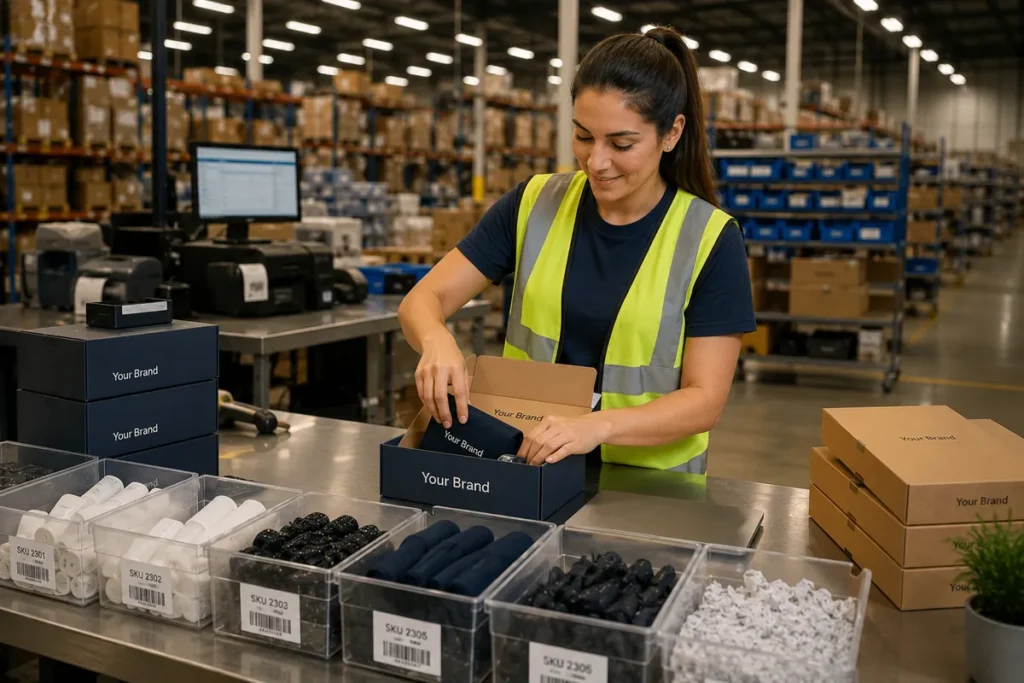

Kitting and assembly services are ecommerce third-party fulfillment operations. A warehouse team combines multiple individual SKUs into a single ready-to-ship unit — whether that’s a subscription box, a promotional bundle, a product with accessories, or a custom gift set.
For ecommerce brands and manufacturers, outsourcing kitting and assembly to a 3PL eliminates the need to build a dedicated assembly operation in-house, reduces per-unit labor costs, and ensures consistent presentation across every order.
Switching to outsourced kitting and assembly services should lower kit error rates and shorten order cycle times. How much depends heavily on how clean your bill of materials was to begin with, so agree the target with your provider rather than assuming a figure.
What Are Kitting and Assembly Services?
Kitting is the process of grouping individual components — separate SKUs — into a single sellable or shippable unit called a kit. Assembly refers to the physical combining, bundling, or building of those components into the finished kit.
Together, product kitting and assembly services handle everything from sourcing the individual parts in your inventory to producing a finished, labeled, packaged unit ready for pick-and-pack fulfillment or direct shipment.
Kitting and assembly fulfillment services are used across a wide range of business types:
- Subscription box companies assembling monthly curated boxes
- Ecommerce brands bundling a hero product with accessories (e.g., a device + charger + case)
- Manufacturers pre-assembling component sets for B2B distribution
- Healthcare companies building clinical trial or promotional kits
- Retailers building promotional gift sets or seasonal bundles
- Software companies assembling physical onboarding kits
The core value of outsourcing is consistency. Every kit built by a professional assembly team follows a documented bill of materials, or BOM. It is verified at the component and finished-kit level, and meets the same quality standard on order 1 and order 10,000.
How the Kitting and Light Assembly Process Works: Step-by-Step
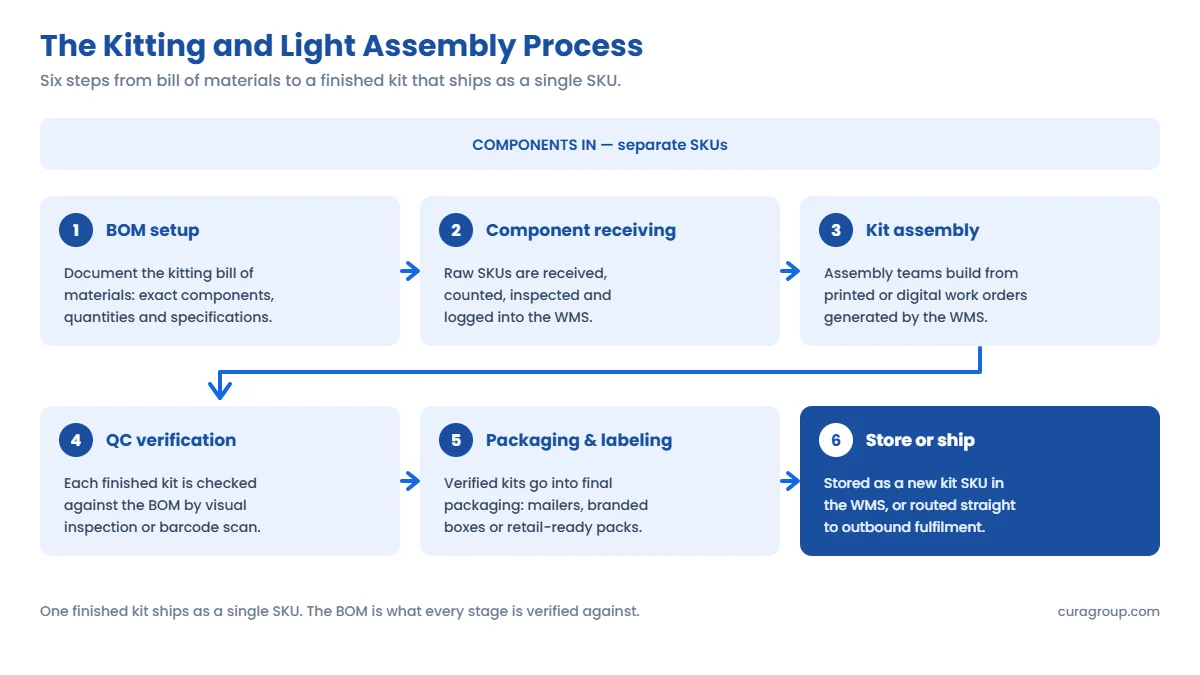
Kitting runs from a bill of materials through component staging, assembly, verification, and putaway as a single new SKU.
Step 1: Bill of Materials (BOM) Setup
Before any kitting begins, your 3PL team works with you to document a kitting bill of materials — the exact components, quantities, and specifications that go into each kit.
The BOM is entered into the warehouse management system (WMS), which uses it to track component inventory, trigger restocking alerts, and verify kit accuracy at each stage. An accurate BOM is the foundation of consistent kitting output.
Step 2: Component Receiving and Inventory Setup
Individual components — your raw SKUs — are received at the fulfillment center, counted, inspected, and logged into the WMS. Components are stored separately from finished goods, in designated pick locations organized for efficient kit assembly. This separation prevents inventory confusion and makes cycle counting straightforward.
Step 3: Kit Assembly
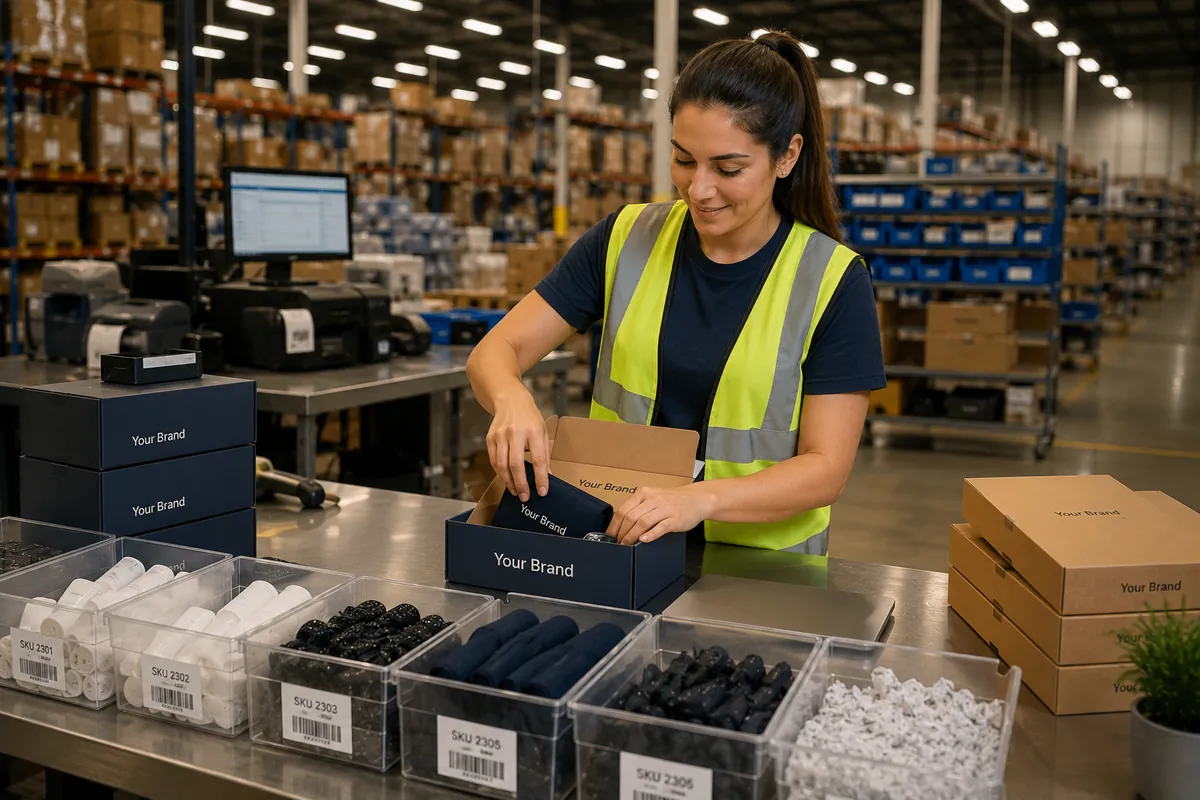
Assembly teams work from printed or digital work orders generated by the WMS. Each station has the components and packaging materials for a specific kit type. Assemblers pull components according to the BOM, combine them in the correct configuration, and pass the kit to the next stage.
For complex kits, assembly may happen in sequential stages across multiple stations.
Step 4: Quality Control Verification
At a QC checkpoint, each finished kit is verified against the BOM — either by visual inspection, barcode scan, or weight check. Any kit that does not meet spec is flagged, corrected, and re-verified before moving forward.
Providers that publish their numbers generally report very high kit accuracy off the back of this verification step; treat reluctance to share the figure as the answer.
Step 5: Kitting, Packaging and Labeling
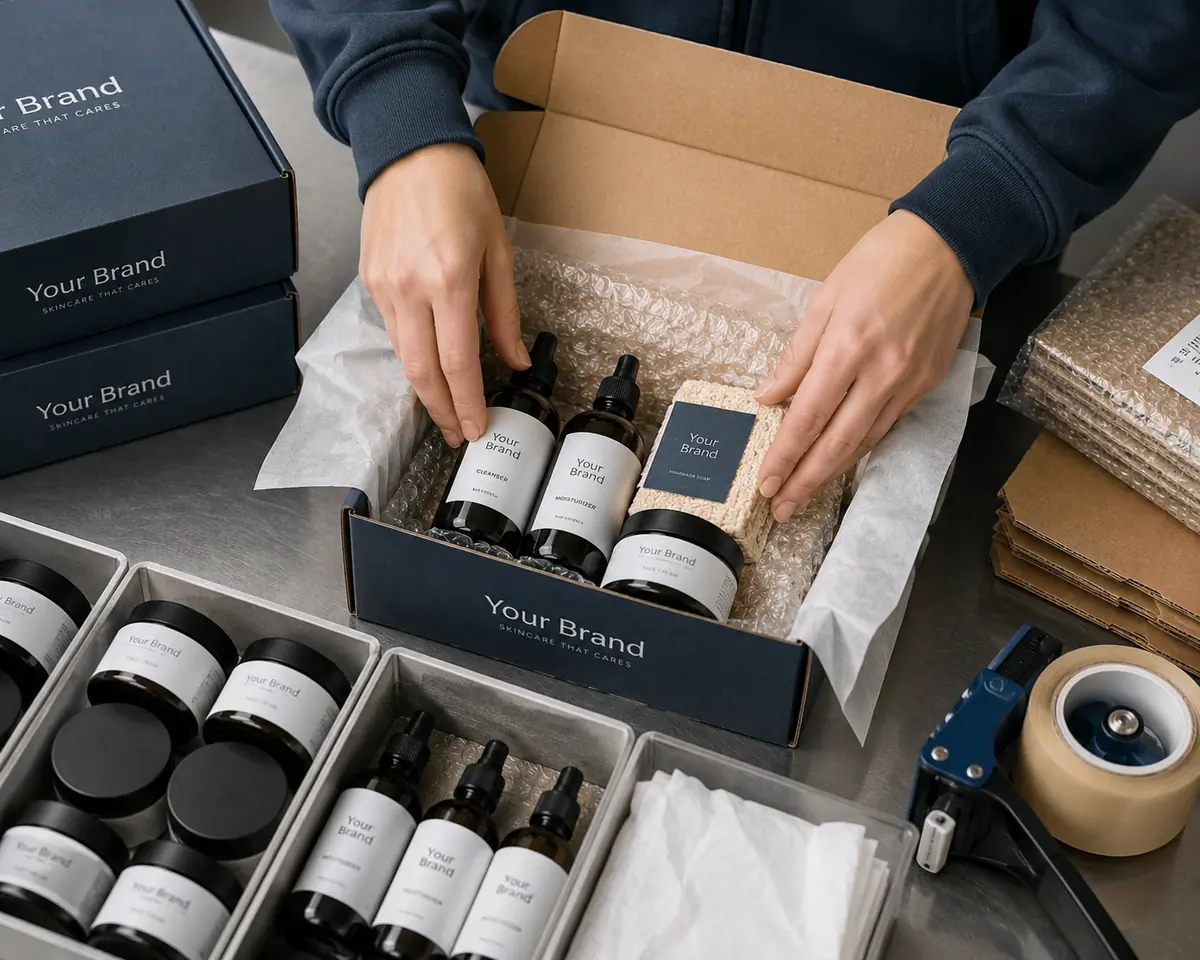
Verified kits are placed into final packaging — custom mailers, branded boxes, poly bags, or retail-ready packaging depending on your spec. Insert cards, instructions, promotional materials, and branding elements are added at this stage. Labels (UPC, FNSKU, shipping label, or retail compliance label) are printed and applied.
Kitting packaging and assembly services often include custom unboxing experiences that reinforce brand identity at the moment of delivery.
Step 6: Storage or Immediate Fulfillment
Finished kits are either stored as a new SKU in the WMS — ready to ship on demand — or immediately routed to the shipping sorter for outbound carrier pickup. On-demand assembly and kitting services allow you to trigger kit assembly only when orders come in, which reduces finished-goods inventory risk for seasonal or limited-run products.
What Do Kitting and Assembly Services Cost?
Pricing for kitting and assembly services varies by kit complexity, component count, and volume. Here are the planning ranges to test against your own quotes, not published rates — actual pricing depends on kit complexity, component count and volume:
| Fee Type | Planning range (illustrative) | Notes |
|---|---|---|
| Kit assembly labor | $0.50-$2.50 per kit | Increases with component count and complexity |
| Component pick fee | $0.10-$0.30 per component | Per individual item pulled for each kit |
| Packaging materials | $0.25-$3.00 per kit | Pass-through or included depending on 3PL |
| Custom insert/branding | $0.10-$0.50 per insert | Tissue paper, cards, stickers, ribbon |
| QC and verification | Included or $0.10-$0.25 per kit | Some 3PLs bundle into assembly fee |
| Project setup fee | $50-$250 one-time | For BOM setup, training, first production run |
| Storage (finished kits) | $0.50-$2.00 per bin/month | Same as standard storage rates |
As a planning range, a simple 3-component kit in standard packaging sits around $1.00-$2.50 per unit in total assembly labor and materials. Complex kits with 8+ components, custom packaging, and branded inserts can run $4.00-$8.00 per unit. Always ask for a rate card and model your cost at your expected monthly volume before committing.
In-House Kitting vs. Outsourced Kitting and Assembly Services
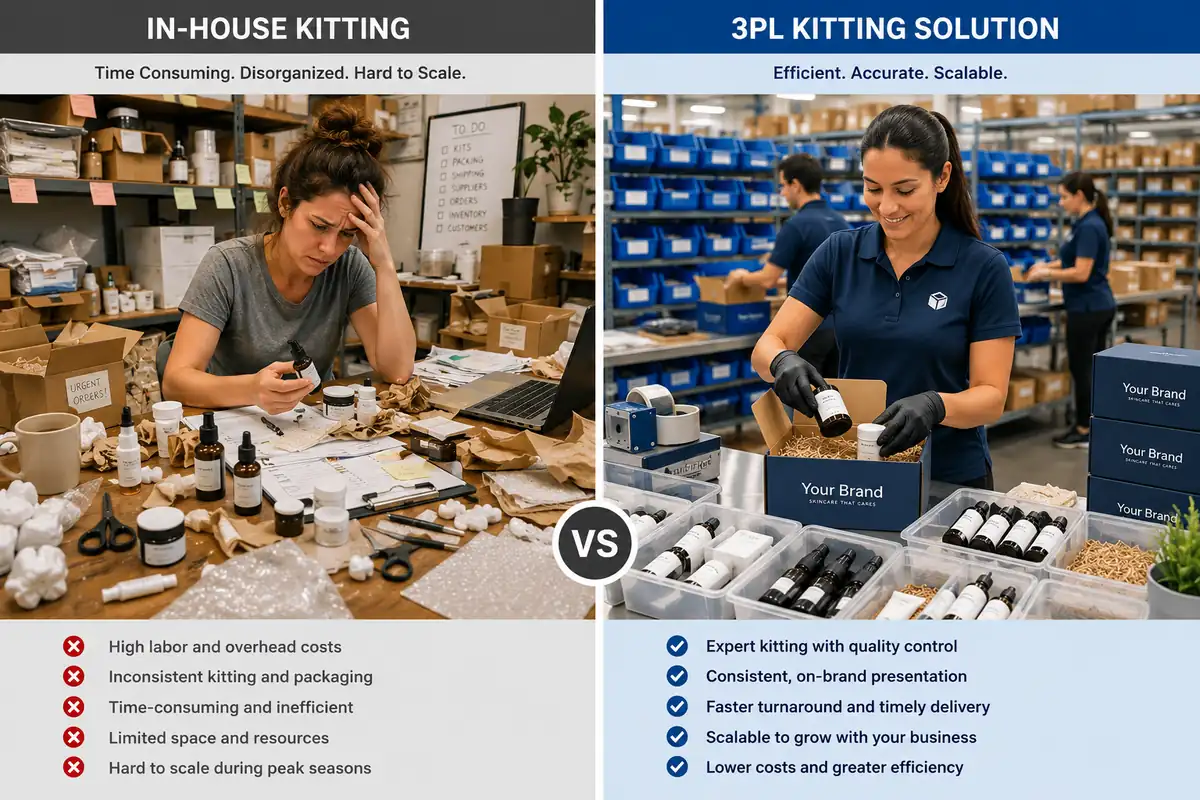
Outsource kitting and light assembly once volume, kit complexity or peak-season spikes outgrow a small in-house team. Keep it in-house while kits stay simple, volumes stay low, and you already have the space and staff. These eight factors decide which side you are on:
| Factor | In-House Kitting | Outsourced Kitting (3PL) |
|---|---|---|
| Upfront cost | High — space, equipment, staffing | Low — pay per kit |
| Labor management | You hire, train, and manage | 3PL provides trained assembly staff |
| Scalability | Limited by headcount and space | Scales with order volume |
| Quality consistency | Varies with staff turnover | Standardized BOM-driven process |
| Peak season capacity | Requires temp hires and overtime | 3PL absorbs volume spikes |
| Custom packaging capability | Limited by in-house materials | Full range including branded boxes |
| WMS integration | Must build or buy | Included with 3PL platform |
| Error rate | Higher without formal QC process | Lower — barcode verification at a formal QC checkpoint |
The tipping point for most brands is 200-500 kits per month. Below that threshold, in-house assembly may still be cost-effective. Above it — especially if kits are complex or branded — outsourcing almost always delivers lower per-unit cost, better quality, and less operational overhead.
When Do You Need Kitting and Assembly Services?
Outsource kitting when errors start reaching customers, assembly labour competes with fulfilment, storage of components and finished kits outgrows your space, or demand swings faster than you can staff for:
- Kit errors are affecting customer experience. If you’re seeing returns or complaints tied to missing components or wrong items, a 3PL’s barcode-verified QC process will resolve this immediately.
- Assembly is consuming fulfillment staff time. When your pick-and-pack team is also building kits, both functions suffer. Dedicated assembly stations and staff eliminate this conflict.
- You’re launching a subscription box or bundle SKU. These require recurring, high-volume, consistent assembly that scales month over month — exactly what a 3PL is built for.
- You need custom branded packaging. Professional kitting packaging and assembly services give you access to custom mailers, tissue paper, ribbon pulls, and branded inserts without managing a packaging operation yourself.
- Your kit complexity is increasing. Adding components, compliance labeling, or multiple packaging configurations to your kits requires a documented process — not improvisation.
How to Choose the Best Kitting and Assembly Services for Your Business
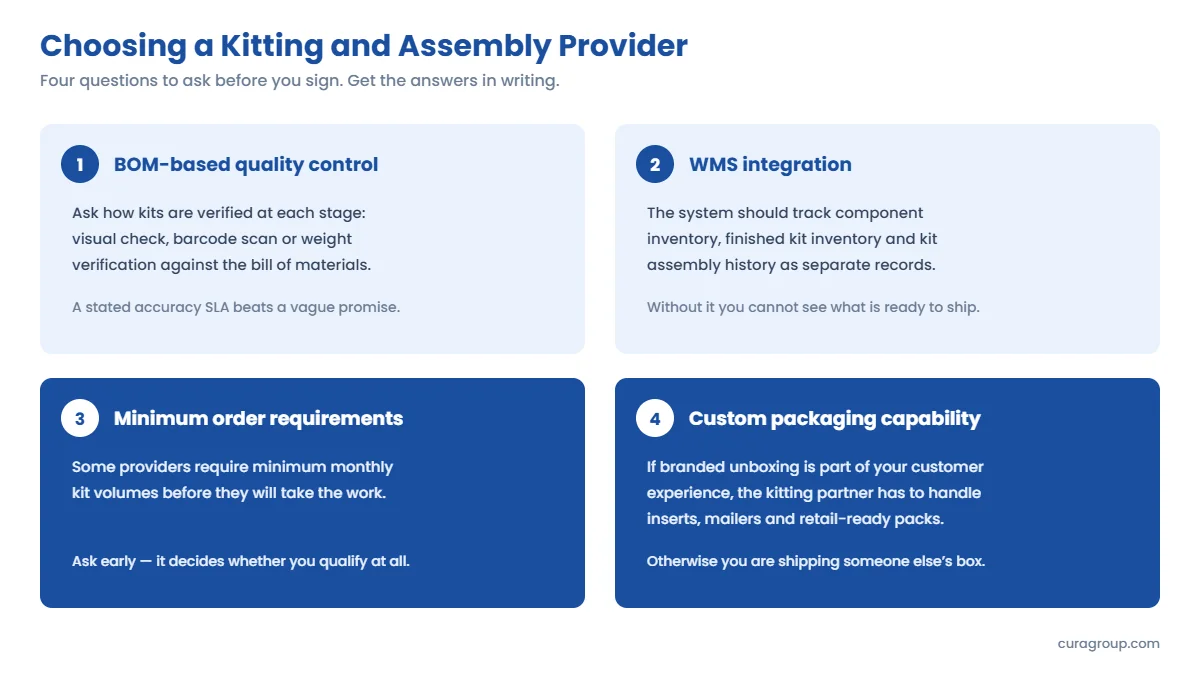
Choose on three things: verified quality control, system integration, and whether the provider can handle your component count.
1. Verify BOM-Based Quality Control
Ask how kits are verified at each stage. The best kitting and assembly services for ecommerce use barcode scanning at both component pick and finished-kit verification. Weight-based verification is an additional option for high-accuracy requirements. Get the documented error rate before you commit.
2. Confirm WMS Integration Capability
Your 3PL’s WMS should track component inventory, finished kit inventory, and kit assembly history as separate, visible records. You should see in real time how many components you have. You should also see how many kits are in progress, and what your finished-goods stock looks like — without sending an email to your account rep.
3. Ask About Minimum Order Requirements
Some 3PLs require minimum monthly kit volumes (500, 1,000, or more) before they will take on assembly projects. If you’re scaling up, find a partner without rigid minimums that would force you into volumes your business is not ready for.
4. Evaluate Custom Packaging Capabilities
If branded unboxing is part of your customer experience, your kitting partner needs to be able to source and handle your custom packaging materials — not just standard poly bags. Ask to see examples of comparable projects they have executed.
5. Understand Project Setup Lead Time
New kit types require BOM setup, staff training, and a test production run before full-scale assembly begins. Ask your provider to commit to an onboarding window in writing; 5-10 business days is a reasonable target. Anything longer is a sign of an inflexible operation.
How Cura Resource Group’s Kitting and Assembly Services Work
At Cura Resource Group, we provide product kitting and assembly services for ecommerce brands, subscription companies, and B2B distributors across the US. Our assembly process is built on three foundations: documented BOMs, barcode-verified QC, and real-time inventory visibility through our WMS.
Every kit we assemble is tracked from component receipt through finished-kit storage to outbound shipment. You can see component inventory, work-in-progress, and finished kit stock in your real-time dashboard — no guessing about what’s ready to ship.
We support the full range of on-demand assembly and kitting services: simple product bundles, complex multi-component kits, subscription boxes, retail-ready sets with compliance labeling, and custom branded unboxing configurations. There are no rigid monthly minimums that don’t fit your actual volume.
Our kitting operation integrates directly with the same fulfillment center handling your standard orders — which means kitted SKUs and individual SKUs flow through the same system, the same carriers, and the same real-time tracking. You don’t manage two separate fulfillment relationships.
We also offer pick and pack services for standard ecommerce orders alongside kitting, so you can consolidate your entire fulfillment operation under one roof.
Ready to get a quote? Contact our team and we’ll build a custom kitting and assembly proposal for your business within 24 hours.
Frequently Asked Questions About Kitting and Assembly Services
What is kitting in warehousing and fulfillment?
Kitting is the process of combining multiple individual SKUs or components into a single ready-to-ship or ready-to-sell unit. In a fulfillment context, kitting happens before an order ships — components are pulled from inventory, assembled into a kit following a bill of materials, verified for accuracy, packaged, and either stored as a finished SKU or shipped directly.
How much do kitting and assembly services cost?
Costs depend on kit complexity and component count. Simple kits of 2-3 components in standard packaging sit around $1.00-$2.50 per unit as a planning range. Complex kits with 8+ components, custom branded packaging, and multiple insert types can cost $4.00-$8.00 per unit. Always request a full rate card and model your cost at actual monthly volume.
What is the difference between kitting and pick and pack?
Pick and pack fulfills individual customer orders by picking existing SKUs from storage and packing them for shipment. Kitting happens earlier: it creates a new bundled SKU from multiple components before any order arrives. The finished kit is then stored and picked like any other single SKU.
Can a 3PL handle custom branded kitting and packaging?
Yes. Most experienced 3PLs offer kitting packaging and assembly services that include custom branded boxes, mailers, tissue paper, ribbon pulls, sticker seals, and insert cards. You supply or source the branded materials and the 3PL integrates them into the assembly process. Always confirm what materials the 3PL can handle and ask for photos of comparable projects.
How accurate are 3PL kitting operations?
Best-in-class kitting operations achieve very high accuracy using BOM-driven assembly with barcode verification at each stage. This means fewer than 5 kit errors per 1,000 units. Ask any provider for their documented kit accuracy rate and their error resolution process before you commit to a contract.
What is a bill of materials (BOM) in kitting?
A bill of materials defines exactly what goes into each kit — every component, quantity, configuration and packaging specification. In a 3PL environment it is entered into the WMS and used to generate assembly work orders, verify component picks and confirm finished-kit accuracy. An accurate BOM is the foundation of consistent output.
How long does it take to set up kitting services with a 3PL?
A competent 3PL can complete BOM setup, staff training, and a test production run within 5-10 business days of receiving your components and specifications. More complex kits with custom packaging sourcing may take 2-3 weeks for initial setup. Once the process is established, ongoing kit production runs on a continuous basis with no per-batch lead time required.
Do kitting services work for subscription box businesses?
Yes — subscription boxes are one of the most common applications. They need recurring high-volume assembly with consistent component sourcing, branded packaging and tight ship windows. A 3PL with dedicated kitting infrastructure runs the assembly, QC and dispatch of each month’s batch without the brand managing that labor.
What is a kitting fee?
A kitting fee is what a 3PL charges to assemble one finished kit, quoted per kit and separate from storage, pick and pack. It covers the assembly labour, the BOM verification step and basic materials. Component sourcing, custom packaging and inserts are normally billed on top.