

Free HS Code Lookup Tool

Cura Resource Group 3PL warehousing and logistics services banner

Search HS and HTS Codes by Product Keyword

Find the correct Harmonized System (HS) tariff classification by searching product keywords.
Include material, function, and form for better matches.

Powered by ADAMftd trade data. Results are a classification aid — confirm the final HTS code against the official tariff schedule, or with your customs broker, before you file.

How to Use the HS Code Finder for Accurate Results

To get the most accurate tariff classification, enter a detailed description of your product in the search box above. For best results, include:

  • Material. What is the product made of? “100% cotton” tells the tool far more than “fabric”.
  • Function. What is it used for? “Industrial cooling” and “home use” can land in different chapters.
  • Form. Is it a raw material, a part, or a finished good? This often decides the heading.

What is an HS Code and Why is it Important?

The Harmonized System (HS) Code is a standardized numerical method of classifying traded products. Developed by the World Customs Organization (WCO), it is used by customs authorities
around the world to identify products when assessing duties and taxes and for gathering statistics.

Using the correct HS Tariff Code is the foundation of global trade compliance. It ensures that you are paying the correct duty rates and helps you avoid costly “red flag” delays during
the customs clearance process.

Benefits of Using a Digital HS Tariff Lookup Tool

Manually searching through the Harmonized Tariff Schedule (HTS) can take hours and lead to errors. Our free digital lookup tool simplifies this by:

  • Reducing human error. The database walks the hierarchy of sections, chapters and headings for you instead of leaving you to guess at it.
  • Saving time. A result takes seconds rather than an afternoon in the tariff schedule.
  • Keeping you current. Classification changes are reflected in the data, which lowers the risk of a fine or a seized shipment.

Understanding HS Code Structure

Every HS code follows the same global framework. The first six digits are standardized worldwide under the World Customs Organization’s Harmonized System, and individual countries add further digits for their own tariff and statistical needs.

  • Digits 1–2 — Chapter: the broad product category (e.g., 09 = coffee, tea & spices).
  • Digits 3–4 — Heading: the product group within that chapter (e.g., 0901 = coffee).
  • Digits 5–6 — Subheading: the specific product (e.g., 0901.21 = roasted coffee, not decaffeinated).
  • Digits 7–10 — National tariff (HTS): the United States extends the six-digit code to a 10-digit HTS number for precise duty assessment.

HS Code Examples by Product

Here are common products and their HS codes, showing how everyday goods map to the Harmonized System:

ProductHS CodeCategory
Roasted coffee0901.21Food & beverage
Cotton T-shirts6109.10Apparel
Laptop computers8471.30Electronics
Lithium-ion batteries8507.60Electronics
Olive oil (extra virgin)1509.20Food & beverage
Leather footwear6403.99Footwear
Wooden furniture9403.60Furniture
Plastic toys9503.00Toys
Packaged medicaments3004.90Healthcare

Codes shown are common subheadings for illustration. Always confirm the exact code for your product, as small differences in material or use can change the classification.

How Your HS Code Affects Duties & Tariffs

The HS code you assign directly determines the duty rate, taxes, and trade rules applied to your shipment. An incorrect code can mean overpaying duties, unexpected charges, or customs delays and penalties. Once you have your code, check the applicable rate with our Global Tariff Lookup tool, and our team can support accurate classification through our Customs Compliance services.

HS vs HTS vs Schedule B: Which Code Do You Need?

Three code systems get called “the HS code”, and they are not the same thing. Which one you need depends on whether goods are moving in or out of the country.

The International Trade Administration explains it simply: the Harmonized System sets the first six digits, and those six are the same everywhere in the world. Countries then add their own digits on the end.

CodeDigitsUsed forWho runs it
HS code6The global base. Recognised in every member country.World Customs Organization
HTS code10US imports. Sets the duty rate you pay.US International Trade Commission
Schedule B10US exports. Used for filing and trade statistics.US Census Bureau

A useful detail from the same source: a product’s full 10-digit Schedule B number and its 10-digit HTS number may differ, but the first six digits will always match. Get the six right and the rest is a country-level decision.

Outside the US the pattern repeats. The European Union adds two digits to make an eight-digit Combined Nomenclature code, then two more for TARIC. The tool above returns the international six, which is the part that travels.

How to Classify a Product in Six Steps

Classification is a process, not a guess. Work through it in order and the answer is usually defensible.

1. Describe what the thing actually is

Write down the material, the function and the form. “Cotton” is not enough. “Men’s knitted T-shirt, 100% cotton, short sleeve” is.

2. Search the description, not the brand

Customs classifies goods, not marketing names. Search the tool above for what the item is made of and what it does.

3. Find the chapter, then narrow down

Codes work top down. The first two digits give the chapter, the next two the heading, the last two the subheading. Each step should feel like a narrower version of the step before.

4. Read the notes for that chapter

Section and chapter notes decide borderline cases, and they override what a heading looks like it says. This is where most disputed classifications are settled.

5. Add the country digits

Take the six-digit result and extend it to the 10 digits your destination requires. For US imports that is the HTS; for US exports it is Schedule B.

6. Confirm before you file

Check the final code against the official schedule or with your customs broker. Our customs compliance team can review classifications before they go on a filing.

Five Classification Mistakes That Cost Money

Most classification problems are not exotic. They are the same handful of errors, repeated.

  • Copying a supplier’s code without checking. Your supplier classified the goods for their export country. The first six digits should hold, but the remaining digits are yours to get right, and the liability is yours too.
  • Classifying by what a product is called. A “smart mug” is a mug with electronics, and the electronics may decide the chapter. Function beats name.
  • Using one code for a whole catalogue. Small material or construction differences move goods between headings. Same shirt in cotton and in polyester are two different codes.
  • Ignoring sets and kits. Goods packaged for retail sale as a set are often classified by the item that gives the set its essential character, not item by item.
  • Leaving a code alone for years. The schedule changes underneath you, and a code that was right in 2017 may not exist now.

Any one of these can mean overpaid duty, a delayed clearance, or a penalty. All five are cheaper to prevent than to unwind.

When HS Codes Change

The Harmonized System is revised on a cycle, not continuously. The World Customs Organization’s current version is the HS 2022 edition, the seventh, and the WCO has already published the HS 2028 edition as the next one.

Revisions add codes for goods that did not exist before and retire codes nobody uses any more. Countries then fold the changes into their own schedules, and they do not all do it on the same day.

The practical effect for an importer is small but real: re-check your codes when a new edition lands, especially on anything technical or environmental, where most of the churn happens.

Reading a Code, Digit by Digit

Take 6109.10, the code for a cotton T-shirt used in the table above, and read it from the left. Each pair of digits narrows the last one.
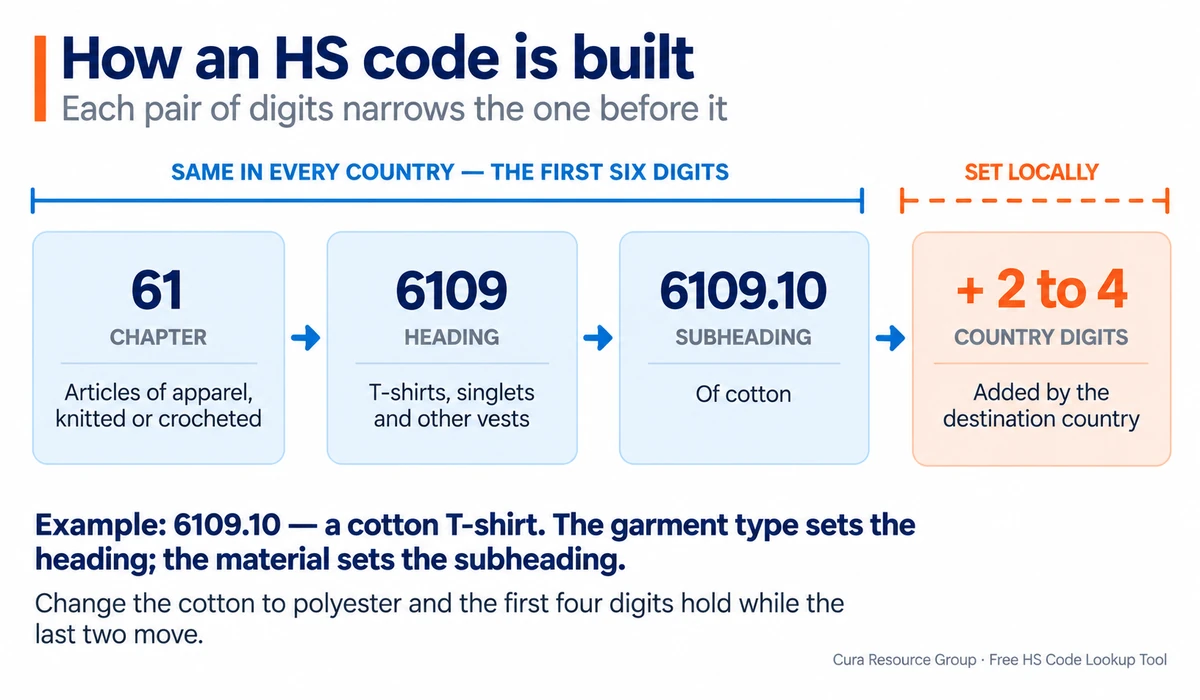
Diagram showing how an HS code is built: chapter 61 for knitted apparel narrows to heading 6109 for T-shirts and singlets, then to subheading 6109.10 for cotton, with two to four further digits added by the destination country. The first six digits are the same in every country.
DigitsWhat it isIn this example
61ChapterArticles of apparel, knitted or crocheted
6109HeadingT-shirts, singlets and other vests
6109.10SubheadingOf cotton
+ 2 to 4 moreCountry digitsAdded by the destination country

Notice what decided the code: the garment type set the heading, and the material set the subheading. Change the cotton to polyester and the first four digits hold while the last two move.

That is the pattern to expect across the schedule. Broad category first, then form, then material or use. If your search result feels too broad, you are usually one level short.

What This Tool Does, and What It Does Not

Clear expectations save rework, so here is the honest scope.

It does: return the international six-digit HS classification from a plain-language product description, in seconds, with no account. That is the part of the code that is the same in every country, and it is the part most people are missing.

It does not: give you a duty rate, file anything, or hand you a legally binding classification. It also will not add the country digits for you.

For the duty rate, use our free Global Tariff Lookup. For a binding ruling, the customs authority in the destination country is the only body that can issue one. For anything in between, that is what a customs broker or our compliance team is for.

Treat the result as a strong starting point that still needs confirming. That is how classification works even when a licensed broker does it.
Frequently Asked Questions

What is the difference between an HS Code and an HTS Code?

The HS code is the international six-digit standard, and it is the same in every member country. The HTS code is the United States version, extended to ten digits, and it is what sets the duty rate on a US import. The first six digits of the two always match.

How often do HS Codes change?

The World Customs Organization revises the Harmonized System on a multi-year cycle rather than continuously. HS 2022 is the current edition, the seventh, and HS 2028 has already been published as the next. Individual countries update their own schedules more often than that.

Can Cura Resource Group help with trade compliance and HS code classification?

Yes. Beyond the free tools on this page, we provide trade compliance and customs compliance support, including classification review, customs documentation, and Importer of Record services. Tell us what you import and we will tell you what the work involves.

Is this HS code lookup tool free?

Yes, and there is no account to create. Search as many products as you need. The results are a classification aid, so confirm the final code against the official tariff schedule before you file.

What is a Schedule B number and how is it different?

Schedule B is the ten-digit code used for United States exports, run by the US Census Bureau, and it feeds export filing and trade statistics. It shares its first six digits with the HS code, but the last four can differ from the HTS number you would use to import the same goods.

Who is responsible if the HS code is wrong?

The importer of record is, not the supplier and not the freight forwarder. A code copied from a supplier’s paperwork is still your declaration once it is filed, which is why the last step should always be a check rather than a copy.

How many digits do I actually need?

Six digits identify the product internationally. Ten are needed to clear US customs, whether you are importing under the HTS or exporting under Schedule B. Other countries land between the two, such as the European Union’s eight-digit Combined Nomenclature.

What happens if I use the wrong HS code?

The usual outcomes are overpaid duty, a held shipment, or a penalty, and the first one often goes unnoticed for years. Errors are also cumulative, because the same wrong code tends to be reused across every shipment of that product.

Let’s Build a Smarter Supply Chain Together

Your business deserves a logistics partner who understands your goals, challenges, and ambitions. With Cura Resource Group, you get more than end-to-end logistics services—you get a strategy for sustainable success.

Cura Resource Group