
3PL vs. in-house fulfillment is one of the most consequential operational decisions a growing ecommerce brand makes — and most brands get it wrong by waiting too long to switch. The average ecommerce brand spends 20-30% of revenue on fulfillment when managing it internally. A well-run 3PL typically delivers the same output for 12-18% of revenue at equivalent volume. That gap compounds every month you delay. This guide gives you the true cost comparison, the clearest signals that you’ve outgrown in-house, and an honest view of when staying internal still makes sense.
What Is In-House Fulfillment?
In-house fulfillment means your business handles every step of the order-to-delivery process internally — receiving inventory, storing it in your own warehouse or leased space, picking and packing individual orders, managing carrier relationships, and handling returns. You own or lease the space, hire and manage the warehouse staff, purchase the equipment, and build or subscribe to your own warehouse management system (WMS). In-house fulfillment gives you maximum control over the process, direct visibility into your inventory, and the flexibility to handle unusual requests without coordinating with a third party. It works well at low volumes and for businesses with highly specialized handling requirements that most 3PLs won’t accommodate.
What Is 3PL Fulfillment?
3PL fulfillment means outsourcing your warehousing, pick and pack, and shipping operations to a third-party logistics provider. You send your inventory to the 3PL’s fulfillment center, integrate your ecommerce platform with their WMS, and they handle everything from inbound receiving to outbound shipment — including returns. The 3PL model is variable-cost by design: you pay for what you use. Storage fees scale with inventory volume, pick fees scale with order volume, and you access the 3PL’s pre-negotiated carrier rates without building that volume yourself. You also inherit their warehouse infrastructure, trained staff, and technology stack — without the capital investment to build it.
3PL vs. In-House Fulfillment: Full Cost Breakdown
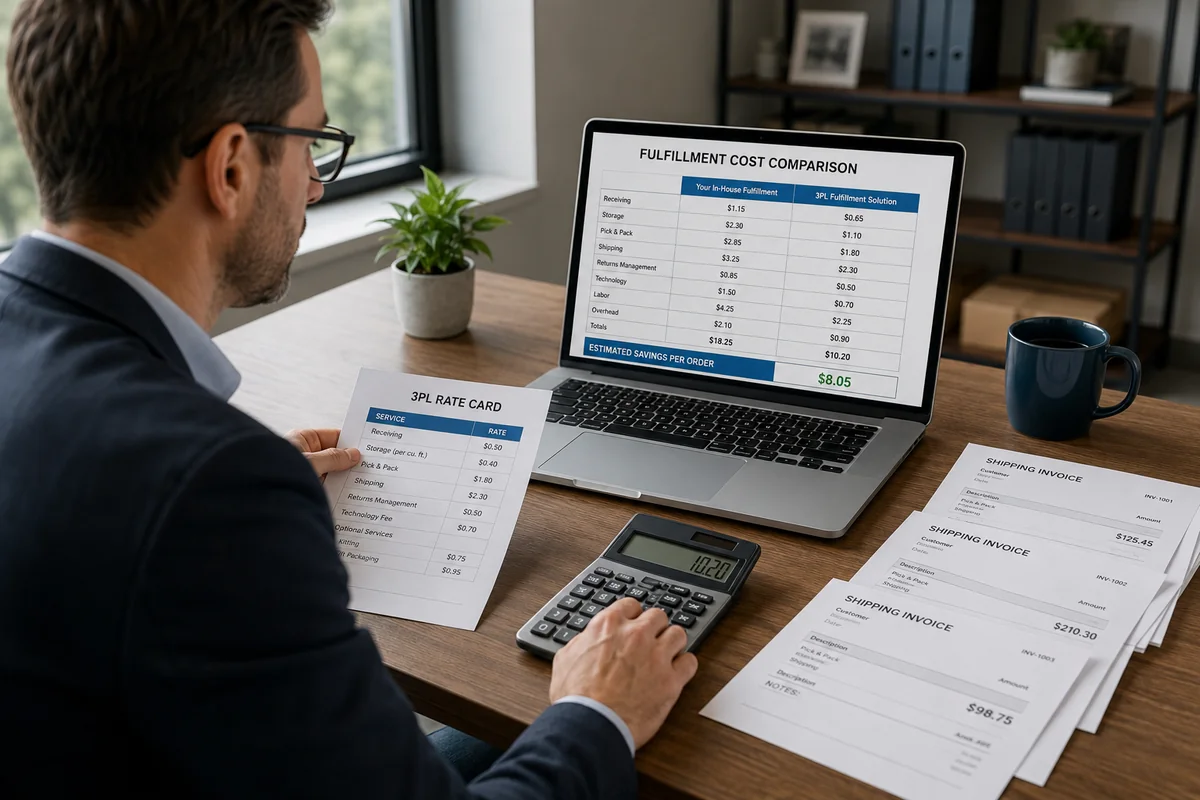
The most common mistake brands make is comparing only labor costs. True fulfillment cost includes every input — space, labor, technology, equipment, carrier rates, and management overhead. Here’s how the two models compare:
| Cost Factor | In-House Fulfillment | 3PL Fulfillment |
|---|---|---|
| Warehouse space | $8-$15/sq ft/year + utilities + insurance | Included in storage fee ($0.50-$2.00/bin/month) |
| Labor (pick/pack) | $17-$22/hour per FTE + benefits, management, HR | Included in per-order pick and pack fee |
| Peak season labor | Costly temp hires, overtime, training ramp | 3PL absorbs; no cost premium to you |
| WMS technology | $500-$3,000/month SaaS or custom build | Included with 3PL; integrates with your store |
| Equipment | $50,000-$200,000+ upfront capital | Included; no capital required |
| Carrier rates | Retail rates (no volume leverage) | Volume-discounted rates (15-30% lower) |
| Management overhead | Warehouse manager ($55,000-$85,000/year) | Account manager included |
| Scalability | Constrained by lease, headcount, equipment | Scales up or down with order volume |
| Error handling | You absorb all rework and replacement costs | SLA-backed; 3PL compensates for errors |
| Geographic reach | One location; long transit to distant zones | Multi-node networks reduce transit time and cost |
When you add up space, labor, technology, equipment depreciation, and management — most brands shipping 500+ orders per month find their true in-house cost per fulfilled order runs $8-$18. A comparable 3PL typically delivers the same order for $5-$10, including carrier discount savings.
How to Calculate Your True In-House Fulfillment Cost Per Order
Monthly fulfillment cost = Space + Labor + Technology + Equipment + Overhead
- Space: Monthly rent + utilities + insurance for warehouse square footage
- Labor: Total hourly wages + benefits (add 25-35% for benefits burden) for all warehouse staff hours
- Technology: Monthly WMS subscription or amortized build cost + integrations
- Equipment: Monthly depreciation or lease cost of forklifts, scanners, packing stations, shelving
- Overhead: Warehouse manager salary + HR time + fulfillment-related admin
Divide that total by your monthly order count. That’s your true cost per order. Now request a rate card from a 3PL and build the same model at your volume. The difference is almost always larger than expected — and it grows as you scale, because 3PL per-order costs decline with volume while your in-house fixed costs remain constant.
7 Signs You’ve Outgrown In-House Fulfillment
- Your fulfillment team is your largest cost center. When warehouse labor consumes more than 20% of revenue, the economics rarely beat a specialized 3PL at any volume under tens of thousands of orders per month.
- Order errors are increasing with volume. In-house accuracy degrades as volume grows faster than your QC processes. A 3PL’s barcode-verified pick and pack services deliver 99.5%+ accuracy at any volume.
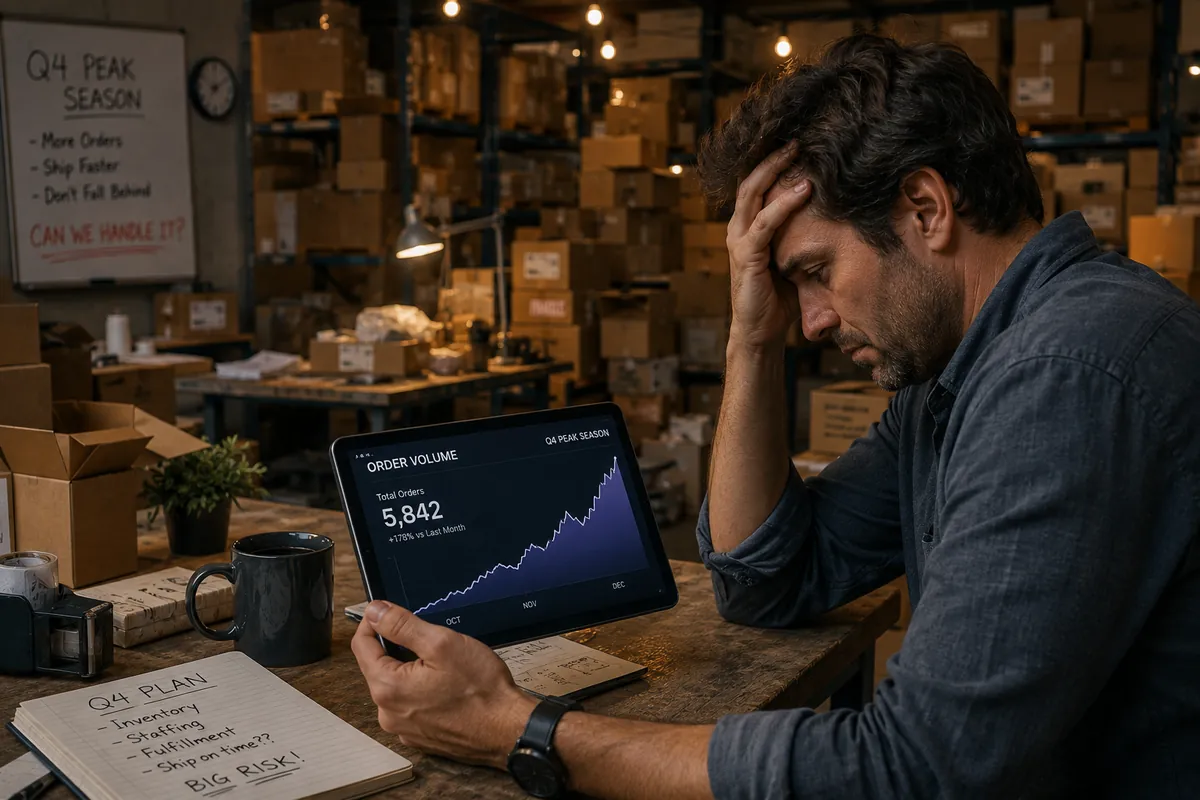
- Peak season is a crisis every year. If Q4 requires emergency temp hires and mandatory overtime, you’re paying a structural premium that a 3PL absorbs as a normal operating condition.
- You’re leasing more space than you need most of the year. If you need 10,000 sq ft in November and 4,000 sq ft in March, you’re paying for 6,000 sq ft of idle space for eight months.
- Your shipping costs are significantly above market. Without carrier volume leverage, you pay retail rates. 3PLs with consolidated volume routinely access rates 20-35% below what individual shippers pay.
- You’re turning down new sales channels because fulfillment can’t handle them. A 3PL with existing channel integrations removes that constraint immediately.
- Your leadership team spends hours per week on fulfillment issues. Executive time spent on carrier claims and inventory discrepancies is time not spent on product, marketing, and growth.
When In-House Fulfillment Still Makes Sense
- You ship fewer than 100-200 orders per month. At this volume, 3PL minimum fees often exceed self-fulfillment costs. The math changes significantly above 300 orders per month.
- Your products require handling most 3PLs won’t accommodate. Highly regulated items, ultra-fragile goods with specialized crating, or proprietary assembly processes may not fit standard 3PL infrastructure.
- Your brand experience requires customization a 3PL can’t replicate. If every order includes highly specific presentation that changes with each order, some brands require proximity — though many premium 3PLs now offer extensive value-added services.
- You’re pre-revenue or in early validation stage. If you’re testing product-market fit and volume is irregular, building a 3PL relationship before you have predictable volume creates friction without proportional benefit.
How Cura Resource Group’s 3PL Fulfillment Works
At Cura Resource Group, we provide 3PL fulfillment for ecommerce brands and B2B distributors that have outgrown in-house operations. Our model is built around three things brands consistently say they didn’t get from their previous in-house setup: real-time inventory visibility, guaranteed accuracy, and a cost structure that improves as they scale. Every client gets a real-time dashboard with SKU-level inventory, order status, and shipment tracking. Our pick accuracy is 99.5%+ backed by barcode scanning at pick and pack. And our carrier network gives clients immediate access to volume-discounted rates that typically run 20-30% below what they were paying as standalone shippers. We don’t require long-term contracts or volume minimums that don’t fit your business. Whether you’re shipping 300 orders per month or 30,000, the model adapts. And because our fulfillment center handles standard ecommerce orders, B2B pallet shipping, kitting and assembly, and returns under one roof, you don’t manage multiple fulfillment relationships as your business evolves. Ready to see what 3PL fulfillment would actually cost for your volume? Contact our team and we’ll build a custom cost comparison for your business within 24 hours.
Frequently Asked Questions: 3PL vs. In-House Fulfillment
At what order volume does switching to a 3PL make financial sense?
For most ecommerce brands, the economics of 3PL fulfillment become favorable at 300-500 orders per month. Below 200 orders per month, self-fulfillment is often cheaper when factoring in 3PL minimum fees. Above 500 orders per month, the combined savings from carrier discounts, eliminated fixed overhead, and labor efficiency almost always favor the 3PL — and the gap widens with scale.
What is the true cost of in-house fulfillment per order?
When you include space, labor (wages plus 25-35% benefits burden), technology, equipment depreciation, and management overhead, most brands shipping 500-2,000 orders per month find their true in-house cost runs $8-$18 per order. Many assume $3-$5 because they only count direct pick labor — that undercount is the most common error in the make-vs.-buy analysis.
How much do 3PL fulfillment services cost?
3PL pricing includes receiving ($25-$50 per pallet), storage ($0.50-$2.00 per bin per month), pick fees ($0.20-$0.75 per item), and pack fees ($1.00-$3.50 per order). Shipping is passed through at discounted carrier rates. Total all-in cost for a standard single-item ecommerce order typically runs $4.50-$10.00 depending on weight, zone, and service tier.
Will I lose control of my inventory if I switch to a 3PL?
No — the opposite is typically true. A well-run 3PL gives you more visibility into your inventory than most in-house operations. Real-time WMS dashboards show SKU-level stock counts, inbound shipment status, order progress, and outbound tracking in one place. What you lose is physical proximity; what you gain is data accuracy and 24/7 digital access.
How long does it take to transition from in-house to a 3PL?
A standard onboarding takes 2-4 weeks from contract signing to first live shipment. This includes WMS integration (typically 1-3 business days for Shopify, Amazon, or WooCommerce), inbound freight to the 3PL warehouse, receiving and putaway, and a test order run before going live. Complex integrations or large inventory transfers may extend the timeline to 6-8 weeks.
What happens to my in-house staff if I switch to a 3PL?
Most brands redeploy warehouse staff to other functions (customer service, returns quality review, inventory management oversight) or manage the transition through natural attrition. The 30-60 day transition timeline gives you time to plan workforce changes without sudden disruption.
Can a 3PL handle kitting, subscription boxes, or custom packaging?
Yes. Most established 3PLs offer value-added services including kitting and assembly, subscription box fulfillment, custom branded packaging, and insert inclusion alongside standard ecommerce fulfillment. These services are priced separately from standard pick and pack rates but handled under the same roof.
What should I look for in a 3PL contract before signing?
Key contract elements: documented pick accuracy SLA (99.5%+ with defined remedies), on-time shipment rate commitment, transparent rate card with no hidden fees, clear inbound receiving standards, inventory discrepancy resolution process, and exit terms that allow you to retrieve inventory without prohibitive fees. Always model your actual monthly cost using the rate card at your expected volume before signing.
Sources & References
- U.S. Bureau of Labor Statistics — Employer Costs for Employee Compensation (employee benefits average roughly 30% of total employer compensation cost, supporting the 25–35% benefits burden cited above).
- Statista — U.S. Ecommerce Fulfillment Costs Distribution (industry fulfillment cost benchmarks).
- Flowspace — Ecommerce Fulfillment Benchmarks for Profitability at Scale (cost-per-order and fulfillment-as-percentage-of-revenue ranges).