



Contract logistics is one type of third-party logistics. The difference is commitment: contract logistics means dedicated space, staff and equipment on a multi-year agreement, while a standard 3PL usually gives you shared space on shorter terms. Same work, different deal.
What is the difference between contract logistics and 3PL?
The difference is what is dedicated to you and for how long. A third-party logistics provider stores and ships your goods, usually from a warehouse shared with other clients, on a rolling or short-term contract. Contract logistics commits space, people and equipment to one client under a long-term agreement.
Think of 3PL as the category and contract logistics as the deep end of it. Every contract logistics provider is a 3PL. Not every 3PL offers contract logistics.
The words also get used loosely. Red Stag Fulfillment draws the line at dedicated resources and term length, while CEVA, DHL and Investopedia each define contract logistics simply as outsourcing logistics work to a third party, with no dedicated-space requirement. So do not trust the label on the website. Ask what is actually dedicated.
Contract logistics vs. 3PL, side by side
Five things separate the two: warehouse space, contract term, how you pay, set-up cost, and the kind of volume each suits.
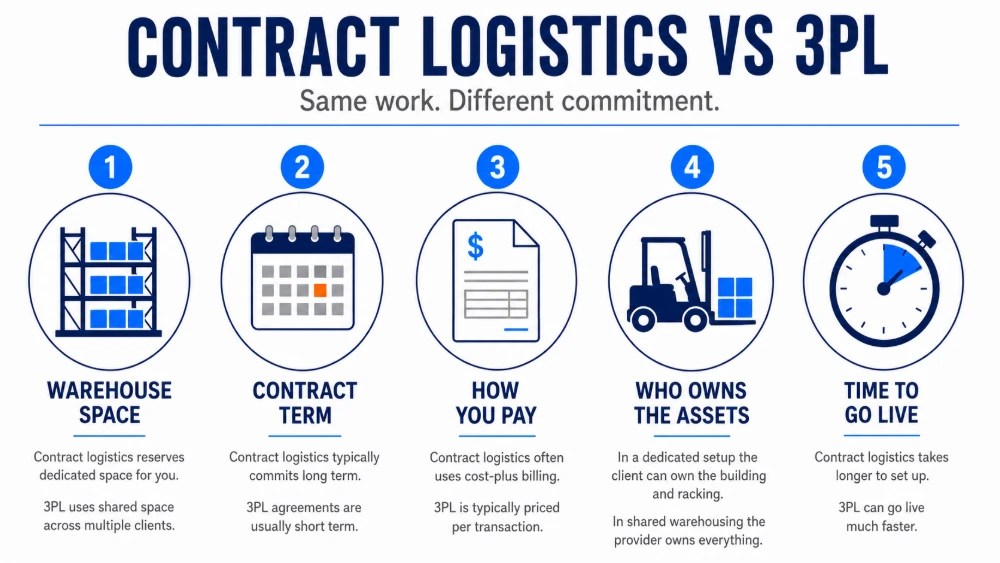
Where the two genuinely differ
Five differences matter when you are choosing: the space, the term, the billing, who owns the assets, and how long set-up takes. Everything else is marketing.
Who the warehouse space belongs to
A standard 3PL puts your pallets in a shared building. Contract logistics gives you space nobody else uses.
Shared space is cheaper and faster to start. You pay for what you occupy and nothing else. The trade is that you compete for labor and dock time during everyone else’s peak, and the layout is not built around your product.
Dedicated space means your layout, your processes, and staff who only handle your orders. You also carry the cost when volume dips.
How long you are committed
Standard 3PL work runs one to three years; contract logistics runs three to five years or more, according to Red Stag Fulfillment. Logistics Bureau puts general 3PL contracts at one to three years, with some reaching five. The more a provider has to buy for you, the longer the term they will want.
How you are billed
A standard 3PL usually charges per transaction: per pallet stored, per order picked, per shipment. Contract logistics more often uses cost-plus, where you pay the provider’s actual costs plus an agreed margin.
Logistics Bureau names three core mechanisms in its March 2026 guide to 3PL warehousing contracts: percentage of sales, cost-plus, and rate-based. Contract logistics provider Kenco Group names four in its February 2024 pricing guide, adding a fixed-variable split. The lists disagree, so ask which one you are being quoted.
Transactional billing is easier to audit. Every line traces to a unit of work. Cost-plus gives you visibility into what the operation actually costs, but only if someone on your side reads the numbers each month.
Who owns the racking, the equipment and the software
In shared warehousing the provider owns all of it. In a dedicated setup, you might. Legacy Supply Chain Services notes that in dedicated warehousing the building can be owned or leased by either the customer or the provider, while in multi-client warehousing the provider owns the real estate, racking and warehouse management system and shares them across clients.
This is the question buyers forget to ask, and it decides what happens when you leave.
How long before you can go live
A dedicated setup takes months to stand up. A shared one can take weeks. That gap is the difference buyers underestimate most.
Dedicated space has to be built around you before the first order ships. Shared warehousing skips that step. The building, the racking and the software already exist and already work. You are joining an operation rather than building one.
Our guide to what contract logistics is sets out the full implementation timeline.
When contract logistics is the better fit
Contract logistics suits steady, predictable volume at meaningful scale. If you ship roughly the same amount every month, dedicated space stops being a luxury and starts being cheaper per unit.
Red Stag Fulfillment suggests it starts to make economic sense once annual logistics spend passes $500,000, though that is one provider’s threshold rather than an industry standard.
It also fits when your handling is unusual. Special equipment, unusual storage conditions, regulated goods or a process nobody else runs are all easier in a building configured only for you.
When a standard 3PL is the better fit
A standard 3PL suits variable or growing volume. If you do not yet know what next year looks like, shared space and a shorter term keep your options open and your fixed costs low.
It is also the right answer when you are still learning. Committing to five years of dedicated space before you understand your own order profile is how brands end up paying for racking they do not use.
If the real question is whether to outsource at all, our comparison of 3PL versus in-house fulfillment works through the cost side first.
Three questions that settle it
Ask what is dedicated, how long the term runs, and who owns the assets. Those three answers tell you which model a provider is actually selling, whatever the page calls it.
- What exactly is dedicated to us? The building, an area inside it, the staff, the equipment, or nothing?
- What is the shortest term you will sign? If the answer is years, that is contract logistics regardless of the label.
- Who owns the racking, the handling equipment and the software? And what happens to it if we leave?
A provider who answers all three plainly is easier to work with than one who does not.
Which one does Cura Resource Group offer?
Cura Resource Group runs warehousing, inventory control, returns management and cross-docking for B2B, wholesale and ecommerce brands. Our contract logistics services page sets out the scope, and our guide to what contract logistics is covers the pricing models, contract lengths and what to check before you sign.
Not sure which model your volume calls for? Get a quote and we will work it out against your actual order profile.
Frequently asked questions
Is contract logistics the same as 3PL?
Not quite. Contract logistics is a type of third-party logistics, distinguished by dedicated resources and a long-term agreement. All contract logistics providers are 3PLs. Only some 3PLs offer contract logistics. Ask what is dedicated rather than relying on which term a provider uses.
Is contract logistics more expensive than a standard 3PL?
It usually costs more to set up and less per unit once running. Dedicated space means committed rent, racking and staff from day one. Shared space spreads those costs across clients. Steady high volume favors the dedicated model; unpredictable volume rarely does.
What does 3PL contract logistics mean?
It describes a third-party logistics provider working under a long-term contract with dedicated resources. The phrase combines both terms because the two overlap. In practice it means the same thing as contract logistics.
Can I start with a 3PL and move to contract logistics later?
Yes, and many brands do. Shared space while volume is unpredictable, then dedicated space once it settles. Moving between providers takes months rather than weeks, so plan the transition outside your peak season.
Does contract logistics always mean a whole building?
No. Dedicated can mean a walled-off area inside a shared facility, a full building, or in some arrangements a warehouse you own that the provider operates. Legacy Supply Chain Services lists all of these as standard dedicated structures.
Which model do most ecommerce brands use?
Most start with shared, multi-client warehousing because volume is unpredictable early on. Dedicated space tends to make sense once order volume is stable and large enough that per-unit savings outweigh the fixed commitment.