



Cycle counting is an inventory auditing method in which a small, defined portion of stock is physically counted on a rotating schedule while the warehouse keeps operating, instead of shutting down once a year to count everything at once. Each count compares what is physically on the shelf against what the inventory system says should be there, so record errors are caught within days rather than months.
For warehouses handling thousands of SKUs, this is the difference between finding a stock discrepancy in a routine Tuesday morning count and finding it when a customer order cannot be filled. This guide covers how cycle counting works, the four counting methods, how often to count, how to measure accuracy, and how the practice changes when inventory sits in a third-party warehouse.
What Is Cycle Counting in Inventory Management?
Cycle counting is an inventory auditing method in which a subset of items is counted on a repeating schedule so that, over a defined period, every SKU in the warehouse is verified at least once. It is a continuous control process rather than a single annual event.
The Association for Supply Chain Management defines cycle counting as an inventory accuracy audit technique where inventory is counted on a cyclical schedule rather than once a year. The emphasis on schedule matters: a cycle count is not a spot check performed when someone notices a problem. It is a planned, documented count that happens whether or not anything appears to be wrong.
The purpose is not simply to correct the count. It is to find the process that broke. A pallet recorded in the wrong location, a receiving error, a mis-picked order, or a damaged unit that was never written off all show up as a variance between the physical count and the system record. The count reveals the symptom; the investigation that follows is where the value sits.
Cycle counting is one of the core disciplines inside a broader warehouse management program, alongside receiving controls, slotting, and order accuracy.
How Does Cycle Counting Work?
Cycle counting works in seven steps: select the items, freeze those locations, count blind, compare against the record, recount any variance, investigate the cause, then adjust and release. The same sequence runs every time, whichever method a warehouse uses. The consistency is the point — a count that is performed differently each time produces variances that cannot be traced back to a cause.
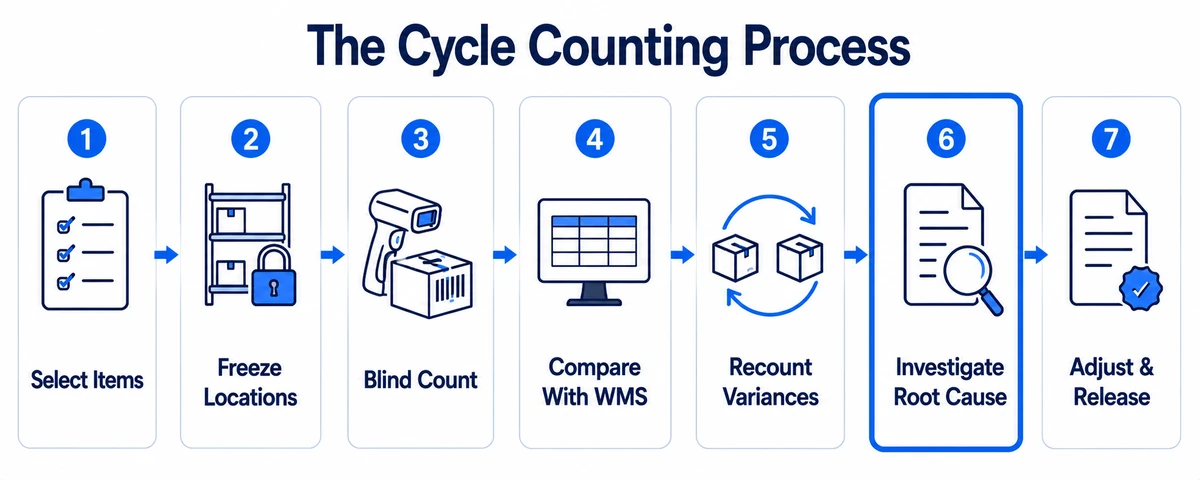
The Standard Cycle Count Sequence
Every cycle count runs through the same seven steps, in the same order.
- Select the items to count. The warehouse management system generates a count list based on the chosen method — value tier, location, random selection, or a triggering event.
- Freeze the affected locations. Picking and putaway are suspended for those specific bins so stock cannot move mid-count. The rest of the warehouse continues working normally.
- Count without seeing the expected quantity. The counter records what is physically present. Hiding the system quantity is what makes the count independent.
- Compare against the system record. The recorded quantity is matched to the expected on-hand balance and any variance is flagged.
- Recount variances before adjusting. A second count confirms whether the variance is real or a counting error.
- Investigate the root cause. Confirmed variances are traced back through recent transactions for that SKU and location.
- Adjust the record and release the location. The inventory record is corrected, the adjustment is documented with a reason code, and the bin returns to normal operation.
The step most often skipped is the sixth. A warehouse that counts, finds a variance, adjusts the record, and moves on has spent labor hours to hide a problem rather than solve it. The same variance reappears at the next count because nothing upstream changed.
Cycle Counting vs Physical Inventory
The difference is scope and timing: a cycle count checks a selected portion of stock continuously while the warehouse keeps running, while a physical inventory counts every item at once, usually with operations halted. Both verify inventory records; they differ in scope, frequency, and disruption.
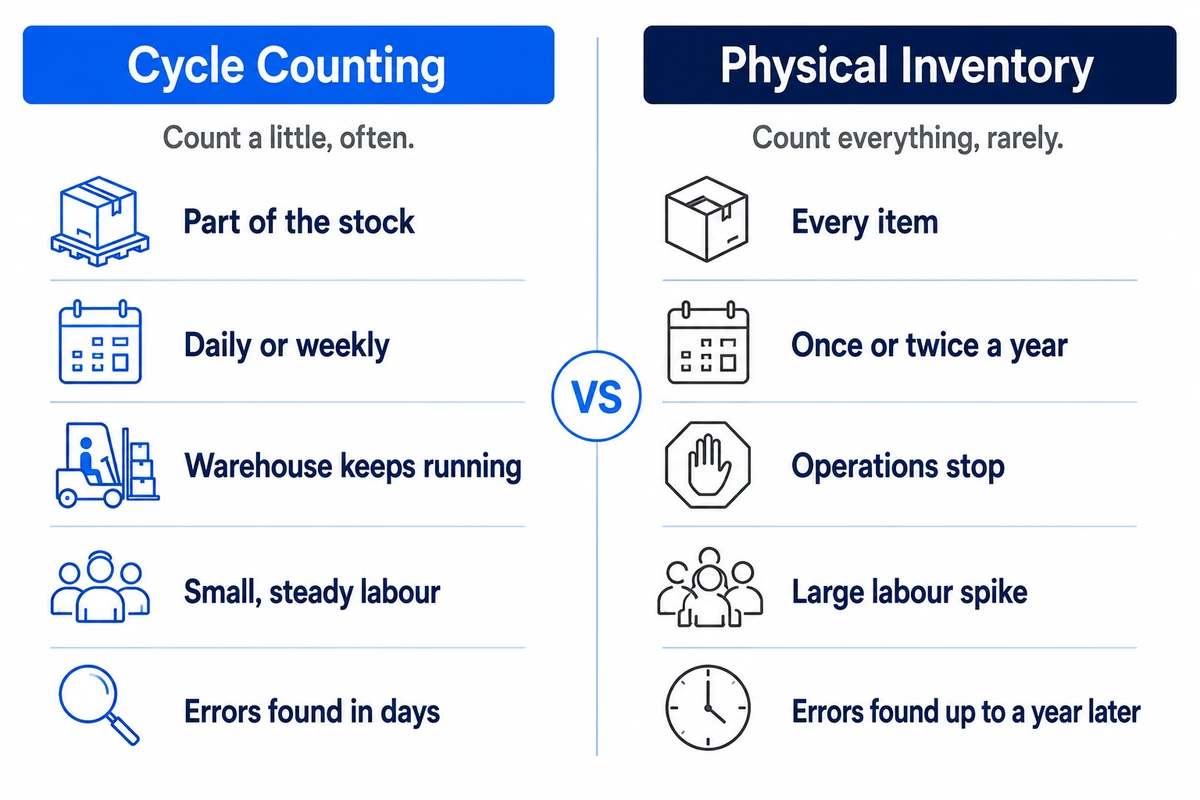
| Factor | Cycle Counting | Physical Inventory |
|---|---|---|
| Scope per count | A selected subset of SKUs or locations | Every SKU in the facility |
| Frequency | Daily, weekly, or continuously | Typically once or twice per year |
| Operational impact | Individual bins frozen briefly; the warehouse keeps running | Shipping and receiving usually stop entirely |
| Labor pattern | Small, predictable, absorbed into daily staffing | Large spike, often requiring overtime or temporary staff |
| Time to detect an error | Days to weeks | Up to a full year |
| Root-cause visibility | High — recent transactions are still traceable | Low — the error could have occurred any time that year |
| Counting accuracy | Generally higher; trained staff counting familiar stock | Often lower; fatigue and unfamiliar temporary counters |
| Primary purpose | Process control and continuous correction | Financial verification of the closing balance |
The two are not mutually exclusive. The two can run together: cycle counts year-round for control, plus a reduced annual physical count for audit purposes. Where a cycle counting program is mature and well documented, external auditors may accept it in place of a full wall-to-wall count — but that decision belongs to the auditor, not the warehouse.
What Is the 80/20 Rule for Cycle Counting?
The 80/20 rule in cycle counting is the Pareto principle applied to inventory: roughly 20% of SKUs account for roughly 80% of inventory value or movement, so those items are counted far more often than the remaining 80%. It is the reasoning behind ABC cycle counting.
Under this logic, a small group of high-value or fast-moving items carries most of the financial and operational risk. An error on one of those SKUs is expensive and disruptive. An error on a slow-moving, low-value item is neither. Counting every SKU with equal frequency spends the same labor on both, which is why flat-frequency counting programs tend to consume effort without improving service levels.
The 80/20 split is a guideline, not a measurement. Real inventories rarely divide that cleanly, and the correct tiering depends on whether a business classifies by annual consumption value, unit cost, pick frequency, or criticality to a customer contract. The method for building those tiers is covered in detail in our guide to ABC analysis in inventory management.
The Four Cycle Counting Methods
The four cycle counting methods are ABC, random sample, control group, and opportunity-based counting. They differ in how items are chosen for each count. Use a combination rather than a single method — commonly ABC as the backbone with opportunity-based counts layered on top.
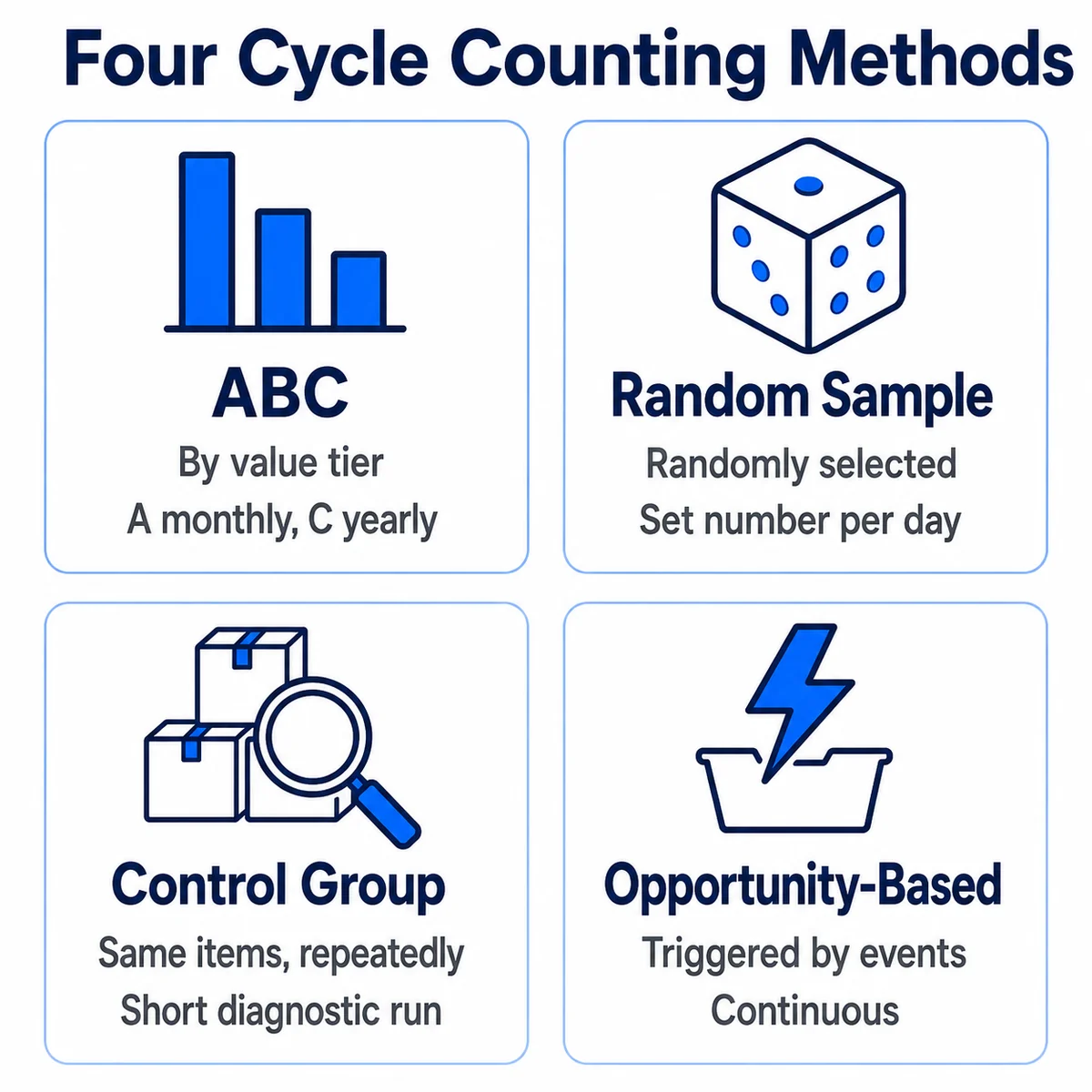
| Method | How Items Are Selected | Typical Frequency | Best Suited To |
|---|---|---|---|
| ABC cycle counting | By value or movement tier | A items monthly, B quarterly, C annually | Warehouses with a wide value spread across SKUs |
| Random sample counting | Randomly selected items or bins | A fixed number of counts per day | Large inventories of similar-value items |
| Control group counting | The same small set of items, repeatedly | Daily or weekly, over a short trial period | Diagnosing a broken process or validating a new one |
| Opportunity-based counting | Triggered by an event, not a schedule | Continuous, as events occur | Fast-moving fulfillment operations with WMS support |
ABC Cycle Counting
ABC cycle counting classifies items into tiers by value or velocity and assigns each tier its own counting frequency. A-tier items — the small group carrying most of the value — are counted most often. C-tier items are counted rarely. The method aligns counting effort with financial risk, and a warehouse management system can generate the schedule automatically.
Its weakness is that classification drifts. A product that was C-tier last year may be A-tier after a seasonal shift or a new customer contract, and a schedule built on stale tiers counts the wrong things. Re-running the classification at least quarterly is what keeps the method honest.
Random Sample Cycle Counting
Random sample cycle counting draws a set number of items or locations at random for counting each day. Because selection is unpredictable, no area of the warehouse can be quietly neglected, and staff cannot anticipate which bins will be audited. Random counting works well where SKUs are broadly similar in value, which makes ABC tiering less meaningful.
There are two variants worth distinguishing. Constant population counting draws from all items, meaning fast-moving SKUs may be counted repeatedly while others are missed. Diminished population counting removes each counted item from the pool until the full cycle completes, guaranteeing full coverage but requiring more tracking.
Control Group Cycle Counting
Control group cycle counting counts a small group of items repeatedly over a short period — often daily for several weeks. The purpose is diagnostic rather than corrective. By counting the same items over and over, a warehouse isolates where errors are being introduced, because the only variable is what happened to those items between counts.
This method is not a permanent program. It is used when accuracy is poor and the cause is unknown, or when validating a new process, a new WMS configuration, or a newly trained team. Once the source of error is identified and fixed, the warehouse reverts to a standing method.
Opportunity-Based Cycle Counting
Opportunity-based cycle counting triggers counts by events rather than a calendar. Common triggers include a bin reaching zero during picking, a replenishment arriving at an empty location, a picker reporting a shortage, or an item crossing a reorder point. The count happens at the moment when counting is cheapest — when the location is already open and the quantity is small.
This method produces the fastest error detection of the four because it inspects stock at the exact points where discrepancies surface in real operations. It depends on a warehouse management system capable of generating count tasks from those events, which is why it is more common in modern fulfillment operations than in spreadsheet-managed warehouses.
How Often Should You Cycle Count Inventory?
Counting frequency should be set so that every SKU is verified at least once per year, with high-value and fast-moving items counted monthly or more often. A common ABC schedule counts A items monthly, B items quarterly, and C items once or twice a year, though the right frequency for any given operation depends on its own variance history rather than a standard table.
Frequency is really a function of three things: how much the item is worth, how often it moves, and how much damage an error would cause. A low-cost component that is picked forty times a day has more opportunities to go wrong than an expensive item that ships twice a year — velocity matters as much as value.
Setting a Realistic Daily Count Target
Set the daily count target from the labor you actually have, not from an ideal schedule. Work backwards from the total number of counts required per year, divide by working days, and check the result against available staff hours. If an ABC schedule demands 400 counts a day in a warehouse that can realistically perform 60, the schedule is fiction and it will quietly be abandoned within a month.
A program that counts 40 locations a day every day will outperform one that plans 200 and completes them sporadically. Consistency compounds; ambition that collapses does not.
Adjusting Frequency Based on Results
Adjust counting frequency using your own variance results rather than leaving the schedule fixed. Items or zones that repeatedly show variances warrant more frequent counting until the underlying cause is fixed. Categories that have been accurate for several consecutive cycles can be counted less often, freeing labor for problem areas. Treating the schedule as a fixed rule rather than a feedback loop is one of the more common ways a program stops delivering.
How Is Cycle Count Accuracy Calculated?
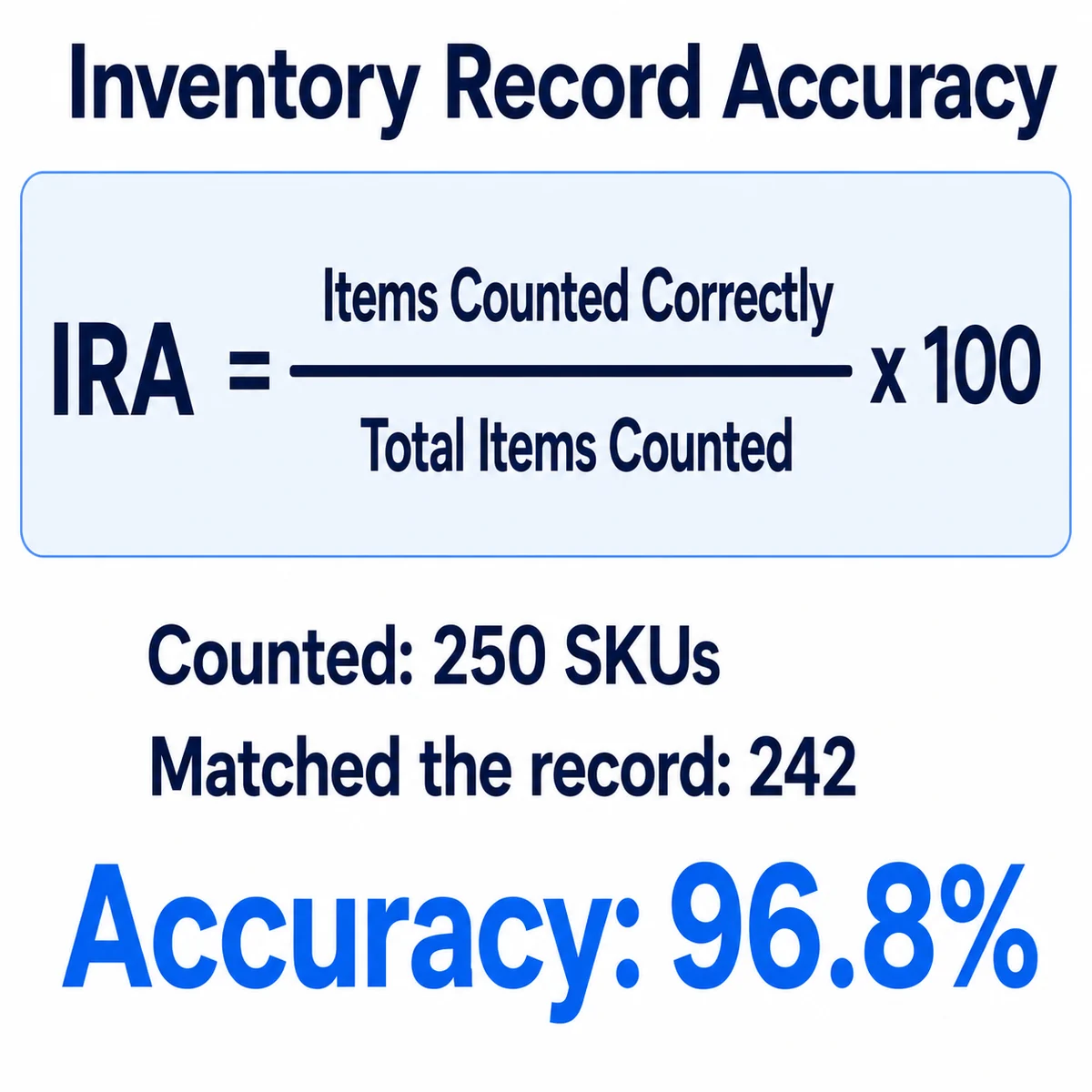
Cycle count accuracy is measured as inventory record accuracy: the number of items counted that matched the system record, divided by the total number of items counted, expressed as a percentage. The formula is straightforward, but what counts as a match determines whether the number means anything.
Inventory Record Accuracy = (Items Counted Correctly ÷ Total Items Counted) × 100
If a warehouse counts 250 SKUs in a week and 242 match the system exactly, accuracy is 96.8%. Accuracy targets are normally set by item tier rather than as a single site-wide number, tight on A-tier items and more relaxed on low-value bulk goods where a small variance costs little to absorb.
Why Piece Accuracy and Location Accuracy Differ
A warehouse can hold exactly the right total quantity of a SKU and still fail every order, because the stock is in the wrong bin. Counting by total quantity across the facility hides that. Measuring accuracy at the location level — the right quantity, in the right place — is the number that predicts whether orders can actually be filled.
The second measure worth tracking is variance value: the total dollar value of adjustments made, not just the count of them. Twenty small variances on inexpensive parts and one large variance on a high-value item produce very different financial exposure but look similar on a percentage-accuracy chart. Both belong in the reporting set alongside the other warehouse KPIs a facility tracks.
Is Cycle Counting the Same as Inventory?
No. Inventory is the stock itself — the physical goods a business holds. Cycle counting is one of several methods used to verify that the recorded quantity of that stock is correct. The terms are often used loosely in warehouse conversation, which causes confusion when it matters.
The related distinction is between a cycle count and a physical inventory count. Both are counting activities. A physical inventory counts everything at once; a cycle count counts a portion on a rotating basis. When someone says they are doing inventory this weekend, they almost always mean a full physical count, not cycle counting.
Cycle counting also differs from an inventory audit performed by an external party. An auditor verifies the reported balance for financial reporting purposes. A cycle count is an internal operational control that runs continuously, whether or not an audit is scheduled.
How to Build a Cycle Counting Procedure
Build a cycle counting procedure by putting the rules in writing before the first count: what gets counted, how often, by whom, and what happens when the numbers disagree. A written procedure is what turns cycle counting from an activity into a control. Without one, counts are performed differently by different people, variances cannot be compared across weeks, and no auditor will place any weight on the results.
What the Written Procedure Must Define
A usable procedure defines eight things, from how items are classified to who signs off on an adjustment.
- Scope and classification. Which items fall into which tier, what criteria set the tiers, and how often classification is reviewed.
- Counting frequency by tier. The target number of counts per item per year and the daily count volume required to achieve it.
- Who counts. Whether counting is performed by dedicated counters, rotating warehouse staff, or supervisors — and whether the person who manages a zone is permitted to count it.
- Blind count requirement. Whether counters see the expected quantity. Treat blind counts as mandatory for any count with financial significance.
- Variance tolerance. The threshold at which a variance requires a recount, and the higher threshold at which it requires management sign-off before adjustment.
- Recount and approval path. Who performs the second count and who has authority to approve an adjustment.
- Reason codes. A fixed list of causes — receiving error, pick error, damage, mislocation, unrecorded scrap — so variance data can be analyzed.
- Documentation and retention. What is recorded for each count and how long records are kept.
Separation of Duties
The person who is measured on inventory accuracy in a zone should not be the only person counting that zone. This is standard internal control, and it is the first thing an auditor examines when assessing whether a cycle counting program can be relied upon. For businesses subject to Sarbanes-Oxley reporting, controls over inventory records fall within internal control over financial reporting under Section 404, which is why documented separation of duties matters beyond the warehouse floor. Rotating counters between zones costs nothing and removes the conflict entirely.
Cycle Counting Best Practices
The practices that matter most are counting blind, counting before the first pick wave, recounting before any adjustment, and recording a reason code every time. The methods matter less than the discipline around them. These are the practices that separate a program that improves accuracy from one that simply generates adjustment entries.
- Count blind. If the counter can see the expected quantity, the count validates the record instead of testing it.
- Count when the warehouse is quiet. Early morning, before the first pick wave, gives the cleanest snapshot. Counting mid-shift while stock is moving produces variances that are artifacts of timing, not real errors.
- Freeze only the bins being counted. Locking down whole zones creates pressure to rush, which is how counting errors enter the data.
- Recount before adjusting. A single count that disagrees with the system is a question, not an answer.
- Record a reason code on every adjustment. Without cause data, there is nothing to analyze and no way to fix anything upstream.
- Review variance trends monthly. Look for patterns by zone, by SKU family, by shift, and by individual. Patterns point at process failures; individual variances rarely do.
- Use scanning rather than paper where possible. Barcode or RFID capture removes transcription errors, which are a recurring source of apparent variances in paper-based counts.
- Train counters on the procedure, not just the task. A counter who understands why blind counting exists will not shortcut it.
- Keep the schedule achievable. A modest count volume completed every day beats an ambitious one completed occasionally.
Common Cycle Counting Mistakes
The most common mistakes are adjusting records without investigating the cause, counting only easy-to-reach locations, treating variance as a warehouse-only problem, letting ABC tiers go stale, and pausing counts during peak season. Each of these is recoverable, but only if it is recognized as a problem rather than accepted as normal.
Adjusting Without Investigating
Correcting the record and closing the count is the single most common failure. The record is now right and the process that broke it is untouched, so the same variance returns. Every confirmed variance above the tolerance threshold should have a documented cause before the adjustment posts.
Counting Only What Is Easy to Reach
Ground-level, accessible pick faces get counted; bulk reserve locations, high racking, and overflow areas get skipped because they require equipment. Those are precisely the locations where errors survive longest, because nothing routinely disturbs them.
Treating Cycle Counting as a Warehouse-Only Concern
Some of the most persistent inventory variance originates outside the four walls — supplier short-shipments, mislabeled cartons, unrecorded returns, or purchase orders received against the wrong line. If variance data never reaches purchasing or customer service, the causes stay in place. Many of these root causes overlap with the broader problem of inventory shrinkage.
Letting the ABC Classification Go Stale
Tiers built two years ago no longer reflect what moves today. The schedule keeps counting yesterday’s important items while the current high-value SKUs are audited once a year.
Skipping Counts During Peak Season
Counting is often suspended during the busiest months, which are exactly the months with the highest transaction volume and therefore the highest error rate. Reducing volume during peak is reasonable; stopping entirely means starting the new year with an unknown baseline.
Cycle Counting for B2B and Wholesale Inventory
In B2B and wholesale warehousing, cycle counting happens at pallet and case level, must verify lot and expiry data as well as quantity, and often covers stock the warehouse does not own. Most published guidance is written for retail shelves or direct-to-consumer ecommerce, where inventory is counted in eaches and every unit is identical. B2B and wholesale warehousing changes several of the assumptions.
Counting at Pallet and Case Level
Wholesale inventory is stored and moved in pallets and cases, not individual units. A count that requires breaking down a pallet to verify unit quantity is expensive and introduces damage risk. Practical programs count at the storage unit level — verifying pallet quantity and case configuration — and reserve full unit-level verification for high-value goods or when a pallet is already being broken for picking.
Lot, Batch, and Expiry Verification
For food, pharmaceutical, chemical, and regulated industrial goods, the count is not only about quantity. It must also confirm that the lot number and expiry date on the physical stock match the record. A quantity-accurate location holding the wrong lot will still cause a failed shipment or a recall problem, and it will pass a count that only checks numbers.
Customer-Owned and Consigned Stock
In a third-party warehouse, inventory belongs to the client, not the operator. That raises the stakes on accuracy and adds a reporting obligation: the client needs visibility into count results, variances, and adjustments affecting their goods, not just a corrected balance appearing in their portal one morning. Adjustment authority also becomes a contractual question rather than an internal one — confirm in writing whether the warehouse may write off client inventory without client approval.
What to Expect From a 3PL Partner
If a business outsources storage, cycle counting becomes something to verify during selection rather than something to manage directly. The questions worth asking are specific: what method is used, how often are the client’s SKUs counted, are counts blind, what is the documented variance tolerance, who approves adjustments, and what accuracy reporting is provided. A provider that cannot answer those precisely is not running a controlled program.
Cura Resource Group operates cycle counting as a standing control across its warehousing operations, with scheduled counts, documented variance investigation, and accuracy reporting available to clients. Our warehousing and distribution services cover storage, inventory control, and fulfillment for B2B and wholesale operations across the United States. If you are evaluating providers, request a quote and ask to see their actual variance and accuracy reporting rather than their target sheet.
Frequently Asked Questions
Can Cycle Counting Replace an Annual Physical Inventory?
In many cases, yes. Where a cycle counting program is documented, consistently executed, and demonstrates sustained accuracy, external auditors may accept it instead of a full wall-to-wall count. The decision rests with the auditor, and it depends on evidence — count records, variance analysis, and separation of duties — not simply on the program existing.
What Is a Good Inventory Accuracy Rate for a Warehouse?
There is no single benchmark that fits every operation. Targets are normally set by item tier, tight on high-value and fast-moving goods and looser on low-value bulk. The more useful measure is location-level accuracy, since stock recorded in the wrong bin will fail an order even when the total facility quantity is correct.
Who Should Perform Cycle Counts?
Use trained warehouse staff who know the stock rather than temporary labor. The important control is that the person accountable for accuracy in a zone is not the only person counting it. Rotating counters between zones preserves familiarity while removing the conflict of interest.
What Is a Blind Count?
A blind count is one where the counter cannot see the quantity the system expects. Without that figure visible, the count is an independent measurement rather than a confirmation. Blind counting is standard practice for any count that will support a financial adjustment or an audit position.
How Do You Handle a Cycle Count Discrepancy?
Recount the location first, since counting errors are common. If the variance is confirmed, trace recent transactions for that SKU and location to identify the cause, assign a reason code, obtain approval if the variance exceeds the defined threshold, then post the adjustment and document the outcome.
What Tools Are Needed to Run Cycle Counts?
At minimum, a system of record with accurate location data and a way to capture counts without transcription. Barcode scanners connected to a warehouse management system are the practical baseline; RFID and count-assist mobile robotics are used in larger operations. Spreadsheet-based counting is workable only for very small inventories.
Does Cycle Counting Work for Bulk or Low-Value Items?
Yes, but at reduced frequency and often by weight or full-container verification rather than unit count. The objective for low-value bulk goods is confirming that the recorded quantity is broadly correct, not achieving unit-level precision that would cost more than the variance is worth.
Should Cycle Counts Happen During Operating Hours?
They can, provided the specific locations being counted are frozen for the duration. Counting before the first pick wave gives the cleanest results because no stock is in motion. Counting mid-shift without freezing locations produces variances caused by timing rather than genuine record errors.
Sources
- Association for Supply Chain Management (ASCM), ASCM Supply Chain Dictionary — definition of cycle counting and inventory record accuracy.
- U.S. Securities and Exchange Commission, Sarbanes-Oxley Act Section 404 — internal control requirements over financial reporting, including inventory balances.