


Contract logistics means outsourcing your warehousing, fulfillment, and shipping to an outside provider under a long-term contract. The provider runs the operation. You keep the stock and the customer. Most agreements run for years, not months. Each one states what the provider must deliver, what it costs, and what happens if service slips.
What is contract logistics?
Contract logistics is outsourced warehousing and fulfillment governed by a formal, long-term contract. A provider stores your goods, picks and packs orders, and ships them. You pay agreed rates and hold the provider to agreed service levels.
The word that matters is contract. Plenty of companies will store your pallets on a handshake and a monthly invoice. Contract logistics is different. The scope, the rates, the performance targets, and the exit terms are all written down before anyone moves a pallet.
That paperwork exists because the commitment runs both ways. You commit volume for years. The provider commits space, racking, equipment, and people to serve you. Both sides need to know what they are buying.
What work does a contract logistics provider actually do?
A contract logistics provider runs the physical work between your supplier and your customer. The usual scope covers five things:
- Warehousing — receiving goods, storing them, and keeping them secure.
- Order fulfillment — picking items, packing them, and handing them to a carrier.
- Inventory control — counting stock and keeping the numbers accurate.
- Returns management — receiving returns, inspecting them, and putting good stock back on the shelf.
- Cross-docking — moving goods straight from the inbound truck to the outbound one, without putting them into storage.
Larger agreements add kitting, light assembly, labeling, and customs paperwork.
Contract logistics vs. 3PL — the same thing, or not?
Contract logistics sits inside third-party logistics as its long-term, dedicated form. The difference is commitment: dedicated space, staff and equipment on a multi-year agreement, against a third-party logistics provider that more often gives you shared space on shorter terms.
Standard 3PL work usually means shared, multi-client space on a shorter contract. Contract logistics means dedicated resources on a longer one, most often as dedicated warehousing. Providers use the two words interchangeably, so do not trust the label. Ask what is dedicated.
Our full comparison of contract logistics versus 3PL works through all five differences, including how you are billed and how long each model takes to go live.
How contract logistics providers price the work
Most contract logistics deals price one of three ways. You pay a rate per unit of work, the provider’s costs plus an agreed margin, or a share of the savings. Those three appear in every published list. Beyond them, the labels vary from provider to provider.
Consultancy Logistics Bureau names three core mechanisms in its March 2026 guide to 3PL warehousing contracts. They are percentage of sales, cost-plus, and rate-based. It then adds two variations you can bolt on to any of them: gain sharing and performance-based logistics.
Here is what each one means in plain terms:
| Model | How you pay | Watch for |
|---|---|---|
| Rate-based / transactional | A set price per unit, pallet, order, or shipment | Out-of-scope work priced separately |
| Cost-plus / open book | The provider’s actual costs, plus an agreed margin | Costs can drift if nobody polices them |
| Percentage of sales | A share of the sales value of goods handled | Bears no relation to the work actually done |
| Fixed variable | Fixed costs separated from variable costs | Savings on fixed costs may stay with the provider |
| Gain share | Savings above an agreed baseline get split | Needs a year of baseline data first |
| Performance-based | Fees tied to hitting performance targets | Targets must be measurable and fair |
Logistics Bureau founder Rob O’Byrne rates the rate-based structure as the best mix of the three. Setting the rates forces both sides to work out what the job really involves. It also forces them to agree volume break points up front.
Percentage of sales draws the sharpest criticism. Logistics Bureau calls it a “lazy” approach that may bear no relation to the resources and costs of the service provided. It also gives the customer no benefit when volumes rise.
Who owns the warehouse, the racking, and the WMS?
In multi-client and public warehousing, the provider owns all three. In a dedicated setup, you may own or lease the building and the equipment while the provider runs the operation. Most buyers forget to ask which one they are getting.
Dedicated warehousing. You or the provider owns or leases the building. The provider employs and manages the labor. These agreements run for years rather than months. Pricing runs on cost-plus, transactional, or hybrid terms.
Multi-client warehousing. The provider owns the building, the racking, and the handling equipment. It also owns the warehouse management system — the software that tracks where every item sits. You share all of it with other clients. These run month to month, priced per transaction or per pallet in and out.
Public warehousing. The provider owns everything. You get storage plus basic pallet in-and-out handling. It is month-to-month with no value-added services.
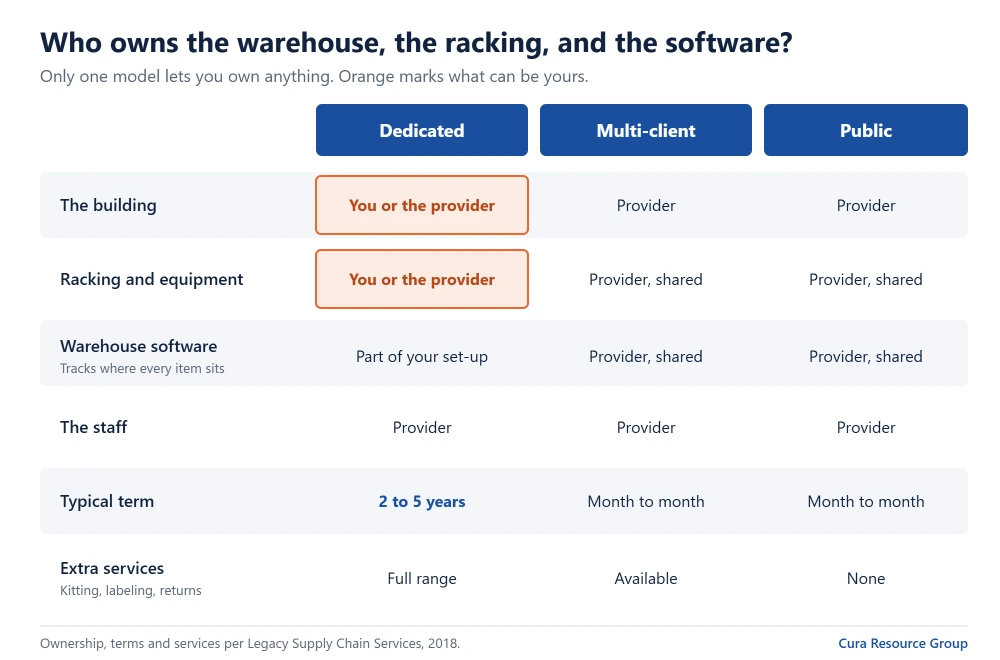
Yes, a provider can run a warehouse you already own. That is a common dedicated setup. You hold the lease and the assets. The provider supplies the management, the labor, and the processes.
If you are weighing reserved space against renting by the pallet, our guide to contract warehousing compares the contract, public and private models side by side.
How long is a contract logistics agreement?
Most run one to five years. The range depends on how much the provider has to invest up front. Logistics Bureau states that a 3PL contract can last from one to three years, with some going up to five.
The more dedicated the setup, the longer the term. Nobody buys racking, hires a team, and builds a software link for a twelve-month deal. Shared 3PL work runs on the shortest terms. Dedicated contract logistics runs on the longest, because the provider has to recover what it built for you.
Watch the renewal clause as closely as the term. Fulfillment consultancy F. Curtis Barry & Company warns that the ninety-day non-renewal deadline is one of the most commonly missed dates in these agreements. Miss it and you roll into another full term.
The same firm recommends one of two exit routes. Ask for 180 days’ notice. Or ask for 90 days’ notice plus a guaranteed 90-day wind-down period. Either way, you can move without losing control of your stock.
What to check before you sign
Check the pricing definitions, the service levels, and the exit terms — in that order. F. Curtis Barry & Company lists 27 provisions worth negotiating in a 3PL contract, and the numbers it recommends give you a benchmark to negotiate against.
On pricing:
- Every charge on the rate card should name its unit of measure. If you cannot trace a charge to a defined unit and an agreed rate, you cannot audit it.
- Cap the annual escalator. F. Curtis Barry & Company notes vendors often word this as “up to 3%”, and recommends tying the increase to a published economic index rather than accepting a flat number.
- Build volume tiers that move in both directions. The firm suggests a 15% volume drop as a repricing trigger. Rates should adjust when your business shrinks, not only when it grows.
- Read the minimum charges and revenue commitments closely. They apply whether you ship or not.
On service levels:
- Set the metrics by channel and by reporting period. F. Curtis Barry & Company gives inventory accuracy as an example, measured annually at 99.5%.
- Make the remedies bite. The firm recommends credits of 5% to 15% of the charge on the affected order. Another option is 3% to 5% of all monthly order-processing fees.
- An allowance sounds small until you size it. F. Curtis Barry & Company shows why. A 0.5% allowance is $10,000 against $2 million of average inventory. It is $100,000 against $20 million of annual throughput.
On invoices and exit:
- Require transaction-level detail on every invoice.
- Check the dispute window. The firm warns it is commonly only 5 to 15 days after receipt. That is rarely long enough to catch an error.
- Agree the wind-down terms before you start, at current rates. Nobody negotiates well while leaving.
Build the statement of work from real data, not estimates. F. Curtis Barry & Company recommends at least twelve months of transaction-level history. That way the rates reflect your actual order profile.
What happens between signing and go-live
Expect months, not weeks — F. Curtis Barry & Company puts a typical implementation at six to nine months, from signature to steady-state operation.
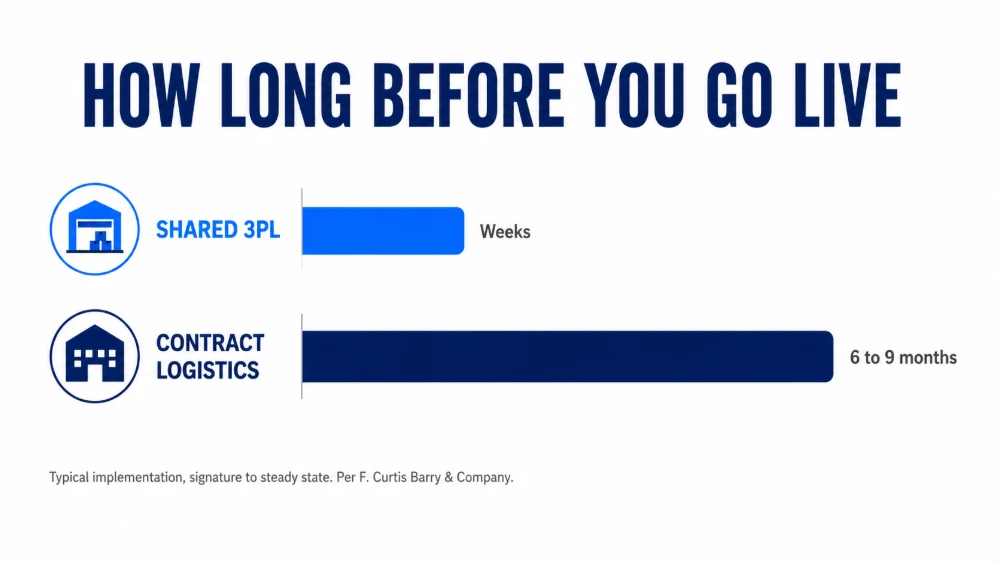
The time goes into systems and stock, not paperwork. Your order data has to flow into the provider’s warehouse management system. Inventory has to be counted, moved, received, and put away. Processes have to be documented and staff trained on them.
Receiving is slower than most people expect. F. Curtis Barry & Company notes that mixed inventory takes 1.5 to 2 times longer to receive than clean, single-SKU pallets.
Service levels usually do not apply from day one. The same firm reports that a 30 to 90-day suspension of SLA remedies during the ramp period is common — reasonable while the operation settles, but the end date belongs in the contract.
Plan the transition for your quiet season. Moving a warehouse during peak is how brands miss Christmas.
Why brands outsource this work at all
The case rests on cost, capacity, and productivity. US ecommerce sales reached $340.2 billion in the second quarter of 2026, 17.1% of all retail sales and up 12.2% year on year, according to the U.S. Census Bureau’s release of 18 August 2026. Order volumes are still climbing.
Labor is the pressure point. The Bureau of Labor Statistics put average warehousing and storage wages at $26.84 an hour in June 2026. That is the number that decides whether your own operation is cheaper than a provider’s.
The productivity trend is the strongest argument, and almost nobody cites it. Bureau of Labor Statistics figures show labor productivity in warehousing and storage fell 11.5%, 11.0%, and 4.4% in 2021, 2022, and 2023, then rose just 0.1% in 2024. Warehouses have been getting less efficient, not more. Running one well is harder than it looks.
If you are still weighing whether to outsource at all, our comparison of 3PL versus in-house fulfillment works through the cost side, and our guide to choosing the right 3PL partner covers how to run the selection.
Contract logistics with Cura Resource Group
Cura Resource Group runs warehousing, order fulfillment, inventory control, returns management, and cross-docking. We work with B2B, wholesale, and ecommerce brands. Our contract logistics services page sets out the full scope.
Want to see how the numbers work for your volume and order profile? Get a quote and we will build one against your own data.
Related reading: what a 3PL provider does · supply chain logistics · warehouse management · how a fulfillment center works
Frequently asked questions
What does contract logistics mean in simple terms?
It means paying an outside company to run your warehousing and shipping under a written, long-term agreement. You keep ownership of the stock and the customer. The provider supplies the building, the staff, and the systems, and has to hit the service targets you both agreed.
Is contract warehousing the same as third-party logistics?
Not quite. Contract warehousing usually means dedicated space and a multi-year commitment. Third-party logistics is the broader term. It often means shared space on shorter, more flexible terms. Many providers use both words loosely. Ask what is dedicated rather than trusting the label.
Can a provider operate a warehouse my company already owns?
Yes. In a dedicated setup you can hold the building lease and own the racking and equipment. The provider supplies management, labor, and day-to-day processes. This is one of the standard dedicated warehousing structures. Ask any provider whether it will operate on your site.
How much do contract logistics providers charge?
It depends on the pricing model. Rate-based deals charge a set price per unit, pallet, or order. Cost-plus deals charge the provider’s actual costs plus an agreed margin. Ask which model applies, then ask for a worked example against twelve months of your own order data.
What service levels should a logistics contract include?
At minimum, order accuracy, inventory accuracy, and on-time shipping, each measured by channel and reporting period. F. Curtis Barry & Company gives inventory accuracy measured annually at 99.5% as one example. Make sure the contract also states what you get paid if the provider misses.
How long does it take to move to a new provider?
Longer than most brands plan for. F. Curtis Barry & Company puts typical implementation at six to nine months from signing to steady state. Systems integration and inventory transfer take the bulk of that. Schedule the move outside your peak season.
What is the shortest commitment I can make?
Public and multi-client warehousing usually run month to month. Dedicated contract logistics rarely does, because the provider is committing space, equipment, and staff to you alone and needs time to recover that investment. If you need flexibility, ask about shared space instead.
What is the most commonly missed clause?
The non-renewal deadline. F. Curtis Barry & Company flags the ninety-day notice date as one buyers routinely miss, which rolls them into another full term. Diary it the day you sign, not the month it falls due. Set a reminder ninety days before that, too.