
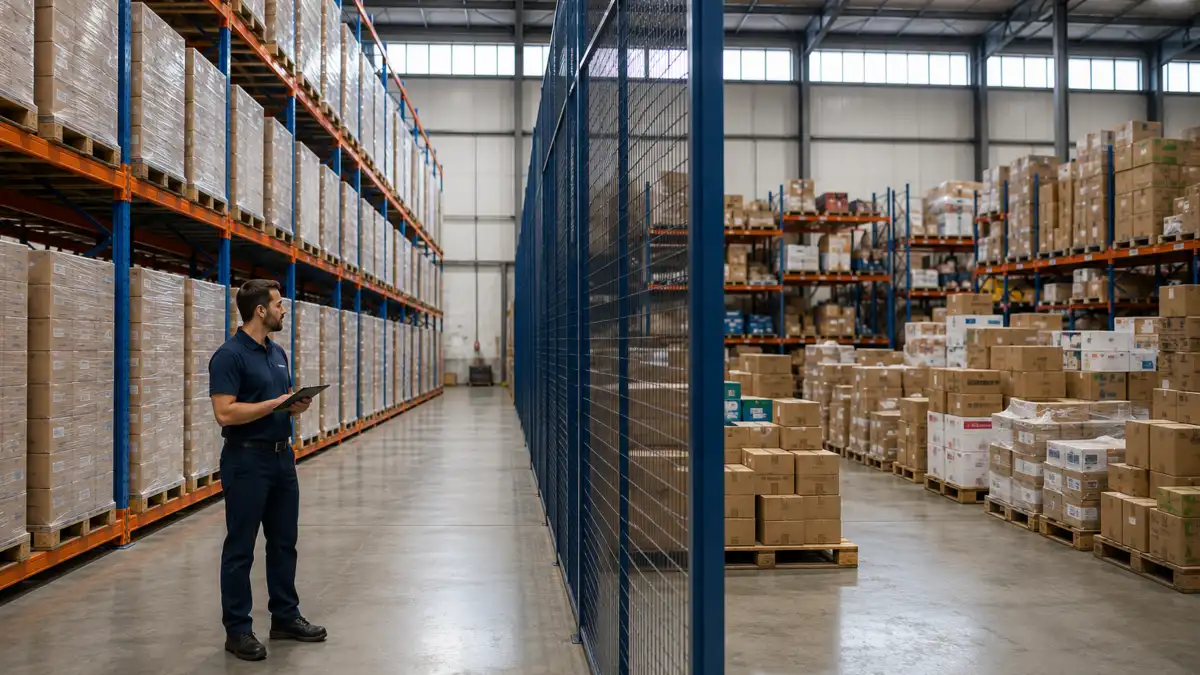

Dedicated warehousing is an arrangement where the space, the staff and the equipment handling your goods are used only by you. Nobody else’s pallets share the aisle. The word is used loosely, though: it can describe a fenced-off corner of a busy building or an entire site running one product line, and both are sold under the same name. The gap matters because the thing being dedicated is usually labor. And labor is getting harder to commit. U.S. Bureau of Labor Statistics figures show warehousing productivity falling across 2021, 2022 and 2023, then rising just 0.1% in 2024. A provider that assigns a fixed team to one account is betting your volume holds up.
This guide is about the physical arrangement: what gets set aside, which of the three shapes you are being offered, who employs the people, and how to move without breaking your peak. The commercial side — terms, minimums and pricing models — is covered in our guide to contract warehousing.
What is dedicated warehousing?
Dedicated warehousing means a provider sets aside space, people and equipment for one client. The building may serve other clients, or none at all. What makes it dedicated is that your share is not handed to someone else next week.
Shared warehousing works the other way. One building, one labor pool and one set of equipment get spread across many clients. Who gets what is decided week by week.
A contract logistics provider can offer either one. Dedicated is the shape of the space, not a separate product.
What Are the Three Dedicated Warehousing Models?
Dedicated takes one of three shapes: a walled-off area inside a shared building, a full building your provider runs for you, or a building you own that a provider operates. They differ in who holds the lease and how quickly you can start.
| Walled-off area | Full building, provider-run | Your building, provider-run | |
|---|---|---|---|
| Who holds the building | Provider, shared with others | Provider, owned or leased | You |
| What is set aside | An aisle, a zone or a mezzanine | The whole site | The whole site |
| Who employs the people | Provider, assigned to you | Provider, hired for your account | Provider, hired for your account |
| Time to start | Weeks | Months | Months |
| Peak-season labor | May be pulled to other clients | Stays on your account | Stays on your account |
| Fits when | Steady volume that will not fill a site | Volume fills a site year-round | You hold space you cannot staff |
A walled-off area inside a shared building
You get a marked zone in a building that also serves other clients. The racking and the layout inside that zone answer to your product; the dock, the yard and often the overflow labor pool do not.
This is the fastest and cheapest form of dedicated space, and the one most often sold without the word shared ever coming up. Ask where the boundary physically is, and whether people assigned to you can be moved during another client’s peak.
A full building your provider operates
The provider holds a site and runs it for your product alone. Shift patterns, equipment, put-away logic and pick paths are all set for one order profile, and nothing competes for dock time.
This is what most buyers picture when they hear the word. It has to be built before the first order ships, which is why it starts in months rather than weeks.
A building you own, operated by someone else
You keep the lease or the deed and hand daily operation to a provider. It suits companies that already hold space and have found that staffing and running it is the hard part, not renting it.
Cura Resource Group describes this on its about page as a build-operate-manage approach — building the network, operating it with trained teams, then managing compliance and cost over time.
What Does “Dedicated” Actually Cover?
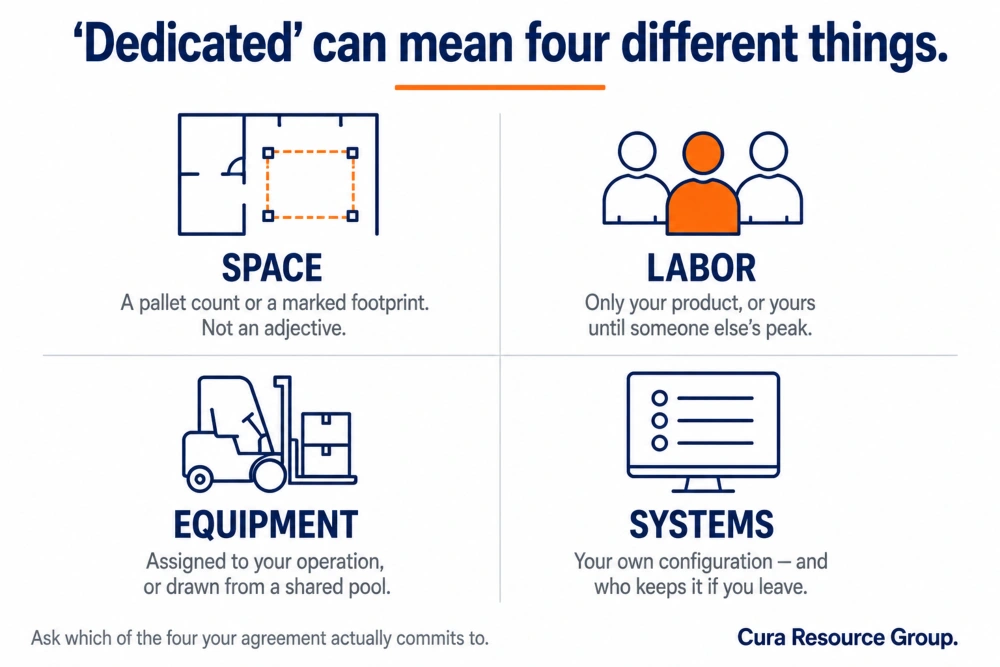
Dedicated can apply to four separate things, and an agreement may commit to some and not others. Get each one named rather than assuming the word carries all four.
- Space. A pallet position count, a marked footprint, or a whole site. A promise of reserved space with no number attached commits nobody.
- Labor. People who only ever touch your product, or people who are yours until someone else’s peak arrives. Those are different promises sold in the same sentence.
- Equipment. Forklifts, scanners and pack benches assigned to your operation, or drawn from a floor-wide pool as needed.
- Systems. Whether you get your own configuration inside the provider’s warehouse management system, and who keeps that configuration if you leave.
Most disappointment in year two traces back to one of these four being assumed rather than written.
Who Actually Staffs a Dedicated Warehouse?
The provider employs the staff in almost every case, even when the building is yours. What changes between models is whether those people can be moved to another account.
In a walled-off zone, your team is usually assigned rather than exclusive. That works most of the year and gets tested in Q4, when the same pool is needed by three clients at once. In a full dedicated building there is nobody else to move them to.
This is the question with the biggest gap between what buyers assume and what is written down, and it is worth asking before square footage. Space is easy to add. A trained team that knows your product is not.
When dedicated space is the wrong shape
It is the wrong shape when the space would sit part-empty most of the year. In shared warehousing, someone else absorbs that cost. In dedicated space, nobody does. Your cost per unit goes up exactly when your volume goes down.
It is also wrong when your peak is short and steep. Three busy months against nine quiet ones is what shared space is for. Dedicating a building to that means paying for nine months of stillness.
And it is wrong while your handling is still changing. Racking, pick paths and shift patterns get built around one order profile. Rebuilding them a year later costs more than starting shared and moving once you know.
How Do You Move From Shared to Dedicated?
You move in the gap between peaks, keeping the old site live until the new one has proved itself on real orders. The common mistake is planning a date instead of an overlap.
Fulfillment consultancy F. Curtis Barry & Company reports that a 30 to 90-day suspension of service-level penalties during ramp-up is common practice. That is fair while a new operation settles, but the date it expires belongs in the agreement rather than in an email thread.
Expect the work to sit in two places: moving stock, and proving the systems. Every SKU has to arrive, be counted and be findable again, and every order type has to run end to end before the old site goes dark.
Run both in parallel for as long as cash allows. Paying twice for a few weeks costs less than a failed cutover in October.
What to put in writing about the space
Write down the four things the word dedicated hides. Use numbers, not adjectives. Terms, minimums and pricing belong in the contract and are covered separately.
- Where the boundary is. A pallet position count or a marked footprint on a site plan, not a description.
- Whether labor can be redeployed. If it can, what notice you get, and what happens during another client’s peak.
- What equipment is assigned to your operation rather than shared, and who pays for it if the account ends.
- Who owns the system configuration built for your product, and whether it leaves with you.
Our guide to contract warehousing covers the other half: how long the deal runs, what you must commit to, and how you get out.
Sources and further reading
- U.S. Bureau of Labor Statistics, Warehousing and Storage: NAICS 493 — sector labor productivity.
- Institute for Supply Management, Types of Warehouses (December 2025) — public, private and bonded warehouse definitions.
- F. Curtis Barry & Company, fulfillment and distribution consulting — ramp-period service-level practice.
Dedicated warehousing with Cura Resource Group
Cura Resource Group builds, operates and manages distribution centers for B2B, wholesale and ecommerce brands. Our contract logistics services page sets out the scope, and our comparison of contract logistics and 3PL shows where dedicated sits against a standard shared arrangement.
Not sure whether a zone, a building or your own site is the right shape? Get a quote and we will size it against your real order profile.
Frequently asked questions
What does dedicated mean in logistics?
It means a resource is assigned to one client and not shared out. In warehousing it can apply to space, staff, equipment or systems, and an agreement may cover some of those and not the rest. Ask which of the four are included and get each one stated as a number.
What are the four types of warehousing?
There is no single agreed list, which is why published ones disagree. The Institute for Supply Management defines public, private and bonded warehouses. Dedicated describes how space is assigned rather than a fourth kind of building, so it appears on some lists and not others.
Is dedicated warehousing the same as a private warehouse?
No. A private warehouse is one your own company owns and staffs directly. Dedicated warehousing normally means a provider holds the building and assigns it to you. The overlap case is a provider operating a site you already own, which sits between the two models.
How much volume do you need before dedicated makes sense?
No published threshold exists, and a provider quoting one is describing its own business rather than an industry rule. The practical test is whether your volume keeps the footprint and the team busy in your quietest month, since that is when an empty dedicated site costs most.
Can dedicated space sit inside a shared building?
Yes, and it is the most common form. A zone, aisle or mezzanine is set aside for one client inside a building serving several. Ask where the boundary physically runs and whether the people working it can be reassigned during another client’s busy season.
Who employs the staff in a dedicated warehouse?
The provider does, in nearly every arrangement, including when you own the building. What varies is whether those people work only on your account or are simply assigned to it for now. That difference stays invisible for most of the year and shows up during peak season, so ask before you sign.