



Contract warehousing is a long-term agreement in which a provider stores and handles your goods in space reserved for you. You commit to a term and usually to a minimum volume. In exchange you get fixed rates, dedicated space and staff who only handle your product. The choice matters because warehousing is mostly a labor cost. Warehouse labor ran $26.85 an hour in June 2026, on the Bureau of Labor Statistics’ preliminary figure. Its figures also show sector labor productivity fell 11.5%, 11.0% and 4.4% in 2021, 2022 and 2023, then rose just 0.1% in 2024. Warehouses are getting more expensive to run and no more efficient. Contract warehousing sits between renting space by the pallet and owning a building outright.
What is contract warehousing?
Contract warehousing is warehousing bought on a fixed-term agreement rather than by the pallet. A provider sets aside space for your goods, staffs it, and runs receiving, storage and shipping to agreed rates and service levels.
What separates it from renting space by the pallet is the commitment on both sides. Public warehousing charges you for what you use, month to month. Contract warehousing asks you to commit — and prices accordingly.
It is one of the services a contract logistics provider delivers, and it is often the first one a growing brand buys.
What Is the Difference Between Contract, Public and Private Warehousing?
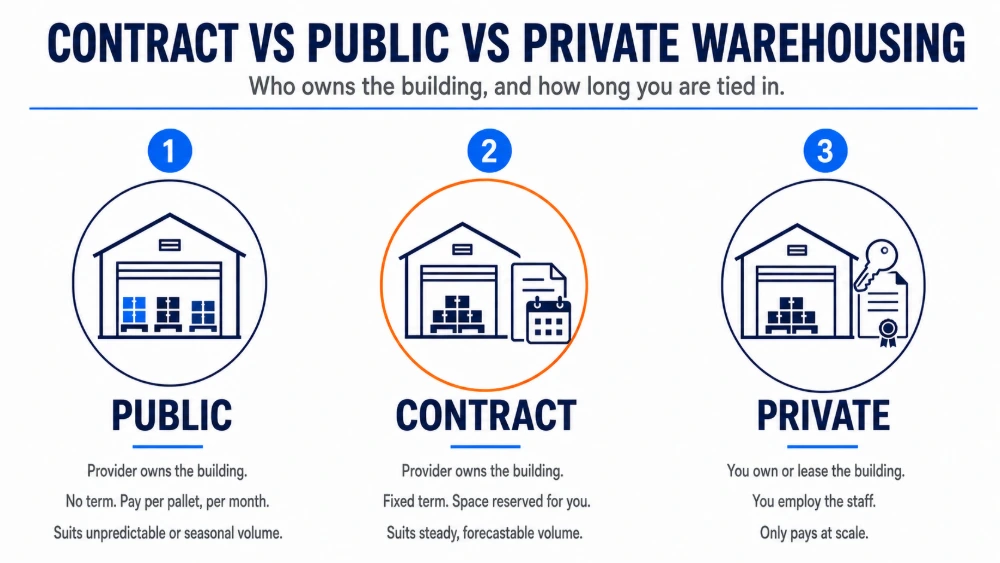
The three differ by who owns the building and how long you are tied in. Public is rented by the pallet, contract is reserved for you on a term, and private means you own or lease the building yourself.
| Public | Contract | Private | |
|---|---|---|---|
| Who owns the building | Provider | Provider | You |
| Commitment | None | Fixed term | You hold the asset |
| How you pay | Per pallet, per transaction | Fixed fee, rate-based or cost-plus | All fixed costs, full or empty |
| Space | Shared, allocated week to week | Reserved for you | Entirely yours |
| Best for | Unpredictable or seasonal volume | Steady, forecastable volume | Very large, stable operations |
| What you give up | Cost per unit and layout control | Flexibility to walk away | Capital and the option to shrink |
Public warehousing
You pay for the space and handling you actually use, with no long commitment. Rates are per pallet, per month, per transaction. It suits unpredictable volume and short seasons, and it costs more per unit once volume steadies. The Institute for Supply Management describes public warehousing as owned and operated by a third party and rented to many companies, on short or medium terms charged per pallet, per unit of floor area, or per week.
Contract warehousing
You commit to a term, and the provider reserves space and people for you. Rates are fixed or cost-based rather than transactional, and the operation can be set up around your product rather than around everyone’s. Terms run to years rather than months, because the provider is committing space and people to you alone. Ask any provider for its shortest term directly rather than assuming an industry norm.
Private warehousing
You own or lease the building and employ the staff. You get total control and carry the whole cost, full or empty. It only pays at scale, and it turns a variable cost into a fixed one.
What Does a Contract Warehouse Actually Include?
You get space, labor and systems bundled into one rate. The usual scope covers four things:
- Storage — racked or floor-stacked space reserved for your goods, not shared out week to week.
- Receiving and put-away — unloading inbound trucks, checking goods against the paperwork, and getting them into a known location.
- Inventory control — cycle counts and reconciliation, so the system matches the shelf.
- Outbound handling — picking, staging and loading, to whatever accuracy and timing the contract sets.
Larger agreements add kitting, labeling, returns handling and cross-docking, where goods transfer between trucks without ever being stored.
When contract warehousing is worth it
It pays once your volume is steady enough to forecast. If you ship roughly the same amount month after month, reserved space costs less per unit than renting it by the pallet.
It also pays when your product needs something specific. Temperature ranges, hazardous goods, oversized pallets or a handling routine specific to your product all fit better where the layout is yours.
And it pays when service level matters more than flexibility. In a shared building you compete for labor and dock time during everyone else’s peak. In reserved space you do not.
When it is the wrong choice
Skip it while your volume is still moving. A term commitment on space you might not fill is the most common way brands overpay for warehousing.
Skip it if your season is short. Three heavy months and nine quiet ones is what public warehousing exists for.
And skip it if you cannot yet describe your own order profile. Rates are built from your volumes, your SKU count and your order shapes. Without twelve months of real numbers, any quote you get is a guess, and it will be repriced later.
How Much Does Contract Warehousing Cost?
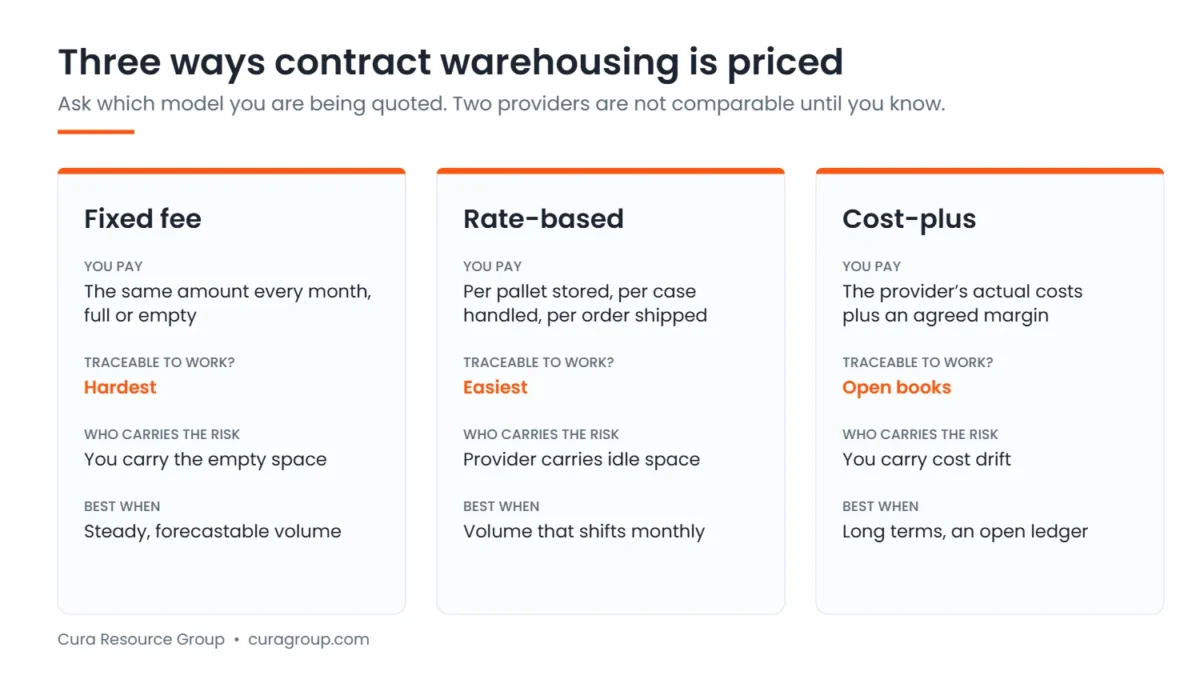
Most agreements price on a fixed fee, a rate per unit of work, or the provider’s costs plus a margin. Which one you get changes what you can audit and what you carry when volume moves.
A fixed fee buys predictability. You pay the same each month whether the space is full or empty, which is fine when volume is steady and painful when it is not.
A rate-based deal charges per pallet stored, per case handled, per order shipped. Every line traces to a unit of work, so it is the easiest to check.
A cost-plus deal passes through the provider’s actual costs with an agreed margin on top. The books open up, which only helps if you have someone who will read them.
Ask which model you are being quoted before you compare two providers. A fixed fee and a rate card are not comparable without your own volumes behind them. If you are also weighing a shared, pay-as-you-go provider, our guide to contract logistics versus a standard 3PL sets the two side by side on term, billing and who owns the assets.
What to check before signing a warehousing contract
Check the term, the volume commitment, and what happens when your numbers change. Those three decide whether the agreement still fits you in year two.
- Minimum commitment. Many agreements set a floor — a minimum monthly charge or a minimum pallet count — that you pay whether you use it or not.
- Repricing triggers. Agree in writing what happens if volume rises or falls materially. Tiers should move in both directions, not only upward.
- Space definition. Reserved how, exactly? A pallet count, a square footage, a walled-off area, or a whole building? Get it written down.
- Accessorials. The rate card covers normal work. Ask what counts as abnormal, and what it costs.
- Exit and wind-down. Notice period, who moves the stock, and at what rates. Nobody negotiates this well once they have decided to leave.
Our guide to what contract logistics is goes deeper on contract terms, service levels and asset ownership.
Sources and further reading
- Institute for Supply Management, Types of Warehouses (December 2025) — definitions of public, private and bonded warehouses, including ownership, commitment and how each is charged.
- U.S. Bureau of Labor Statistics, Warehousing and Storage: NAICS 493 — average hourly wages and sector labor productivity.
Contract warehousing with Cura Resource Group
Cura Resource Group provides warehousing, inventory control, returns management and cross-docking for B2B, wholesale and ecommerce brands. Our contract logistics services page lists what is included.
Not sure whether reserved space or pay-as-you-go suits your volume? Get a quote and we will price it against your real volumes.
Frequently asked questions
What does a contract warehouse do?
It stores and handles goods for one client under a fixed-term agreement. The provider supplies the building, the racking, the equipment and the staff, and reserves an agreed amount of space. The client keeps ownership of the stock and pays agreed rates rather than per-transaction market prices.
How is a contract warehouse different from a public one?
Commitment. Public warehousing is bought by the pallet with no term, so you pay only for what you use and can leave at any time. Contract warehousing reserves space for you over months or years at fixed or cost-based rates, which usually works out cheaper per unit.
How many types of warehousing are there?
Lists vary by source, and there is no single agreed standard. The types most commonly named are public, contract, private and bonded, with distribution centers and cooperative warehouses appearing in some lists. Treat any tidy numbered list of warehouse types as one author’s framing rather than a definition.
Does a contract warehouse also ship my orders?
Not always. Some contract warehouses store and handle goods only, leaving outbound shipping to you or a separate carrier. Others run picking, packing and dispatch as well. Ask what sits inside the quoted rate and what is billed separately before you compare two providers.
How long is a typical warehousing contract?
Long enough for the provider to recover what it commits to you, which usually means years rather than months. Ask any provider for its shortest term directly. If the answer is a year or more, that is the real trade you are being asked to make.
Do I need a minimum volume for contract warehousing?
Usually yes. Reserved space only makes commercial sense above a certain throughput, so most providers set a minimum monthly charge or pallet count. Ask what the floor is early — it is the fastest way to tell whether a provider is a realistic fit.