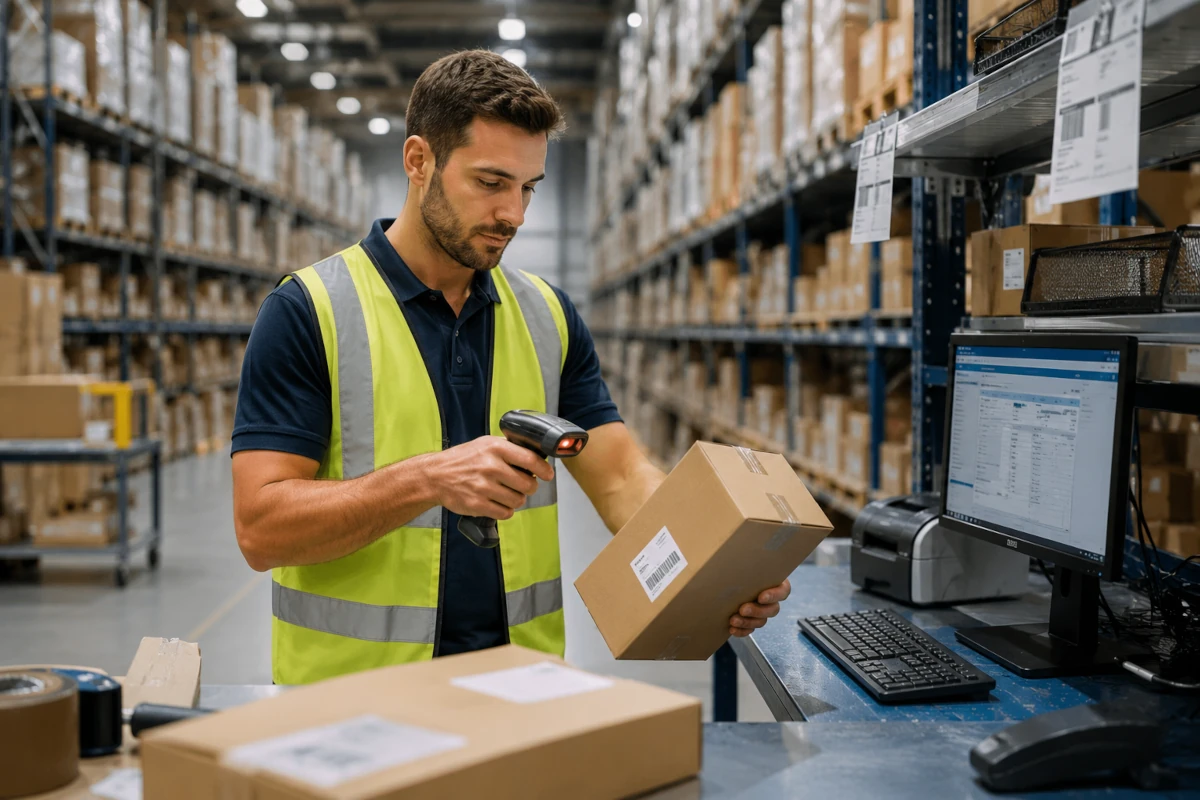

Pick and pack services are third-party fulfillment operations in which a warehouse team or automated system receives your inventory, picks individual items from storage based on customer orders, packs them securely, and ships them directly to the end customer.
For ecommerce brands and B2B distributors, outsourcing this process to a 3PL can take a meaningful bite out of fulfillment labor costs while improving order accuracy.
What Are Pick and Pack Services?
Pick and pack is the core of order fulfillment.
When a customer places an order, a warehouse associate (or automated system) locates the correct SKUs in the warehouse, picks them from the shelves, packs them into appropriate packaging, adds any inserts or branding materials, and hands them off to a carrier for shipping.
Third-party pick and pack providers — also called 3PLs (third-party logistics companies) — handle this entire process on your behalf.
You send your inventory to their warehouse, integrate your ecommerce platform with their WMS (warehouse management system), and they handle everything from receiving to ship-out. Pick and pack services are used by:
- Direct-to-consumer (DTC) ecommerce brands
- Amazon sellers needing FBM (Fulfilled by Merchant) support
- B2B distributors shipping to retail locations
- Subscription box companies
- Healthcare and medical device companies
How Does Pick and Pack Work? Step-by-Step
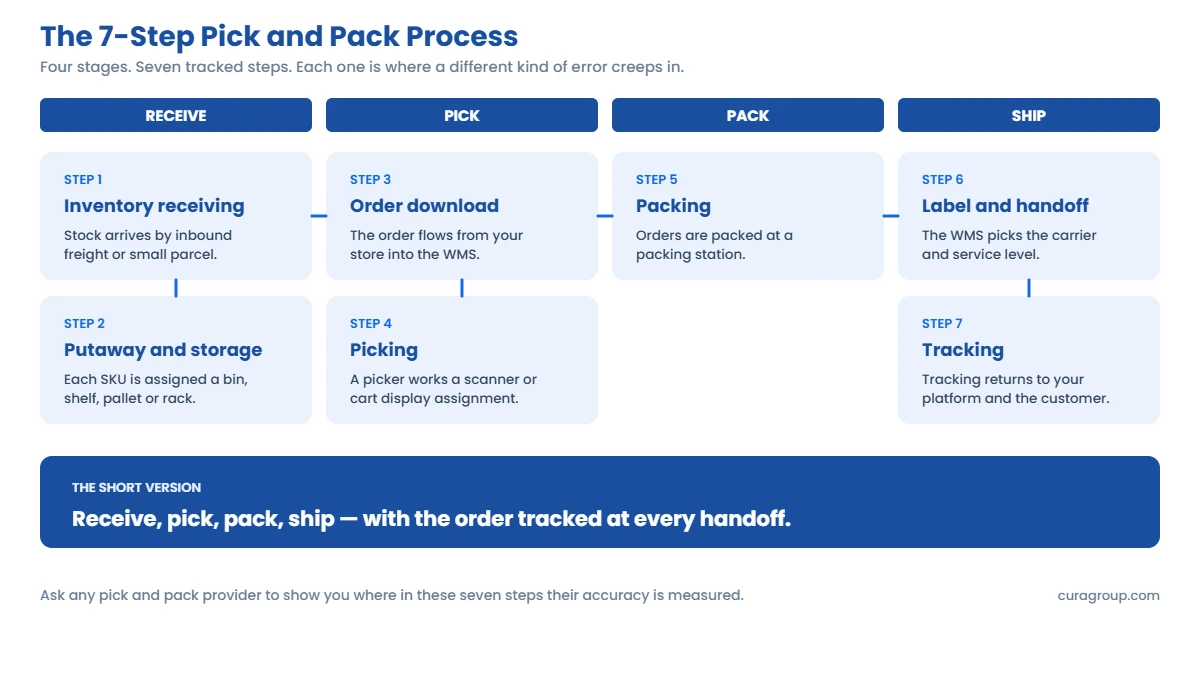
Pick and pack runs in four stages — receive, pick, pack, ship — which a 3PL breaks into seven tracked steps. Each step is where a specific kind of error creeps in.
Step 1: Inventory Receiving
Your products arrive at the 3PL warehouse via inbound freight or small parcel. The warehouse team inspects, counts, and logs every SKU into the warehouse management system (WMS). Accurate receiving is critical — errors here cascade through the entire fulfillment chain.
Step 2: Putaway and Storage
Items are assigned storage locations — bin, shelf, pallet, or rack — based on size, velocity (how often they’re ordered), and storage requirements. Fast-moving SKUs are placed in prime picking locations to reduce travel time.
Step 3: Order Download
When a customer places an order on your store (Shopify, WooCommerce, Amazon, etc.), the order data flows automatically into the 3PL’s WMS via integration. This triggers a pick ticket or wave.
Step 4: Picking
A picker receives their assignment — either on a handheld scanner, pick cart display, or printed sheet — and walks the warehouse to collect each item. Methods vary by operation:
- Discrete picking: One order at a time
- Batch picking: Multiple orders simultaneously, sorted after
- Zone picking: Pickers stay in their zone; items are consolidated
- Wave picking: Scheduled runs of large order volumes
Step 5: Packing
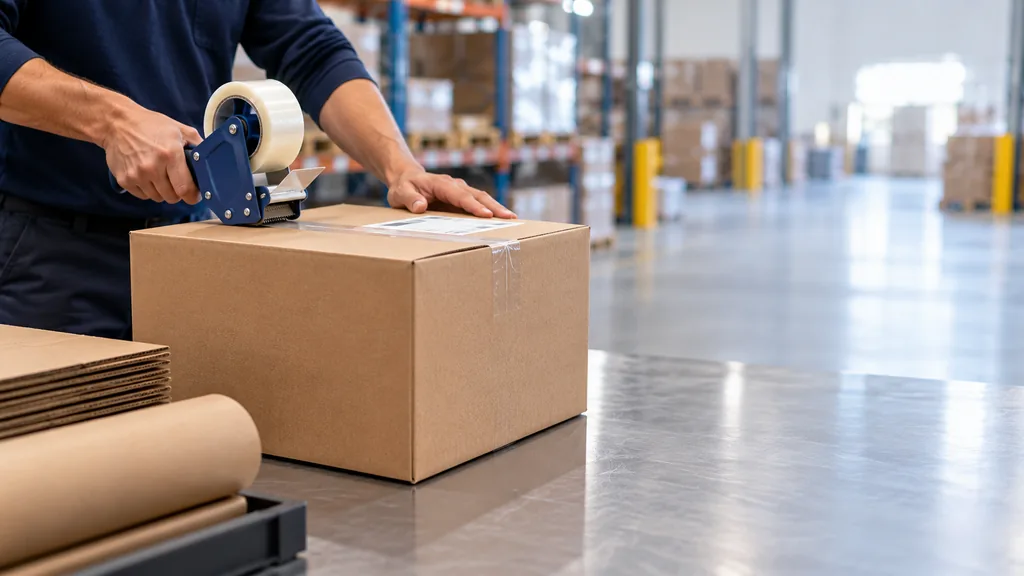
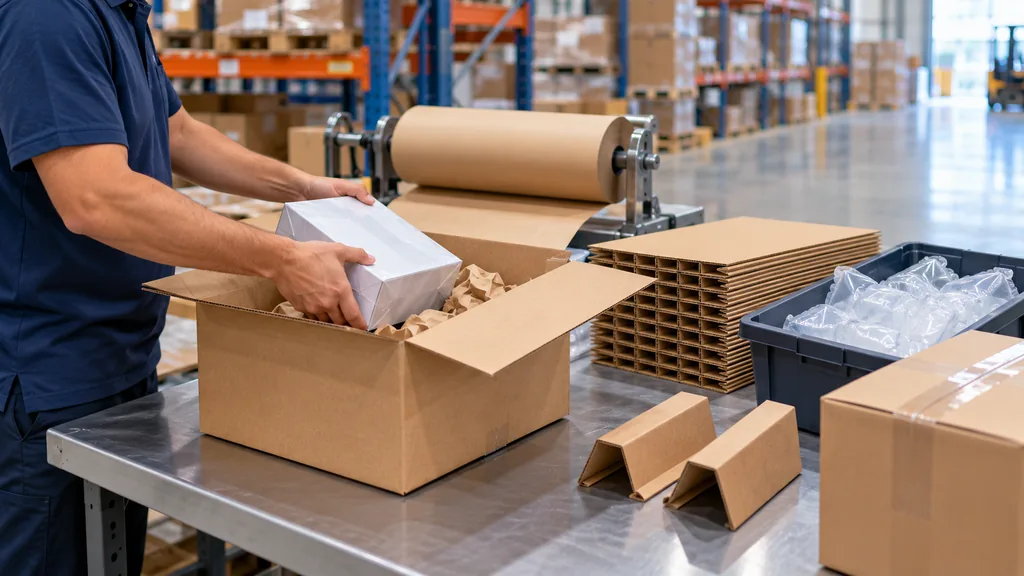
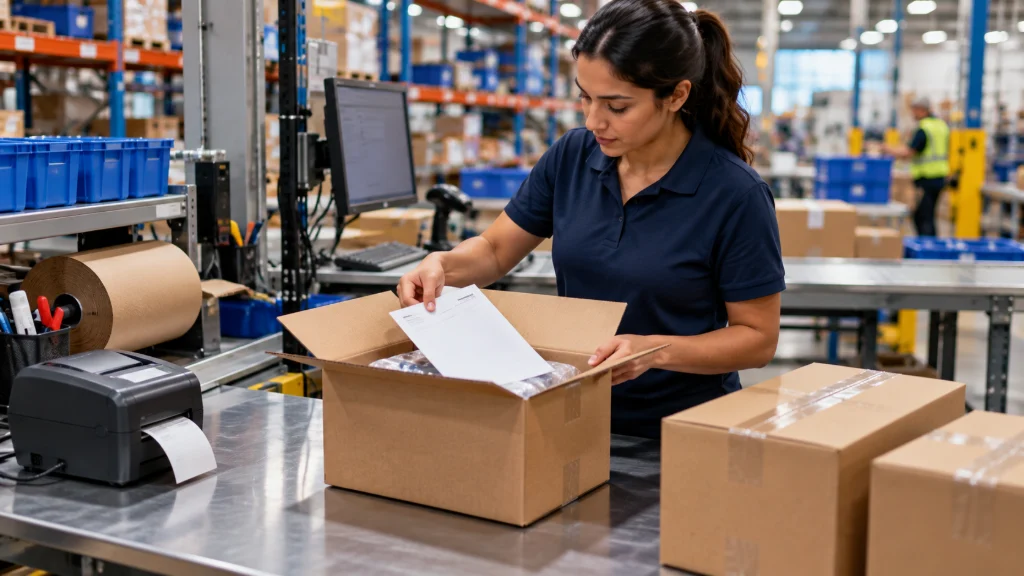
Once picked, orders are packed at a packing station. Packers select the right box or mailer, add protective materials (bubble wrap, void fill, dunnage), include packing slips or inserts, and seal the package. Some 3PLs offer custom branded packaging and kitting services.
Step 6: Shipping Label and Carrier Handoff
The WMS selects the best shipping carrier and service level based on your rules (lowest cost, fastest delivery, carrier preference). A label is printed and applied, and the package is sorted by carrier for pickup or drop-off.
Step 7: Tracking and Confirmation
Tracking numbers are automatically sent back to your ecommerce platform, triggering customer shipping confirmation emails. A good 3PL provides real-time visibility into order status.
What Are the Main Picking Methods?
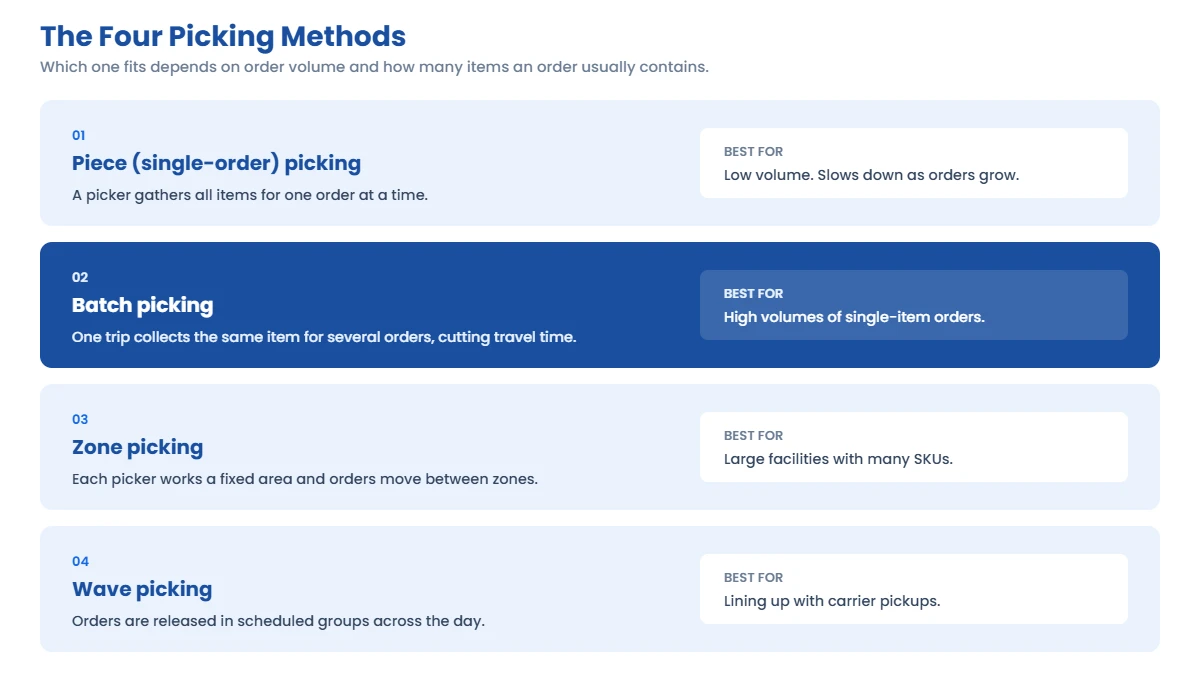
The four main picking methods are piece (single-order) picking, batch picking, zone picking and wave picking. Which one fits depends on order volume and how many items an order usually contains.
- Piece (single-order) picking: a picker gathers all items for one order at a time. Simple and accurate at low volume, but slow as orders grow.
- Batch picking: a picker collects the same item for several orders in one trip, cutting travel time; ideal for high volumes of single-item orders.
- Zone picking: each picker works a fixed area of the warehouse and orders move between zones. Efficient for large facilities with many SKUs.
- Wave picking: orders are released in scheduled groups to line up with carrier pickups or priorities, balancing labor across the day.
Providers usually mix these methods, matching each to the order profile so labor cost per order stays low as volume rises.
Why Pick and Pack Matters for Ecommerce Brands
Pick and pack decides what an ecommerce brand pays per order and how often a customer gets the wrong item. According to the U.S.
Census Bureau, US ecommerce reached $340.2 billion in the second quarter of 2026, 17.1% of all retail sales and 12.2% up year on year. Every one of those orders is an individual pick, and a mispick costs you the item, the return shipping and the customer.
Labor is the cost line pick and pack moves most, because it is the most hands-on stage of fulfillment. The U.S.
Bureau of Labor Statistics put average hourly earnings in warehousing and storage at $26.84 in June 2026, across an industry employing about 1.85 million people. Getting it right directly affects:
- Customer satisfaction: Wrong items, damaged packaging, and late shipments drive returns and negative reviews
- Profit margins: Inefficient pick paths, excess packaging, and rework eat into margins
- Scalability: Manual in-house fulfillment breaks down during peak season
- Returns rate: Poor pick accuracy increases costly reverse logistics
Outsourcing to a specialized 3PL gives you access to optimized warehouse layouts, trained staff, and carrier volume discounts that are nearly impossible to replicate in-house at small to mid scale.
What Are the Benefits of Pick and Pack Fulfillment Services?
Pick and pack fulfillment services buy back four things: staff time, order accuracy, elastic capacity and a lower cost per order.
- Time savings: your team stops packing boxes and goes back to selling, buying and building the product line.
- Order accuracy: barcode-verified picking and a documented SLA replace an informal in-house process.
- Elastic capacity: a Q4 spike is absorbed by the provider’s existing staff and space instead of your temp hires and overtime.
- Lower cost per order: shared warehouse overhead, optimised pick paths and carrier volume discounts land on every order you ship.
What Does Pick and Pack Cost?
Pick and pack is billed as a stack of separate fees, not one rate. The table below is an illustrative planning range to help you read a quote — not a Cura price list, and not a market survey. Get every line in writing from any provider you shortlist.
| Fee Type | Planning Range (illustrative) | Notes |
|---|---|---|
| Receiving | $25-$50 per pallet | One-time inbound fee |
| Storage | $0.50-$2.00 per bin/month | Or per pallet/shelf |
| Pick fee (per unit) | $0.20-$0.75 per item | First item often higher |
| Pack fee | $1.00-$3.50 per order | Includes materials or billed separately |
| Shipping | Pass-through or marked up | Best 3PLs pass discounted rates |
| Kitting/assembly | $0.50-$2.00 per unit | Project-based pricing also common |
Total fulfillment cost per order for a standard ecommerce shipment (one item, standard box, ground shipping) commonly falls somewhere between $4.50 and $12.00 depending on package weight, zone, and service tier — again, a planning band to sanity-check a quote against.
The 500 to 5,000 orders per month band is where outsourcing usually pencils out: high enough to clear most 3PL minimums, not high enough to justify building a private warehouse. Treat it as a planning band, not a rule.
Pick and Pack vs. In-House Fulfillment
Outsourced pick and pack wins on upfront cost, scalability, peak-season capacity, carrier rates and technology; in-house wins on control. Many growing brands start with in-house fulfillment and eventually hit a breaking point. Here is how the two compare across seven factors:
| Factor | In-House | 3PL Pick & Pack |
|---|---|---|
| Upfront cost | High (space, equipment, hiring) | Low (pay per order) |
| Scalability | Limited by space and staff | Scales on demand |
| Peak season | Costly overtime and temp staff | Handled by 3PL workforce |
| Carrier rates | Retail rates | Discounted volume rates |
| Control | Full visibility and control | Dependent on 3PL systems |
| Expertise | Build from scratch | Immediate access to expertise |
| Technology | Must buy or build WMS | 3PL WMS included |
A practical trigger to review outsourcing is fulfillment labor climbing past roughly a fifth of revenue, or order errors and late shipments starting to cost you repeat customers. Set the exact threshold against your own margins.
How to Choose the Right Pick and Pack Provider
Judge a pick and pack provider on six things: location, system integration, documented accuracy, pricing transparency, scalability and account support. Evaluate all six before signing a contract:
1. Location and Distribution Coverage
Warehouse location affects shipping speed and cost. A single warehouse in the Midwest covers most of the continental US within 2-3 days via ground. If you’re shipping heavily to both coasts, a bi-coastal footprint reduces transit times and shipping costs.
2. Technology and Integrations
Your 3PL should integrate natively with your ecommerce platform (Shopify, WooCommerce, Magento, Amazon, etc.) and provide a real-time dashboard for inventory visibility, order tracking, and reporting. Manual order entry is a red flag.
3. Accuracy Rates and SLAs
Ask for documented pick accuracy rates and on-time shipping SLAs, and treat an unwillingness to share the figures as the answer. Get these in writing in your contract, along with how errors are handled and compensated.
4. Pricing Transparency
Avoid 3PLs with complex fee schedules full of hidden minimums, fuel surcharges, and “handling fees.” Ask for a full rate card and model your actual monthly cost before committing.
5. Scalability and Flexibility
A provider should absorb a Q4 volume spike without renegotiation, and add kitting, subscription box assembly or B2B pallet shipping as your mix changes. Ask both questions before you sign, not after.
6. Communication and Support
You need a dedicated account contact — not a generic support ticket system. Ask how exceptions (damaged goods, inventory discrepancies, carrier claims) are handled and what your escalation path looks like.
How Cura Resource Group’s Pick and Pack Services Work
At Cura Resource Group, we provide pick and pack fulfillment for ecommerce brands and B2B distributors across the US. Our fulfillment center uses a WMS with real-time inventory visibility, native integrations with major ecommerce platforms, and dedicated account management for every client.
Our pick and pack process is built around three priorities: accuracy, speed, and transparency. Every order is scanned at pick and again at pack. Shipping labels are generated automatically based on your carrier and service rules. And you get real-time order status in your dashboard — no black-box fulfillment.
We also offer value-added services including kitting and assembly, custom branded packaging, subscription box fulfillment, and returns processing — all under one roof. Whether you’re shipping 200 orders a month or 20,000, our team scales with your volume without long-term commitments or volume minimums that don’t fit your business.
To understand how our fulfillment center capabilities support the full logistics picture, see our guide: Warehousing and Fulfillment: 8 Key Differences. Ready to get a quote? Contact our team and we’ll build a custom fulfillment proposal for your business within 24 hours.
Pick and pack is also where most growing brands first consider handing shipping over, because it is the one cost that scales with every order rather than with revenue. If you are weighing that, when to outsource shipping sets out the comparison.
Frequently Asked Questions About Pick and Pack Services
What is pick and pack in logistics?
Pick and pack is the process of selecting individual items from warehouse storage against a customer order, packaging them appropriately, and preparing them for carrier shipment. It is the core operational stage of ecommerce order fulfillment, sitting between inventory storage and the moment a parcel leaves the building.
How much do pick and pack services cost?
Pick and pack is billed as separate fees rather than one rate: a per-order pack fee, a per-item pick fee, plus storage and receiving. As an illustrative planning band, all-in cost per fulfilled order commonly lands between $4.50 and $12.00 depending on weight, zone and packaging. Get every line in writing.
What is the difference between pick and pack and fulfillment?
Pick and pack refers specifically to the warehouse process of selecting and packaging individual orders. Fulfillment is the broader term covering the entire order-to-delivery chain, including inventory receiving, storage, pick and pack, shipping and returns. Every fulfillment operation contains pick and pack, but not every pick and pack service runs full fulfillment.
Is pick and pack worth it for small ecommerce businesses?
Below roughly 100 to 200 orders a month, in-house fulfillment often still pencils out. Past that, or once stockouts, shipping errors and peak-season overwhelm start appearing, outsourcing to a 3PL usually lowers cost per order and improves the customer experience. Set the exact threshold against your own margins.
How do I integrate my Shopify store with a pick and pack provider?
Shopify integration is standard: providers connect through a Shopify app or the API. Once connected, orders flow automatically from your store into the provider’s WMS in real time, and tracking is pushed back to Shopify when each order ships. Setup usually takes one to three business days.
What accuracy rate should I expect from a pick and pack service?
Ask for the provider’s documented pick accuracy rate rather than accepting a headline figure. A rate of 99.5% works out to fewer than five errors per 1,000 orders, which is the arithmetic, not a benchmark. Treat an unwillingness to share the number, or the error resolution process behind it, as the answer.
Can pick and pack services handle kitting and custom packaging?
Yes. Kitting (assembling multiple SKUs into a single product set), subscription box assembly, custom branded packaging and insert inclusion are all commonly offered alongside standard pick and pack. They are priced separately from the base rate, so ask for those lines specifically when you compare quotes.
What should I look for in a pick and pack SLA?
Key SLA elements include same-day or next-day order cutoff times, a guaranteed pick accuracy percentage, on-time shipment rates, and defined remedies when something goes wrong, such as replacement units or refunded fees. Get the measurement method in writing too, not just the target number, as part of your 3PL contract.