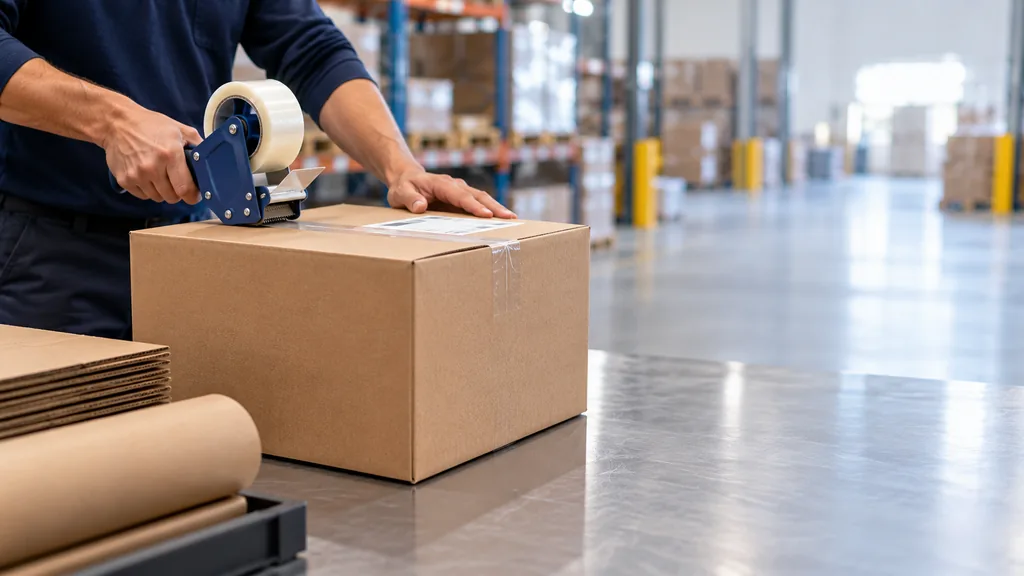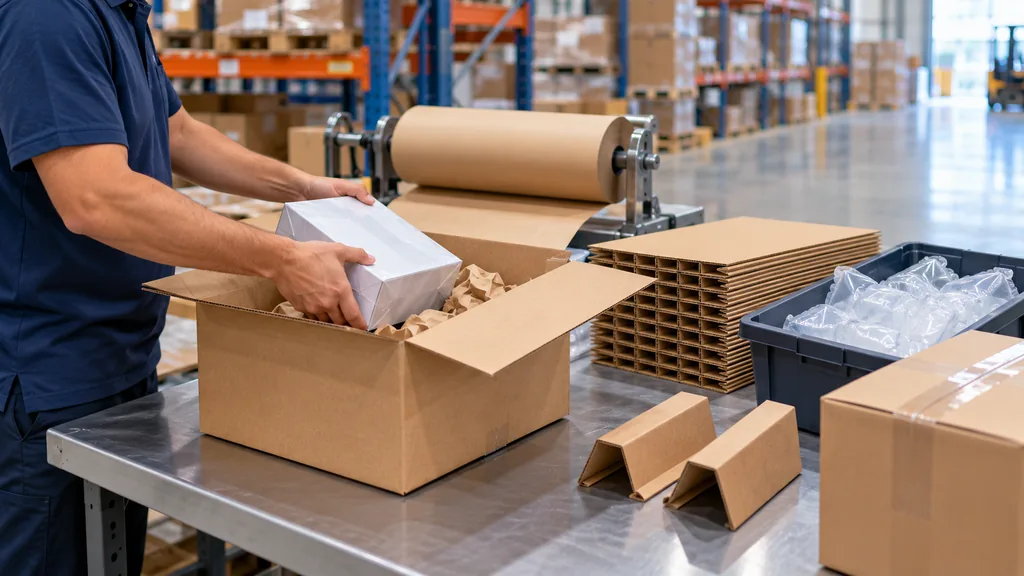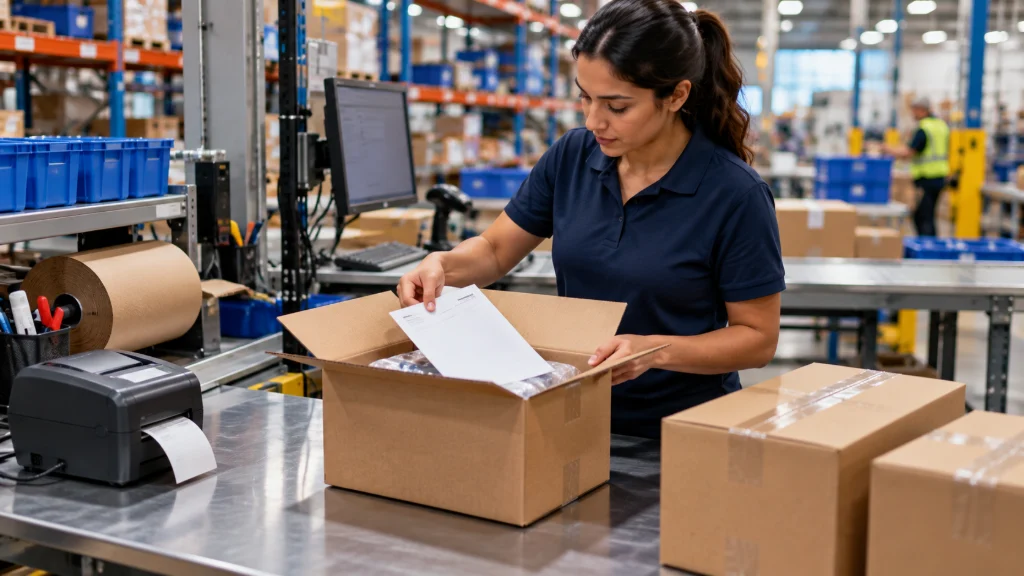


Small business shipping is how a growing brand gets orders to customers. It covers the carriers, rates, packaging and labor behind every parcel that leaves the door.
The real question is usually not which carrier to use, but how long to keep running shipping logistics yourself.
This guide covers the shipping solutions for small business, what in-house shipping costs once labor is counted, and how to reach discounted carrier rates. It ends with the point at which it costs less to outsource shipping to a fulfillment center than to keep it in the building.
What Is Small Business Shipping?
Small business shipping is the end-to-end process of getting a customer order out the door. That means choosing a carrier, buying postage, printing the label, packing the item, and getting it delivered.
It covers both the money — carrier rates, packaging, surcharges — and the labor, which is the half most businesses leave out of the calculation.
The channel driving it keeps growing. The U.S. Census Bureau put US retail ecommerce at $340.2 billion in the second quarter of 2026. That was 17.1% of all retail sales, up 12.2% year on year. Small sellers compete for those orders against retailers whose delivery speed is subsidized by scale.
The central constraint is buying power. Carriers price by volume. A business shipping a few dozen orders a week pays close to retail, while a large brand pays far less for the identical box.
What Shipping Solutions Are Available to a Small Business?
Five small business shipping solutions cover almost every need — USPS, UPS and FedEx, regional carriers, flat-rate services, and shipping through a 3PL — and the right mix depends on package size, weight, speed and destination:
- USPS: usually cheapest for small, lightweight parcels, with flat-rate boxes that simplify pricing.
- UPS and FedEx: stronger for heavier packages, faster ground networks, and business shipping tools.
- Regional carriers: can beat the national carriers on price and speed within a specific area.
- Flat-rate shipping: one price regardless of weight within a zone, which makes costs predictable for heavier small items.
- 3PL / fulfillment shipping: a third-party logistics partner ships on your behalf using its own discounted carrier rates and its own labor.
Rate-shopping each order against two or three of these is the baseline. What it does not change is who packs the box.
What Does In-House Shipping Actually Cost?
In-house shipping costs more than postage, because the largest line item is usually the time spent packing.
Warehouse and storage labor averaged $26.84 an hour in June 2026, according to the U.S. Bureau of Labor Statistics. Whether you pay that to staff or absorb it yourself, it is real money either way.
Three costs go missing from most in-house calculations:
- Labor per order. The minutes to pick, pack, label and manifest, multiplied by every order, at the rate above or your own hourly worth.
- The retail rate gap. What you pay per parcel versus what a high-volume shipping operation pays for the same box to the same zip code.
- Space and materials. Storage, boxes, void fill, tape, printers and the scale — small individually, constant in aggregate.
Add those three to postage and you have a real cost per order. That number, not the label price, is what a 3PL quote should be compared against.
It also explains why the answer changes as you grow. The best carrier for high-volume shipping is rarely the best carrier at twenty orders a week. The discounts that matter at scale are the ones you cannot access at low volume.
How Do You Reduce Small Business Shipping Costs?
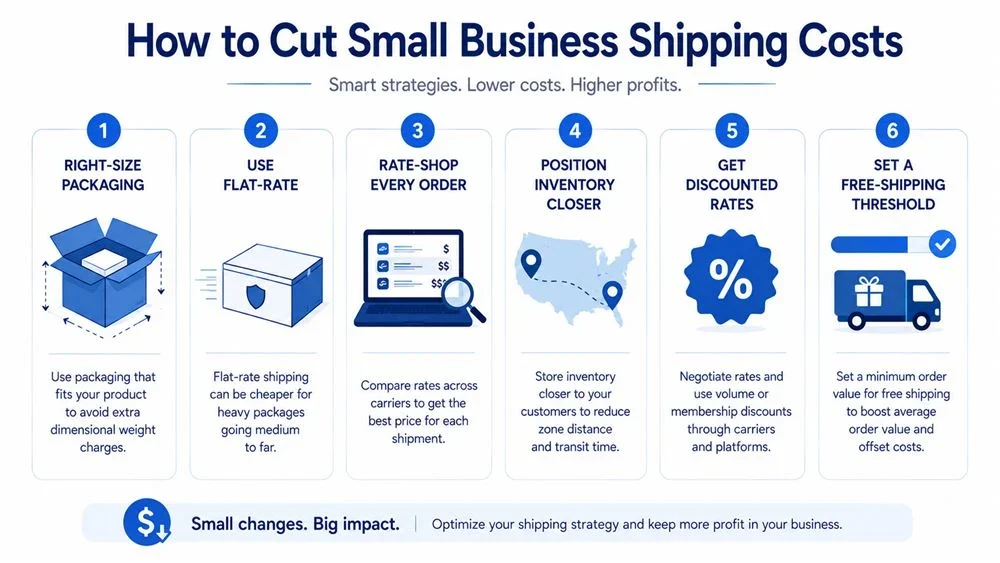
The six moves that cut shipping cost most are right-sizing packaging, using flat-rate where it wins, rate-shopping every order, positioning inventory closer to customers, getting below-retail carrier rates, and setting a free-shipping threshold:
- Right-size your packaging: carriers charge by dimensional weight, so an oversized box costs more even if the item is light.
- Use flat-rate where it wins: for dense or heavy small items, flat-rate boxes often beat weight-based pricing.
- Rate-shop every order: the cheapest carrier changes with weight and distance.
- Position inventory closer to customers: shipping across fewer zones costs less and delivers faster.
- Access discounted rates: the single biggest lever, and the one a small business cannot pull alone.
- Set a free-shipping threshold: a minimum order value for free shipping lifts average order size and offsets the postage you absorb.
The first four you can do yourself this week. The fifth is the one that requires someone else’s volume.
How Do Small Businesses Get Discounted Shipping Rates?
A small business gets discounted shipping rates by borrowing someone else’s volume — either through shipping software that pools many small shippers, or through a 3PL shipping under its own carrier contracts:
- Shipping software and aggregators: platforms that pool small shippers to access discounted USPS, UPS and other rates, plus label printing and rate comparison in one place.
- A 3PL: a fulfillment partner ships your orders under its own high-volume contracts, at rates a small business could not negotiate directly.
Be precise about where software stops being enough. Shipping platforms get you better rates; they do not pick, pack or store anything — you or your staff still do that. If rates are your problem, buy software. If the packing bench is your problem, software will not fix it.
When Should You Outsource Shipping Instead of Doing It In-House?
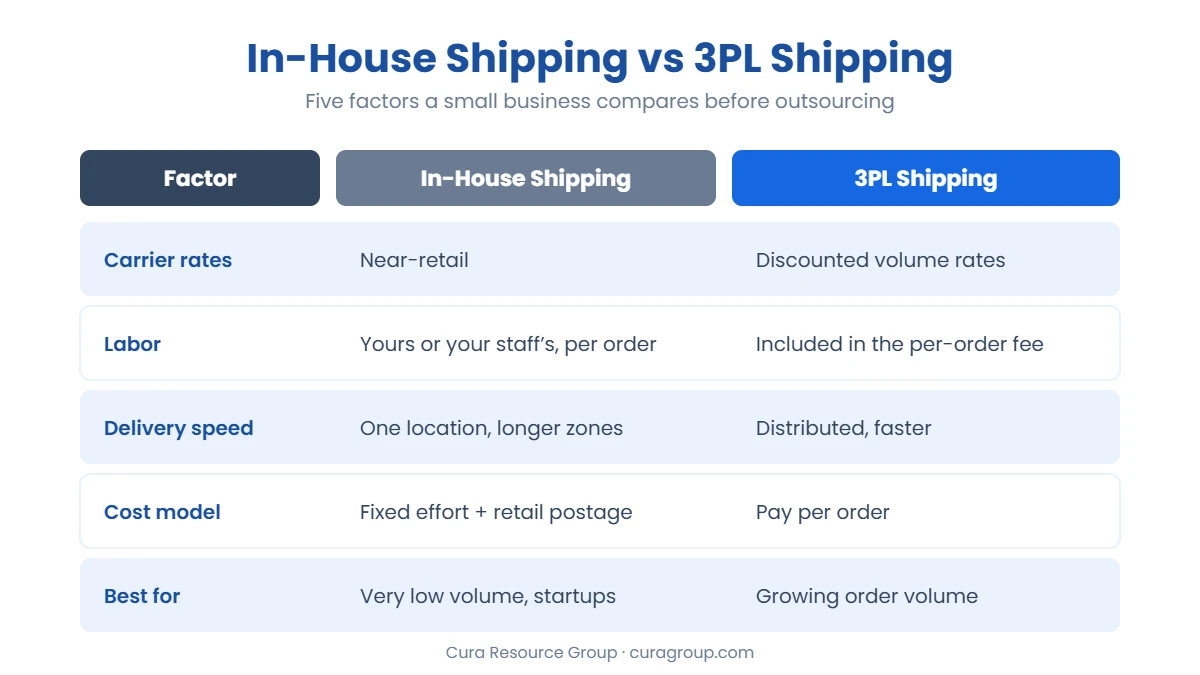
You should outsource shipping when the labor stops being worth it. That point arrives when packing hours displace work only you can do, or when the retail rate gap outgrows a 3PL’s fees. It also arrives when delivery speed starts costing sales.
| Factor | In-House Shipping | 3PL Shipping |
|---|---|---|
| Carrier rates | Near-retail | Discounted volume rates |
| Labor | Yours or your staff’s, per order | Included in the per-order fee |
| Delivery speed | One location, longer zones | Distributed, faster |
| Cost model | Fixed effort + retail postage | Pay per order |
| Best for | Very low volume, startups | Growing order volume |
For the full comparison, including the cases where in-house genuinely wins, see 3PL vs in-house fulfillment.
How Does a 3PL Help a Small Business Ship?
A 3PL manages shipping end to end on discounted carrier rates, which simplifies shipping to a single handoff. You send inventory in, and it runs the full order fulfillment process — receiving, storage, pick and pack, and shipping — for every order.
The advantages compound. Below-retail rates come from the 3PL’s volume, and inventory sits across an ecommerce fulfillment warehouse network to shorten delivery zones. Same-day delivery becomes an option in some markets, and consistent packing can include custom packaging.
Working with a 3PL like Cura Resource Group is not about cheaper labels — it is about handing over the hours.
What About Retail Shipping and Wholesale Orders?
Retail shipping is a different problem from parcel shipping. You are sending pallets and cases into someone else’s receiving dock on their terms, not boxes to consumers. Retail buyers impose routing guides, labeling requirements, delivery windows and chargebacks for getting any of it wrong.
If you sell both direct-to-consumer and into retail, the two flows need different handling out of the same inventory. That is usually the point at which brands stop doing it themselves.
What Shipping Mistakes Should Small Businesses Avoid?
The six most expensive shipping mistakes are oversized boxes, defaulting to one carrier, guessing at rates, ignoring discounted rates, having no shipping policy, and waiting too long to outsource:
- Oversized boxes: triggers dimensional-weight charges and wastes fill on every order.
- Defaulting to one carrier: means overpaying on shipments another carrier would carry cheaper.
- Guessing on rates: a flat fee that doesn’t match real cost either eats margin or scares off buyers at checkout.
- Ignoring discounted rates: paying retail postage when software or a 3PL could cut it.
- No shipping policy: unclear delivery times drive cart abandonment and support tickets.
- Waiting too long to outsource: packing every order by hand past a certain volume quietly caps growth.
Final Word
Small business shipping starts as a cost disadvantage. Closing it takes two things: tightening what you control, and borrowing volume for what you don’t.
Right-size packaging, rate-shop every order and position stock closer to customers. Then work out your true cost per order, including labor. Compare it honestly against what a 3PL’s shipping solution for small business would cost instead.
The part most brands underestimate is the physical work per order. Pick and pack services are where that labor sits, and where outsourcing takes it out of your week.
Ready to ship like a big brand without the big operation?
Frequently Asked Questions
What does small business shipping involve?
Small business shipping is the process a small business uses to package and send customer orders. That means selecting a carrier, buying postage, printing labels, packing the item, and getting it delivered. It covers the carriers, rates, packaging, and workflow behind every parcel a business ships.
What is the best shipping option for a small business?
There’s no single best option; the right mix depends on parcel weight and volume. USPS is usually cheapest for small, light parcels (especially flat-rate boxes), while UPS and FedEx suit heavier packages. The best overall approach is to rate-shop each order. Growing businesses often get the lowest rates by shipping through a 3PL’s discounted carrier contracts.
How do small businesses ship products cheaply?
Keep package dimensions tight, because carriers bill on dimensional weight and an oversized box costs more even when the item is light. Use flat-rate boxes where the product fits the tier, and hold stock closer to your customers so each order crosses fewer shipping zones.
Can a small business negotiate carrier rates?
Carriers price by volume, so a small business gets discounts by borrowing someone else’s volume. That means shipping platforms that pool many small shippers, or a 3PL that ships orders under its own high-volume carrier contracts. It passes on rates a small business couldn’t negotiate alone.
When should a small business use a 3PL for shipping?
A small business should consider a 3PL once packing orders takes time away from running the business. The same applies when shipping costs eat into margins or delivery speed limits growth. A 3PL provides discounted rates, distributed warehousing, and full fulfillment on a pay-per-order basis.
How much should a small business charge for shipping?
Work backwards from your true cost per order, including labor rather than postage alone. Free shipping above a threshold set slightly over your average order value lifts basket size while covering the cost. A flat rate is simpler for customers but loses money on heavy or distant orders.
What is the best shipping platform for small businesses?
Aggregators such as Pirate Ship, Shippo and EasyPost pool volume to give small sellers discounted USPS and UPS rates, and most integrate with ecommerce platforms. They lower what you pay per label, but none of them pick, pack or store anything — that work stays with you.
How do I set up shipping for my small business?
Decide first whether you will ship in-house or outsource, because everything else follows from that. In-house means opening carrier accounts, choosing a rate-shopping platform and building a packing station. Outsourcing means sending inventory to a 3PL and connecting your store to it.