
Cura Resource Group
Supplement fulfillment is the storage, picking, packing and shipping of vitamins, powders, capsules and gummies for the brands that sell them. Every unit carries a lot number and an expiration date, so the warehouse tracks both from receipt to the customer’s door.
Cura Resource Group runs supplement fulfillment from three FDA-registered warehouses in Memphis, Tennessee; Riverside, California; and Carolina, Puerto Rico. We hold supplements under the federal cGMP rule and ship DTC, subscription, retail and FBA prep orders from one stock count.
Get a supplement fulfillment quote with your SKU count, monthly orders and sales channels.
Six jobs make up the work: receiving, lot-tracked storage, first-expiring-first-out picking, packing, shipping and returns. Each one keeps the lot number attached to the unit, because a recall or an expiry check depends on it.
The same stock can serve four kinds of order, and each needs different handling.
| Order type | What the warehouse does |
|---|---|
| Online store (DTC) | Picks single orders by expiry date, packs them in your branded box and ships the same day before the agreed cut-off |
| Subscriptions | Builds monthly boxes and per-subscriber versions, with inserts and thank-you cards |
| Retail and wholesale | Ships cases and pallets with the retailer’s labels and paperwork |
| FBA prep | Labels each unit with its expiration date and preps cartons for marketplace inbound |
Our warehouses handle six common forms: vitamins and minerals, protein and sports powders, capsules and tablets, gummies, herbal products, and wellness subscription boxes. Tell us which forms you sell, because powder tubs, glass bottles and gummies each need different packing and storage.
Functional foods and other nutraceutical products need the same lot and expiry tracking, so they fit the same account.
Four steps keep each unit traceable: record the lot, store by lot, ship the earliest expiry first, and hold or trace a lot.
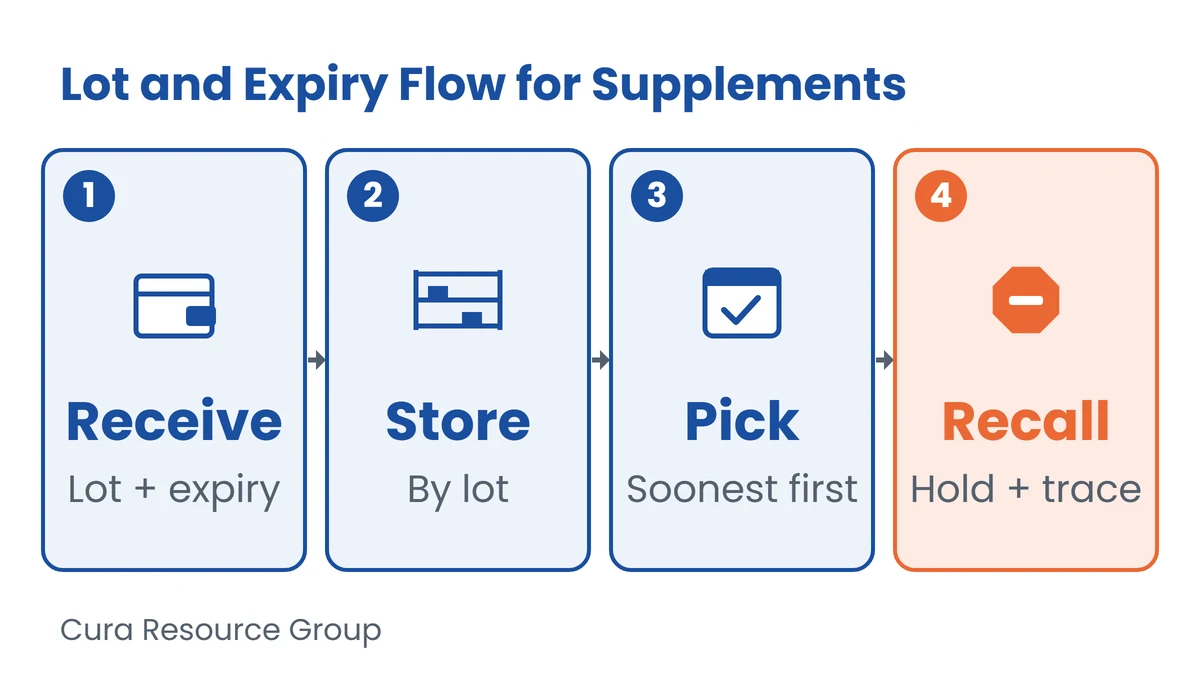
Receiving staff record each carton’s lot number and expiration date into our warehouse management system before the stock goes on a shelf. The team also counts inbound cartons against your purchase order, so a short shipment shows up before your store sells it.
Each lot gets its own recorded location, so the system knows which batch sits where. Cycle counts check those lots against the records, as part of our inventory control services.
Pickers pull the unit with the earliest expiration date before any newer stock. That rotation, called FEFO, stops product from aging out on the shelf or reaching a customer close to its date.
During a recall, we hold the affected lot so no order ships from it. We then pull the list of customer orders that already shipped from that lot, so you can contact those buyers.
Memphis, Riverside and Carolina each hold an FDA food facility registration, and our supplement storage follows the federal good manufacturing practice rule for holding.
That rule, 21 CFR Part 111, applies to anyone who manufactures, packages, labels or holds a dietary supplement, according to the eCFR. Food facility registrations also need renewing every other year, according to the FDA.
Ask any supplement 3PL for its registration status before you send stock.
Our kitting team builds every monthly box, multi-pack and starter set before it ships. That covers rotating monthly boxes and per-subscriber versions, and we pre-build boxes before the ship date so orders go out as single picks.
Marketing inserts and thank-you cards go into the box at packing, so each shipment carries your brand. Our pages on monthly subscription boxes and kitting services explain each one in full.
Each of our three sites keeps one count of your supplement stock. Web orders, retailer purchase orders and marketplace shipments all draw on that count, so no channel runs on a separate pile.
Your online store and marketplace orders reach our system automatically as shoppers check out. For FBA prep, we label each unit with its expiration date and prep the cartons for marketplace inbound.
Retail orders ship as cases and pallets through our retail distribution services, and our guide to DTC fulfillment covers the single-parcel side.
Gummies and other heat-sensitive supplements go into the temperature-controlled space at our Memphis warehouse. Powders, capsules and tablets that keep at room temperature can ship from any of the three sites.
We do not offer refrigerated or frozen storage or humidity control. Probiotics and other products that need cold storage belong with a cold-chain specialist.
Herbalife, the nutrition company, started working with Cura Resource Group in our first year. Our Herbalife case study from 2017 shows how we built, staffed and ran nine Herbalife sales centers in the US and Puerto Rico.
“Cura is a service provider. We still own the inventory, but they are in the business of fulfillment,” said Tim Waters, then Herbalife’s Americas VP of Finance and Member Operations.
Providers price supplement work by the space your stock takes and the handling each order needs. A quote breaks into the lines below.
| Cost line | What it covers |
|---|---|
| Receiving | Counting inbound stock and recording each lot and expiry date |
| Storage | The space your supplements take each month, including temperature-controlled space |
| Pick and pack | Picking each order by expiry date and packing it |
| Kitting and subscriptions | Building monthly boxes, bundles and starter kits |
| Packaging and inserts | Boxes, mailers, inserts and thank-you cards |
| FBA prep | Expiration-date labels and carton prep for marketplace inbound |
| Shipping | The carrier charge for each parcel or pallet |
| Returns | Receiving, inspecting and restocking returned units |
We quote each account to its products and order profile. Have every provider price one identical month of your orders, then compare the totals line by line.
Six checks separate a supplement-ready warehouse from a general one: registration, cGMP, lot capture, FEFO, recall handling and storage limits.
| Ask the 3PL | A strong answer |
|---|---|
| Is the warehouse registered with the FDA as a food facility? | Yes, with a current registration |
| Does it follow cGMP for holding supplements (21 CFR Part 111)? | Written procedures it can show you |
| Does it record lot and expiry at receiving? | Every carton recorded in the warehouse system |
| Does it pick first-expiring, first-out? | FEFO set as the pick rule for your SKUs |
| How does it handle a recall? | A hold on the lot, plus a list of orders shipped from it |
| Which products can it store, and which not? | Clear limits, including temperature and cold storage |
Our three FDA-registered warehouses in Memphis, Riverside and Carolina, Puerto Rico all run supplement accounts, from receiving to returns. Our supplement fulfillment services give each account lot and expiry tracking, FEFO picking, lot holds for recalls and order-level trace.
Returned units come back to the same team for inspection and restocking, as our guide to ecommerce returns explains. Our page on ecommerce fulfillment services for online stores sets out the full order process.
Larger brands can hand us the whole operation through our contract logistics service.
The fit is strongest for brands that sell online, through retailers and on marketplaces at once and need lot control across all three. Look elsewhere if most of your range needs refrigeration, since we store at room temperature or in temperature-controlled space only.
Request a supplement fulfillment quote with your SKU list, monthly orders and the channels you sell on.
A 3PL stores a brand’s vitamins, powders, capsules and gummies, then picks, packs and ships each order while tracking lot numbers and expiration dates. The service covers online, subscription, retail and marketplace orders, plus returns. A recall or expiry check depends on knowing where each batch went.
In most cases, yes: a warehouse holding dietary supplements counts as a food facility, so it registers with the FDA and renews every other year. It also falls under the cGMP rule for holding supplements, 21 CFR Part 111. All three Cura warehouses hold an FDA registration.
First-expiring, first-out picks the unit with the earliest expiration date before any newer stock. It keeps supplements from aging out on the shelf or reaching a customer near their date. FIFO ships the oldest received stock first instead, which can differ when batches arrive out of order.
The warehouse places a hold on the affected lot so no further orders ship from it. It then pulls the list of customer orders that already shipped from that lot and sends it to the brand. Cura does both, and the brand runs customer contact from that list.
Yes, if it has temperature-controlled space, since gummies can melt or stick together in heat. Cura stores gummies and other heat-sensitive supplements in the temperature-controlled space at our Memphis warehouse. We do not offer refrigerated or frozen storage, so cold-storage products need a cold-chain provider.
Yes, when it runs every channel from one inventory. Cura ships subscription boxes, online orders, retail purchase orders and FBA prep from the same stock count at each site. Supplement units bound for FBA get expiration-date labels before they ship to the marketplace.
The term covers the same warehouse work for functional foods, herbal products and other health items sold beside supplements. The needs match supplement fulfillment: lot and expiry tracking, FEFO picking, and the right storage conditions for each product form, from powders to gummies.
A quote usually has eight lines, set by your products and order profile. They are (1) receiving, (2) storage, (3) pick and pack, (4) kitting, (5) packaging, (6) FBA prep, (7) shipping and (8) returns. Compare providers on the same month of orders.