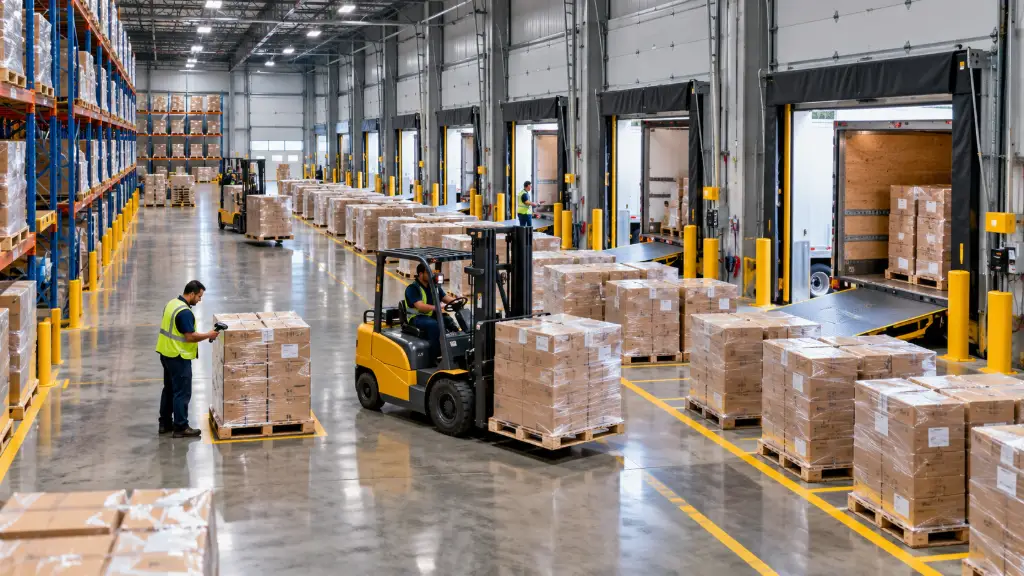
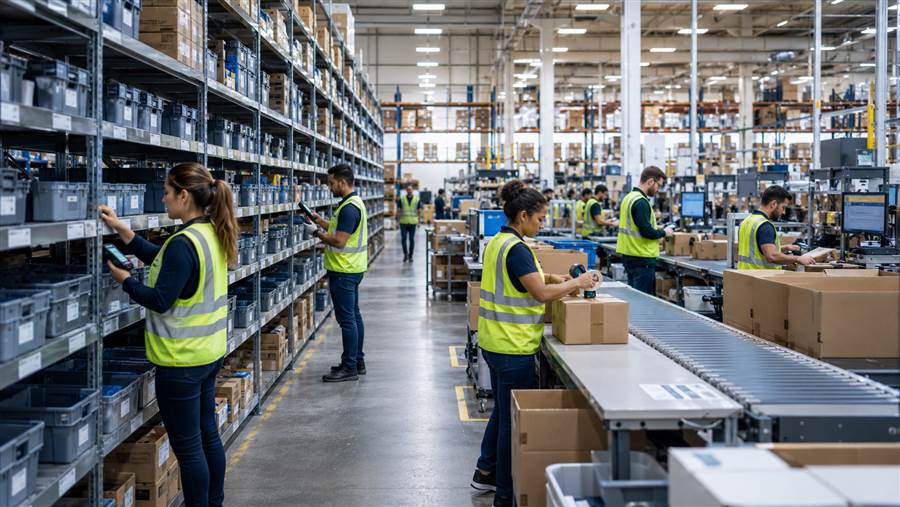

An ecommerce fulfillment warehouse is a specialised facility that stores products and processes online orders. It handles receiving inventory, storing it, picking items off shelves, packing boxes, shipping parcels to buyers, and managing returns — everything between a completed checkout and a delivered package.
An ecommerce fulfillment warehouse is the engine room of any online business. It’s where inventory is received, stored, picked, packed, and shipped to customers — and where most of the cost and speed of your delivery promise is actually decided. As online order volumes climb and customers expect faster shipping every year, the warehouse behind your store stops being a back-office detail and becomes a core driver of margin, accuracy, and growth. This guide explains what an ecommerce fulfillment warehouse is, how it works, what it costs, how it differs from a traditional warehouse, and how to choose the right one — whether you run it in-house or by handing warehousing and fulfillment to a partner. Get this decision right and fast, accurate shipping becomes a quiet competitive advantage; get it wrong and it shows up in your margins and your reviews.
What Is an Ecommerce Fulfillment Warehouse?
An ecommerce fulfillment warehouse is a facility designed specifically to store online-retail inventory and fulfill direct-to-customer orders. Unlike a storage-only warehouse, an ecommerce fulfillment warehouse is built around outbound order flow: small, frequent, often single-item shipments going straight to consumers rather than bulk pallets going to retailers.
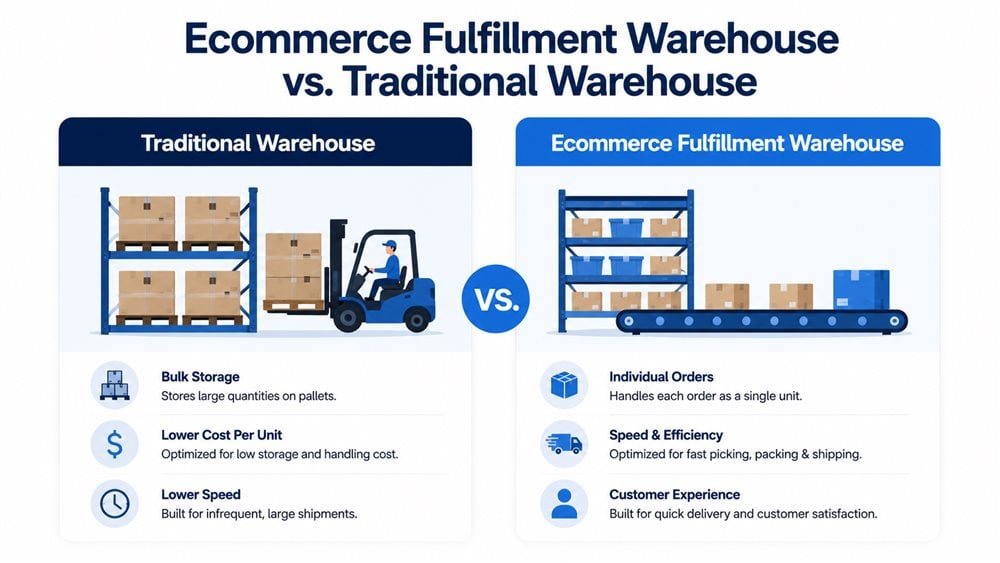
That difference shapes everything — the layout, the technology, the labor model, and the carrier mix. A traditional warehouse optimizes for holding goods cheaply; an ecommerce warehouse fulfillment operation optimizes for picking and shipping individual orders quickly and accurately. It’s the physical foundation underneath your checkout button.
How Does an Ecommerce Fulfillment Warehouse Work?
Every ecommerce fulfillment warehouse runs the same core order fulfillment process, compressed and optimized for online retail:
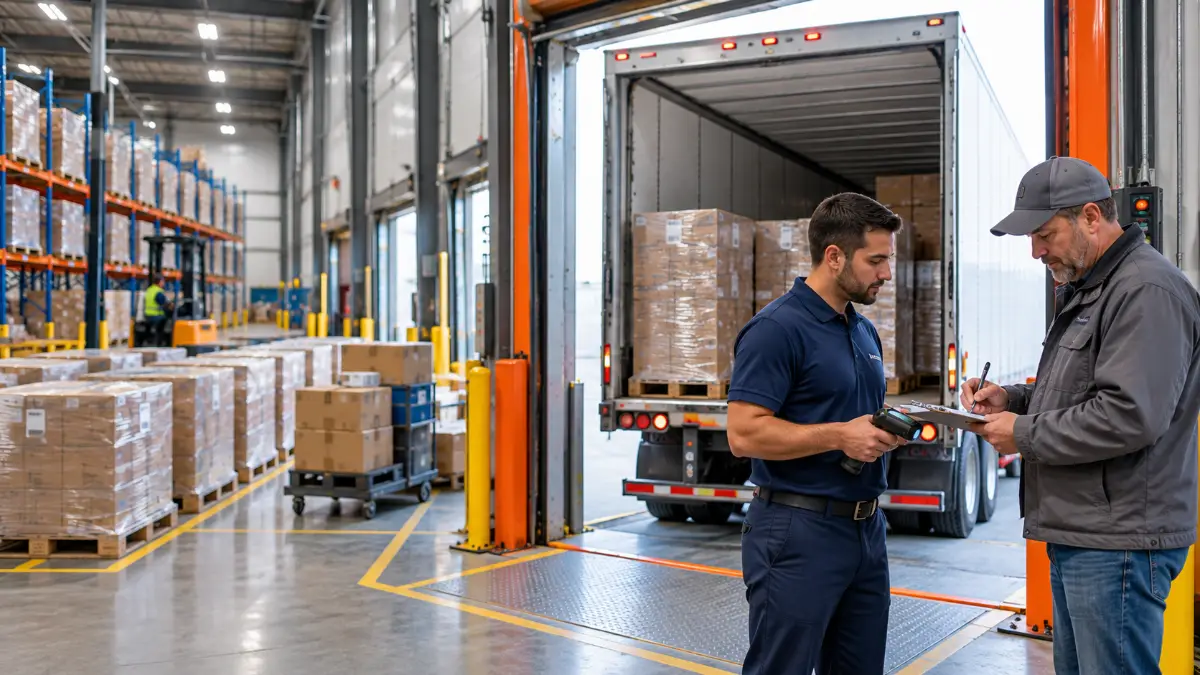
- Receiving: inbound inventory from suppliers is counted, inspected, and logged into the warehouse management system.
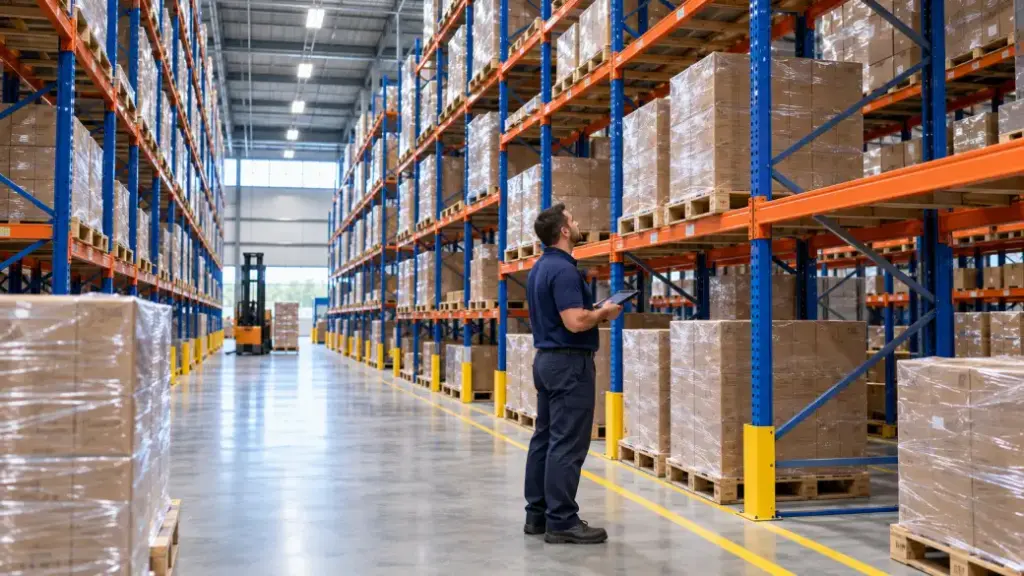
- Storage and slotting: products are placed in bins, shelves, or racks, with fast-moving SKUs positioned close to packing stations.
- Order processing: orders flow in automatically from your ecommerce platform and generate pick lists in real time.
- Picking and packing: staff or automation retrieve items and pack them in right-sized boxes — the pick and pack stage.
- Shipping: orders are rate-shopped across carriers, labeled, and dispatched, with tracking pushed back to the customer.
- Returns: returned items are inspected and restocked, closing the loop on ecommerce returns management.
The whole cycle is governed by a warehouse management system (WMS) that tracks every unit and keeps inventory counts accurate in real time — the single most important capability in any ecommerce order fulfillment warehouse. It also lets a brand sell through store, web and marketplace at once, which is the operating basis of omnichannel fulfillment.
What Is the Difference Between an Ecommerce and a Traditional Warehouse?
The two look similar from the outside but operate on opposite priorities:
| Factor | Traditional Warehouse | Ecommerce Fulfillment Warehouse |
|---|---|---|
| Primary goal | Store inventory cheaply | Ship orders fast and accurately |
| Outbound unit | Bulk pallets / cases | Individual customer orders |
| Order frequency | Low, scheduled | High, continuous |
| Technology | Basic inventory tracking | WMS + ecommerce/OMS integration |
| Value-adds | Rare | Kitting, custom packaging, returns |
If your business ships many small orders directly to consumers, a storage warehouse will quietly bleed you on labor and errors. A purpose-built ecommerce fulfillment warehouse is designed for exactly that flow.
In-House vs. Outsourced Ecommerce Fulfillment
You can run an ecommerce fulfillment warehouse yourself or outsource it to a 3PL. Each model fits a different stage of growth:
- In-house: you lease the space, buy the racking and WMS, hire and manage staff, and negotiate carrier rates. It offers full control and can make sense for very high volume or highly custom operations — but the fixed costs and management burden are significant.
- Outsourced (3PL): a third-party logistics provider operates the warehouse on your behalf, charging per order and per unit of storage. You get distributed warehouse coverage, an established WMS, trained labor, and discounted shipping rates without the capital outlay. This is why most growing ecommerce brands use a 3PL ecommerce fulfillment warehouse rather than building one.
The tipping point usually comes when fulfillment starts stealing time from product and marketing, when shipping costs climb, or when error rates begin hurting reviews and retention.
Cura Resource Group sits on the outsourced side of this comparison, and the honest framing is that it is a trade rather than an upgrade. You give up direct control of the packing bench and gain back the hours, the carrier rates and the ability to absorb a peak without hiring for it.
Technology: WMS and Automation in Ecommerce Fulfillment Warehouses
Technology is what separates a modern ecommerce fulfillment warehouse from a stockroom. Two layers matter most:
- Warehouse management system (WMS): the software backbone. A WMS that integrates directly with your ecommerce platform keeps inventory accurate, routes pick lists, prevents overselling, and gives you real-time visibility into stock and order status.
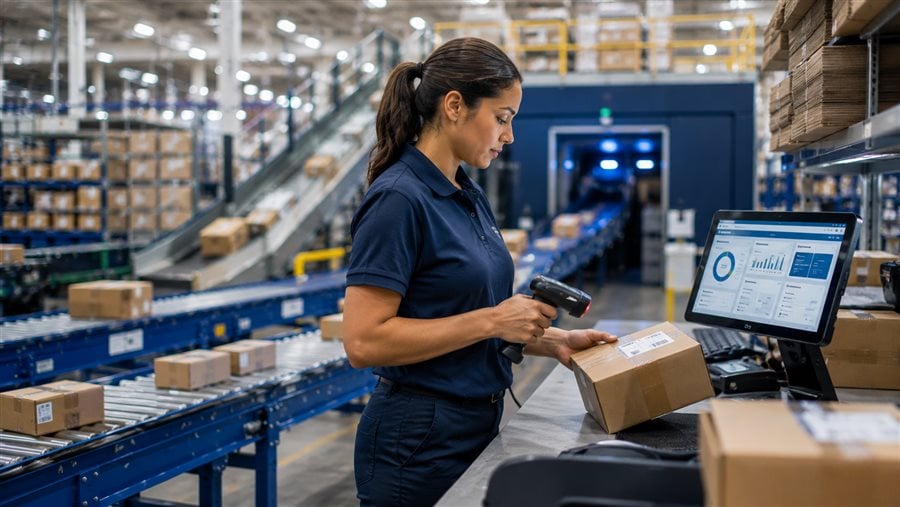
- Automation: barcode scanning, pick-to-light systems, conveyor sortation, and increasingly autonomous mobile robots reduce picking errors and labor cost as volume scales. Our guide to warehouse automation breaks down what each tier costs and returns. Automation isn’t all-or-nothing — most warehouses adopt it selectively where order volume justifies the investment.
For a growing brand, you don’t have to build this stack yourself. A good 3PL already operates an integrated WMS and the right level of automation across its ecommerce fulfillment warehouses.
How Do You Choose an Ecommerce Fulfillment Warehouse?
When evaluating ecommerce fulfillment warehouse companies or deciding where to locate your own, weigh these factors:
- Location and coverage: proximity to your customers determines shipping speed and cost. Multiple locations shorten transit zones and enable faster delivery, including same-day delivery in dense metros.
- Technology and integrations: confirm the WMS connects natively to your store (Shopify, WooCommerce, Amazon, marketplaces). If you sell through Amazon, ask about Amazon FBA prep services too.
- Order accuracy and speed SLAs: ask for real metrics — accuracy rate, same-day order cutoff, on-time shipping percentage.
- Scalability: can the warehouse absorb seasonal peaks without a drop in performance?
- Value-added services: kitting, custom packaging, and returns handling under one roof reduce complexity.
- Transparent pricing: understand storage, pick-and-pack, and shipping costs so there are no surprises.
What Does an Ecommerce Fulfillment Warehouse Cost?
Whether you build or outsource, ecommerce fulfillment warehouse costs break down into a few predictable buckets. Understanding them helps you compare in-house economics against a 3PL quote:
- Storage: charged per pallet, shelf, or bin (3PL) or as fixed rent and utilities (in-house). Slow-moving inventory quietly inflates this line.
- Receiving: the cost to unload, count, and log inbound inventory, usually per unit or per hour.
- Pick and pack: typically the largest variable cost — a per-order base fee plus a charge per additional item, covering labor and packaging.
- Shipping: carrier postage, where a 3PL’s volume discounts often save more than their fees cost.
- Value-added services: kitting, custom packaging, and returns processing, billed separately.
The advantage of a 3PL model is that most of these convert from fixed overhead into variable, per-order costs — you pay for fulfillment in proportion to sales instead of carrying an empty warehouse in a slow month.
As a rough benchmark, industry pricing tends to fall in these ranges: storage around $0.50 to $2.00 per cubic foot (or roughly $15 to $40 per pallet) per month, pick and pack around $3 to $5 for a standard order plus a smaller fee per additional item, and returns around $3 to $10 per order. Total fulfillment, including shipping, often lands near 12 to 20 percent of product revenue, higher for heavy or bulky items and lower for small, light products shipped regionally. Treat these as a starting point and judge any quote on total cost per order, not a single fee.
Signs You’ve Outgrown In-House Fulfillment
The volume pressure is measurable. According to the U.S. Census Bureau, US ecommerce reached $340.2 billion in the second quarter of 2026 — 17.1% of all retail sales and 12.2% higher than the same quarter a year earlier. Returns compound it: the National Retail Federation reports online returns running at 19.3% of sales against 15.8% overall, so roughly one in five parcels comes back and needs handling. Most in-house operations hit their ceiling on the returns volume before they hit it on outbound.
Most brands don’t plan to move to an ecommerce fulfillment warehouse partner — they hit a wall that forces it. The common signals:
- Order volume is consuming hours you should spend on product and marketing.
- Shipping errors, mispicks, or delays are showing up in customer reviews.
- You’re running out of space, or your shipping rates are stuck at retail levels.
- Peak seasons overwhelm your team and service quality drops.
- You want to offer faster delivery but can’t reach customers quickly from one location.
If two or more of these sound familiar, a dedicated ecommerce fulfillment warehouse — usually through a 3PL — is the move that opens the next stage of growth.
Final Word
An ecommerce fulfillment warehouse is where your brand’s delivery promise is kept or broken. The right one — purpose-built for online order flow, run on an integrated WMS, and located close to your customers — turns fulfillment from a cost center into a growth advantage. For most ecommerce brands, partnering with a 3PL that already operates modern ecommerce fulfillment warehouses delivers the speed, accuracy, and scalability of an enterprise operation without the capital and management burden of building it alone.
The warehouse is the building; the operation running inside it is ecommerce fulfillment — receiving, pick and pack, shipping and returns handled per order rather than per pallet.
Looking for an ecommerce fulfillment warehouse that scales with your store?
For a smaller brand the question usually arrives earlier, and as a shipping problem rather than a warehousing one: what each order actually costs to get out the door. That is the starting point of shipping solutions for a small business.
Frequently Asked Questions
How is an ecommerce warehouse different from storage?
An ecommerce fulfillment warehouse is a specialised facility that stores products and processes online orders. It handles receiving inventory, storing it, picking items from shelves, packing boxes, shipping parcels to customers, and managing returns — all optimised for high volumes of small, individual orders rather than bulk pallet movements.
What is an ecommerce warehouse?
An ecommerce warehouse is any facility holding inventory sold online. The term is often used loosely, but a true ecommerce warehouse is built for single-item picking, carrier integration and fast dispatch, unlike a traditional warehouse designed to store and move goods in bulk quantities.
What happens inside an ecommerce fulfillment warehouse?
Orders flow in from your store or marketplace through a system integration. The warehouse management system generates a pick list, a picker retrieves the items, they are packed and labelled, and a carrier collects the parcel. Tracking updates flow back to the customer automatically throughout.
What is the difference between an ecommerce fulfillment warehouse and a traditional warehouse?
A traditional warehouse stores goods in bulk and ships pallets to businesses on a predictable schedule. An ecommerce fulfillment warehouse ships thousands of individual parcels to consumers daily, so it is designed around fast picking, right-sized packaging, carrier integration and returns handling instead of dense storage.
Should I run my own ecommerce fulfillment warehouse or use a 3PL?
Run your own if volume is stable, margins support fixed cost, and your process is genuinely proprietary. Use a 3PL if you are growing, seasonal, expanding regionally, or spending leadership time on warehouse problems. The trigger is usually operational strain rather than a pure cost calculation.
How do I choose an ecommerce fulfillment warehouse?
Check location relative to your customers, systems integration with your platform, documented accuracy and on-time shipping figures rather than targets, certifications matching your product, and capacity headroom at three times current volume. Then read the exit clause and visit the facility before signing.