



A 3PL RFP (request for proposal) is the document you send to third-party logistics providers so each one prices the same job. It sets out your products, order volume, storage, shipping channels, systems and service levels in one place.
Send a vague RFP and the bids come back impossible to compare. Send a precise one and the prices line up side by side.
The choice keeps widening too: Armstrong & Associates puts the U.S. 3PL and contract logistics market at $323.4 billion in 2025, up 5.0% on the year.
Download the free 3PL RFP template, or send your RFP to Cura and get a reply within 24 to 48 business hours.
When Should You Send a 3PL RFP?
Send an RFP once you know your volumes and want firm, comparable prices from two or more providers. Before that point, an RFI gathers capabilities; after it, an RFQ only checks price on a fixed scope.
| RFI (request for information) | RFP (request for proposal) | RFQ (request for quotation) | |
|---|---|---|---|
| Purpose | Learn which providers could do the job | Compare full solutions and prices | Compare prices on a fixed scope |
| When to use it | Early, while you build a shortlist | You know your volumes and needs | Only the price is still open |
| What comes back | Capabilities, sites and services | A proposed operation, rates and service levels | A rate card or a quote |
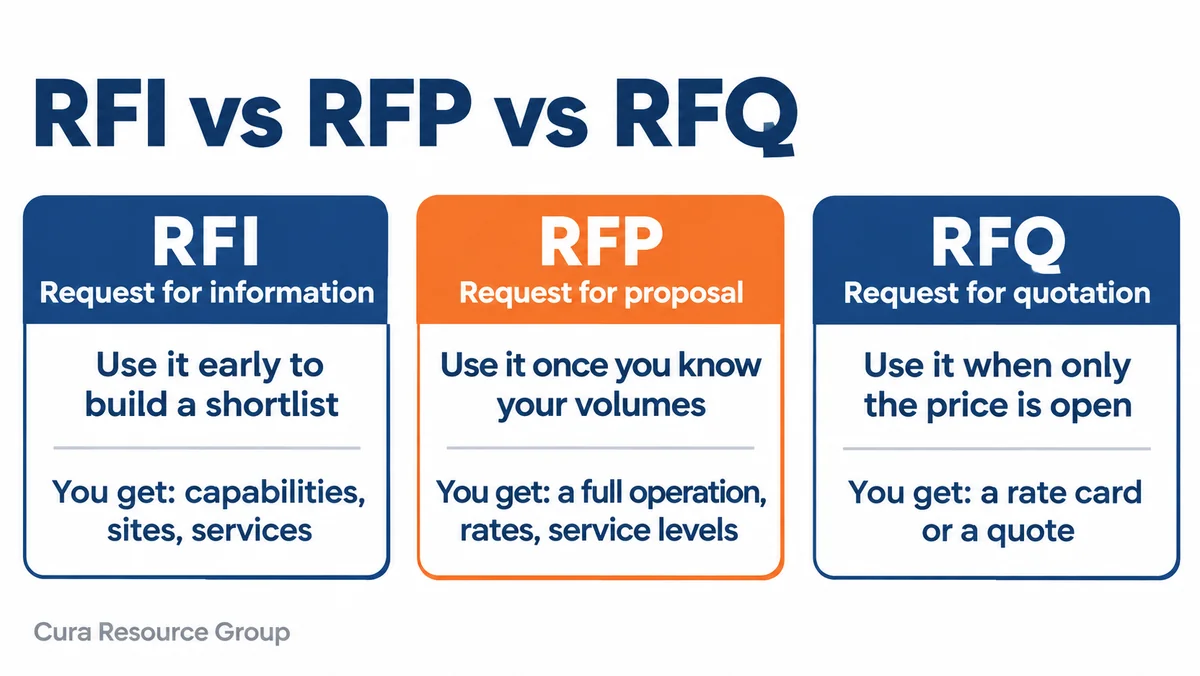
If you have never outsourced before, an RFI first helps you cut a long list down to three to five providers worth a full RFP. If you have not yet decided to outsource, compare the true cost of a 3PL against in-house fulfillment first.
Gather Your Data Before You Write a Word
The numbers you send decide the price you get back, and order volume matters most. It is the gap we see most often in the RFPs we receive, and without it no 3PL can size the labor your account needs.
Pull these figures from your systems before you write a single section:
- Order volume by month for the last 12 months, with your peak weeks marked
- Units and lines per order
- SKU count, with the dimensions and weight of your top sellers
- Pallets or cartons on hand, on an average day and at peak
- Inbound volume: containers or pallets per month, and whether they arrive floor-loaded or palletized
- Sales channels: online, wholesale, retail stores and marketplaces
- Returns per month and what happens to each return
A 3PL that receives these figures can quote real labor and real space. One that receives guesses will add a buffer to every rate.
The 10 Sections of a 3PL RFP
A complete 3PL RFP has 10 sections: goals, products, storage, inbound, orders, outbound, extra services, technology, service levels and pricing. Each one answers a question the provider would otherwise have to guess.
Company Overview and Goals
Open with who you are, what you sell and why you want a 3PL now. Say what success looks like in a year, such as faster delivery to the West Coast or room for a new retail account.
Products and SKUs
List your SKU count, product types and any special handling, such as fragile, heavy or lot-tracked items. Attach a product file with dimensions, weights and units per case.
Storage Needs
State how many pallets, cartons or bins you hold today and at your peak. Note any items that need temperature control or extra security.
Inbound Receiving
Describe how stock arrives: containers, pallets or parcels, how often, and from where. Say whether your suppliers label cartons and send advance shipping notices.
Order Profile
Give monthly order volume, units per order and your busiest days. This section drives labor cost more than any other, so include 12 months of history rather than an average.
Outbound Shipping and Channels
Explain where orders go: consumers, wholesale buyers, retail stores or marketplaces. List the carriers you use today, your delivery promises and any retailer routing guides you must follow.
Value-Added Services
Name the extra work you need, such as kitting, custom packaging, labeling, inserts or returns grading. Give a monthly quantity for each, so the provider can price it.
Technology and Integrations
List the systems the 3PL must connect to: your store, order management system, ERP or EDI partners. Ask how inventory and order status reach you, and how often.
Service Levels and KPIs
Set the targets you will hold the provider to, such as order accuracy, same-day ship cut-off and receiving time. Ask each bidder how they measure every target and how often they report it.
Pricing Format
Send a rate card template and ask every bidder to fill in the same lines. Ask them to list setup fees, minimums and every charge outside the rate card, so nothing appears later.
How to Run a 3PL RFP, Step by Step
A 3PL RFP runs in six steps: shortlist, send with a deadline, answer questions, visit warehouses, score the replies and award the contract. Set a date for each step and share the calendar with every bidder.
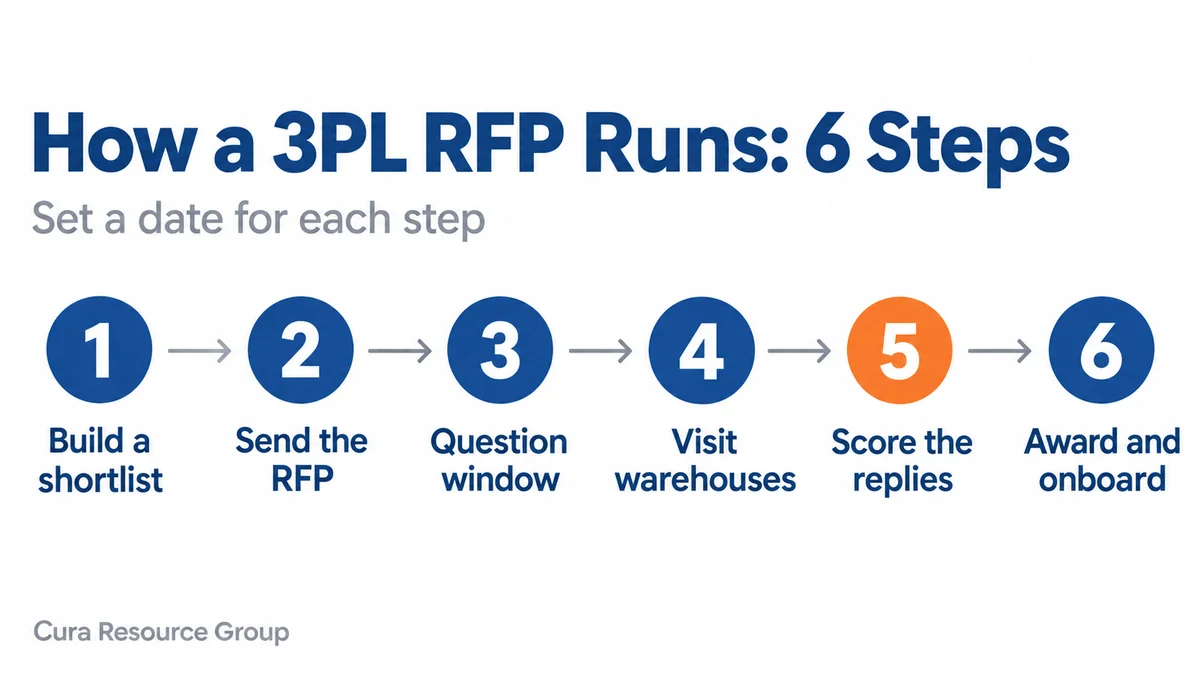
Build a Shortlist
Pick three to five providers that fit your size, channels and locations. Our list of the best 3PL companies by business type is a fast place to start.
Send the RFP With a Clear Deadline
Send the same document to every provider on the same day. Give a firm reply date and one named contact for questions.
Hold a Question Window
Collect questions until a set date, then send every answer to every bidder. Equal information keeps the bids comparable.
Visit the Warehouses
Walk the floor of each finalist before you choose. You see how the team stores stock, moves orders and works on an ordinary day.
Score the Responses
Score each reply against the same weighted sheet and the same sample month of orders.
Award the Contract and Plan Onboarding
Tell the winner and the other bidders on the same day. Agree an onboarding plan with dates for the inventory move, system tests and the first live orders.
How to Score 3PL RFP Responses
Score each reply against weighted criteria and price every bid on one sample month, so you compare like with like. The weights below are an example. Set your own from your goals, using the factors to weigh when choosing a 3PL partner.
| Criterion | Example weight | Score (1 to 5) | Weighted score |
|---|---|---|---|
| Operational fit | 30% | 4 | 1.2 |
| Total cost on the sample month | 25% | 3 | 0.75 |
| Technology and integrations | 15% | 5 | 0.75 |
| Service levels and reporting | 15% | 4 | 0.6 |
| Locations and delivery reach | 15% | 4 | 0.6 |
| Total | 100% | 3.9 |
To compare price, build one sample month from your own data: pallets stored, units received, orders picked, packaging used and parcels shipped. Run every bidder’s rate card against it. A low rate on one line can hide a higher cost on another, and the sample month shows the true total.
Red Flags in a 3PL RFP Response
Question hard any reply that hides costs, dodges your targets or skips the questions you asked. These are the signs to look for:
- Storage priced for your average month, with no rate for your peak
- Setup fees, monthly minimums or account fees missing from the rate card
- Accuracy claims with no word on how the provider measures them
- “Custom pricing” as the answer to every line
- Charges grouped under “other” or “miscellaneous”
- No named contact for your account after go-live
Free 3PL RFP Template
Our free 3PL RFP template is an Excel file that holds every section above, a pricing sheet and a scoring tab. It needs no email or form to download.
It also works as a warehouse RFP when you need storage and fulfillment only, while a freight-only logistics RFP asks carriers for lane rates instead.
The RFP tab lists the 10 sections with prompts for each answer. The pricing tab gives every bidder the same rate lines. The scoring tab weights each reply and totals it for you.
Sending Your RFP to Cura
Upload your RFP on our quote form and we reply within 24 to 48 business hours. You can also visit our warehouses while you run your RFP, so you see the operation before you sign.
Cura Resource Group runs contract logistics services from three warehouses in Memphis, Tennessee, Riverside, California, and Carolina, Puerto Rico. Request a quote from Cura with your RFP and order volume attached, so our first reply already carries real prices.
Frequently Asked Questions
What is an RFP in logistics?
An RFP in logistics is a formal document a shipper sends to several providers to compare complete solutions and prices for the same job. It describes products, order volume, storage, inbound and outbound flows, systems and service levels. Each provider replies with a proposed operation and rates you can score side by side.
What is the difference between an RFP and an RFQ?
An RFP asks providers to propose how they would run your operation and what it would cost. An RFQ asks only for prices on a scope you have already fixed. Use an RFP when you want to compare solutions as well as rates, and an RFQ when only the price is still open.
What should a 3PL RFP include?
A 3PL RFP should include 10 sections: (1) company and goals, (2) products, (3) storage, (4) inbound, (5) order profile, (6) outbound and channels, (7) value-added services, (8) technology, (9) service levels and (10) pricing format. Each section answers a question the provider would otherwise guess, so the bids come back comparable.
How do you set a 3PL RFP timeline?
Set a date for each step before you send anything: the send date, the question window, the reply deadline, site visits, scoring and the award. Space the dates by how many providers you invite and how complex your operation is. Share the calendar with every bidder at the start, so nobody asks for extra time.
How many 3PLs should you send an RFP to?
Send your RFP to three to five providers. Fewer than three gives you little to compare, and more than five buries your team in replies to score and warehouses to visit. Use an RFI or a quick call first if your long list is bigger, then send the full RFP only to the providers that fit.
What data does a 3PL need to price your business?
A 3PL needs your monthly order volume, units per order, SKU count, product sizes, storage at average and peak, inbound volume and sales channels. Order volume matters most. It is the figure RFPs leave out most often. Without it, a provider guesses the labor and adds a buffer to every rate.
How do you compare 3PL pricing?
Build one sample month from your own data, covering storage, receiving, picks, packaging and shipping. Run each provider’s rate card against that month and compare the totals, not single rates. Ask every bidder to list setup fees, minimums and other charges, so the totals include everything you would actually pay.
Is the 3PL RFP template free?
Yes. The Cura 3PL RFP template is free to download as an Excel file or a PDF, with no email or form required. It holds the 10 RFP sections and a pricing sheet with the same lines for every bidder. A scoring tab weights each reply and totals it for you.