


A packing slip is the document that travels with a shipment and lists what is inside it. It names the items and quantities, and it carries no prices.
The receiver uses it to check the delivery before signing. Your warehouse uses it to prove what left the building, which is what settles a short-shipment argument weeks later.
This guide covers what goes on one and where it belongs on the parcel. It also covers how it differs from an invoice, a shipping label and a bill of lading, and when it is legally required. There is a free template at the end, in print and spreadsheet form.
What Is a Packing Slip?
A packing slip is an itemized list of the contents of a shipment, packed with the goods. It answers one question for the person opening the box: is everything here.
It is sometimes called a packing list, a delivery note or a waybill insert. The names change, the job does not.
Packing sits inside the wider order fulfillment process, and the slip is produced at that step, when the order is picked and boxed.
That step usually runs in a fulfillment center built for single-order shipping, where the slip prints as the order is picked.
What Goes On a Packing Slip?
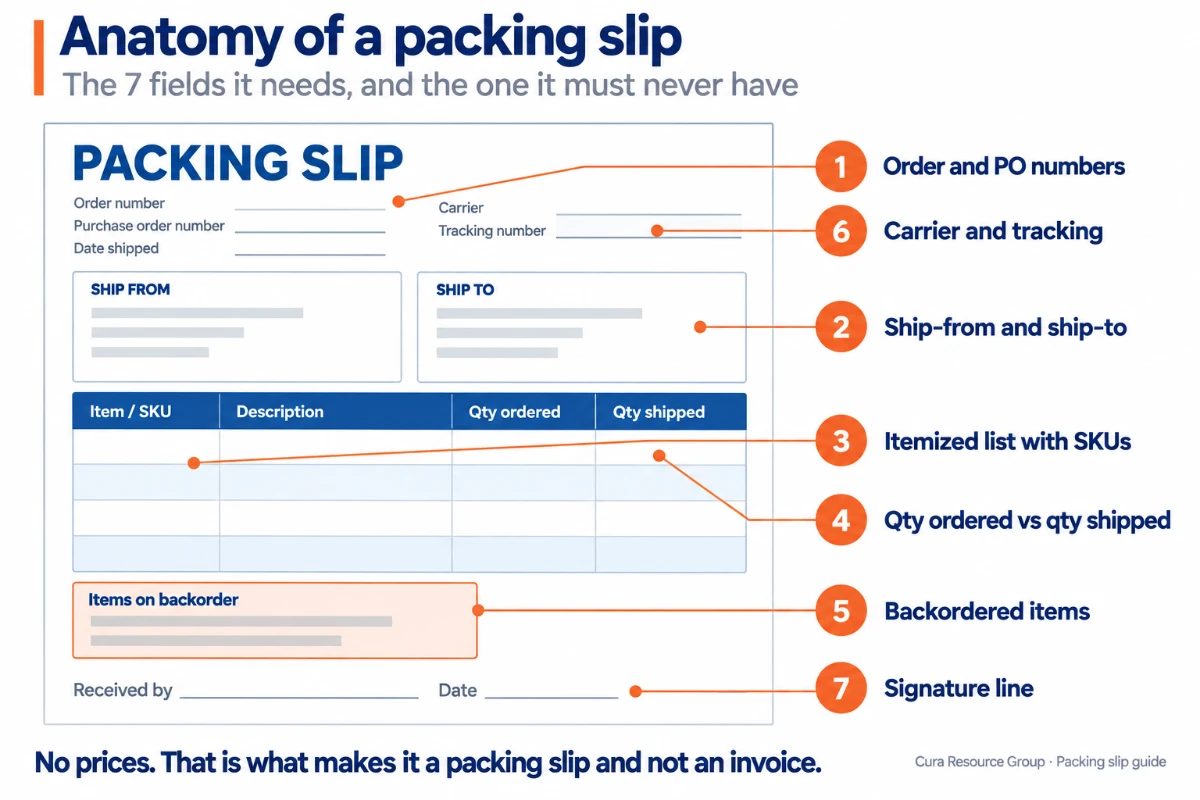
A packing slip needs 7 things. Anything beyond them is branding, and anything missing from them turns into a phone call.
- Order and purchase order numbers. The reference the buyer uses in their own system, which is how the delivery gets matched to the order.
- Ship-from and ship-to addresses. Who sent it and where it landed, including the department or store number for retail deliveries.
- An itemized list with SKUs. One line per product, with the code the receiver recognizes rather than your internal part number.
- Quantity ordered and quantity shipped. Two separate columns. One column hides short shipments.
- Backordered items. What is missing and not coming in this box, stated plainly so nobody searches for it.
- Carrier and tracking number. The thread back to the shipment if the box and the paperwork get separated.
- A signature line. Space for the receiver to sign and date, which is what makes the document evidence.
No prices appear on a packing slip. That is the line between this document and an invoice. Crossing it causes trouble when a shipment goes to a store rather than to the buyer.
Packing Slip vs Invoice vs Shipping Label vs Bill of Lading
Four documents travel with goods, and each one speaks to a different reader. The packing slip talks to the receiver and the invoice to the accounts department. The label talks to the carrier, and the bill of lading to the carrier and the law.
| Document | Who reads it | What it says | Shows prices |
|---|---|---|---|
| Packing slip | Whoever opens the box | What is inside, by item and quantity | No |
| Invoice | Accounts payable | What is owed and when | Yes |
| Shipping label | The carrier | Where the parcel goes and how it is tracked | No |
| Bill of lading | The carrier, and a court if it comes to that | The contract to carry the freight | No |
Mixing them up has a cost. A customer who finds an invoice in a gift box remembers it. A retailer who gets the wrong format where its routing guide named one charges you for the error.
Where Does the Packing Slip Go?
Inside the box for ecommerce orders, in a pouch on the outside for pallets and freight. The rule follows who needs to read it first.
A shopper opens the parcel, so the slip goes on top of the goods where it is seen before anything is unwrapped. A warehouse receiver checks a pallet before it is broken down, so the slip rides outside in a clear document pouch.
Retail deliveries specify the exact position. The routing guide names which side of the pallet the pouch sits on. Getting it wrong is a chargeback like any other compliance miss.
Are Packing Slips Required?
Not by US law for a domestic parcel. No federal rule says a box moving between two US addresses must carry a packing slip.
Three situations change that. Imports need a customs invoice, retail contracts demand slips in a set format, and freight claims are far harder to win without one.
For imports the requirement is specific. Under 19 CFR 141.86, each invoice of imported merchandise must set out a detailed description and the marks and numbers on the packages. It must also give quantities and the purchase price.
Retailers write their own rules. Their routing guides specify the document and the format, and usually an electronic equivalent. That is the X12 856 Ship Notice/Manifest, which lists the contents of a shipment before it arrives.
What a Packing Slip Does for Returns and Claims
It decides who pays when something is wrong. A signed slip showing 12 units shipped against 12 ordered puts the burden on the receiver to prove otherwise.
Returns run on the same document. A customer can circle a line and send the box back. That tells you the SKU, the quantity and the order number without a word written.
Damage claims need it too. A carrier assessing a claim wants the itemized list and the signature, and returns management gets slower without both.
Retail and 3PL Packing Slips
Retail packing slips are not yours to design. Each retailer publishes a format in its routing guide, down to the fields and the order they appear in. It also sets where the document rides on the pallet.
That is one piece of retail distribution and routing guide compliance, alongside labels, pallet patterns and delivery appointments.
If a third party packs your orders, the slip is generated by their system from your order data. Ask whether they can print your design, and whether they can print each retailer’s.
How to Create a Packing Slip
Most order systems generate one automatically, and that is the right way to do it. Shopify, WooCommerce, Amazon and every WMS produce a slip from the order record, so the document and the pick list cannot disagree.
Build it by hand only for low volume or a one-off shipment. Typing a slip for every order invites the transcription error the document exists to catch.
Whichever route you take, match the fields to the 7 above, keep prices off it, and give the receiver somewhere to sign.
Free Packing Slip Template
Two versions, both free and neither gated behind a form. Use the print version as it is, or the spreadsheet if you want to change the fields.
- Packing slip template, PDF. One page, ready to print and fill in by hand, with 12 item lines.
- Packing slip template, Excel. The same layout as a spreadsheet, so you can add your logo, rename fields or paste order data in.
Both carry all 7 fields, separate columns for quantity ordered and shipped, a backorder box and a signature line. Neither has a price column, by design.
When the Slip and the Contents Disagree
Note it on the slip before you sign, not afterwards. A signature with no exception written on it says the delivery arrived as listed, and reversing that later is an argument rather than a claim.
At the point of receipt
Count against the quantity shipped column, not the quantity ordered one. Those two differ whenever something is on backorder, and treating the order quantity as the target produces shortage claims that are not shortages.
Write the exception on the document
Record what is missing or damaged on the slip itself and on the carrier’s delivery receipt, then photograph both along with the carton and its label. A short note carries more weight than a long email sent the next day.
Raise it inside the window
Carriers and retailers both set a deadline for concealed damage and shortage claims, and the clock starts at delivery. Check the terms you are shipping under, because the window is often far shorter than people assume.
Where the goods were packed by a third party, the slip is also the record that settles who is responsible. That is one reason pick and pack operations keep a copy of every slip they produce.
Packing Slips for International Shipments
A packing slip does not clear customs. The commercial invoice does, and the slip supports it by showing what is in each carton.
The requirement is in the regulation itself. Under 19 CFR 141.86(e), each invoice must state in adequate detail what merchandise is contained in each individual package, and paragraph (a)(3) requires the marks and numbers of the packages the goods are packed in. A packing slip that already carries carton-level detail makes that straightforward.
Two practical points follow. The document must be in English, or carry an accurate English translation, under paragraph (d) of the same regulation. And the carton marks on the slip need to match the marks physically on the boxes, because that is how an officer ties the paperwork to the freight in front of them.
For multi-carton shipments, a separate packing list that breaks the shipment down box by box is worth producing even though nothing compels it. It is the fastest way to answer the only question customs is asking, which is whether what is declared is what is actually there.
Five Packing Slip Mistakes That Cause Chargebacks
Retail chargebacks for documentation are rarely exotic. The same few errors repeat.
- Printing prices on it. The moment a slip shows money it is doing an invoice’s job, and for a gift or a drop-ship order it tells the recipient what the sender paid.
- Omitting the quantity shipped column. Without it there is no way to distinguish a backorder from a shortage, and every partial shipment looks like an error.
- Using your format instead of the retailer’s. Routing guides specify the fields, the order and often the position on the pallet. Deviating is a compliance miss like any other.
- Typing it by hand. A slip keyed separately from the pick list will eventually disagree with it, and the disagreement surfaces at the receiving dock.
- Leaving it loose in the carton. On top of the goods means it is seen first. Buried under packaging, it may as well not be there.
Each one is cheap to prevent at the packing bench and expensive to argue about afterwards.
Packing Slips With Cura Resource Group
Cura Resource Group includes a packing slip or insert in every order we pack, as part of pick and pack. The document is produced from your order data, so it matches what actually went in the box.
You can supply your own design, with your logo and your wording. We can also print the format a retailer’s routing guide demands, with their purchase order and SKU layout.
If you want a returns slip or an RMA form in the box, we include that too. Get a quote with your order volume and which retailers you ship to.
Sources and Further Reading
- Legal Information Institute, 19 CFR 141.86, Contents of invoices — what an invoice for imported merchandise must contain.
- X12, 856 Ship Notice/Manifest — the electronic document retailers use alongside or instead of a paper slip.
Frequently Asked Questions
What is a packing slip?
A packing slip is an itemized list of what is inside a shipment, packed with the goods. It names each item, the SKU and the quantity shipped, and it carries no prices. The receiver uses it to check the delivery is complete before signing for it.
Is a packing slip the same as an invoice?
No. A packing slip lists what is in the box and goes to whoever opens it. An invoice lists what is owed and goes to the accounts department. The simplest test is prices: an invoice shows them, a packing slip never does.
Is a packing slip the same as a shipping label?
No. The shipping label is on the outside of the box and tells the carrier where the parcel goes and how to track it. The packing slip sits inside and tells the receiver what the parcel holds. One moves the box, the other explains it.
Does the packing slip go inside the package?
For parcels, yes, placed on top of the goods so it is seen first. For pallets and freight it rides outside in a clear document pouch, because the receiver checks the load before breaking it down. Retail routing guides often specify the exact position.
Are packing slips required by law?
Not for a domestic US parcel. Imports are different: under 19 CFR 141.86 an invoice for imported merchandise must give a detailed description, marks and numbers, quantities and the purchase price. Retail contracts also require slips, in the format their routing guide sets.
Is a packing slip a receipt?
No, because it shows no amounts paid. A receipt proves payment, while a packing slip proves contents. Sellers often include both in the same box, or send the receipt by email instead. A customer returning an item usually needs the receipt, not the slip.
What should a packing slip include?
Seven things: order and purchase order numbers, ship-from and ship-to addresses, an itemized list with SKUs, and quantity ordered against quantity shipped. Then any backordered items, the carrier and tracking details, and a signature line for the receiver. Leave prices off it entirely.
How do I make a packing slip?
Let your order system generate it, so the slip and the pick list come from the same record. For one-off shipments, use a template instead of typing one from scratch. Our free print and spreadsheet templates carry all seven fields.
What do I do if the packing slip does not match the delivery?
Note the exception on the slip and on the carrier’s delivery receipt before you sign, then photograph both with the carton. Count against the quantity shipped column rather than quantity ordered, because the two differ whenever an item is on backorder. Raise the claim inside the carrier or retailer deadline, which starts at delivery and is often shorter than people expect.
Do I need a packing slip for international shipping?
Customs clears on the commercial invoice, not the packing slip, but the slip supports it. Under 19 CFR 141.86 the invoice must state in adequate detail what is in each individual package and give the marks and numbers of those packages, and it must be in English or carry an accurate translation. A slip with carton-level detail makes that easy to satisfy.