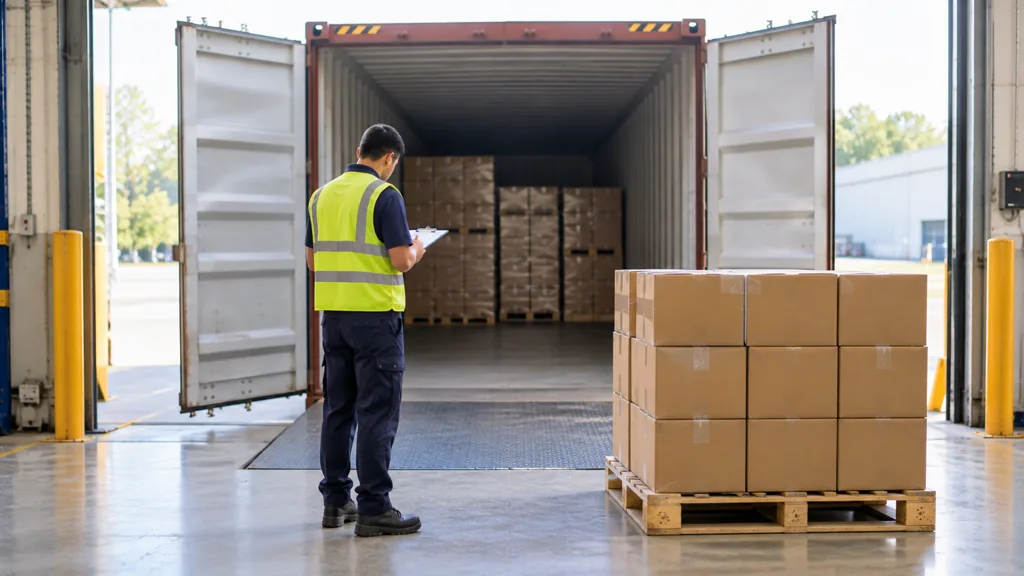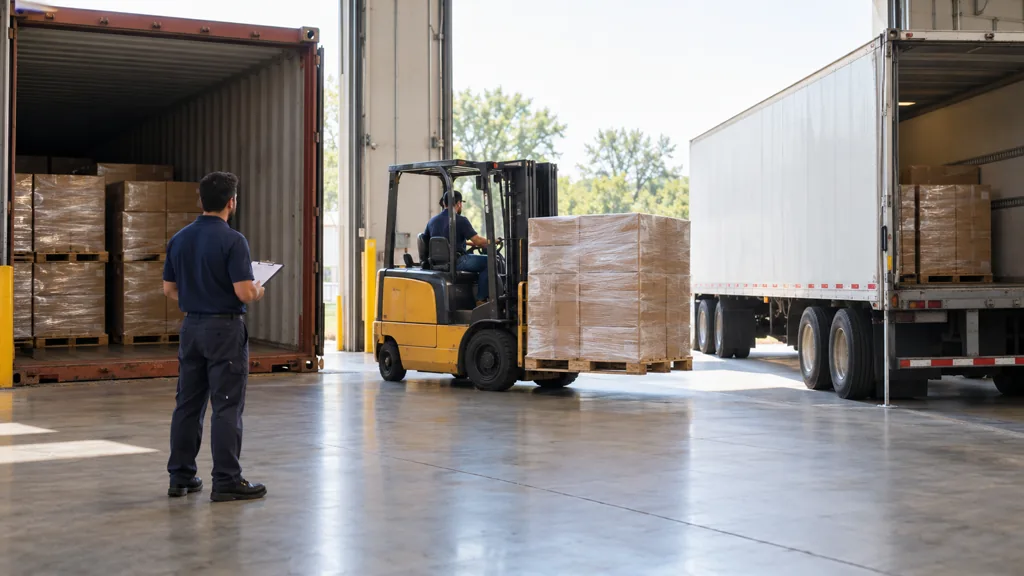
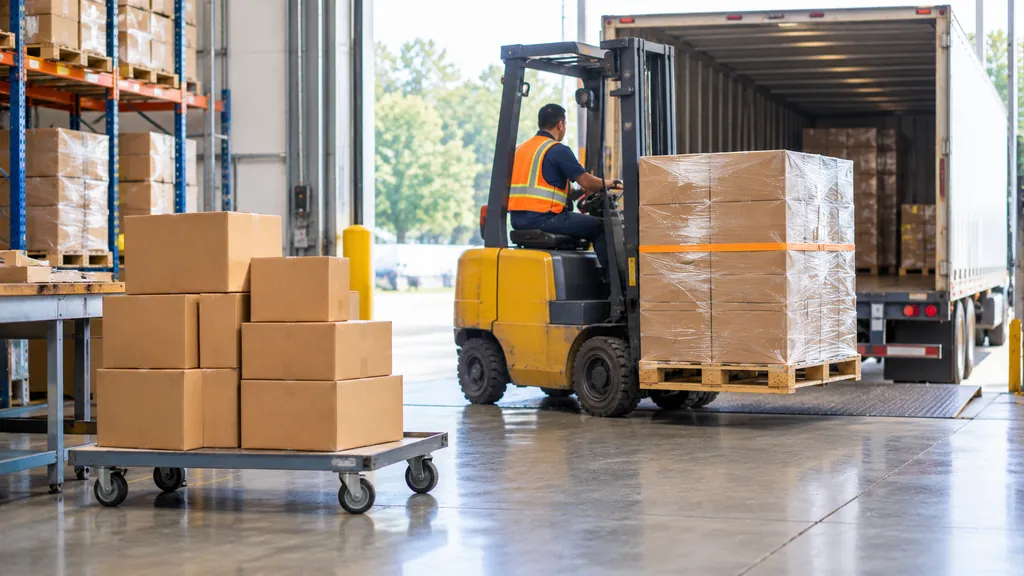

Freight vs shipping comes down to scope: shipping is the act of moving goods, and freight is the larger, commercial side of it. FedEx draws the working line by treating a shipment over 150 pounds as freight.
This guide covers what freight shipping is, when a load crosses that line and the 6 differences that follow. It also covers what carriers pay when goods are lost.
Get it right and you book the right service with the right cover. Get it wrong and you can face over-limit charges, a reclassified pallet or a claim capped well below your invoice.
Freight vs Shipping: The Short Answer
Freight is a kind of shipping, not a different thing. Merriam-Webster defines shipping as the act or business of one that ships, so the word fits a load of any size.
Freight is narrower. In any shipping vs freight comparison, it means large commercial loads, and parcel means the small packages on the other side.
So is freight the same as shipping? All freight is shipping, but not all shipping is freight.
A box of samples sent to a customer is shipping. Twelve pallets sent to a retailer are shipping and freight.
What Is Freight Shipping?
Freight shipping is the movement of large commercial loads by ship, aircraft, truck or train. The goods travel on pallets, in crates or in containers, and a motor carrier issues a receipt or bill of lading for them.
On the road, freight splits into two services. Less-than-truckload (LTL) means your pallets share a trailer with other shippers. Full truckload (FTL) means one shipper books the whole trailer.
Our shipping services cover parcel, LTL and FTL, so one provider can move both kinds of load.
Freight is also how stock reaches a warehouse, which makes it the first link in warehousing and distribution services.
The word itself has two everyday meanings. Merriam-Webster lists freight as goods to be shipped and as the compensation paid for moving them.
When Does a Shipment Become Freight?
A shipment usually becomes freight when any single package weighs more than 150 pounds. The UPS tariff effective April 17, 2026 does not accept packages over 150 pounds. It also bars packages over 108 inches long, or over 165 inches in length plus girth.
That limit works per package, not per order. Ten 40-pound cartons total 400 pounds and can still move as ten parcels. UPS also sells a multi-package service for shipments over 150 pounds.
Weight is not the only test. Old Dominion Freight Line says LTL freight must be packaged for movement by forklift. It gives a typical LTL range of 150 to 15,000 pounds.
Three questions settle most loads:
- Does any package exceed the carrier’s limits? If so, it cannot move as a parcel.
- Is it on a pallet or in a crate? If so, plan for it as freight.
- Does it need a forklift to unload? If so, plan the receiving end before you book.
What Changes When a Shipment Becomes Freight?
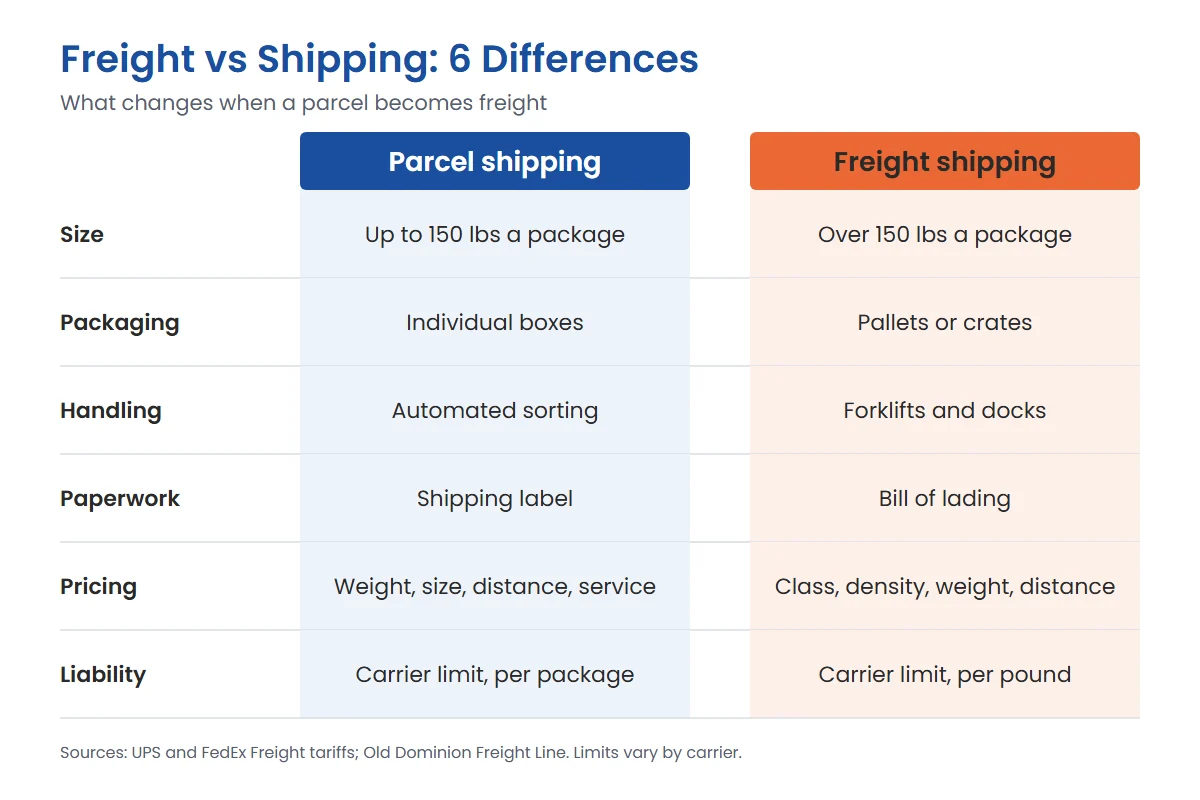
Six things change when a shipment becomes freight: size, packaging, handling, paperwork, pricing and liability.
| Difference | Parcel shipping | Freight shipping |
|---|---|---|
| Size | Up to 150 pounds a package | Over 150 pounds; LTL typically runs to 15,000 pounds |
| Packaging | Individual boxes, no pallets | Pallets or crates, packed for a forklift |
| Handling | Highly automated sorting | Forklifts and hub-and-spoke sorting |
| Paperwork | Shipping label | Bill of lading |
| Pricing | Weight, dimensions, distance and service level | Freight class, weight, dimensions, density, distance and extra services |
| Liability | UPS: $100 a package unless you declare more | FedEx Freight: up to $25 a pound on new goods |
The size, packaging, handling and pricing rows come from Old Dominion’s comparison of parcel, LTL and truckload.
How Is Freight Priced?
Freight is priced on class, weight, dimensions, density, distance and extra services. Parcel is priced on weight, dimensions, distance and service level, so class and density are the two new ideas.
The National Motor Freight Traffic Association (NMFTA) gives each commodity a freight class from 50 to 500. It bases the class on density, handling, stowability and liability. Denser freight that is easier to move gets a lower class and a lower cost.
Density is weight relative to space, measured in pounds per cubic foot. It matters more than it did. NMFTA says it moved a large share of the classification to density-based classes in 2025.
The rules are still moving, so check the current class before you book. NMFTA’s public docket files show how often classes change, and its 2026 calendar ends with a mixed-shipment rule proposed for January 23, 2027.
Small measurements can change the bill. NMFTA’s own example puts a pallet at 15.0 pounds per cubic foot in Class 70, and the same pallet at 14.9 in Class 85.
Extra services add to the total. These are called accessorials, and Old Dominion’s examples are liftgate delivery, delivery appointment changes and inside delivery.
What Is Your Shipment Covered For?
Freight carriers start from liability for actual loss under federal law, then their terms can cap what you recover. Check the limit before the goods move, because it can sit well below your invoice.
What Does Federal Law Say About Carrier Liability?
Federal law makes motor carriers and freight forwarders liable for actual loss or injury to the goods. 49 U.S.C. 14706 also requires them to issue a receipt or bill of lading, and failing to issue one does not remove their liability.
The same section lets a carrier limit that liability to a value set by written declaration or agreement, if the value is reasonable. Goods in a water carrier’s custody follow its bill of lading and water transport law instead.
Contracts can change the default too. 49 U.S.C. 14101 lets a shipper and carrier expressly waive these rights in writing, so read any contract before relying on the rule.
What Limits Do Carriers Set?
Carrier liability limits vary widely, from $100 a package to $25 a pound in these three tariffs:
- UPS parcel. The UPS tariff limits liability to $100 per domestic package unless you declare a higher value and pay the charge.
- FedEx Freight. The 100-Y rules tariff effective January 5, 2026 caps new goods at invoice cost, up to $25 a pound per package or $100,000 per incident. Used goods stop at 50 cents a pound or $10,000.
- Estes. The Estes EXLA 105 tariff effective January 2, 2026 caps liability at $5 a pound per package or $50,000 per shipment.
Take 100 pounds of new goods in one package, invoiced at $10,000. With no extra coverage, those caps work out at $100, $2,500 and $500. NMFC released values can set a lower figure still.
How Do You Raise a Carrier’s Limit?
You raise a carrier’s limit by declaring a higher value or buying excess coverage before the goods move. UPS sets that value in the shipping system, and FedEx Freight notes excess coverage on the original bill of lading.
FedEx Freight caps new goods at $50 a pound per package with excess coverage, and $100,000 per incident. At UPS, declared value is not insurance, and the tariff tells shippers who want cargo insurance to buy it from a third party.
How Long Do You Have to File a Claim?
For freight carriers covered by 49 U.S.C. 14706, you have at least 9 months to file a claim and 2 years to sue. Those carriers cannot set shorter periods. The 2 years run from written notice that the carrier has disallowed part of the claim.
Carrier deadlines can add steps. The UPS tariff requires notice within 60 days of delivery on domestic shipments, then a filed claim within 9 months. International UPS claims must be filed within 60 days.
Once a claim is in, federal rules set the pace. 49 CFR 370.5 gives the carrier 30 days to acknowledge a written claim. 49 CFR 370.9 gives it 120 days to pay, decline or make a firm offer, or it must report status in writing.
Record damage at the door. FedEx Freight’s claims guide says “subject to inspection” alone is not a valid notation, so write down exactly what is damaged on the delivery receipt.
Is Freight Cheaper or Slower Than Parcel?
Freight is cheaper per unit and slower than ground parcel, according to Old Dominion’s comparison. Its guide gives 1 to 5 days for ground parcel and 1 to 7 days for LTL. It also says parcel has the highest cost per unit.
Those are one LTL carrier’s ranges, not a quote. Parcel costs can also climb on big boxes. The UPS tariff adds a Large Package Surcharge to a domestic package over 110 pounds or longer than 96 inches. The same surcharge applies above 130 inches in length plus girth or 17,280 cubic inches.
No single weight decides freight vs parcel. Price the same load both ways, with every extra service included, before you choose.
How Warehousing Connects Freight and Shipping
Warehousing connects freight and shipping by turning bulk loads into customer orders. Stock arrives through inbound logistics from your suppliers, then orders leave by parcel, LTL or truckload through outbound logistics to your customers.
Cura Resource Group handles parcel, LTL and FTL shipments, domestic and international, with warehouses in Memphis, Riverside and Carolina, Puerto Rico. Supplier shipments that need combining can run through freight consolidation at our Carolina warehouse.
We can also work out freight class on LTL shipments, arrange cargo insurance or excess carrier coverage, and file or manage loss and damage claims. To find out how your load should move, request a shipping quote from our team.
Sources and Further Reading
- FedEx, Freight Shipping Services — the 150-pound line between parcel and freight.
- UPS, Tariff/Terms and Conditions of Service, United States — package limits, the $100 liability limit, claim deadlines and the Large Package Surcharge, effective April 17, 2026.
- UPS, Ground with Freight Pricing — the multi-package service for shipments over 150 pounds.
- FedEx Freight, 100-Y Rules Tariff — Item 420, carrier liability, effective January 5, 2026.
- FedEx Freight, Guide to Loss and Damage Claims — how to note damage on a delivery receipt.
- Estes, EXLA 105 Rules and Regulations — maximum cargo liability, effective January 2, 2026.
- Old Dominion Freight Line, Less-Than-Truckload Shipping: When to Use It — size, packaging, pricing and transit comparison.
- NMFTA, Classification — freight class 50 to 500 and its four characteristics.
- NMFTA, Public Docket Files — the record of classification changes.
- NMFTA, Docket 2026-3 To Be Released November 6 — the density shift and the proposed mixed-shipment rule.
- NMFTA, How Much Density Margin Does Your Packaging Need? — the Class 70 and Class 85 example.
- Legal Information Institute, 49 U.S.C. 14706 — carrier liability, limits and minimum claim periods.
- Legal Information Institute, 49 U.S.C. 14101 — written waivers in shipper contracts.
- Legal Information Institute, 49 CFR 370.5 and 49 CFR 370.9 — claim acknowledgment and disposition times.
- Merriam-Webster, freight and shipping — dictionary definitions.
Frequently Asked Questions
What is the difference between freight and shipping?
Shipping is any movement of goods, while freight is the larger commercial side of it. There are 6 main differences: (1) size, (2) packaging, (3) handling, (4) paperwork, (5) pricing and (6) liability. Freight usually means packages over 150 pounds, moved on pallets under a bill of lading.
Is freight the same as shipping?
No. All freight is shipping, but not all shipping is freight. Shipping covers a load of any size, including a single parcel. Freight refers to large commercial loads, which carriers such as FedEx separate from parcel shipping once a shipment passes 150 pounds.
What does freight mean?
Freight means goods being transported, usually in large commercial loads. Merriam-Webster also lists a second meaning, the compensation paid for moving goods. That is why the word can describe cargo on a dock or a charge on an invoice. In logistics it also names the service that moves those loads.
What is the difference between freight and a shipment?
A shipment is one consignment of goods moving from a shipper to a receiver, whatever its size. Freight describes the type of goods or service. A single carton is a shipment but not freight, while twelve pallets moving together are one shipment of freight.
What is considered freight shipping?
Freight shipping generally means a load with a package over 150 pounds, or goods on pallets, in crates or in containers. UPS does not accept packages above that weight, and FedEx says they need to ship as freight. Oversized items can also fall outside parcel limits at a lighter weight.
How fast is freight shipping?
Freight speed depends on the mode and service level. Old Dominion Freight Line gives a typical range of 1 to 7 days for LTL, against 1 to 5 days for ground parcel. It also describes full truckload as the fastest point-to-point option for large volumes.
What is freight class?
Freight class is a rating from 50 to 500 that the National Motor Freight Traffic Association gives each commodity. It rests on density, handling, stowability and liability. Denser freight that is easier to move gets a lower class and a lower cost, and the rules change through regular dockets.
Does a carrier pay the full value of lost freight?
Not always. For freight carriers, federal law starts from actual loss under 49 U.S.C. 14706, but they can limit liability by written declaration or agreement. FedEx Freight caps new goods at $25 a pound per package. UPS parcel terms set $100 a package unless a higher value is declared.
How long do you have to file a freight claim?
Under 49 U.S.C. 14706, a carrier cannot allow less than 9 months to file a claim or less than 2 years to sue. The 2 years run from written notice that part of the claim is disallowed. Check the carrier terms too, because some add earlier notice steps.