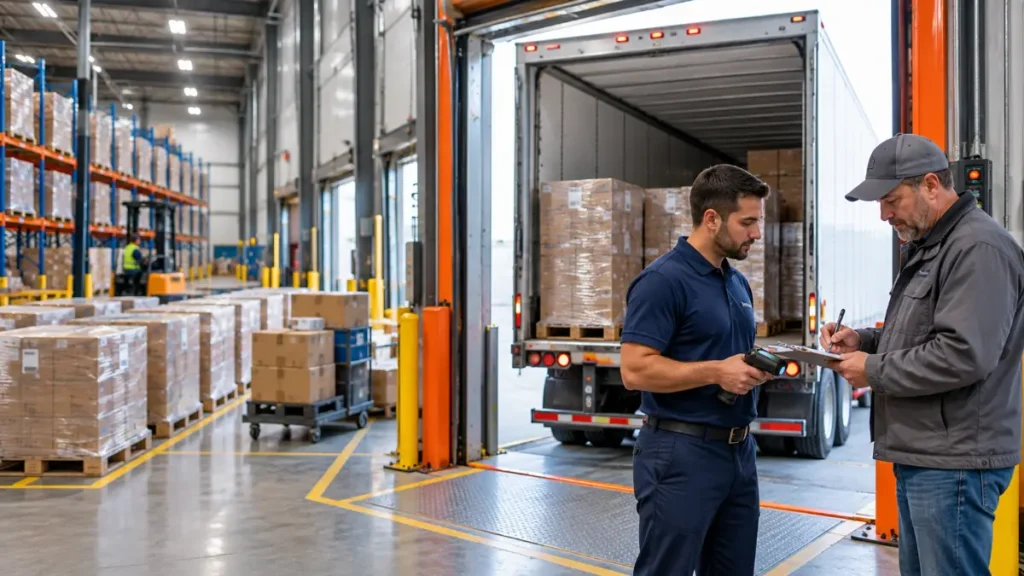

Outbound logistics is the work of storing finished goods and moving them out to the customers who ordered them. The Association for Supply Chain Management (ASCM) includes order fulfillment, packing, shipping, delivery and returns handling in its definition of outbound logistics.
This guide covers the 5 stages of an outbound shipment, its paperwork, KPIs, common problems and cost cuts. Get outbound right and orders arrive complete and on time; get it wrong and a customer remembers the late box.
U.S. Census Bureau figures show $340.2 billion in US online sales for the second quarter of 2026, up 12.2% in a year. That is 17.1% of US retail, and every order that ships still has to be picked, packed and handed to a carrier.
What Is Outbound Logistics?
Outbound logistics is everything that happens to a finished product between the customer’s order and its arrival. It starts at the warehouse shelf and ends at a front door, a store or another company’s receiving dock.
Inbound logistics runs the other way, bringing stock in from suppliers. The two meet inside the warehouse, so outbound work is one half of the wider warehousing and distribution process.
Our supply chain guide sets out how inbound and outbound logistics compare on freight type, cost drivers and common failures.
Why Outbound Logistics Matters
Outbound logistics matters because it is the part of the supply chain your customer actually sees. A buyer never watches your receiving dock, but they do open the box, count the cartons and notice when the truck shows up.
Outbound is also where cost grows with volume. Freight, packaging and the labor to pick and load are paid per order or per shipment, so every extra order adds to all three.
B2B and retail shipments can carry a second bill. Retailers issue chargebacks, which are penalties deducted from your invoice, when a shipment breaks their routing guide or labeling rules.
The 5 Stages of Outbound Logistics
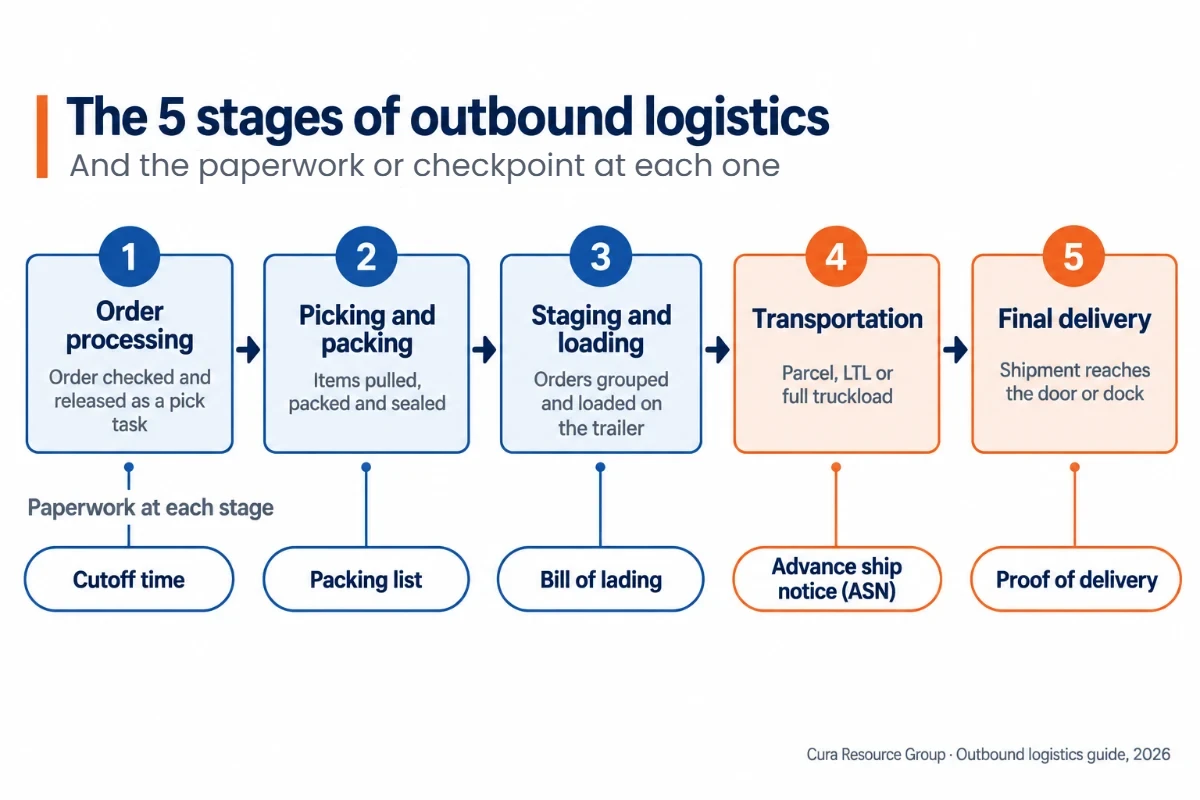
The 5 stages of outbound logistics are order processing, picking and packing, staging and loading, transportation, and final delivery. Lists vary by source, and some, including ASCM’s, also count returns handling as part of outbound.
Stage 1: Order Processing
Order processing turns a customer order into a warehouse task. The order is checked for stock and a valid address, then released to the floor as a pick instruction.
Timing at this stage sets every later one. A cutoff time is the latest an order can be released and still make that day’s carrier pickup. Orders released after it wait for the next truck, however fast the floor moves.
Stage 2: Picking and Packing
Picking and packing pull the ordered items from their shelf locations and prepare them for the trip. Pickers work from a list or scanner, and packers choose the carton, add dunnage (the filler that stops goods shifting) and seal it.
For online orders, picking and packing sit inside the seven steps of ecommerce order fulfillment, handled one parcel at a time. Orders for a store or distribution center are built onto pallets and shrink-wrapped instead.
Stage 3: Staging and Loading
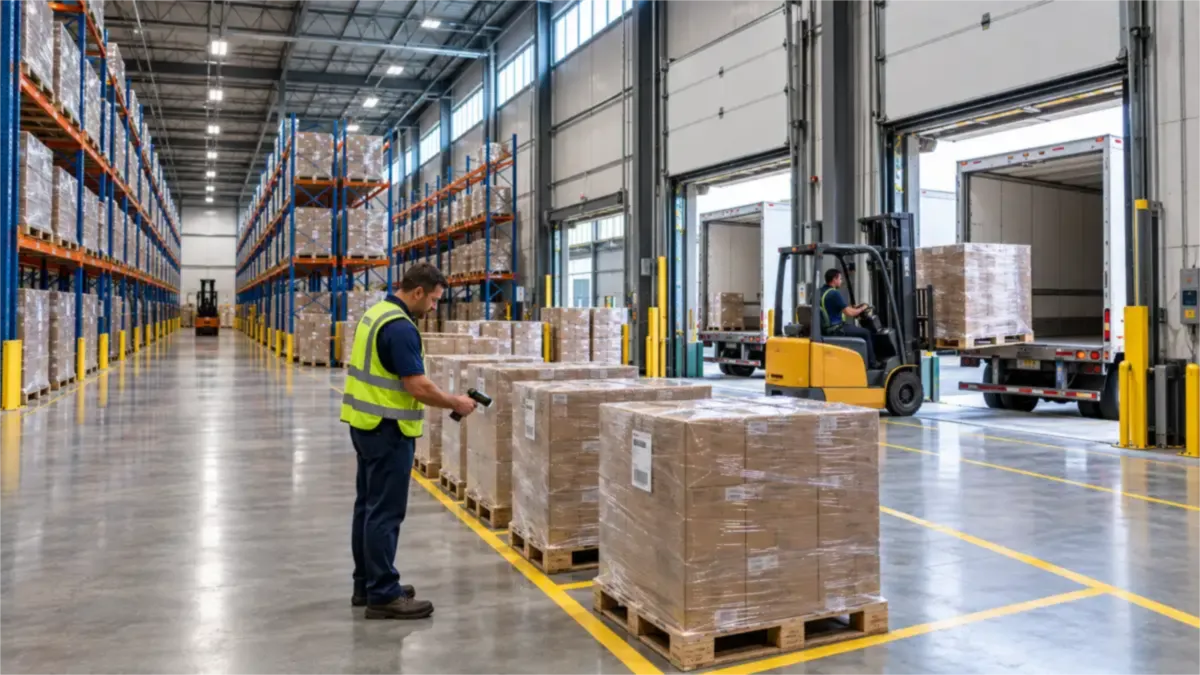
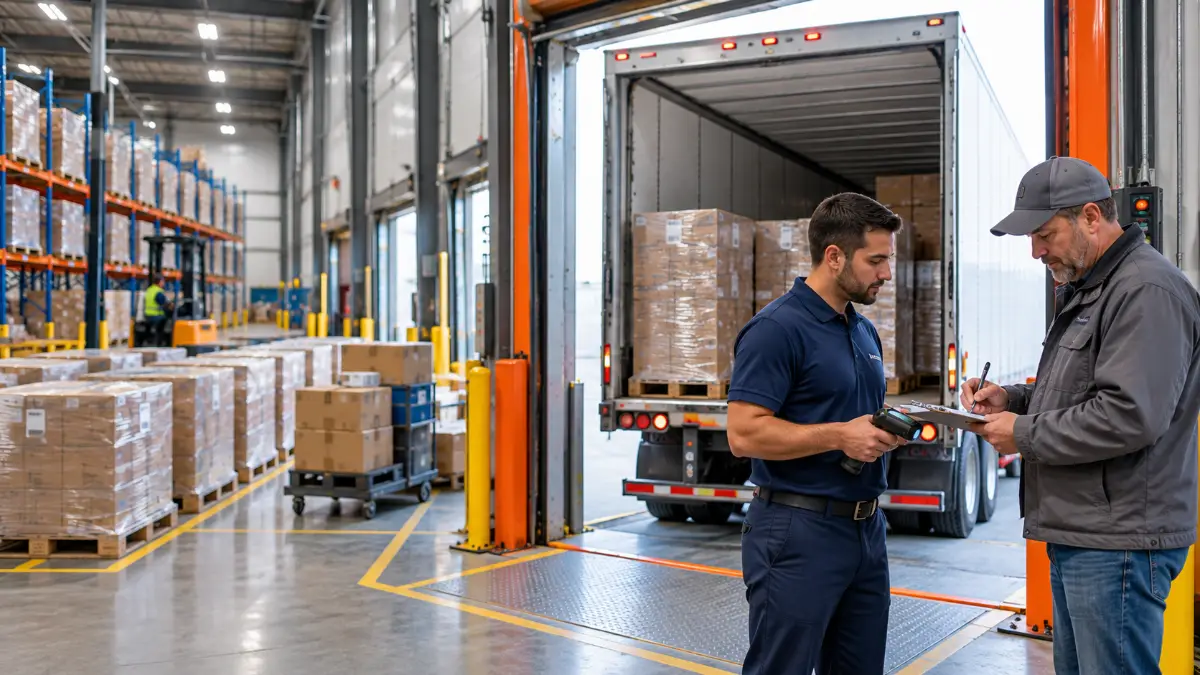
Staging and loading group packed orders by carrier or destination, then put them on the right trailer. Staging lanes near the dock hold each load until its truck arrives.
Loading order matters on multi-stop trucks. The last delivery goes on first, so the driver does not unload half the trailer to reach one pallet.
Freight that arrives already sorted by destination can skip storage in a cross-docking operation, moving from an inbound trailer straight to an outbound one.
Stage 4: Transportation
Transportation moves the shipment from your dock toward its destination by parcel, less-than-truckload (LTL) or full truckload (FTL). Parcel carriers handle individual boxes, LTL combines pallets from several shippers, and FTL reserves an entire trailer for one shipper.
Mode choice depends on weight, speed and how many stops the freight needs. Our parcel, LTL and FTL shipping services page sets out how each mode is booked and tracked.
Stage 5: Final Delivery
Final delivery is the last leg, from a carrier terminal or local hub to the customer’s door or dock. It ends with proof of delivery, a signature, photo or scan confirming who received the shipment and when.
Retail deliveries add appointments, because big-box retailers set receiving windows through their routing guides. Same-day orders are the exception to this sequence, since same-day delivery from local inventory squeezes all 5 stages into a single day.
What Documents Does an Outbound Shipment Need?
An outbound shipment needs three core documents: a bill of lading, a packing list and, for retailers that require one, an advance ship notice (ASN). Each one answers a different question for a different reader.
Bill of Lading
A bill of lading (BOL) is the receipt and contract of carriage between a shipper and a carrier. Under federal rule 49 CFR 373.101, a motor carrier must issue a receipt or bill of lading for property it moves in interstate commerce.
That document must show the shipper and receiver, origin and destination, package count, a freight description and, where it affects the rate, the weight.
For LTL freight, the BOL also carries a freight class. The National Motor Freight Traffic Association’s changes to the National Motor Freight Classification took effect on July 19, 2025. They updated density-based class assignments and packaging requirements.
Packing List
A packing list itemizes what is inside each carton or pallet, by SKU and quantity. It travels with the goods so the receiver can check the contents against the order before signing.
A packing list is not the same as a BOL. The BOL describes the freight for the carrier, while the packing list describes the contents for the customer.
Advance Ship Notice (ASN)
An advance ship notice (ASN) is an electronic message that tells the customer what is on its way before the truck arrives. It is sent by electronic data interchange (EDI), the standard format companies use to swap business documents system to system.
The EDI transaction used for ASNs is the X12 856 Ship Notice/Manifest. It can list order details, product descriptions, packaging, carrier information and how goods are loaded in the trailer.
Which Outbound Logistics KPIs Should You Track?
The outbound logistics KPIs worth tracking are order cycle time, on-time shipping rate, on-time in full (OTIF), freight cost per order and damage rate. Together they show whether orders leave fast, arrive complete and cost what you planned.
- Order cycle time. The time from receiving an order to shipping it.
- On-time shipping rate. The share of orders that leave the dock by their promised ship date.
- On-time in full (OTIF). The share of orders delivered on time with every line and unit complete.
- Freight cost per order. Total outbound freight spend divided by orders shipped, tracked separately for each mode.
- Damage rate. The share of shipments that end in a damage claim or a refused delivery.
Outbound numbers only mean something next to the rest of the operation. Picking accuracy upstream drives OTIF downstream, so the full set of warehouse KPIs, from receiving to returns belongs on the same dashboard.
Common Outbound Logistics Problems
Outbound logistics problems fall into five groups: missed cutoffs, picking errors, wrong freight class or weight, retail compliance errors and damage in transit. Each one costs money twice, once to fix and again in the customer’s trust.
- Missed cutoffs. Orders released late sit on the dock overnight. The fix is timing order release to carrier pickups, not rushing the floor at the end of the day.
- Picking errors. A wrong or missing item means a second shipment and a return to process. Scanning each item at pick and pack catches the error before the carton is sealed.
- Wrong freight class or weight. LTL carriers can inspect freight and rebill the shipment when it does not match the BOL. Measuring and weighing every pallet before pickup prevents the surprise invoice.
- Retail compliance errors. A wrong label, a late ASN or a missed delivery appointment can each bring a chargeback.
- Damage in transit. Weak cartons, poor pallet builds and loose loads break goods on the road. You then pay for the replacement and ship it again.
How to Lower Outbound Costs
You lower outbound costs by shipping fuller loads, right-sizing packages, classing freight correctly, placing stock near customers and cutting compliance chargebacks. None of these requires a cheaper carrier.
Ship Fewer, Fuller Loads
Consolidating shipments cuts cost because a fuller trailer spreads the same trip across more units. Several LTL orders bound for one region can move as a single load to a regional hub, where local carriers finish the delivery.
Size Packaging to the Product
Right-sized packaging lowers parcel costs because parcel rates depend on dimensional weight, a billable weight worked out from a box’s length, width and height. An oversized carton full of void fill pays to ship air.
Class and Weigh LTL Freight Correctly
Correct freight class and weight on the BOL stop rebilled freight charges before they start. Measure and weigh each pallet, and recheck your product classes against the NMFC changes that took effect in July 2025.
Place Inventory Closer to Customers
Placing inventory closer to customers shortens the distance every order travels, which cuts ground transit time and freight cost per order. The trade-off is more stock to manage, because each extra location needs its own safety stock.
Cut Compliance Chargebacks
Cutting chargebacks saves money that never shows up on a freight bill. Build each retailer’s routing guide, label format and ASN timing into picking and packing, so a shipment cannot leave the dock until it matches.
When Should You Outsource Outbound Logistics?
Outsource outbound logistics when shipping, carrier management or retail compliance takes more of your team’s time than selling does. A third-party logistics provider (3PL) runs the warehouse, carrier bookings and paperwork from its own sites.
Three signals point that way:
- Peaks you cannot staff. Hiring for a short busy season means training people you let go weeks later.
- Retail accounts with strict rules. A new big-box customer brings a routing guide, label specs and chargebacks from the first order.
- Customers far from your warehouse. One site cannot reach both coasts quickly by ground.
Warehouse labor is also producing less per hour than it did in 2020. U.S. Bureau of Labor Statistics data show productivity in the sector dropped 11.5%, 11.0% and 4.4% from 2021 to 2023. The 2024 recovery was just 0.1%.
Brands selling into stores need a partner that handles retail distribution and routing guide compliance, not just parcels.
Outbound Shipping With Cura Resource Group
Cura Resource Group ships outbound freight and parcels from three warehouses: Memphis, Tennessee; Riverside, California; and Carolina, Puerto Rico. We move parcel, LTL and full truckload freight, domestic and international, and handle routing guides, retail labeling and chargebacks.
Every client can check inventory levels in real time as orders ship. Send us your order profile and get a quote for your outbound volume.
Sources and Further Reading
- Association for Supply Chain Management, What Is Outbound Logistics? — definition and scope.
- U.S. Census Bureau, Quarterly Retail E-Commerce Sales, 2nd Quarter 2026 — release CB26-133, August 18, 2026.
- Legal Information Institute, 49 CFR 373.101, Motor carrier bills of lading — required BOL contents.
- National Motor Freight Traffic Association, NMFC changes and ClassIT launch — posted July 21, 2025; changes effective July 19, 2025.
- X12, 856 Ship Notice/Manifest — transaction set scope.
- U.S. Bureau of Labor Statistics, Warehousing and Storage: NAICS 493 — sector labor productivity.
Frequently Asked Questions
What is outbound logistics?
Outbound logistics is the process of storing finished goods and moving them to customers. It covers order processing, picking and packing, staging and loading, transportation and final delivery. Some definitions, including the one from ASCM, also count returns handling. The process ends when the shipment reaches the customer and delivery is confirmed.
What are the 5 stages of outbound logistics?
There are five stages: (1) order processing, (2) picking and packing, (3) staging and loading, (4) transportation by parcel, LTL or full truckload, and (5) final delivery with proof of delivery. Lists vary by source, so some guides split or merge these steps, and some add returns as a sixth.
What is the difference between inbound and outbound logistics?
Inbound logistics covers everything arriving from suppliers, such as raw materials, components and resale stock. Outbound logistics covers finished goods leaving for customers. Both run through the warehouse, but inbound centers on receiving and storing, while outbound centers on picking, packing, shipping and delivery. Inbound failures show up as stockouts, and outbound failures show up as late or wrong orders.
What are the three types of logistics?
Lists vary by source, but the three most commonly named are inbound, outbound and reverse logistics. Inbound brings goods in from suppliers, outbound ships finished goods to customers, and reverse handles returns and goods coming back. Some lists add a fourth type, such as third-party logistics, depending on the author.
What documents are needed to ship freight?
A freight shipment needs a bill of lading, the receipt and contract with the carrier. It also needs a packing list showing what is in each carton or pallet. Retail customers may require an advance ship notice, sent electronically before the truck arrives. International shipments add customs documents on top.
Is outbound logistics the same as distribution?
Not quite. Distribution is the movement of goods from a warehouse or distribution center to stores, businesses or consumers. Outbound logistics is broader, starting when an order is processed and including picking, packing, loading and final delivery. In everyday use the two overlap, so the terms are sometimes used interchangeably.
When should a business outsource outbound logistics?
Outsource when seasonal peaks outgrow your staff, when retail customers bring routing guides and chargebacks, or when one warehouse sits too far from your buyers. A 3PL provides the space, labor, carrier bookings and paperwork, so your team can focus on selling rather than booking trucks and fixing labels.
Who issues the bill of lading?
Under federal rule 49 CFR 373.101, the motor carrier must issue a receipt or bill of lading for interstate freight. The shipper can fill in the details, such as package count, description and weight, and the carrier signs the form at pickup. Errors in those details can lead to rebilled freight charges.