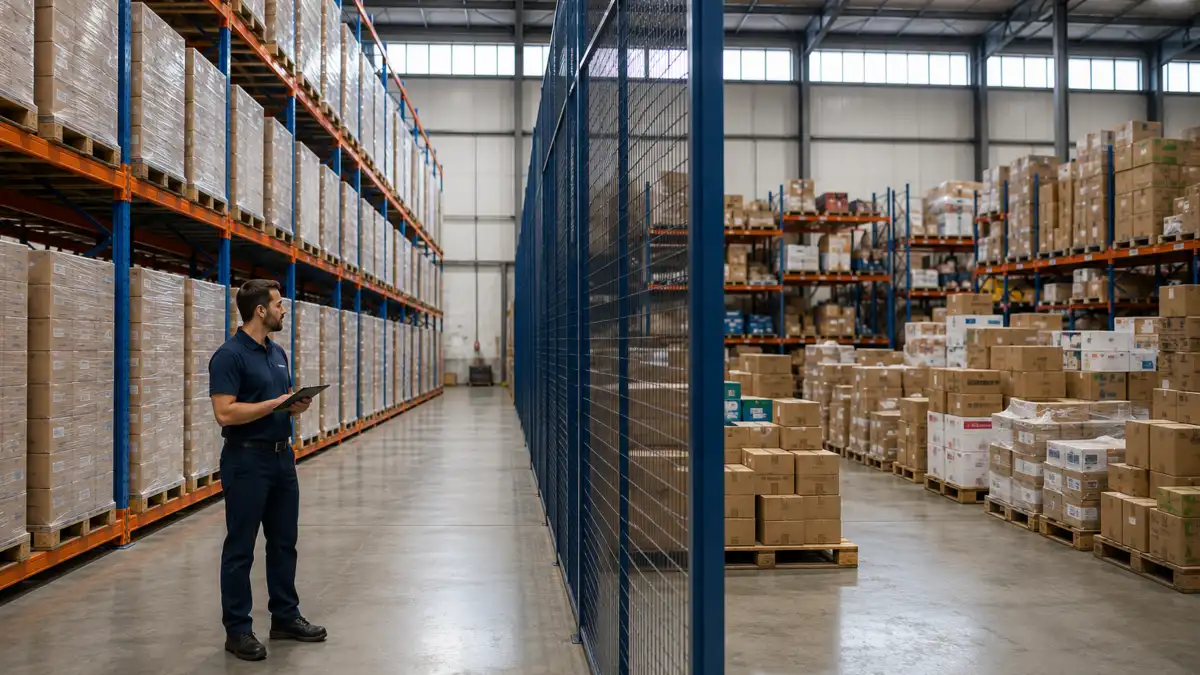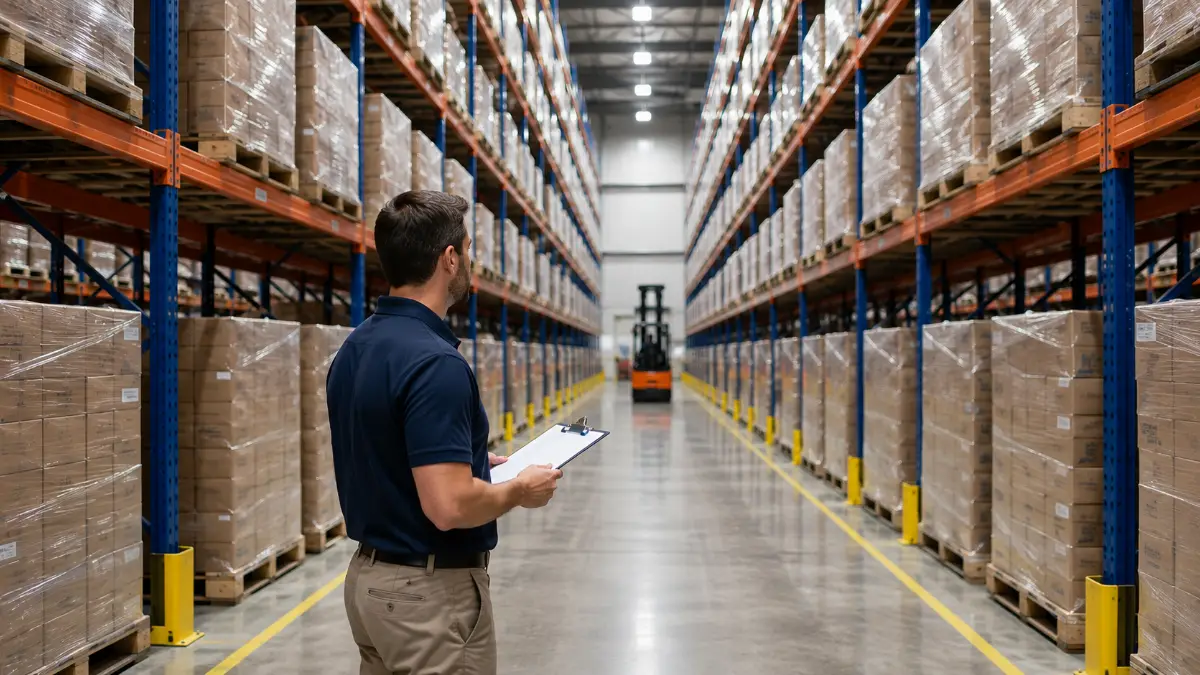
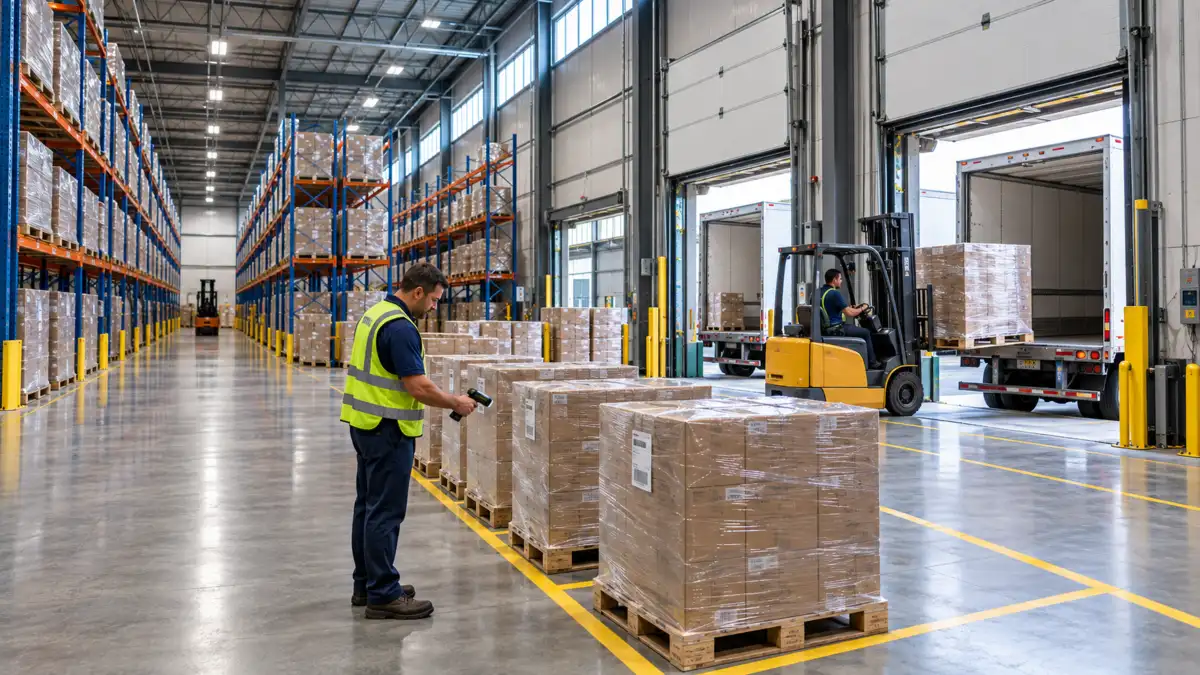

Warehousing and distribution is the work of storing goods and then moving them to the stores, businesses or homes that ordered them. Warehousing keeps inventory safe and counted until it is needed. Distribution turns that inventory into shipments that arrive complete and on time.
Both halves run on labor, and an hour of warehouse labor now produces less than it did in 2020. The U.S. Bureau of Labor Statistics reports that warehousing output per hour fell 11.5% in 2021, 11.0% in 2022 and 4.4% in 2023. BLS data show a 0.1% rise in 2024.
This guide explains how a warehouse differs from a distribution center and the five stages goods pass through. It also covers the services involved, what drives cost and how to choose a partner.
What Is Warehousing and Distribution?
Warehousing and distribution is one connected job: hold inventory, then deliver it where demand is. A warehouse receives goods, stores them and keeps an accurate count. Distribution picks those goods, loads them and gets them to the next stop.
The next stop depends on who you sell to. A wholesaler ships pallets to retail stores, while an ecommerce brand ships single parcels to homes. A brand that sells both ways needs one pool of inventory that can serve each.
Providers sell this as warehousing and distribution services, or as warehousing and distribution solutions when transport and systems are bundled in.
Online orders keep adding pressure on the parcel side. Online buying reached 17.1% of US retail sales between April and June 2026, according to U.S. Census Bureau estimates. Those online sales came to $340.2 billion, up 12.2% from a year earlier, the bureau said.
What Is the Difference Between a Warehouse and a Distribution Center?
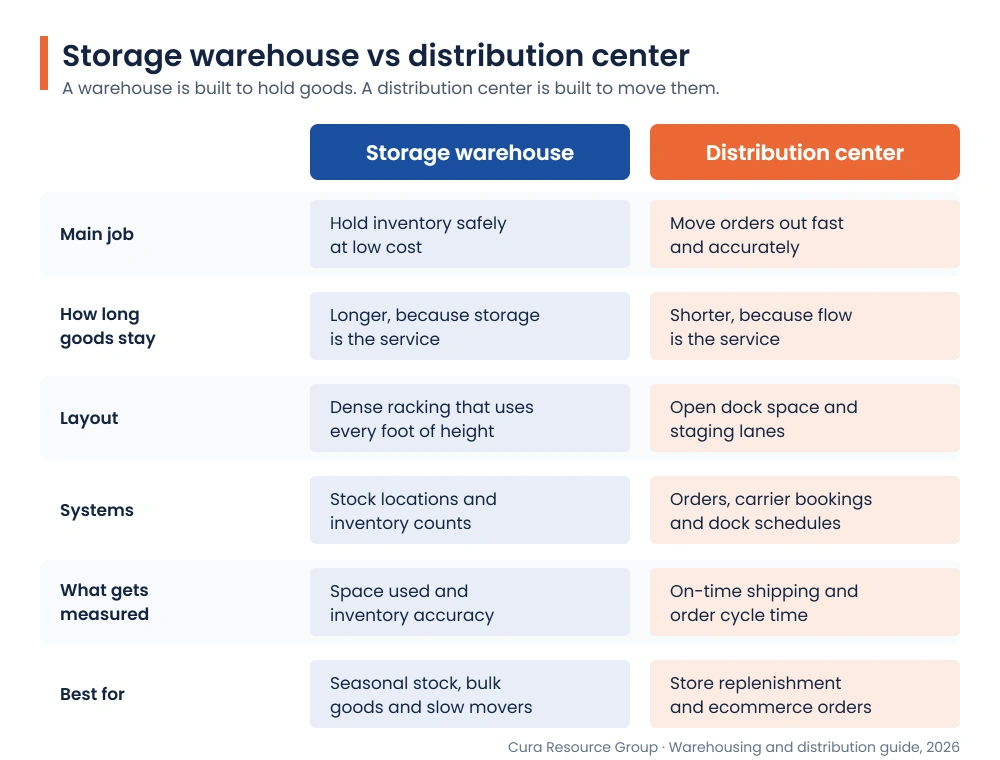
A warehouse is built to hold goods, while a distribution center is built to move them. In a storage warehouse, inventory can sit for long periods. In a distribution center, goods arrive, get sorted and leave again quickly.
The difference shows up in the building, the systems and what the team is measured on.
| Storage warehouse | Distribution center | |
|---|---|---|
| Main job | Hold inventory safely at low cost | Move orders out fast and accurately |
| How long goods stay | Longer, because storage is the service | Shorter, because flow is the service |
| Layout | Dense racking that uses every foot of height | Open dock space and staging lanes |
| Systems | Stock locations and inventory counts | Orders, carrier bookings and dock schedules |
| What gets measured | Space used and inventory accuracy | On-time shipping and order cycle time |
| Best for | Seasonal stock, bulk goods and slow movers | Store replenishment and ecommerce orders |
A third type, the fulfillment center, is a distribution center set up for single-unit ecommerce orders. The gap between a warehouse and a fulfillment center, across eight differences, matters most if you ship parcels to consumers.
What Are the 5 Stages of Warehousing and Distribution?
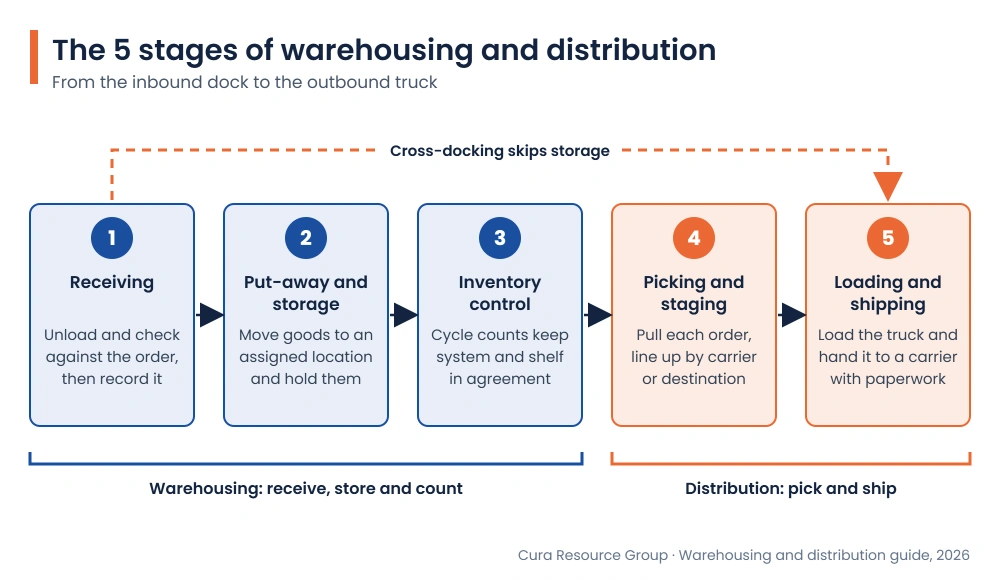
Goods pass through five stages: receiving, put-away and storage, inventory control, picking and staging, and loading and shipping. In warehousing and distribution logistics, each stage hands work to the next, so an early mistake grows more expensive the further it travels.
Stage 1: Receiving
Receiving is where inbound goods are unloaded, checked against the purchase order and entered into the system. An advance ship notice, or ASN, is the supplier’s electronic list of what is on the truck. Checking deliveries against it catches short or damaged loads at the dock.
Problems found at the dock can still be charged back to the supplier. Problems found weeks later are much harder to recover.
Stage 2: Put-Away and Storage
Put-away moves received goods to an assigned location, and storage keeps them there safely until an order needs them. Where each item goes matters. Fast-moving products belong near the shipping docks, while slow movers can sit higher or farther back.
Storage can mean pallet racking, shelving for small parts or floor space for bulk goods. The storage type should match how your products are packed and how fast they sell.
Stage 3: Inventory Control
Inventory control keeps the count in the system matched to the count on the shelf. Cycle counting checks a few locations every day instead of stopping work for one big annual count.
Those counts stay reliable when a warehouse management system directs and records every move. The system tells staff where to put each item and where to find it again.
Stage 4: Picking and Staging
Picking pulls the right items for each order, and staging lines them up by carrier or destination before loading. A retail order can be picked as full cases or pallets. An ecommerce order is picked as single units and packed into a parcel.
Parcel orders then move through each step an online order takes from checkout to the customer’s door.
Stage 5: Loading and Shipping
Loading puts staged orders onto the right truck, and shipping hands them to a carrier with the paperwork attached. Pallet freight moves as less-than-truckload (LTL), which shares a trailer, or full truckload (FTL), which books the whole trailer.
Some goods skip storage altogether. Cross-docking moves freight from the inbound truck to an outbound one without putting it away, which suits loads already sorted by destination.
Transport choice is one part of supply chain logistics, from transport modes to inbound and outbound flows.
What Services Are Included in Warehousing and Distribution?
Warehousing and distribution services cover seven areas: storage, inventory management, order fulfillment, cross-docking, value-added services, retail compliance and freight coordination. Not every provider runs all seven itself.
- Storage. Pallet, shelf or bulk space, priced by pallet position or by space used each month.
- Inventory management. Receiving, cycle counts and a live view of what is in stock, the core of day-to-day distribution and warehousing management.
- Order fulfillment. Picking, packing and shipping orders to stores, businesses or homes.
- Cross-docking. Sorting inbound freight straight onto outbound trucks with no storage step.
- Value-added services. Kitting, labeling, repacking and quality checks before goods ship.
- Retail compliance. Building each order to a retailer’s routing guide, its rulebook for how shipments must be packed, labeled and delivered.
- Freight coordination. Booking parcel, LTL and truckload carriers and managing pickups.
A chargeback is the deduction a retailer takes when a shipment breaks its routing guide. Ask each provider which of these services it runs itself and which it buys from partners.
What Are the Main Types of Warehouses?
Counts differ between sources; the Institute for Supply Management recognizes three kinds, which are private, public and bonded. Each answers a different question about who runs the building and why.
- Private warehouse. The company that owns the goods also owns or leases the building and runs it.
- Public warehouse. A third party runs the building and rents space to many businesses.
- Bonded warehouse. Imported goods are held under customs control before duties are paid.
Two other terms describe how space is bought, not what the building is. Contract warehousing trades a term commitment for reserved space and agreed rates, while dedicated warehousing gives one client its own zone or building and team.
Distribution centers, fulfillment centers and cold storage sites are warehouses built around a specific job rather than extra categories on that list.
What Drives the Cost of Warehousing and Distribution?
Labor is the cost to watch, because receiving, picking and loading all need people. All employees in warehousing and storage earned an average of $26.84 an hour in June 2026, based on U.S. Bureau of Labor Statistics data.
With output per hour nearly flat in 2024, a provider cannot rely on productivity gains alone to hold prices down. That makes it worth understanding exactly what each quote line pays for.
When you compare quotes, ask for these lines separately:
- Receiving. Charged per pallet, carton or container unloaded.
- Storage. Charged per pallet position, shelf or cubic foot each month.
- Picking and packing. Charged per order, per line or per unit.
- Outbound handling. Charged for staging and loading freight.
- Account or minimum fee. A monthly charge some providers apply regardless of volume.
- Freight. Carrier charges, passed through at cost or with a markup.
Two quotes with the same total can hide very different unit prices. Price every quote against a real month of your own orders before you compare.
When Should You Outsource Warehousing and Distribution?
Outsource when your volume, customer locations or retail rules outgrow what your own team can run well. Watch for these signs:
- You pay for space all year to cover a few peak months.
- Your only warehouse sits far from most of your customers, so deliveries take too long.
- Retailers keep charging you back for routing, labeling or delivery misses.
- Stock counts in your system no longer match the shelves.
- Hiring and keeping warehouse staff takes up management time.
Running it yourself still suits steady, highly specialized operations with enough volume to keep your own building busy. The wider trade-offs of what a 3PL does, what it costs and how to choose one apply here too.
How Do You Choose a Warehousing and Distribution Partner?
Choose on six things: location, systems, compliance, pricing, onboarding and measurement. Any warehouse and distribution services provider that answers all six clearly before you sign is easier to hold to account.
- Location. Warehouses close to your customers or your inbound ports shorten transit and cut freight cost.
- Systems. A live inventory view and integrations with your store or ERP, with a WMS behind them.
- Compliance. Proven work with retailer routing guides, retail labels and any regulated products you sell.
- Pricing. A quote split into receiving, storage, picking and freight, priced on your real volumes.
- Onboarding. A written plan for data, inventory transfer and test orders. Plan for weeks rather than days.
- Measurement. Agreed targets written into the contract, drawn from the warehouse KPIs that track accuracy, speed and cost.
Longer, dedicated arrangements are covered by contract logistics, where pricing models, contract length and asset ownership are agreed.
Warehousing and Distribution With Cura Resource Group
Cura Resource Group has run third-party logistics since 2008. It operates warehouses in Memphis, Tennessee; Riverside, California; and Carolina, Puerto Rico. Its corporate office is in Washington, Michigan.
Cura handles retail compliance, including routing guides, retail labeling and chargebacks, and stores regulated products. Clients get a real-time view of their inventory.
The scope of each service is set out on the Cura warehousing services page. To price distribution and warehousing services against your own order profile, request a warehousing and distribution quote.
Sources and Further Reading
Every figure on this page comes from the public sources below.
- U.S. Bureau of Labor Statistics, Warehousing and Storage: NAICS 493 — annual change in output per hour for 2021 through 2024.
- U.S. Bureau of Labor Statistics, Average hourly earnings of all employees, warehousing and storage (CEU4349300003) — June 2026.
- U.S. Census Bureau, Quarterly Retail E-Commerce Sales, 2nd Quarter 2026 — release CB26-133, August 18, 2026.
- Institute for Supply Management, Types of Warehouses, December 6, 2025 — source for the three warehouse kinds named above.
Frequently Asked Questions
These answers cover common questions about warehousing and distribution.
What does a distribution warehouse do?
A distribution warehouse receives goods in bulk, holds them briefly and ships them out as orders to stores, businesses or homes. It is designed for flow rather than long storage, so dock doors, sorting space and staging lanes matter more than rack height. Speed and order accuracy are the measures that count.
Is every warehouse a distribution center?
No. Every distribution center is a warehouse, but not every warehouse is a distribution center. A storage warehouse is designed to hold inventory for longer periods at the lowest cost per pallet. A distribution center is designed to move orders out quickly, with more docks, staging lanes and carrier scheduling.
How many types of warehouses are there?
The answer depends on the list you read. For example, a December 2025 guide from the Institute for Supply Management covers only three kinds: private, public and bonded. Other lists add distribution centers, fulfillment centers and cold storage. Contract and dedicated space describe how a building is bought or used, not a separate kind of building.
What goes into a warehousing and distribution quote?
Ask for a quote split into receiving, monthly storage, picking and packing, outbound handling and freight, plus any account or minimum monthly fee. Price each quote against a real month of your own orders. Equal totals can hide very different unit prices, and that gap appears once your volumes change.
When does it make sense to outsource warehousing?
It makes sense when seasonal peaks leave you paying for idle space or when customers sit too far from your only site. Rising retail chargebacks are another signal. Running your own building can still suit steady, specialized operations with enough volume to keep the space and team busy all year.
Can one provider handle both retail and ecommerce orders?
Yes. A provider can serve both from one pool of inventory, picking full cases and pallets for retailers alongside single units for online orders. Check that it meets the routing guide and label rules of each retailer. The provider also needs to hit parcel cut-off times, because both order types compete for the same staff and docks.
How long does a move to a new warehouse provider take?
Plan for weeks rather than days. A move involves connecting your store or ERP, mapping every SKU, sending inventory in, counting it on arrival and running test orders. Keep shipping from your current site until the new provider has handled real orders without errors, so customers never notice the switch.