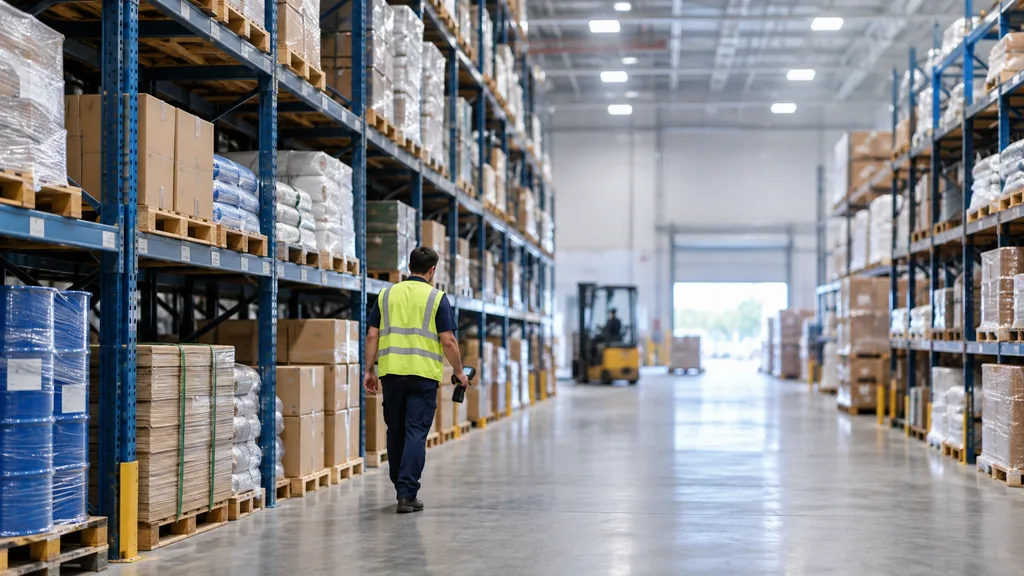

A bonded warehouse is a building where imported goods sit under customs control before duty is paid. The goods are in the country, but legally they have not yet entered it.
That gap is the whole value. You can land stock and hold it, paying duty only when you withdraw it for sale. Ship it abroad instead and you never pay US duty at all.
This guide covers how a bonded warehouse works and the classes the regulation actually recognizes. It also covers how long goods can stay and what the arrangement costs you.
What Is a Bonded Warehouse?
A bonded warehouse is a customs-approved facility that stores imported goods with the duty suspended. US Customs and Border Protection licenses the building and holds a bond against it.
The bond is the point of the name. It is a financial guarantee from the warehouse operator that the goods will be accounted for and the duty eventually paid or lawfully avoided.
Until the goods leave, they sit in a kind of legal waiting room. They are on US soil, under customs supervision, and not yet formally imported for consumption.
How a Bonded Warehouse Works
Goods arrive, enter under a warehouse entry, and the duty clock stops. Four steps cover the whole life of a bonded shipment.
- Entry. The shipment is entered for warehousing rather than for consumption, so no duty is due on arrival.
- Storage. The goods sit under customs supervision, recorded against the warehouse account.
- Manipulation, if allowed. Depending on the class of warehouse, stock can be sorted, repacked or cleaned while still in bond.
- Withdrawal. Duty is paid when goods are withdrawn for US sale, or avoided entirely if they are exported.
Partial withdrawal is the feature that matters commercially. You can take out and pay duty on a hundred units this month and leave the rest in bond.
The Classes of Customs Bonded Warehouse
The regulation recognizes ten classes, and they are numbered 1 to 11. There is no class 10 in the current rule, which is the sort of detail that trips up a lot of guides.
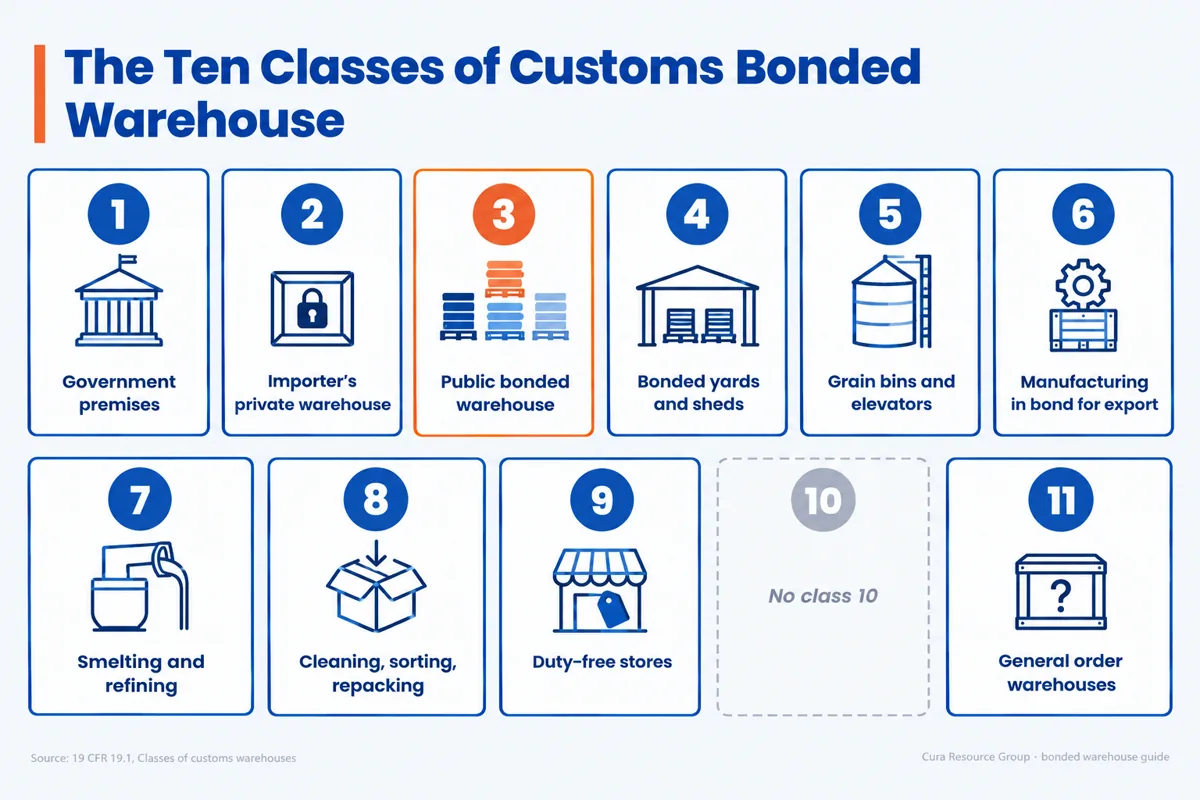
| Class | What it is for |
|---|---|
| 1 | Government premises for goods under examination, seizure or general order |
| 2 | An importer’s private bonded warehouse, for its own merchandise only |
| 3 | Public bonded warehouses, used only for imported merchandise |
| 4 | Bonded yards or sheds for heavy and bulky goods, plus stables and pens |
| 5 | Bonded bins or elevator sections for storing grain |
| 6 | Manufacturing in bond, solely for export |
| 7 | Smelting and refining imported metal-bearing materials |
| 8 | Cleaning, sorting and repacking under customs supervision, but not manufacturing |
| 9 | Duty-free stores |
| 11 | General order warehouses, for unclaimed and abandoned merchandise |
Most commercial storage happens in class 3, the public bonded warehouse. 19 CFR 19.1 defines it as a warehouse used exclusively for the storage of imported merchandise. The only difference from an ordinary public warehouse is the customs status.
Class 8 matters more than its position suggests. It allows cleaning, sorting and repacking under customs supervision, which is how goods get relabeled for a market before duty is ever paid.
Bonded vs Non-Bonded vs Foreign Trade Zone
Three arrangements, and the difference is when duty lands and what you may do to the goods. Picking between them is a cash-flow decision.
A non-bonded warehouse is ordinary storage. Duty was paid when the goods cleared customs, so the money has already left before a single unit sells. That is standard warehousing and distribution, with no customs layer on top.
A bonded warehouse suspends that payment, with limits on what you can do to the stock and a time limit on how long it stays.
A foreign trade zone goes further. Manufacturing is permitted, there is no statutory time limit, and duty can sometimes be paid at the finished-goods rate rather than the component rate.
The trade-off is administration. A zone carries more oversight and more record-keeping than a bonded warehouse, which already carries more than ordinary storage.
How Long Goods Can Stay
Five years from the date of importation. That is a statutory limit, not a policy the warehouse sets.
Under 19 U.S.C. 1557, merchandise may be deposited in a bonded warehouse at the owner’s risk. It may then be withdrawn at any time within 5 years of importation.
Goods still there at the deadline are treated as abandoned and sold by customs. In practice almost nothing approaches five years, because storage costs make slow stock expensive long before then.
What Goes Into a Bonded Warehouse
Goods where the duty is large, the sale is slow, or the destination is still undecided. The pattern is the same every time: money tied up too early.
- High-duty goods. Alcohol, tobacco and anything carrying a steep rate, where deferral is worth the most.
- Seasonal stock. Goods landed months ahead of a selling season that has not started.
- Re-export inventory. Stock passing through the US on its way elsewhere, which never owes US duty.
- Goods awaiting a decision. Stock held while a buyer, a market or a label is still being settled.
- Tariff-exposed imports. Shipments landed while a rate or an exclusion is still in question.
Perishables are the main exception. Section 1557 excludes perishable articles and most explosive substances from warehouse entry, so those cannot sit in bond at all.
What a Bonded Warehouse Saves You
Cash, mostly, and sometimes duty you never pay at all. Four benefits do the work.
- Deferred duty. The payment moves from arrival to withdrawal, so your money stays with you while stock sits.
- Re-export without US duty. Goods that leave for another market never attract the duty at all.
- Buying ahead safely. You can land stock early for a season without funding the duty months before the sales.
- Partial release. Duty is paid in step with demand rather than all at once on a whole container.
For an importer with slow-selling or seasonal goods, the deferral alone can be worth more than the storage costs.
The Disadvantages
You trade flexibility and simplicity for the duty delay. The costs are real and they are mostly administrative.
Storage is dearer than ordinary warehousing, because the operator carries the bond, the customs obligations and the record-keeping that goes with them.
What you may do with the stock is limited. Manufacturing is confined to specific classes, and anything beyond permitted manipulation needs the goods entered for consumption first.
The paperwork is heavier too. Every movement is recorded against the warehouse account, and discrepancies are a customs matter rather than an inventory one.
And the clock runs. Five years is generous, but it is a deadline attached to goods you may have hoped to sell quickly.
What It Takes to Operate One
A customs license, a bond and an approved building. A warehouse cannot simply decide to be bonded.
The operator applies to Customs and Border Protection, naming the class of warehouse and the building. The building has to be secure enough that goods cannot leave unrecorded.
A bond is then filed. That is the money behind the promise, and the operator answers for the goods from arrival until they leave lawfully.
That is why most importers use someone else’s bonded facility rather than seeking their own. The license, the bond and the paperwork rarely pay for themselves at one company’s volume.
Bonded Warehousing With Cura Resource Group
Cura Resource Group operates customs-bonded warehousing, so imported stock can sit with the duty suspended until you withdraw it. That sits alongside our general warehousing services.
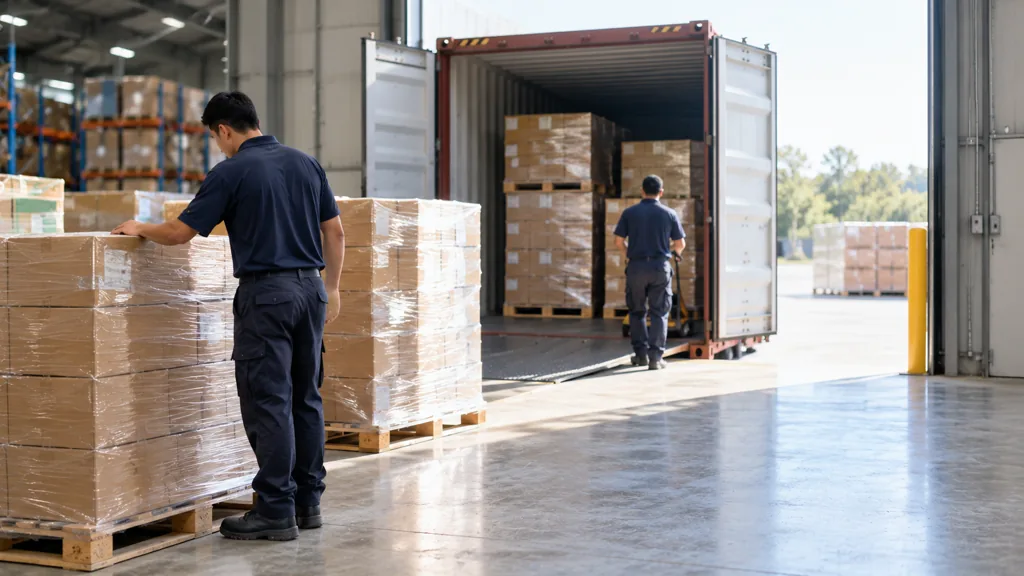
We can also move freight in bond. That means bringing containers from the port or rail ramp under customs control as part of drayage, rather than clearing them first.
Where you need someone named on the entry, we act as importer of record, taking legal responsibility for the declaration. That is a different role from a customs broker, and our IOR page explains the distinction.
Classification, valuation and the rest of the compliance work sit with trade compliance. Get a quote with your commodity, your origin country and how long you expect to hold the stock.
Sources and Further Reading
- Legal Information Institute, 19 CFR 19.1, Classes of customs warehouses — the ten classes, numbered 1 to 11 with no class 10.
- Legal Information Institute, 19 U.S.C. 1557, Entry for warehouse — the five-year storage limit and the rules on withdrawal.
Frequently Asked Questions
What is a bonded warehouse?
A bonded warehouse is a customs-approved building where imported goods are stored with the duty suspended. Customs and Border Protection licenses the facility and holds a bond against it. Duty becomes payable when the goods are withdrawn for sale, or is avoided entirely if they are exported.
What does it mean if a warehouse is bonded?
It means the operator holds a customs license and has filed a bond. The bond guarantees that goods will be accounted for and duty paid or lawfully avoided. Goods inside are under customs supervision and are not yet formally imported for consumption, even though they are physically in the country.
What is the difference between a bonded and non-bonded warehouse?
Timing of the duty. In a non-bonded warehouse the goods have already cleared customs and the duty is paid, so the money is gone before anything sells. In a bonded warehouse the duty is suspended until withdrawal, in exchange for customs oversight and limits on what you can do with the stock.
How long can goods stay in a bonded warehouse?
Five years from the date of importation, under 19 U.S.C. 1557. Goods still in the warehouse at that point are treated as abandoned and sold by customs. In practice stock rarely approaches the limit, because storage charges make slow-moving goods expensive well before five years.
Who owns a bonded warehouse?
Usually a private operator, not the government. The building belongs to the company that runs it, while Customs and Border Protection licenses the premises and holds the bond. The one exception is class 1, which covers government premises used for goods under examination or seizure.
What are the disadvantages of a bonded warehouse?
Higher storage rates, because the operator carries the bond and the compliance burden. Limits on what you can do to the goods, since manufacturing is confined to specific classes. Heavier record-keeping, as every movement is a customs matter. And a five-year deadline attached to the stock.
Who pays the duty on bonded goods?
The importer of record pays it, at the point of withdrawal rather than arrival. The warehouse operator is responsible to customs for the goods themselves, under its bond. But the duty liability itself stays with the party named on the customs entry, not with the warehouse.
What are the requirements for a bonded warehouse?
An application to Customs and Border Protection, nominating the class and the premises. A facility secure enough that goods cannot leave unrecorded. And a filed bond. The operator then carries responsibility for the merchandise from arrival until it is lawfully withdrawn.