


A public warehouse stores goods for anyone who pays for the space. You rent room by the pallet, share the building and the staff with other companies, and leave when you no longer need it.
The law puts it more plainly than the industry does. Under the Uniform Commercial Code, a warehouse is a person engaged in the business of storing goods for hire. The words for hire are what make it public.
This guide covers how a public warehouse works and how it differs from private, contract and dedicated space. It also covers what it costs and the rights you hold over goods you do not store yourself.
What Is a Public Warehouse?
A public warehouse is a building that rents storage space and handling to multiple customers at once. No single company owns the space or the labor.
That shared model is the whole point. The operator spreads the rent, the racking, the equipment and the staff across every account in the building. You pay for a slice instead of a site.
It is also the oldest arrangement in logistics. Goods move in, the warehouse takes responsibility for them, and you get them back when you ask.
How a Public Warehouse Works
You send stock in, the warehouse stores it, and you pay monthly for what you occupy. Nothing is built for you.
Goods arrive and are received against your paperwork, counted and put away into whatever space is free that week. Your pallets may sit in a different aisle next month.
Billing runs on what you used. Storage is charged for the space your goods occupied, and the work done on them is charged separately.
Leaving is the easy part. Most public warehousing runs month to month, so you give notice, the stock ships out and the account closes.
Public vs Private vs Contract vs Dedicated Warehousing
Four models sit on one spectrum, from renting a shelf to running your own building. The public vs private warehouse question is only the two ends of it, and the difference throughout is who carries the risk.
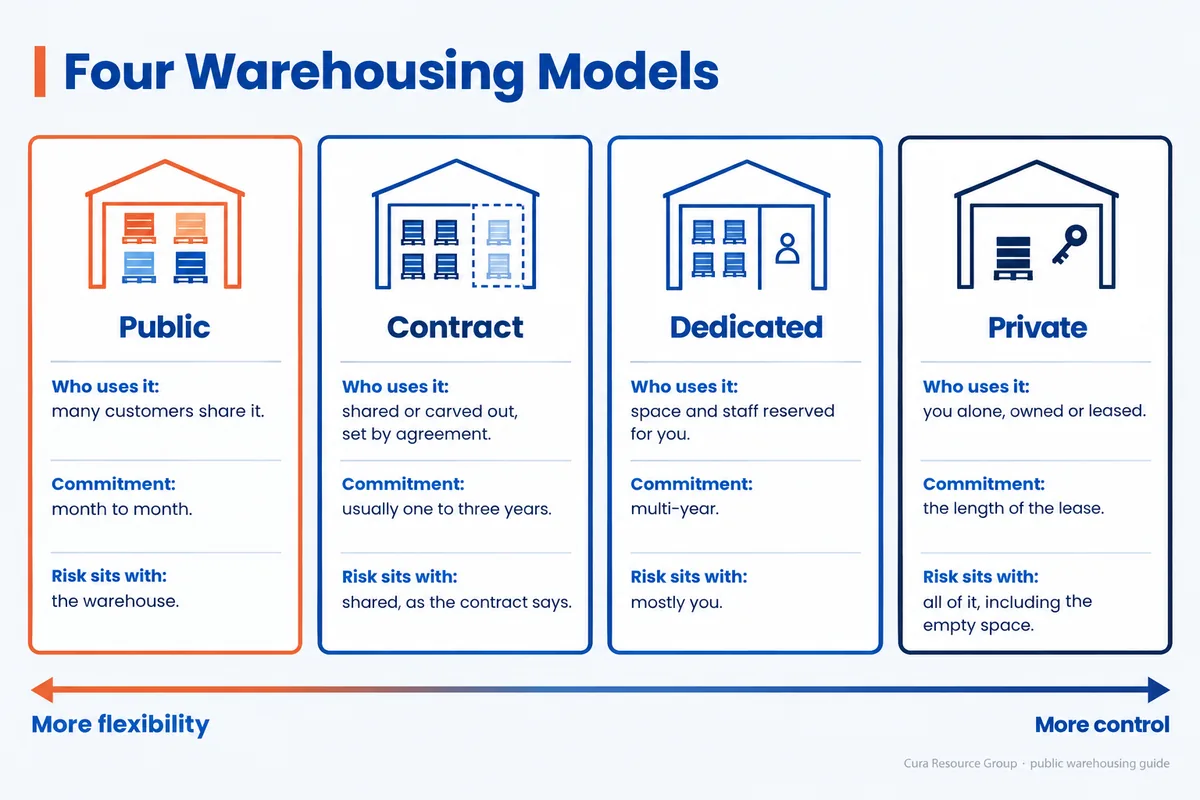
| Model | Who uses the space | Commitment | Who carries the risk |
|---|---|---|---|
| Public | Many customers share it | Month to month | The warehouse |
| Contract | Shared or carved out, set by agreement | Usually one to three years | Shared, as the contract says |
| Dedicated | Space and staff reserved for you | Multi-year | Mostly you |
| Private | You alone, in a building you own or lease | The length of the lease | All of it, including the empty space |
Public is where you start and where seasonal stock belongs. Contract warehousing trades flexibility for a better rate, and dedicated warehousing gives you space and people that answer only to you.
Private is the only model where empty space still costs you money. That is the trade for complete control.
What a Public Warehouse Includes
Storage is the floor, not the ceiling. Most public warehouses sell handling alongside the space, and you pick what you need.
- Receiving. Unloading the truck or container, checking it against your paperwork and putting it into stock.
- Storage. Pallet positions in racking, open floor for bulk goods, or shelving for small items.
- Inventory records. A count you can see, usually through the warehouse system rather than a spreadsheet.
- Order handling. Picking, packing and shipping, if you want the warehouse to run orders as well as hold stock.
- Outbound loading. Building pallets and loading trailers against your release instructions.
Some accounts take storage only. The stock sits, nothing is picked, and the warehouse simply holds it until you call for it.
What Public Warehousing Costs
A quote has two halves: what the space costs and what the work costs. Reading one means pulling those apart.
Storage is billed on the space you occupy, by pallet position, square foot or cubic foot depending on the operator. Our guide to pallet storage cost covers the four pricing models in detail.
Handling is billed on the work. Receiving, picking, packing and loading are counted and charged on their own lines, which is where a cheap-looking storage rate can turn expensive.
Then there are the fees around both. Minimums, long-term storage surcharges on aging stock and special handling all appear on real invoices. Ask for the full rate card rather than the headline number.
Your Goods and Your Rights
Storing goods with someone else changes your legal position, and most guides skip this. Three rules decide what happens when something goes wrong.
The warehouse owes you care. Under UCC 7-204 a warehouse is liable for loss or injury to goods caused by failing to exercise reasonable care. It is not liable for damage that such care could not have prevented.
That liability can be capped. The same section allows damages to be limited by a term in the warehouse receipt or storage agreement. The number in that document is the one that matters.
And the warehouse can hold your stock. UCC 7-209 gives a warehouse a lien on the goods for storage, handling, insurance and related charges. Unpaid invoices can stop your inventory leaving.
Read the storage agreement before the first pallet arrives. It sets the liability cap, the notice period and what happens if you fall behind.
When a Public Warehouse Is the Right Call
When your volume moves and you do not want to own the consequences. Four situations make the case on their own.
- Seasonal peaks. You need space for four months and nothing for the other eight.
- A new market. Holding stock in a region before you know whether the demand is real.
- Overflow. Your own building is full, or a container has landed with nowhere to go.
- Early growth. Volume is climbing but not far enough to justify a lease and a payroll.
The common thread is uncertainty. Public warehousing is the model that lets you be wrong about your forecast without paying for it all year.
When It Is the Wrong Call
When your volume is steady, large and predictable. At that point you are paying a premium for flexibility you no longer use.
A non-standard process is the other limit. Shared labor follows shared procedures, so goods needing bespoke handling, tight sequencing or specialist equipment fit badly.
Very high volume changes the maths too. Once you fill a meaningful share of a building, contract or dedicated space is normally cheaper per unit.
Nothing is permanent, though. Plenty of brands start public, prove the volume, then move into warehousing and distribution on firmer terms.
Public Warehousing With Cura Resource Group
Cura Resource Group rents storage on its own, with no fulfillment attached. If all you need is somewhere for the stock to sit, that is a complete account with us.
Short-term and overflow work is welcome. Peak stock, or a container that needs a home for a few months, is normal rather than an exception.
Every one of our warehouses takes storage-only customers, and each runs distribution work alongside storage. So the same site can hold your pallets now and pick orders later, as part of the order fulfillment process, without moving your inventory.
Pricing is quoted to your profile rather than read off a list, because the right model depends on how your stock behaves. A storage minimum applies, so ask for it with your quote.
Get a quote with your pallet count, how long you need the space and whether you want orders picked.
Sources and Further Reading
- Legal Information Institute, UCC 7-102, Definitions — a warehouse is a person engaged in the business of storing goods for hire.
- Legal Information Institute, UCC 7-204, Duty of Care and Contractual Limitation of Liability — what the warehouse owes you, and how that can be capped.
- Legal Information Institute, UCC 7-209, Lien of Warehouse — the warehouse’s claim on stored goods for unpaid charges.
Frequently Asked Questions
What is a public warehouse?
A public warehouse stores goods for multiple customers in one building, renting space and handling to anyone who pays. The Uniform Commercial Code defines a warehouse as a person in the business of storing goods for hire. Terms are usually monthly, so you can leave when the stock does.
What is the difference between a public and a private warehouse?
A public warehouse is shared, rented by the month and operated by someone else. A private warehouse is yours alone, owned or leased, staffed by your people. Public means you pay only for what you use; private means you pay for the whole building whether it is full or empty.
What are examples of public warehousing?
Any third-party operator renting space to several customers at once qualifies. Typical cases are seasonal overflow for a retailer and a regional stock holding for a brand testing a new market. Another is a container unloaded and held while its goods are sold.
How does public warehouse pricing work?
Space and labor are billed as two different things. Storage is charged on what you occupy, by pallet position, square foot or cubic foot. Handling, receiving, picking and loading are charged on their own lines. Minimums and long-term storage surcharges are common, so ask for the full rate card.
Is a public warehouse the same as a 3PL?
Not quite. A public warehouse sells storage and handling by the month. A third-party logistics provider does that and usually more, taking on order fulfillment, carrier management and returns. Many 3PLs run public warehousing, but plenty of public warehouses only store goods.
Can a warehouse keep my goods if I do not pay?
Yes. Under UCC 7-209 a warehouse has a lien on the goods it holds, covering storage, handling, insurance and related charges. In practice that means unpaid invoices can stop your inventory leaving the building, so the payment terms matter as much as the storage rate.
Who is liable if goods are damaged in a public warehouse?
The warehouse is, where damage came from failing to take reasonable care, under UCC 7-204. It is not liable for damage that reasonable care could not have prevented. The same rule lets the storage agreement cap the damages, so check that limit before signing.
How long can I store goods in a public warehouse?
As long as you keep paying, though the price can change with time. Many operators apply a long-term storage surcharge once stock passes a set age, because slow pallets block space that could turn over. Short stays of a few months are entirely normal.