
Dunnage is the loose material packed around goods so they cannot move in transit. Federal motor carrier rules put it plainly: 49 CFR 393.5 defines dunnage as all loose materials used to support and protect cargo.
The word covers far more than bubble wrap. It runs from an air pillow in a parcel to timber blocking under a steel coil, and it is older than both.
This guide covers what dunnage means, the eight materials that do most of the work, and how to pick between them. It also covers what the rules say in trucking and on a construction site.
What Is Dunnage?
Dunnage is any loose material placed around cargo to stop it moving and to absorb shock. It is the filler, not the container.
The original dunnage meaning came from the sea. Merriam-Webster dates the word to the 15th century and defines it as loose material used to support and protect cargo in a ship’s hold.
Modern freight law drops the ship. The federal dunnage definition in 49 CFR 393.5 covers all loose materials used to support and protect cargo, in any vehicle.
That breadth is why the word confuses people. A paper sheet and a timber beam are both dunnage, because both exist to keep cargo still.
Why Dunnage Is Used
Dunnage stops movement. Every other benefit follows from that one job.
Goods break because they shift, strike each other or absorb vibration over hundreds of miles. Fill the gap and most of that stops.
It does three things at once. It immobilizes the item, it absorbs shock and vibration, and it separates pieces that would otherwise rub or collide.
The cost of skipping it is rarely just the product. A damaged arrival means return freight, a replacement unit and the labor to process it. Often it means a public review too, which is why returns management and packing belong together.
The Types of Dunnage, Compared
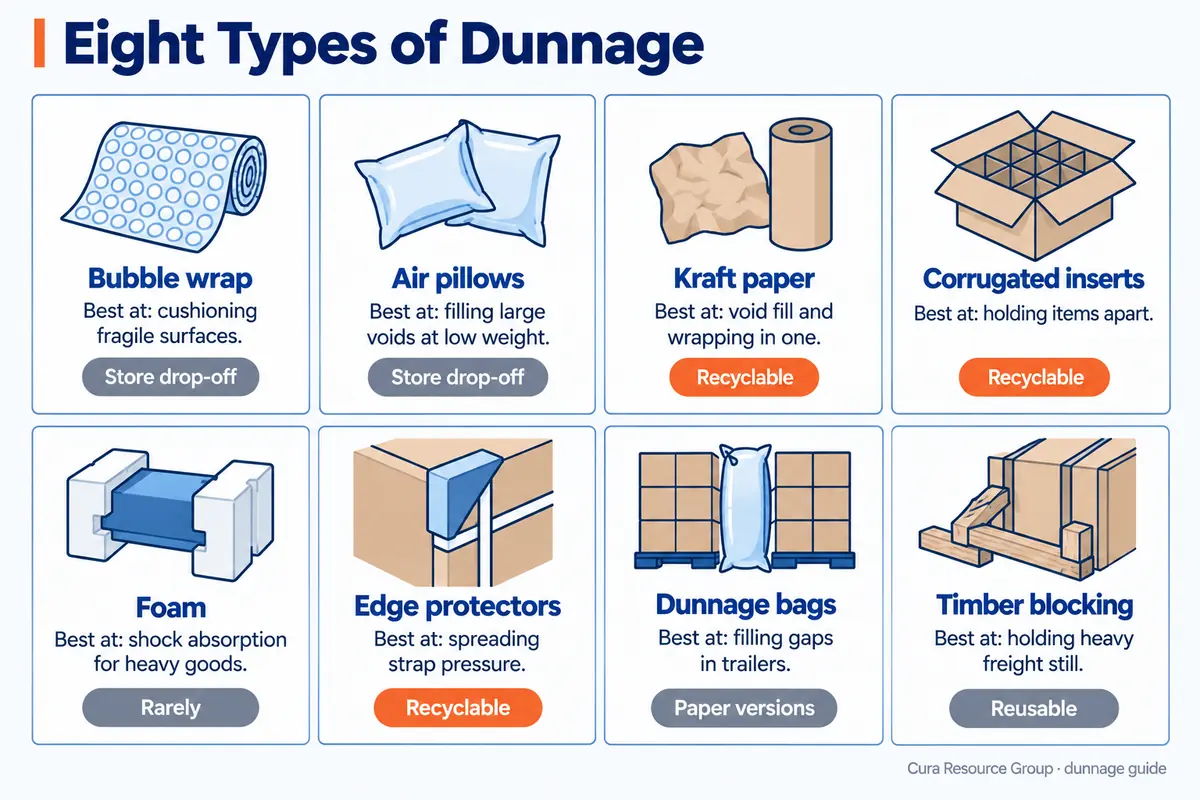
Eight materials cover almost every shipment. The right one depends on what you are protecting against, not on what is cheapest per unit.
| Material | Best at | Weak point | Recyclable |
|---|---|---|---|
| Bubble wrap | Cushioning fragile surfaces | Bulky to store, usually plastic film | Store drop-off only |
| Air pillows | Filling large voids at very low weight | No load bearing, punctures | Store drop-off only |
| Kraft paper | Void fill and wrapping in one material | Heavier than air, less cushioning | Yes |
| Corrugated inserts and dividers | Holding items apart in a fixed position | Needs designing per product | Yes |
| Foam sheet, plank and molded foam | Shock absorption for heavy or fragile goods | Costly, bulky, mostly not recyclable | Rarely |
| Edge and corner protectors | Spreading strap pressure off corners | Protects edges only, not faces | Yes, if paper based |
| Dunnage bags | Filling large gaps in trailers and containers | Mostly single use, needs correct fitting | Paper versions yes |
| Timber blocking and bracing | Holding heavy freight still | Adds weight and labor, needs fastening | Reusable |
Most operations run three or four of these, not eight. A parcel brand might use paper, air pillows and corrugated inserts and never touch the rest.
Dunnage vs Void Fill vs Packaging
Void fill is one kind of dunnage, and packaging is the container around both. The three words are not interchangeable.
Packaging is the box, mailer or crate. Dunnage is everything loose placed inside or around the goods. Void fill is the narrower subset whose only job is to occupy empty space.
Air pillows are both void fill and dunnage. Molded foam that grips a product is dunnage but not void fill, because it positions the item rather than just filling a gap.
A pallet is usually classed as packaging, since it carries the load rather than fills space. Timber laid under cargo to keep it off a wet floor is dunnage, which is where the confusion starts.
Anything branded or designed around the unboxing moment sits with custom packaging rather than here.
Dunnage in Trucking and Containers
In freight, dunnage has a legal definition and a named family of parts. US federal rules name each one.
A dunnage bag is defined in 49 CFR 393.5 as an inflatable bag that fills empty space beside cargo. That space may be between two items, or between cargo and the vehicle wall. Drivers call them airbags.
The same rule defines blocking as a structure placed against or around cargo to prevent horizontal movement. Bracing is placed against cargo to stop it tipping, and may stop it shifting too.
It also defines an edge protector. The device sits on an exposed edge and spreads tiedown forces over a wider area of cargo than the tiedown alone.
These are not decorative distinctions. A load that shifts on a highway is a safety failure before it is a damage claim. The parts have legal names for that reason.
Dunnage in Construction
On a building site, dunnage is the timber that keeps stored material off the ground and level. It is there to hold a stack steady, not to cushion it.
OSHA sets the rule. Under 29 CFR 1926.250, materials stored in tiers must be stacked, racked, blocked, interlocked or otherwise secured to prevent sliding, falling or collapse.
The same standard requires lumber to be stacked on level and solidly supported sills. Those sills are what a site crew means by dunnage.
The term carries into buildings too. Steel or timber frames that raise rooftop equipment off the roof deck are also called dunnage.
Reusable and Returnable Dunnage
Some dunnage is built to come back. In a closed loop between a supplier and a plant, returnable dunnage replaces single-use fill entirely.
It usually means molded trays, foam cradles or steel racks sized to one part. Automotive and aerospace supply chains run this way, because the same component moves the same route every week.
The economics invert. Unit cost is far higher, but it is spread over hundreds of trips rather than one, so cost per shipment falls.
The catch is everything around it. Empties have to come back, get cleaned, get counted and get stored, and that storage is a pallet storage question of its own.
It fails on one-way freight. An ecommerce parcel going to a different address every time is never coming back, so single-use dunnage stays the right answer there.
How to Choose Dunnage for Your Product
Match the material to the failure you are trying to prevent. Start with how the product actually breaks.
Four questions settle most decisions:
- What kills it? Drops need cushioning, vibration needs damping, crushing needs structure, and scratching needs a barrier.
- How much space is empty? A large void needs volume filler. A tight fit needs a thin protective layer instead.
- Who opens it? A consumer unboxing shapes the choice. A warehouse receiver does not care what the fill looks like.
- What happens to it after? Someone has to dispose of it, and that is increasingly part of the brand impression.
Then test it rather than guess. Ship sample units to yourself through the carriers you actually use, and open them like a customer would.
Sustainable Dunnage
Paper-based dunnage enters the one packaging stream that really does get recycled. The gap between materials is wide.
The EPA reports that the recycling rate for corrugated boxes was 96.5 percent in 2018, against 53.9 percent for containers and packaging overall.
So switching foam and film for kraft paper and corrugated inserts does more than look responsible. It puts the protective layer into a stream that genuinely returns.
Right-sizing helps more than material choice. A box cut to the product needs less dunnage, weighs less and costs less to ship.
Dunnage With Cura Resource Group
Cura Resource Group packs with dunnage at every packing station, chosen per product rather than by default. The material is picked when the packing spec is set, not at the bench.
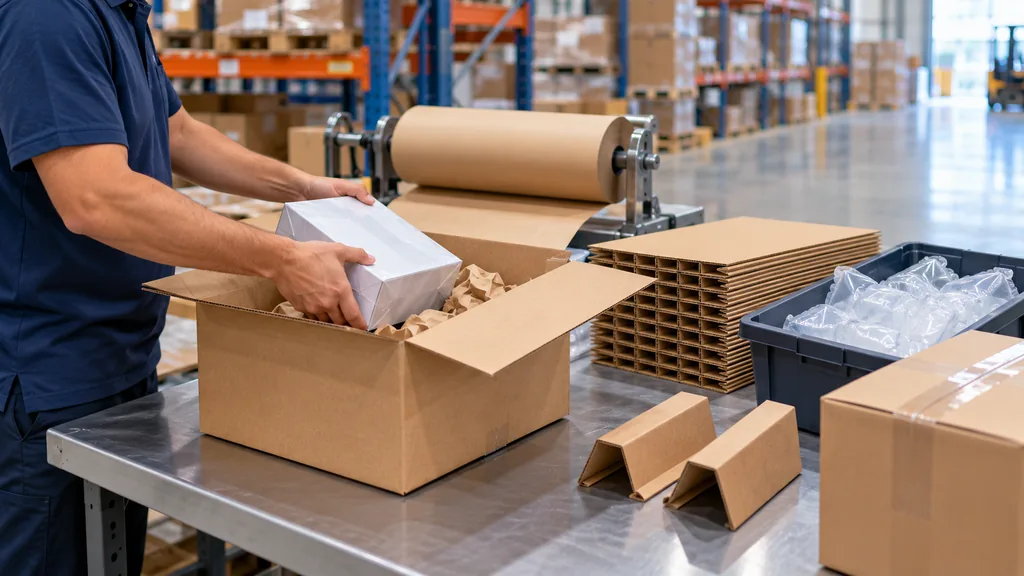
Our packers add protective materials as part of pick and pack, including bubble wrap, void fill, foam, inserts and dividers for fragile or multi-item orders.
Standard materials sit inside the pack rate or pass through at cost. That is the normal arrangement across the industry. Custom or branded material is sourced for you instead.
We also run the paper-based route where it fits, using recyclable corrugated and paper void fill. Right-sizing the carton then cuts both material and freight.
All of it sits inside the wider order fulfillment process and our warehousing and distribution operation. Get a quote with your product dimensions and fragility profile.
Sources and Further Reading
- Legal Information Institute, 49 CFR 393.5, Definitions — the federal definitions of dunnage, dunnage bag, blocking, bracing and edge protector.
- OSHA, 29 CFR 1926.250, General requirements for storage — stacking, blocking and supported sills on a construction site.
- US EPA, Containers and Packaging: Product-Specific Data — recycling rates by packaging material.
- Merriam-Webster, dunnage — the original shipping sense and the 15th century first use.
Frequently Asked Questions
What is dunnage?
Dunnage is loose material packed around goods to stop them moving and to absorb shock in transit. Federal rules define it as all loose materials used to support and protect cargo. It covers paper, foam, air pillows, corrugated inserts, inflatable bags and timber blocking.
Why is dunnage used?
Dunnage is used to stop cargo moving. Goods break when they shift, strike each other or absorb vibration over a long journey, and filling the gap prevents most of it. It also separates items that would otherwise rub, and spreads pressure away from corners.
Is a pallet considered dunnage?
Usually not. A pallet is normally classed as packaging, because its job is carrying the load rather than filling space around it. Timber laid under cargo to raise it off a wet or uneven floor is dunnage, which is why the two get mixed up.
What is dunnage in trucking?
In trucking, dunnage is the loose material used to secure a load inside a trailer or container. Federal rules name the parts: dunnage bags fill empty space beside cargo, blocking prevents horizontal movement, and bracing stops cargo tipping. Edge protectors keep strap pressure off the corners.
What is dunnage in construction?
On a construction site, dunnage is the timber that keeps stored material off the ground and level. OSHA requires lumber to be stacked on level and solidly supported sills, and those sills are the dunnage. Rooftop frames under equipment carry the same name.
What is the difference between dunnage and void fill?
Void fill is a type of dunnage. Dunnage is every loose material placed around goods, while void fill is the narrower group whose only job is occupying empty space. Air pillows are both. Molded foam that grips a product is dunnage but not void fill.
What materials are commonly used for dunnage?
The common eight are bubble wrap, air pillows, kraft paper and corrugated inserts. The rest are foam, edge and corner protectors, inflatable dunnage bags, and timber blocking and bracing. Most operations use three or four rather than the full range.
Is dunnage recyclable?
It depends entirely on the material. Kraft paper and corrugated inserts recycle easily, and the EPA puts the corrugated box recycling rate at 96.5 percent. Bubble wrap and air pillows need store drop-off, and most foam is not recycled at all.