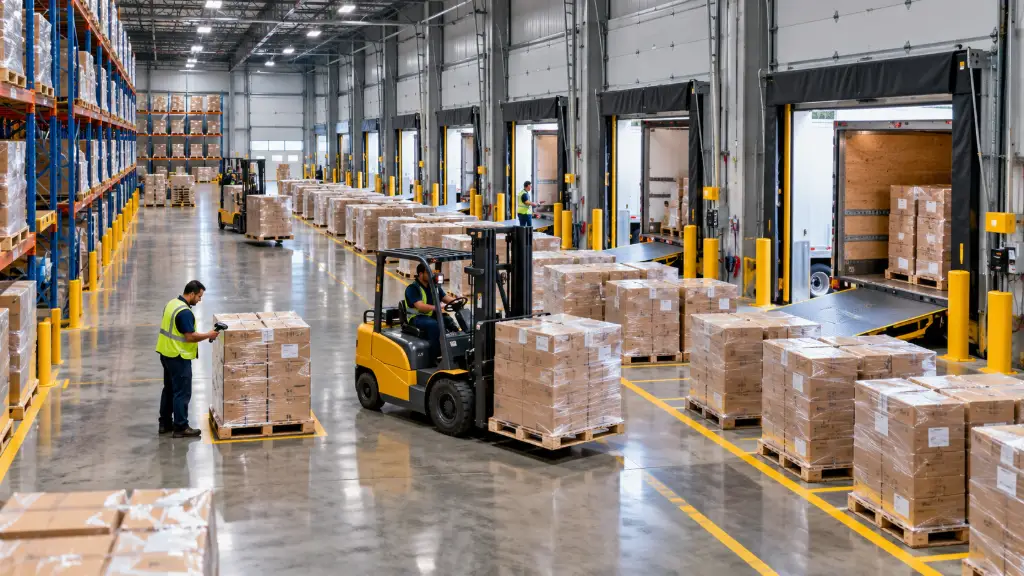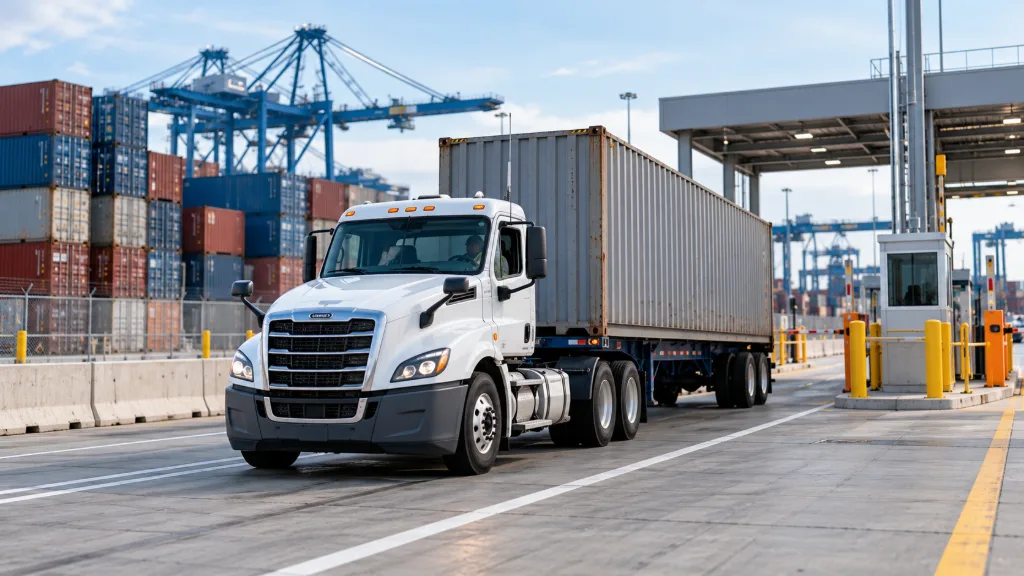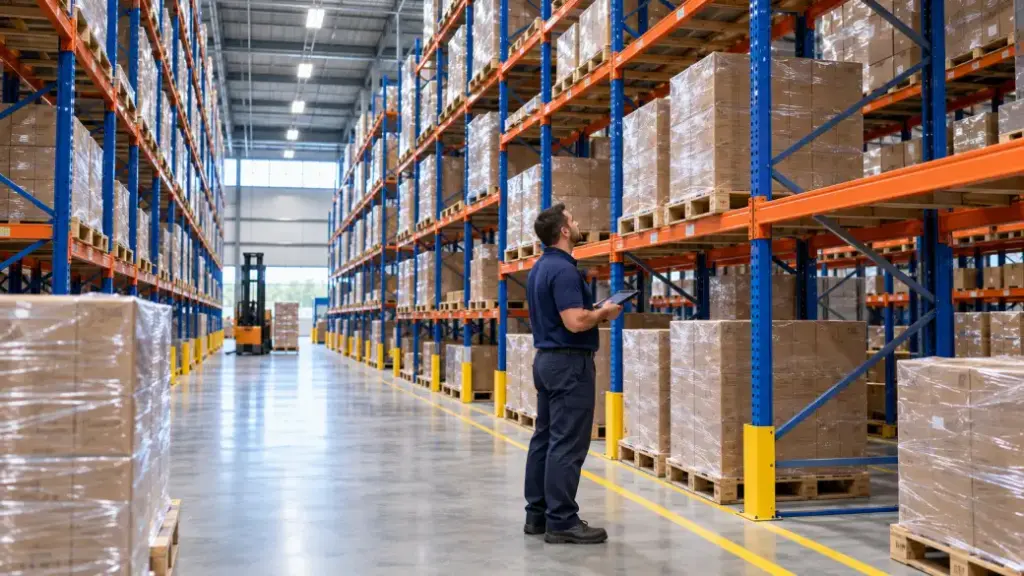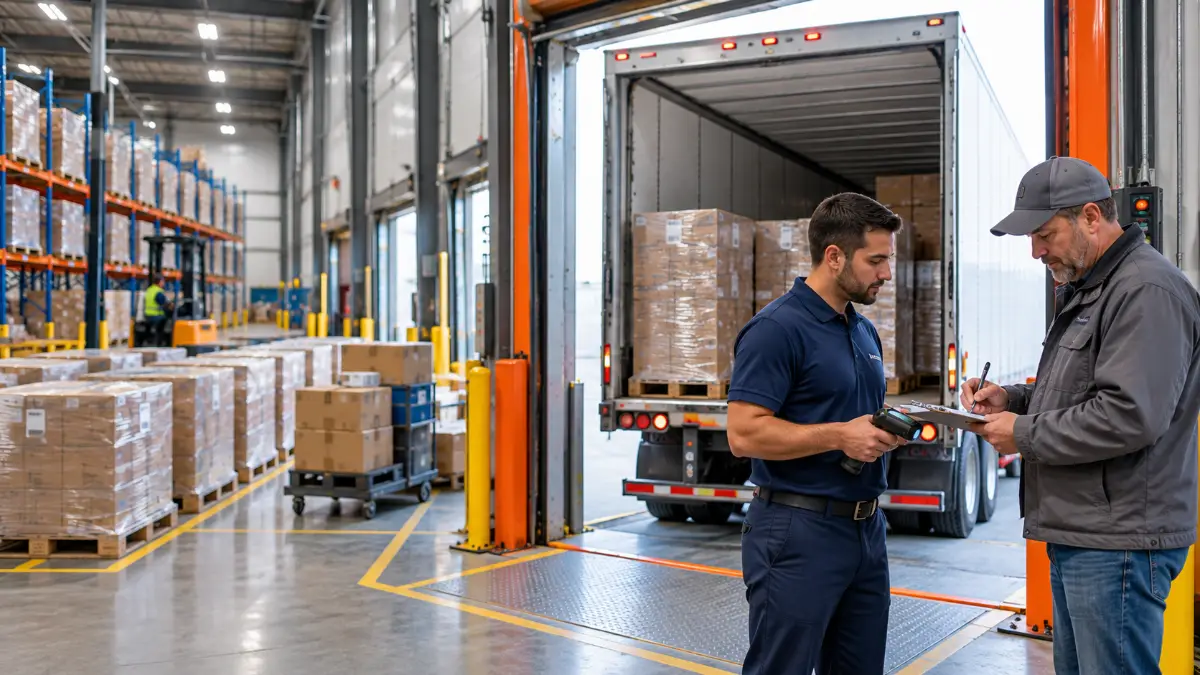
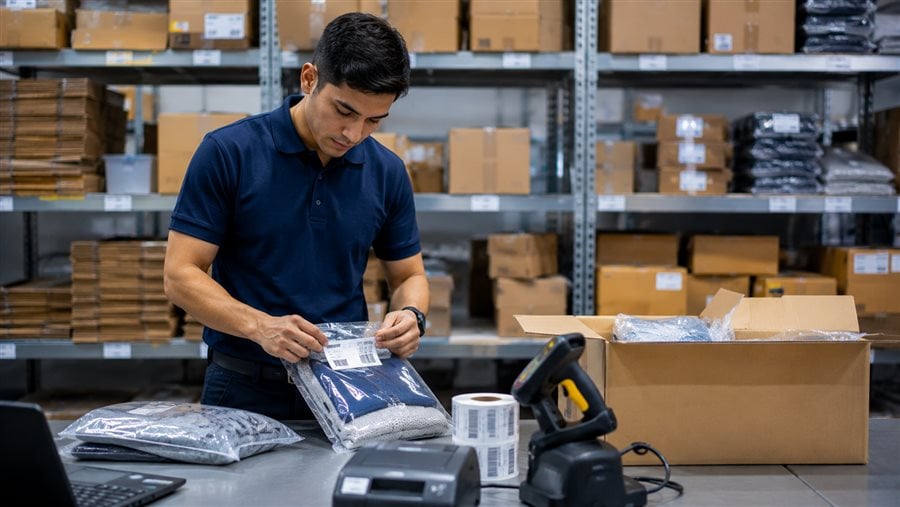

Amazon FBA prep services are third-party providers that receive your inventory, prepare each unit to Amazon’s exact receiving requirements — FNSKU labelling, poly-bagging, bundling and protective packaging — and ship it into Amazon fulfilment centres ready to sell.
Amazon FBA prep services are the unglamorous step that decides whether your inventory sails into Amazon’s network or gets rejected at the dock. Every unit sent to Fulfillment by Amazon (FBA) has to meet Amazon’s exact prep and labeling requirements — FNSKU labels, poly-bagging, bundling, and packaging rules — or it risks fees, delays, or refusal. As Amazon’s FBA prep and labeling requirements grow stricter and harder to manage at scale, more sellers are turning to third-party Amazon FBA prep services to get inventory compliant and into FBA without the headache. This guide explains what FBA prep services are, what they include, the requirements behind them, what they cost, and how to choose the right prep partner. Whether you’re a first-time seller importing your first container or an established brand shipping thousands of units a month, prep is one of the easiest places to lose money — and one of the easiest to fix by handing it to specialists.
What Are Amazon FBA Prep Services?
Amazon FBA prep services are third-party services that prepare your products to meet Amazon’s FBA requirements before they’re shipped into an Amazon fulfillment center. Instead of you (or your supplier) labeling, bagging, and packing every unit to Amazon’s spec, a prep center receives your inventory, preps it correctly, and forwards it to FBA — fully compliant and ready to sell.
For sellers importing from overseas or shipping high volumes, this is often the difference between a smooth FBA operation and a stream of compliance problems. A good prep service acts as the quality-control checkpoint between your supplier and Amazon’s warehouse.
Why Does FBA Prep Matter More in 2026?
Two things changed. Amazon discontinued several of its own prep services in January 2026, pushing that work back onto sellers and their 3PL partners — the requirements are set out in Amazon Seller Central, and enforcement on labelling and packaging compliance has tightened alongside it. Meanwhile volume keeps climbing: according to the U.S. Census Bureau, US ecommerce reached $340.2 billion in the second quarter of 2026, 17.1% of all retail sales and 12.2% up year on year. More units moving through a stricter gate means prep errors cost more than they used to.
Amazon’s prep and labeling requirements have grown stricter, and the platform expects inventory to arrive at FBA already prepped to spec. There’s little margin for error: units that aren’t compliant get held, surcharged, or returned, and Amazon won’t always fix prep problems for you. For sellers scaling volume, that makes reliable prep a front-line priority rather than an afterthought.
That’s why demand for third-party Amazon FBA prep services has climbed. Outsourcing prep to a dedicated center — or a 3PL that offers prep alongside broader fulfillment — keeps your FBA pipeline compliant without forcing you to build a prep operation in-house. (Always check Amazon Seller Central for the current, official prep and labeling policies, since requirements change.)
The biggest shift is Amazon itself. As of January 2026, Amazon no longer offers its own prep and labeling services, covering labeling, poly-bagging, bubble wrap, and opaque bagging, for inbound FBA inventory in the US. That leaves sellers with two options: prep every unit in-house to Amazon’s exact spec, or hand it to a third-party FBA prep service. For many sellers that change alone turned prep from something Amazon handled into a task they now have to own or outsource, which is why demand for 3PL prep has climbed.
What Is Included in Amazon FBA Prep Services?
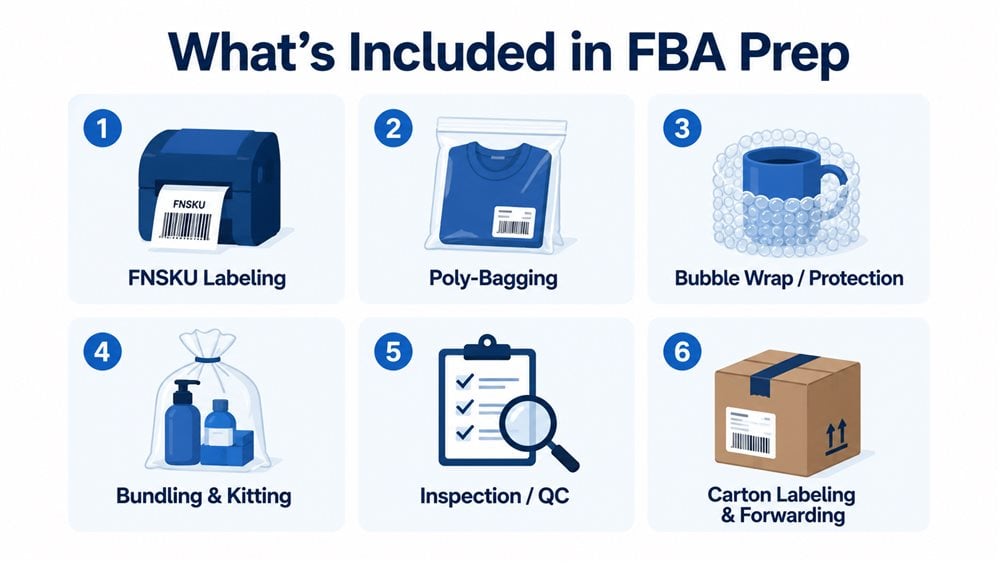
FBA prep covers everything Amazon requires before a unit can enter its network. A full-service prep center typically handles:
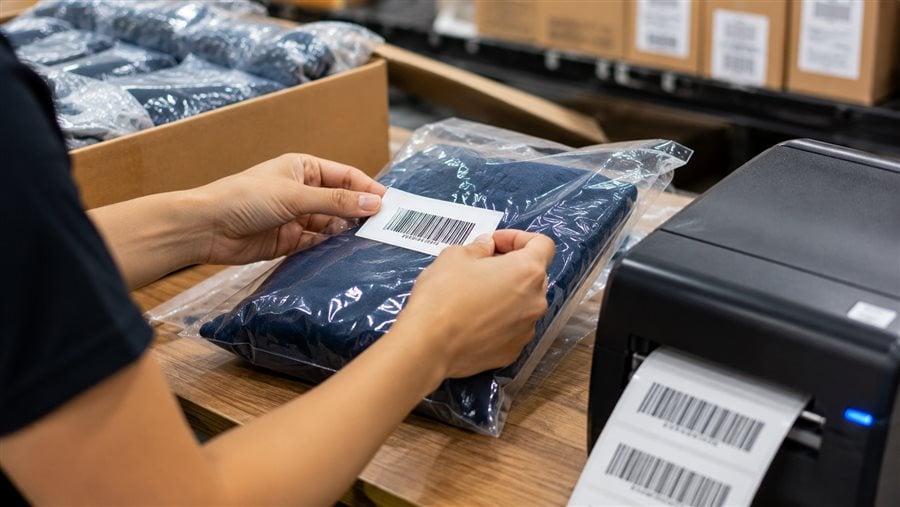
- FNSKU labeling: applying Amazon’s barcode label to each unit so it’s tracked correctly in FBA.
- Poly-bagging: bagging items that require it, with the mandatory suffocation warning on bags above a certain size.
- Bubble wrap and protective packaging: protecting fragile or loose items so they survive transit and Amazon handling.
- Bundling and kitting: combining multiple items into a single sellable unit — closely related to kitting and assembly services.
- Inspection and quality control: checking for damage, defects, and correct quantities before anything ships to FBA.
- Expiration date and lot labeling: required for consumables, supplements, and other regulated categories.
- Carton labeling and shipment forwarding: labeling boxes and creating the inbound shipment into Amazon.
Many prep centers also handle FBM (Fulfillment by Merchant) and multi-channel orders, so the same inventory can serve Amazon, your ecommerce store, and other marketplaces.
Amazon FBA Prep Requirements to Know
Even if you outsource, it helps to understand what the prep service is protecting you from. Amazon’s core prep requirements include:
- Each unit must carry a scannable FNSKU label that covers any existing barcode.
- Poly-bagged items over 5 inches in any dimension need a suffocation warning.
- Sets and bundles must be labeled as a single unit and marked “sold as set” so they aren’t separated.
- Sharp, fragile, or liquid products need protective packaging.
- Expiration-dated goods must show the date in the required format.
Miss any of these and Amazon can charge an unplanned prep fee, delay your shipment, or refuse it outright — which is exactly the risk a prep service removes.
Why Do Sellers Outsource FBA Prep to a 3PL?
Doing prep yourself is feasible at low volume, but it scales badly. As order counts grow, prep becomes a time sink that pulls you away from sourcing and marketing — and a single labeling mistake repeated across hundreds of units gets expensive. Outsourcing to an FBA prep service or 3PL gives you:
Cura Resource Group takes on this work for sellers who would rather not run a prep bench, and the question worth asking any prep provider is who pays when Amazon rejects a shipment. If the answer is you, the per-unit rate is not the real price.
- Compliance expertise: a team that already knows Amazon’s rules and keeps up with changes.
- Speed and scale: prep that keeps pace with peak season instead of bottlenecking it.
- Receiving from overseas suppliers: a US-based address to receive imports, inspect, and prep before FBA.
- One partner for prep and fulfillment: a 3PL can prep your FBA inventory and run your direct ecommerce order fulfillment under one roof.
Common FBA Prep Mistakes That Cost Sellers Money
Most FBA prep problems are avoidable — and they’re exactly what a prep service exists to catch. The expensive recurring mistakes:
- Wrong or unscannable labels: a damaged, low-quality, or misapplied FNSKU label means Amazon can’t receive the unit, triggering delays and fees.
- Missing suffocation warnings: poly-bagged items over the size threshold without the required warning get flagged.
- Inadequate protection: fragile or liquid products that arrive damaged generate removals, refunds, and negative reviews.
- Bundles split apart: sets not clearly labeled “sold as set” get separated and sold individually, breaking your listing.
- Expired or undated consumables: regulated goods without correct date labeling are rejected at receiving.
- Box and weight violations: cartons that exceed Amazon’s size or weight limits incur surcharges or get refused.
Each of these is small on its own but multiplies fast across a large shipment — which is why consistent, expert prep pays for itself.
What Do Amazon FBA Prep Services Cost?
FBA prep pricing is usually charged per unit, with add-ons for specific tasks. Typical fee structure:
The real question is not the per-unit fee but the total cost of each approach:
| Factor | Self-Prep (In-House) | 3PL Prep Service |
|---|---|---|
| Per-unit cost | No fee, but your labour time | $0.50 to $2.00 depending on complexity |
| Labour | You or your staff, at your hourly cost | Included in the per-unit rate |
| Materials | Bought separately at retail | Bought at volume, usually bundled |
| Compliance risk | Yours entirely | Provider absorbs rework on their errors |
| Scaling at peak | Capped by your own hours | Absorbs surge within existing agreement |
| Rejected shipments | You fix it, stock sits idle | Provider reworks and reships |
| Best fit | Under a few hundred units a month | Growing volume, seasonal peaks, multi-SKU |
- Receiving: a per-carton or per-unit fee to accept and check inbound inventory.
- Labeling: a per-unit charge for FNSKU labels.
- Poly-bagging / bubble wrap: a per-unit charge for protective prep.
- Bundling/kitting: priced by complexity and number of components.
- Storage: if inventory waits before forwarding to FBA.
The right comparison isn’t prep fees in isolation — it’s prep fees versus the cost of Amazon’s own prep surcharges, rejected shipments, and your own time. For most growing sellers, a per-unit prep fee is far cheaper than the alternative. Ask any prospective provider for a clear, itemized rate card so you can model your true landed cost per unit before committing.
How Do You Choose an Amazon FBA Prep Service?
When comparing FBA prep services or providers, look for:
- Amazon expertise: proven experience with current FBA prep and labeling requirements.
- Location: a facility near major ports or close to Amazon fulfillment centers shortens transit and cost.
- Turnaround time: how fast inventory is received, prepped, and forwarded to FBA.
- Multi-channel capability: can they also handle FBM, Shopify, and other marketplaces?
- Transparent per-unit pricing: no surprise fees for standard prep tasks.
- Scalability: can they absorb your peak-season volume without slipping?
How Cura’s Amazon FBA Prep Process Works
Our FBA prep runs as a simple, hands-off workflow so your inventory reaches Amazon compliant and on time:
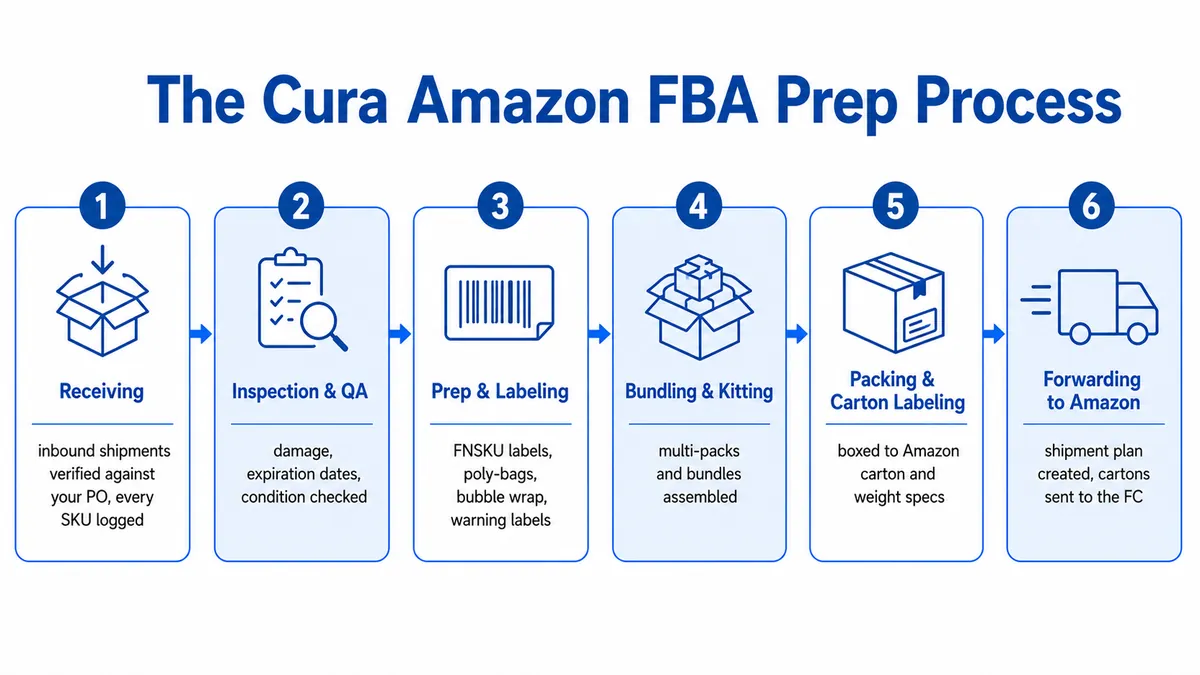
- Receiving: We accept inbound shipments from your suppliers or manufacturers, verify quantities against your purchase order, and log every SKU into our system.
- Inspection & QA: Each unit is checked for damage, expiration dates, and condition, so non-compliant items are caught before they ever reach Amazon.
- Prep & Labeling: We apply FNSKU labels, poly-bag with suffocation warnings, bubble-wrap fragile items, and add any required warning or expiration labels to Amazon’s specifications.
- Bundling & Kitting: Multi-packs, bundles, and kits are assembled accurately so each listing ships exactly as configured.
- Packing & Carton Labeling: Prepped units are boxed to Amazon’s carton and weight requirements with correct box labels.
- Forwarding to Amazon: We create the inbound shipment plan, apply shipment labels, and forward your cartons to the assigned Amazon fulfillment centers.
Because prep, storage, and freight all sit under one roof, most standard orders move through in a few business days, and we scale capacity for Q4 and peak-season surges. Ready to hand off your prep? Request a prep quote or explore our full ecommerce fulfillment services.
Final Word
Amazon FBA prep services have shifted from a nice-to-have to a near-necessity as Amazon’s requirements tighten and the cost of getting prep wrong rises. Getting prep right protects you from fees, rejections, and lost selling time — and outsourcing it to a 3PL that also handles your wider fulfillment turns a compliance chore into an efficient, scalable pipeline. Whether you sell only on Amazon or across multiple channels, the right prep partner keeps your inventory compliant, your shipments moving, and your attention on growing the business.
Need a reliable Amazon FBA prep partner that scales with your sales?
Frequently Asked Questions
What is an Amazon FBA prep service?
An Amazon FBA prep service is a third-party provider that receives your inventory, prepares each unit to Amazon’s exact requirements, and ships it into Amazon fulfilment centres. Preparation covers FNSKU labelling, poly-bagging, bundling, suffocation warnings and packaging checks that Amazon rejects shipments for missing.
What does FBA prep mean?
FBA prep means preparing inventory so it complies with Amazon’s receiving standards before it enters a fulfilment centre. Each unit needs a scannable FNSKU label, appropriate protective packaging, and any required warnings. Prep is what stands between your stock and a rejected or quarantined inbound shipment.
What is included in FBA prep services?
Typical inclusions are receiving and inspection, FNSKU labelling, poly-bagging with suffocation warnings, bubble wrap or protective packaging, bundling and multi-packs, expiry-date labelling for consumables, carton labelling, and palletising for LTL shipments into Amazon. Some providers also handle returns and removal orders.
How much does Amazon FBA prep cost per unit?
Per-unit prep typically runs between $0.50 and $2.00 depending on complexity. Simple labelling sits at the low end; poly-bagging, bundling or fragile-item handling pushes toward the top. Most providers also charge receiving and storage separately, so compare full rate cards rather than the headline per-unit figure.
Why is Amazon FBA prep more important in 2026?
Amazon discontinued several of its own prep services in January 2026, moving that work back onto sellers or their 3PL partners. Combined with tighter enforcement on labelling and packaging compliance, sellers who previously relied on Amazon to fix prep issues now absorb the cost of rejections themselves.
Should small businesses use an FBA prep service?
Usually yes, once volume passes a few hundred units a month. Below that, self-prep is manageable. Above it, the labour cost and the risk of a rejected shipment outweigh the per-unit fee — and a rejected inbound can lock up stock for weeks during your best selling window.
What should you look for in an FBA prep provider?
Check proximity to the Amazon fulfilment centres you ship into, documented receiving turnaround, a full rate card including accessorials rather than a headline per-unit price, and whether they handle your product category’s specific requirements. Ask what happens when Amazon rejects a shipment they prepared.