

Discreet packaging is shipping that gives away nothing about what is inside. No logos, no product names, no branded tape, and a label that reads like any other parcel.
It matters because a delivery is seen by people who did not order it. Neighbors, doormen, mailroom staff and family all handle the box before the buyer does.
This guide covers what a discreet shipment actually looks like, how a warehouse sets one up, and which products need it. It also covers where discretion stops and federal law takes over.
What Is Discreet Packaging?
Discreet packaging is packaging designed to conceal the nature of the contents from anyone who is not the recipient. The goods are not hidden, only the clues about them.
It works by removing information rather than adding it. A branded mailer tells a hallway what you bought, so discreet packing takes the branding away.
Discreet shipping is the same idea applied to the whole journey. The packaging is the box, while discreet shipping also covers the label, the sender name and the carrier.
It is the deliberate opposite of custom packaging, where the box is designed to be recognized on sight. Both are spec decisions made before a single order ships.
What a Discreet Shipment Looks Like
Five things give a parcel away, and discreet packing addresses each one. Miss any single layer and the rest stops working.
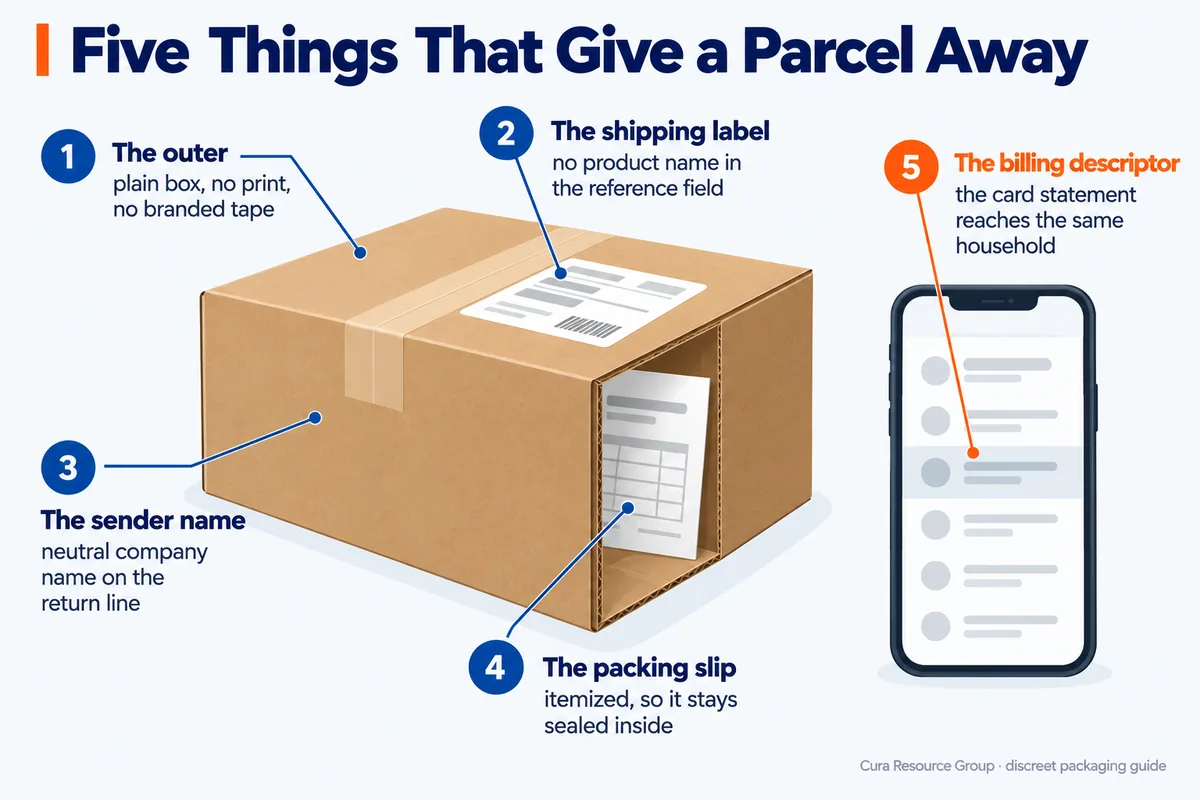
- The outer. A plain corrugated box or a neutral poly mailer, with no printing, no product imagery and no branded tape.
- The shipping label. Carrier labels show a sender and a service, not a product. The risk sits in any reference field that echoes a SKU or product name.
- The sender name. A company called Adult Toy Co on the return line undoes everything else on the parcel.
- The packing slip. The document inside names every item, so it stays inside a sealed box rather than a document pouch on the outside.
- The billing descriptor. Not packaging at all, but the card statement reaches the same household, and a revealing descriptor defeats the point.
Most brands get the first two right and miss the last three. That is where the complaints come from.
How a 3PL Sets Up Discreet Packing
Discreet packing is a configuration, not a product you buy. It is set once in the warehouse and then runs on every order.
The packing spec comes first. A warehouse packs to whatever the brand specifies, so the spec names a plain outer and leaves out inserts, branded tape and marketing material.
The label rules come next. Carrier and service are chosen by the brand’s rules. Any reference field that would carry a product name is blanked or filled with an order number instead.
Then the sender identity. Shipping through a third party already helps here, because the return address belongs to the warehouse rather than the brand.
Finally the paperwork. The packing slip lists what is in the box, so for discreet orders it travels sealed inside rather than in an outer pouch.
All of it is decided at the order fulfillment process stage, not improvised at the bench.
Which Products Need Discreet Packaging
Anything a buyer would not want announced in a hallway. The categories are consistent across the industry.
- Adult products. The original use case, and the one with its own federal mailing rules.
- Medical and personal health. Incontinence supplies, fertility and sexual health products, hearing aids and mobility aids.
- Supplements and wellness. Weight management and hair loss products in particular.
- High-value goods. Jewelry, watches and electronics, where the motive is theft prevention rather than embarrassment.
- Security and surveillance. Cameras and alarms, where a branded box advertises exactly what is being installed.
The motive differs by category. Health and adult buyers want privacy, while jewelry and electronics sellers want the parcel to look boring to a porch thief.
Discreet vs Plain vs Unbranded Packaging
They are three different things, and the difference decides what you buy. Plain is a material, unbranded is a choice, discreet is an outcome.
A plain box is simply undecorated corrugated. It is the cheapest option and often the right one.
Unbranded means your branding has been removed, which can still leave a box shaped unmistakably like what it holds. A guitar ships in a guitar-shaped box however blank the cardboard is.
Discreet is the standard that actually has to be met: nobody handling it can tell. That sometimes means a larger, squarer box and more void fill, which is a cost decision as much as a packaging one.
How to Tell Customers It Is Discreet
Say it on the product page, not in the confirmation email. Buyers in these categories decide whether to order at all based on what you promise up front.
Be specific rather than reassuring. A line saying the order ships in a plain box with no product markings works harder than a vague promise of discretion.
Name the sender. Telling buyers which company name appears on the label removes the last doubt, and it cuts the tickets asking what the parcel will look like.
Say what the card statement shows. The billing descriptor reaches the same household as the parcel, so it belongs in the same promise.
Then hold to it on every order. One branded insert slipped into a discreet shipment undoes the policy. That is why the spec lives in the warehouse, not in a marketing document.
Do USPS, FedEx and UPS Offer Discreet Packaging?
No carrier sells discretion as a service. USPS, FedEx and UPS move the parcel you hand them, and the packaging choice stays with the shipper. The carrier controls the label, not the box.
That split matters, because it decides which parts of a discreet shipment you can fix and which parts are set by rule.
Does the carrier choose your box?
The shipper chooses the outer, not the carrier. Every standard ground and priority service accepts plain corrugated or a plain poly mailer.
Carrier-branded free packaging is not a discretion failure on its own. A branded box names the carrier, not the contents, so a neighbor learns the parcel came by post and nothing more.
It does cost you one thing. Free supplies come in fixed sizes, so an awkward shape is harder to disguise than it would be in a box you chose.
Does your name have to be on the parcel?
The address has to be there. The name does not.
Under USPS DMM 602.1.5.3, a domestic return address is required on Priority Mail, Priority Mail Express, USPS Ground Advantage, Package Services and Parcel Select. It is also required on insured, registered and collect-on-delivery mail.
The same rule set adds the part most brands miss. Under DMM 602.1.5.2, if the sender’s name is left off, another clear designation such as a suite or room number takes its place.
So you can ship from a fulfillment address with no company name on the return line, as long as the address itself is complete. FedEx and UPS labels carry a shipper address the same way.
What the carrier controls, and what it does not
The carrier controls the label, the service marking and the tracking scan. It does not control the box, the tape, the void fill or the packing slip inside.
The label is the only one of the five layers the carrier touches. The outer, the sender name, the packing slip and the billing descriptor are all set by the merchant.
That is why discretion is configured at the packing bench rather than bought from a carrier.
Where Discretion Stops
Discretion is not concealment, and federal law draws the line in four places. A plain box never overrides a disclosure requirement.
Hazardous materials must still be labeled. Under 49 CFR 172.400, anyone offering hazardous material for transport must label the package as the hazmat tables require, whatever the outer looks like.
Some goods cannot be mailed at all. 18 U.S.C. 1716 makes poisons, explosives and hazardous materials nonmailable, and discreet packing does not create an exception.
International shipments must declare their contents honestly. 19 CFR 145.11 requires a customs declaration giving a full and accurate description of the contents and value. A vague description is a customs problem, not discretion.
Adult products carry their own rules. 18 U.S.C. 1735 governs the mailing of sexually oriented advertisements, which is a restriction on what you send, not on how plain the box is.
What Discreet Packaging Costs
Usually very little, and sometimes nothing. Removing print and inserts takes cost out rather than adding it.
A plain corrugated box is cheaper than a printed one, and skipping branded tape and marketing inserts removes material and a little pack labor.
Four things can push it the other way:
- An overbox. An awkwardly shaped item needs a second, squarer carton around it.
- Extra void fill. Disguising a shape takes more material than simply protecting it.
- A slower service. Some brands pick ground over an express label that draws attention.
- A second pack spec. Running discreet alongside standard stops you using one process for everything.
The real cost is operational. Running two packing specs side by side is where the time goes, not the cardboard.
Discreet Packaging With Cura Resource Group
Cura Resource Group packs to the spec you set. A plain outer with no inserts and no branded tape is a spec choice, made once and applied to every order after it.
Shipping through our fulfillment centers helps on its own. As our fulfillment guide notes, the return address on a third-party shipment shows the provider’s location rather than the seller’s.
Your documents stay yours. The packing slip is produced from your order data in the format you specify, as part of pick and pack. Carrier and service follow your rules rather than a default.
Tell us the category and the standard you need to meet. Get a quote with your product profile and your order volume.
Sources and Further Reading
- Legal Information Institute, 49 CFR 172.400, General labeling requirements — hazmat labeling applies whatever the outer packaging looks like.
- Legal Information Institute, 18 U.S.C. 1716, Injurious articles as nonmailable — what cannot go in the mail at all.
- Legal Information Institute, 19 CFR 145.11, Declarations of value and invoices — the customs declaration must describe the contents fully and accurately.
- Legal Information Institute, 18 U.S.C. 1735, Sexually oriented advertisements — the federal rules behind adult-category mailing.
- U.S. Postal Service, DMM 602.1.5, Return addresses — when a return address is required, and when the sender’s name may be omitted.
Frequently Asked Questions
What is discreet packaging?
Discreet packaging is shipping that reveals nothing about the contents. The outer is plain, there is no branded tape or product imagery, the sender name is neutral, and the itemized packing slip stays sealed inside. The goal is that nobody handling the parcel can tell what it holds.
Is discreet packaging legal?
Yes, with limits. Plain packaging is legal, but it never overrides disclosure rules. Hazardous materials must still carry the labels required by 49 CFR 172.400, some goods cannot be mailed at all under 18 U.S.C. 1716, and international parcels still need an accurate customs declaration.
How much does discreet packaging cost?
Often nothing extra, and sometimes less. A plain box costs less than a printed one, and dropping inserts and branded tape removes material. Costs rise only when you need an overbox, extra void fill to hide a shape, or a second packing spec running alongside your standard one.
Does the shipping label show what is inside?
Not normally. A carrier label carries the sender, the recipient, the service and a tracking number, not a product description. The risk sits in reference fields that echo an SKU or product name. A company name on the sender line can also give the category away.
Are Amazon and Walmart packages discreet?
Only partly. Large retailers ship most orders in their own branded boxes, which announce the retailer but not the product. Some offer a plain-box option on sensitive categories. A branded retail box is not discreet packaging, because the carton itself is still recognizable.
What is the difference between discreet and plain packaging?
Plain describes the material, discreet describes the result. A plain box is undecorated corrugated. Discreet means nobody handling the parcel can work out the contents. That sometimes needs a larger or squarer box, so the shape itself does not reveal the product.
Can you ship discreetly to another country?
Yes, but the paperwork stays honest. Under 19 CFR 145.11 the customs declaration must give a full and accurate description of the contents and value. The outer packaging can be completely plain, while the declaration attached to it cannot be vague.
Does discreet packaging work for restricted items?
No. Restricted and hazardous goods carry mandatory markings and documents that a plain outer cannot replace. If an item needs a hazmat label it gets one, and if it is nonmailable under 18 U.S.C. 1716 no packaging choice makes it shippable.