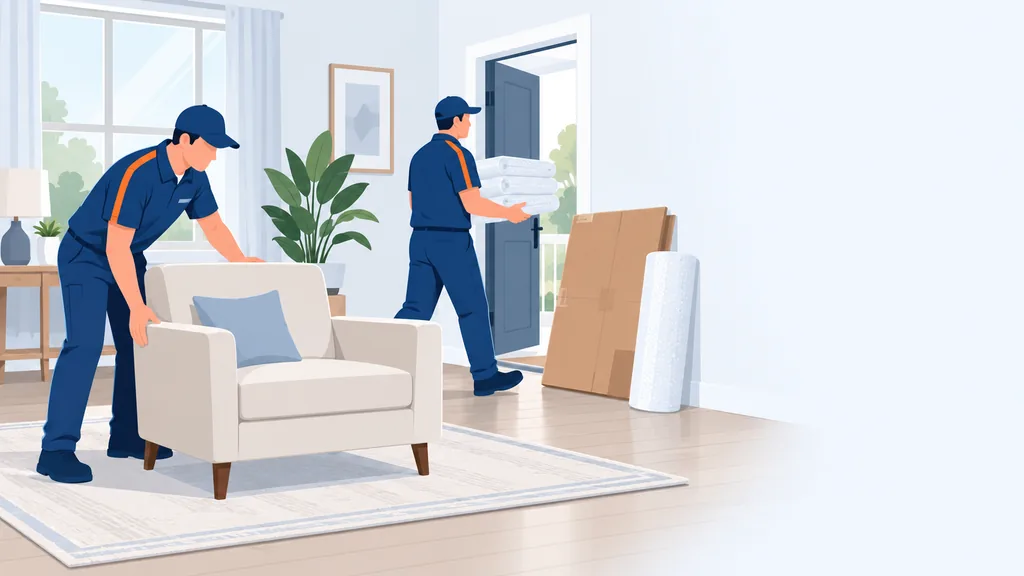

White glove delivery is the top delivery tier. A crew brings the item inside, unpacks it, sets it up in the room you choose and leaves with the packaging. Costco, which publishes every level it offers, calls its white glove option the “best of the best”.
The tier you pick decides who carries a 200-pound sofa up two flights of stairs. Choose the wrong one and your customer gets a crate on the driveway.
This guide sets out the six delivery levels side by side. It also covers what the crew does at the door, what drives the price, and which products need the upgrade.
What Is White Glove Delivery?
A white glove delivery service is the level where the crew comes inside and does the work. That means unpacking, placing the item, setting it up and taking the box away. It buys labor, not speed.
Ashley Furniture says its white glove crews place, build and check items in the room you choose, with packaging taken away after assembly. Its doorstep option includes no assembly at all.
The carrier ArcBest draws the wider line, calling final mile everything that happens during delivery, including inside delivery, assembly and trash removal. White glove sits at the top of that range.
The Six Delivery Levels, Compared
Six levels separate a parcel left on a porch from a crew building a bed frame upstairs. Costco publishes all six, so its delivery methods list is the clearest public guide to the ladder.
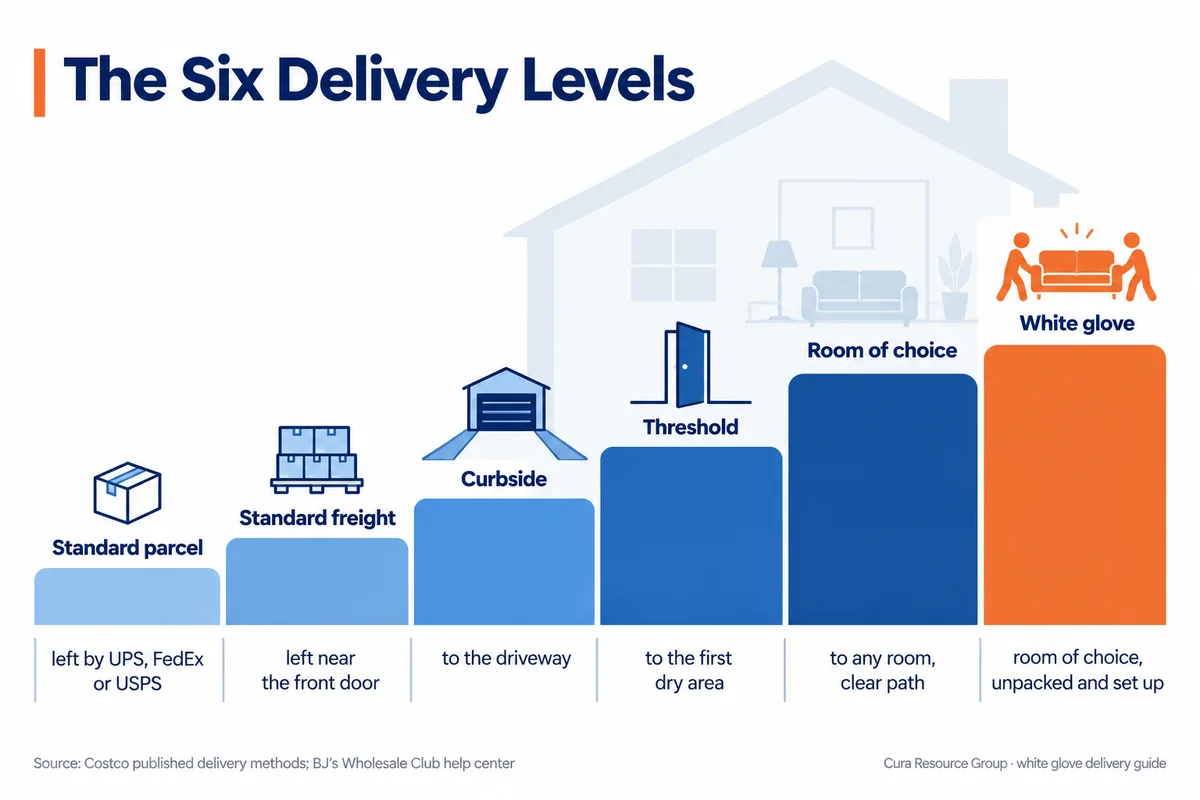
| Level | How far the item travels | Appointment | Unpacked and set up |
|---|---|---|---|
| Standard parcel | Shipped by parcel carriers such as UPS, FedEx or USPS | No | No |
| Standard freight | Left near the front door by a freight carrier | No | No |
| Curbside | To the driveway | Yes, with signature | No |
| Threshold | To the first dry area, such as a garage or just inside the front door | Yes, with signature | No |
| Room of choice | To any room, if the path is clear and safe | Yes, with signature | No |
| White glove | To the room of choice | Yes | Yes, plus inspection and packaging removal |
The gap between threshold and white glove causes the most arguments. BJ’s says setup, connection, assembly and removal of packaging materials are not included at the threshold tier.
What the Crew Does at the Door
A white glove crew unpacks the item, places it, sets it up, checks it with the customer and leaves with the packaging. The scope is narrower than most buyers assume.
Costco’s published white glove sheet for televisions lists six steps. The crew delivers to a room of choice, attaches the base and places the set on its stand. It then connects one cable or antenna, plugs the set in and removes all packaging material.
The same sheet marks the limit, stating the service does not include attachment to a mount such as a wall mount. A customer expecting a mounted television will be disappointed.
BJ’s sets a physical limit instead. Its white glove service covers unpacking, inspection and disposal of packing materials. It also covers carrying goods up or down a maximum of two flights of stairs.
Appointments are part of the service. Costco books its white glove television deliveries between 8am and 5pm on weekdays, and BJ’s runs threshold deliveries by appointment Monday to Friday.
What White Glove Delivery Costs
White glove shippers publish no flat rate, because the price is quoted per item and per address. Any single figure you see online is an estimate, not a tariff.
BJ’s says the charge varies according to the type of product purchased and the delivery address. Exact charges are given during checkout.
There are also fees that appear on the day. BJ’s warns that delivery agents may require an added fee for extra services on arrival, such as carrying a product up a flight of stairs.
On the freight side the bill is built from accessorials. ArcBest explains that residential delivery usually attracts a residential surcharge and a liftgate fee on top of the line haul.
Six things move the number:
- Weight and dimensions. Two-person items cost more than one-person items, and anything needing a liftgate costs more again.
- Stairs and access. Flights of stairs, narrow doorways, walk-ups and long carries all add labor time.
- Assembly time. A bed frame takes a crew longer than a television, and the fee follows the clock.
- Appointment window. A tight window or a weekend slot costs more than an open weekday.
- Haul-away. Taking an old mattress or appliance away is a separate service in most published terms.
- Distance from the terminal. Rural addresses sit outside dense delivery routes, so the per-stop cost rises.
Which Products Need White Glove Delivery
Anything heavy, fragile, costly or useless in a box. White glove delivery services pay for themselves when the item cannot just be left at a door.
Furniture and mattresses are the biggest group. That is why Ashley builds its whole delivery menu around whether assembly is included. Large TVs and appliances come next, with hookup and haul-away usually priced on their own.
Gym gear, medical and lab equipment, and shop fixtures sit in the same bracket. These go to a room, get built on site and often need the old unit taken away.
When White Glove Delivery Is Worth Paying For
When a failed delivery costs more than the upgrade. That is the whole calculation, and it is usually easy to run.
Four tests settle it:
- One person cannot carry it. If the item needs two people, the customer either has help waiting or has a problem.
- It needs assembly before use. An unbuilt item in a hallway is not a completed delivery.
- The recipient cannot handle it. Apartment buildings, older customers and offices without a loading dock all change the answer.
- A return would cost more. Reverse freight on a damaged sofa dwarfs the fee you saved at checkout.
White glove is a handling tier, not a speed tier. If you need a faster clock rather than more labor, same-day delivery is the different question.
What Happens in the Warehouse First
Most white glove problems start in the warehouse, not at the customer’s door. The crew can only work with what the shipment allows.
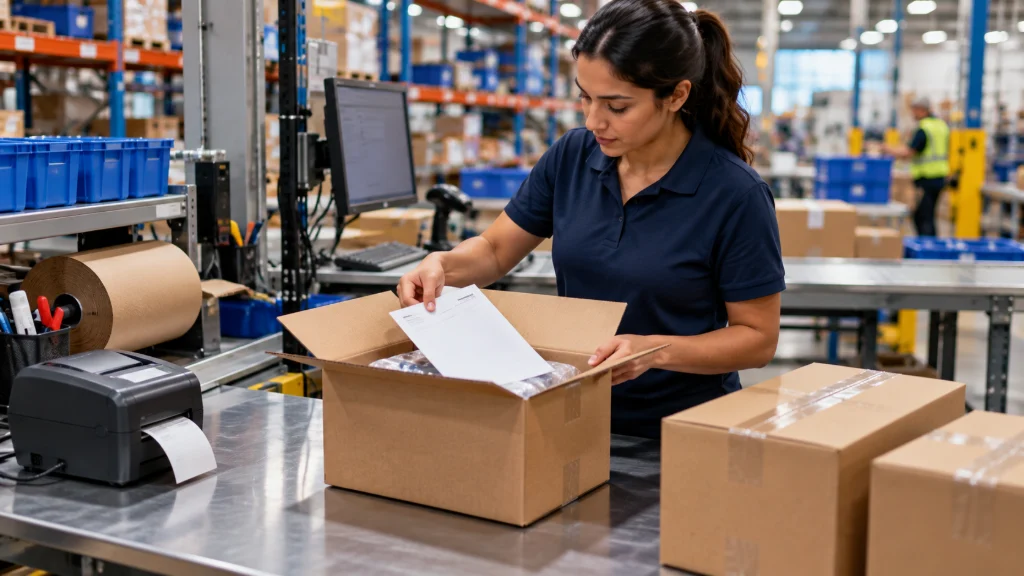
Packing has to survive a second handling. An item unpacked in a living room is opened under inspection. Damage that a standard parcel would hide becomes a refused delivery instead.
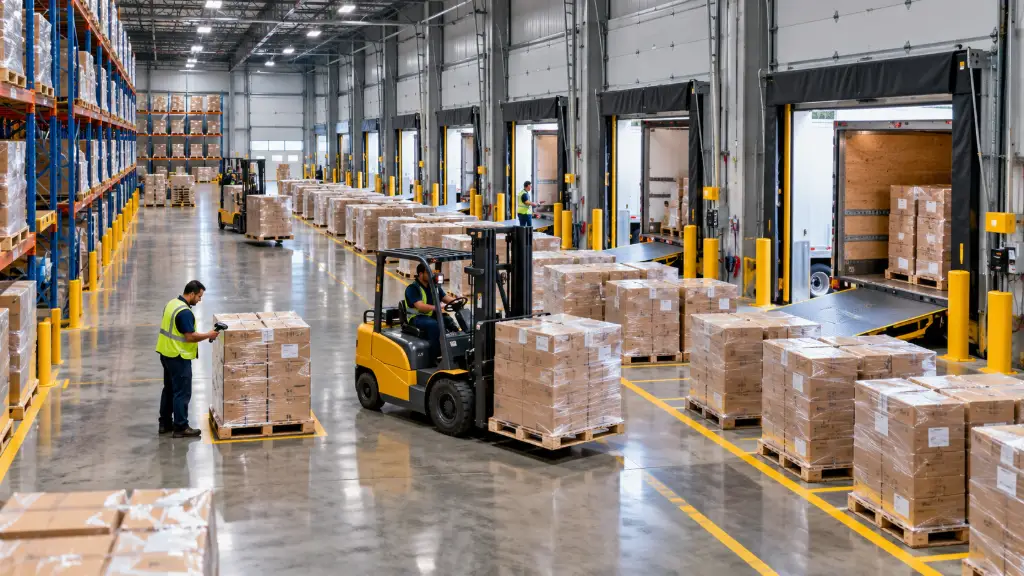
Some assembly belongs upstream. Pre-building a sub-assembly through kitting and light assembly cuts the time a crew spends on site, and the fee with it.
The paperwork matters as much as the pallet. A white glove shipment needs the appointment data, the contact details and the item list correct before it leaves. That is where pick and pack accuracy earns its keep.
All of it sits inside the wider order fulfillment process, and the tier is chosen at the shipping step rather than bolted on later.
White Glove Delivery for B2B and Retail
B2B white glove delivery goes to a store, an office or a job site, and the rules are tighter than at a house. Someone is waiting, and the window is contractual.
Retail deliveries run on a routing guide. It names the appointment, the labels, the pallet pattern and the receiving door. Meeting those terms through retail distribution and routing guide compliance keeps deliveries off a chargeback report.
Office and job-site deliveries add their own limits. No dock, a freight elevator with booked hours, a security desk and a certificate of insurance are all routine. None of them is the carrier’s problem to discover on arrival.
Returns run backwards through the same tier. A white glove return means a crew takes the item apart and collects it. Plan that alongside returns management rather than after the first request.
White Glove Delivery With Cura Resource Group
Cura Resource Group prepares and stages the shipments that white glove crews deliver. The crew at the door belongs to a final-mile carrier. Everything that decides whether their visit goes well happens before the truck is loaded.
From our fulfillment centers we pack for a second handling and build and sequence the pallets. We also pre-assemble what should not be built in a customer’s home, and hold the appointment and contact data the carrier needs.
We select the mode and book the carrier as part of shipping logistics. The tier then matches the SKU rather than the default on the order. Get a quote with your item profile and the markets you deliver to.
Scheduling, Windows and Why Deliveries Get Missed
White glove delivery runs on appointments, not on tracking numbers. The crew needs you there, so the date is agreed before the vehicle is loaded rather than after it leaves.
Costco’s published process shows the shape of it: the item goes out through a local delivery agent, the customer is contacted by email or phone to book a slot, and deliveries run 8am to 5pm, Monday to Friday, in a four-hour window. BJ’s runs its threshold tier by appointment only on the same principle.
Two things follow for anyone selling this way. A four-hour window on a weekday excludes a lot of working customers, which is why missed appointments are the most common failure in the tier. And every reschedule is a second truck roll, so the economics of a missed slot are far worse than for a parcel.
If you are specifying the service, ask what the reattempt policy costs and who absorbs it. That single answer separates carriers more reliably than anything on a capability sheet.
What Can Go Wrong, and Who Pays
Most disputes in this tier come down to one question: was the damage there before the crew arrived, or did the crew cause it. The paperwork decides it, not the argument.
Damage to the goods
The crew unpacks in front of the customer, which is the point of the tier — concealed damage gets found at the door rather than three weeks later. Note it on the delivery receipt before signing, because a clean signature says the item arrived intact.
Damage to the property
Scraped banisters, marked walls and damaged floors are a real exposure once you are carrying a 200-pound item through someone’s home. Ask what property damage cover the carrier holds, not just goods-in-transit cover. They are different policies.
The item will not fit
Stairwells, lift sizes and door frames defeat deliveries regularly, and it is nobody’s fault at the door. Measure the route, not just the item. BJ’s caps its service at two flights of stairs for exactly this reason.
Refusal at the door
If the customer refuses the item, the crew leaves with it and you pay the return leg plus the original delivery. The cost of a refusal is roughly double the cost of the delivery, which is why the pre-delivery call matters more than it looks.
How to Brief a White Glove Carrier
Brief on the room, not the postcode. A carrier can price a lane from an address, but the work happens inside the building, and that is where the cost sits.
- The item. Weight, boxed dimensions and whether it needs two people or four. A sofa and a treadmill weigh the same and handle nothing alike.
- The route. Floor, stairs, lift dimensions, parking. This is the single biggest driver of whether a job runs to time.
- The work at the door. Place only, assemble, connect, test, remove packaging, take the old item away. Each one is a separate line, and “white glove” alone does not specify any of them.
- The exceptions. What happens on a refusal, a no-access and a reschedule, and who pays each.
- The evidence. Photographs on completion, a signed receipt, and where that record is stored if a claim comes later.
Anything left unstated becomes a conversation at the customer’s door, in front of the customer. The brief is cheaper than the conversation.
Where White Glove Fits in the Wider Operation
The delivery tier is the last of several decisions, not the first. What the crew can do at the door is decided by how the item was handled long before it got on the vehicle.
An item that arrives at the final-mile hub already damaged cannot be rescued by a careful crew. That is why how the item is picked and packed and the condition it is stored in matter to a delivery that happens weeks later and hundreds of miles away.
The same applies downstream. A refusal becomes a return, and a return on a 200-pound item is a reverse returns management problem with a truck attached rather than a parcel label. Build the reverse leg into the quote, because it will be used.
White Glove, Final Mile and LTL: Who Does What
These three words describe different things, and quoting them as if they were interchangeable is where most confusion starts. One is a service level, one is a stage of the journey, and one is a freight mode.
Final mile is a stage, not a service
Final mile is the last leg, from the local hub to the address. Everything that happens during that leg sits inside it, which is why the carrier ArcBest treats inside delivery, assembly and trash removal as part of the same bracket. White glove is the top end of what can happen in that leg; it is not a separate leg.
LTL is how the freight travels
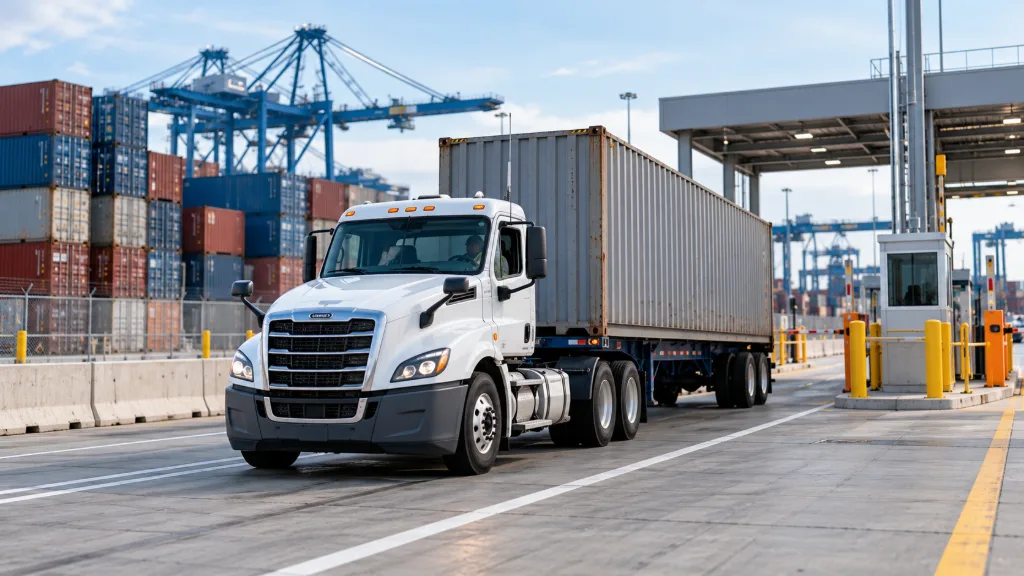
Less-than-truckload is a mode: your pallets share a trailer with other shippers’ pallets. It says nothing about what happens at the destination. An LTL shipment can end at a loading dock, at a kerb, or inside a house with a crew assembling it — those are three different accessorials on the same mode.
The accessorials are where the money is
Residential delivery, liftgate, inside delivery, appointment scheduling and limited access are billed as additions, each with its own charge. A quote that looks cheap on the line haul can land expensive once the destination is residential, has no dock and needs an appointment.
The practical test: ask what the quote assumes about the destination. If it assumes a dock and your customer has a driveway, the number is wrong.
Where the three meet
A typical consumer furniture delivery is LTL for the long haul, final mile from the regional hub, and white glove at the door. All three descriptions are true at once, which is exactly why specifying only one of them leaves the job underdefined.
If the freight leg is the part you are solving, our drayage and outbound logistics guides cover what happens before the final mile begins.
Sources and Further Reading
- Costco, What shipping methods are available on Costco.com? — the published ladder from standard parcel to white glove.
- Costco, White Glove TV Delivery — a six-step scope list and the wall-mount exclusion.
- BJ’s Wholesale Club, What is white-glove delivery? and What is over-the-threshold delivery? — where one tier stops and the next begins.
- ArcBest, What is residential delivery and how does it work? — how a carrier bills residential and liftgate service.
- Ashley, Delivery Methods — white glove against doorstep, by whether assembly is included.
Frequently Asked Questions
What is white glove delivery?
White glove delivery is the premium delivery tier. A crew brings the item into the room you choose, unpacks it, sets it up, checks it with you and takes the packaging away. It is sold as an upgrade on large, fragile or costly items that cannot simply be left at a door.
What is the difference between threshold and white glove delivery?
Threshold delivery stops at the first dry area, such as a garage or just inside the front door. BJ’s states that setup, connection, assembly and packaging removal are not included at that tier. White glove carries the item to the room of your choice and includes all of those.
How much does white glove delivery cost?
There is no published flat rate. BJ’s quotes the charge according to the product type and the delivery address, with the exact figure shown at checkout. Price is driven by weight, stairs and access, assembly time, the appointment window, haul-away and distance from the terminal.
Do you tip a white glove delivery crew?
Tipping is optional. The fee you pay is a service charge set at checkout by the retailer or carrier. Anything given to the crew is on top of it. Many customers tip after several flights of stairs or a long carry, but no published policy requires it.
What is Costco white glove delivery?
Costco’s white glove option delivers on a chosen appointment day, then unpacks, sets up and inspects the item and removes the packaging. Its television sheet goes further, listing base attachment, placement on the stand, one cable connection and power-on, while excluding attachment to a wall mount.
Does white glove delivery include assembly?
Usually yes, and that is the main thing it buys. Ashley’s white glove method places, assembles and inspects items in the room of your choice. Installation is different: Costco notes that installation services depend on the carrier and installer network and on state and local code requirements.
What is the difference between white glove and final mile delivery?
Final mile is the whole last leg to the customer, at any service level. ArcBest describes it as covering everything during the delivery process, including inside delivery, assembly and trash removal. White glove is the top tier within final mile, not a separate network.
Does white glove delivery include removing the old item?
Not automatically. Haul-away is usually a separate service, priced on its own. Costco offers in-home delivery with basic hookup and haul-away on certain appliances, with exceptions noted on the product page. That page is where these terms are set item by item.
Is white glove delivery the same as final mile delivery?
No. Final mile is the last leg of the journey, from the local hub to the address. White glove is the service level performed during that leg. Every white glove delivery is a final mile delivery, but most final mile deliveries are not white glove.
What should I ask a white glove carrier before signing?
Ask what the quote assumes about the destination, what the crew does at the door line by line, and who pays for a refusal, a no-access or a reschedule. Those three answers separate carriers more reliably than a capability sheet.