
A fulfillment company stores your stock, then picks, packs and ships each order for you. The best fulfillment companies differ most in what they ship well: fast online parcels, marketplace orders, bulky items, or retail and wholesale orders.
Match the company to your orders and delivery gets faster and cheaper. Pick the wrong one and you pay for a network you never use, or for retail work it cannot do.
Online sales made up 17.1% of US retail in the second quarter of 2026, according to the U.S. Census Bureau, up 12.2% from a year earlier. As that share grows, the company you choose handles a bigger part of your revenue.
What Are the Best Fulfillment Companies?
Eight fulfillment companies stand out, each for a different kind of order. They are Cura Resource Group, ShipBob, Flexport, Amazon FBA, ShipMonk, Red Stag Fulfillment, Stord and eFulfillment Service.
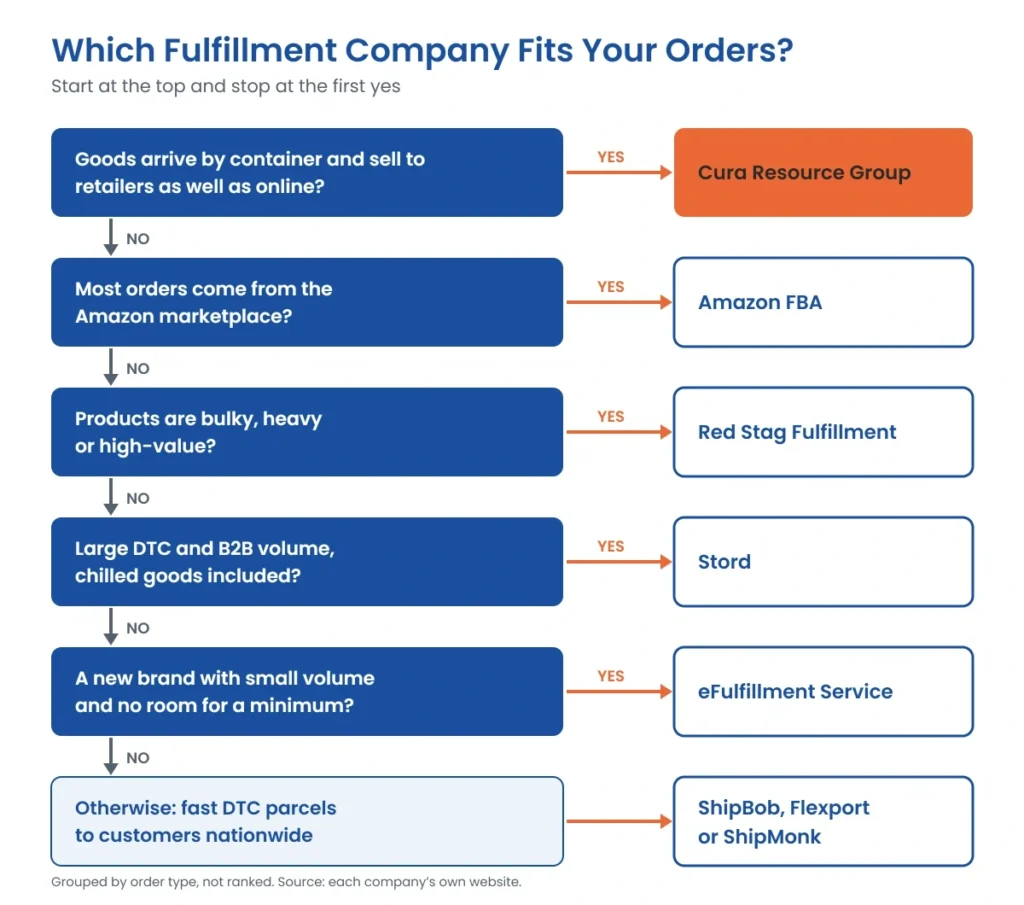
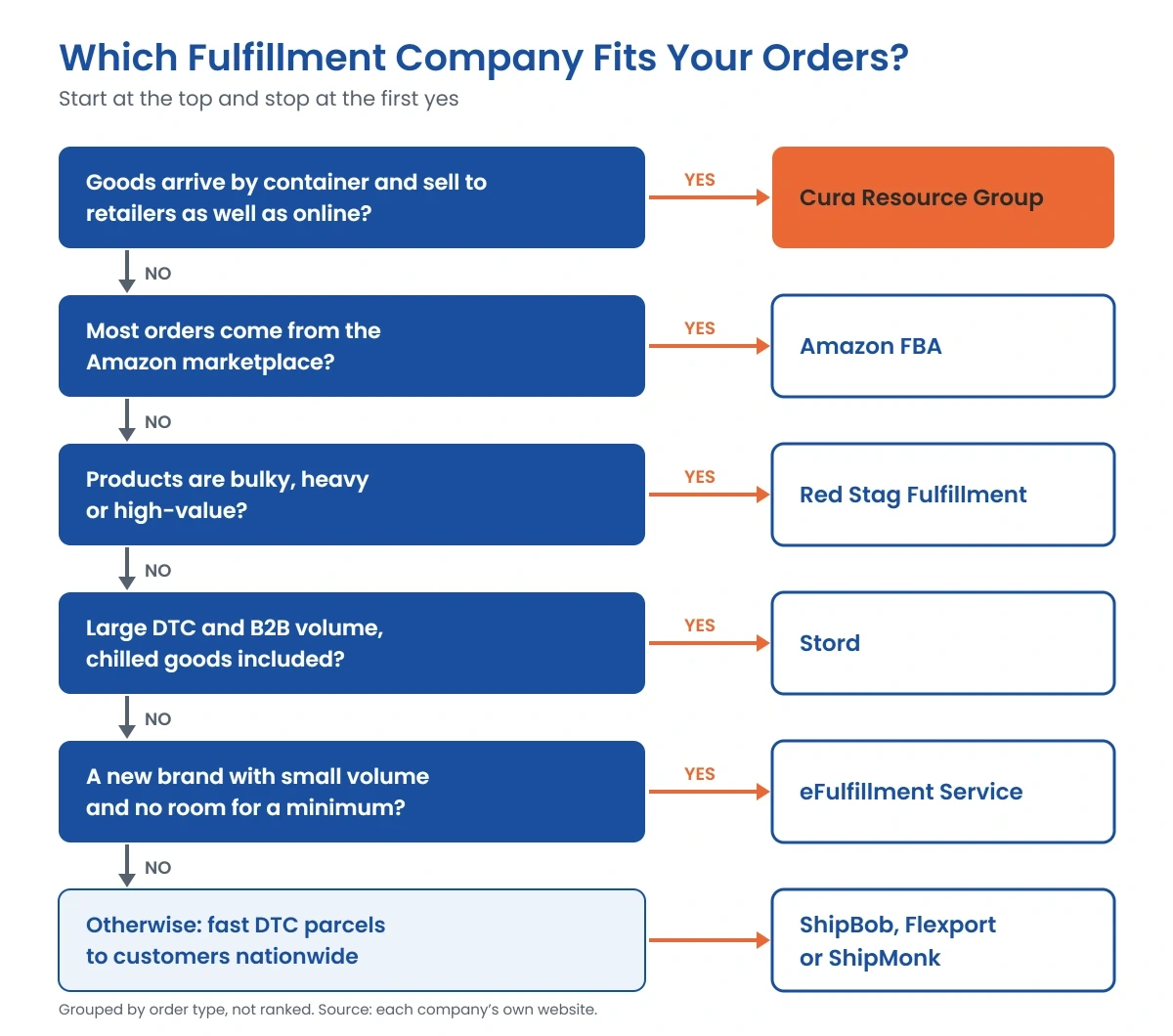
- Importers selling to retailers and online: Cura Resource Group
- Fast DTC delivery nationwide: ShipBob and Flexport
- Marketplace sellers: Amazon FBA
- Steady, high-volume DTC orders: ShipMonk
- Heavy, bulky or high-value products: Red Stag Fulfillment
- Large DTC and B2B networks, cold chain included: Stord
- New and low-volume brands: eFulfillment Service
Each pick runs at least one fulfillment center, the building where your stock waits until an order arrives. What separates them is the kind of order each building handles best. For online-only brands, the best ecommerce fulfillment companies here are ShipBob, Flexport, ShipMonk and eFulfillment Service.
How We Picked These 8 Fulfillment Companies
We judged each fulfillment company on four things. They are the orders it handles best, where its warehouses sit, its published pricing and facts from its own website.
Cura Resource Group wrote this list, and we put ourselves first. Every company-written list of top fulfillment companies we found on Google’s first page ranks its author first too. We would rather say so.
We do not number the picks. Each company sits under the order type it serves best, and we say plainly where a bigger network beats us. We checked every fact on each company’s own site in November 2026.
Best Fulfillment Companies Compared
The table sets the 8 fulfillment companies side by side: what each serves best, how big its network is and what it publishes about pricing.
| Company | Best for | Network, in its own words | Pricing it publishes |
|---|---|---|---|
| Cura Resource Group | Importers selling to retailers and online from one inventory | Warehouses in Memphis, Riverside and Carolina, Puerto Rico | Quoted to each account |
| ShipBob | Fast DTC delivery | 50+ fulfillment centers worldwide | Custom quotes only |
| Flexport | Fast DTC delivery plus retailer dropship orders | 87% of US consumers within two days | Not published |
| Amazon FBA | Marketplace sellers | Hundreds of fulfillment centers worldwide | Depends on product and services |
| ShipMonk | Steady, high-volume DTC orders | 12+ fulfillment centers on 7 campuses | Monthly minimum, no rates shown |
| Red Stag Fulfillment | Heavy, bulky or high-value products | Sweetwater, Tennessee and Salt Lake City | No standard rate card |
| Stord | Large DTC and B2B networks, cold chain included | 15 key nodes and 80+ facilities | Not published |
| eFulfillment Service | New and low-volume brands | One site in Traverse City, Michigan | No minimums, no setup fees |
Best for Importers Selling to Retailers and Online
Brands that bring goods in by container and sell them to retailers, wholesalers and online shoppers get the most from Cura Resource Group. One partner handles the goods from the port to the retailer’s distribution center and the customer’s door.
Cura Resource Group
Cura Resource Group runs every order type from one stock count. Retail, wholesale, online and FBA stock all sit in the same count, so a store order and a website order draw on the same shelf.
Our work starts before the warehouse. Our drayage services pull containers from the ports of Los Angeles, Long Beach and San Juan and from the Memphis rail ramps. We unload them at our own warehouses.
As importer of record, we file the US customs entry in our own name and provide the customs bond. We pay the duty at entry, bill it back to you and file through licensed customs brokers.
On the retail side, our retail compliance team receives purchase orders by EDI and sends advance ship notices back. We book retailer delivery appointments, print GS1-128 carton labels and dispute chargebacks for you.
We also run kitting and assembly services, subscription box fulfillment and FBA prep in the same buildings. Returns from retailers come back into the same inventory.
Our warehouses sit in Memphis, Tennessee, Riverside, California and Carolina, Puerto Rico. Memphis also offers temperature-controlled storage. Founded in 2008, Cura Resource Group has run logistics for 18 years.
Pick us when your goods arrive by sea and leave as store pallets and online parcels. To see how your order mix would run, request a fulfillment quote and we will price it against your real volumes.
Best for Fast DTC Delivery Nationwide
ShipBob and Flexport suit online brands whose customers expect two-day delivery to almost any US address. Both run large parcel networks built around direct-to-consumer (DTC) orders.
ShipBob
ShipBob fits growing DTC brands that want a large network and fast delivery promises. ShipBob says it runs 50+ fulfillment centers across the world and offers 2-day shipping across the continental US.
ShipBob also takes wholesale orders and builds each quote for the customer instead of publishing rates. Choose ShipBob when speed to consumers matters more than retail compliance depth.
Flexport
Flexport suits brands that want one provider for freight, distribution and online orders. Flexport says 87% of US consumers live within two days of one of its fulfillment centers, and its dropship service reaches over 60 retailers.
The service, formerly Deliverr, now runs as Flexport’s eCommerce Fulfillment. Choose Flexport if you also want it to manage your freight.
Best for Marketplace Sellers
Amazon FBA suits sellers whose orders come mostly from the Amazon marketplace. Amazon runs the fulfillment itself and attaches Prime delivery to your listings.
Amazon FBA
Fulfillment by Amazon lets sellers hand order fulfillment to Amazon and offer free two-day Prime shipping from hundreds of fulfillment centers worldwide. Amazon says FBA costs depend on the products you sell and the services you use.
For orders from other channels, Amazon offers Multi-Channel Fulfillment from the same pool of inventory. FBA also sets strict prep and labeling rules for every inbound shipment.
A 3PL can handle that prep before stock reaches Amazon, and our FBA prep services team labels, bags and forwards shipments for sellers. Choose FBA when the marketplace drives most of your sales.
Best for Steady, High-Volume DTC Orders
ShipMonk suits DTC brands with steady monthly order volume and customers across the lower 48 states. Its campus model groups several fulfillment centers in each key market.
ShipMonk
It sets a monthly minimum from your order volume and its first-item pick fee. That model rewards brands with steady orders more than brands with big seasonal swings.
Best for Heavy, Bulky or High-Value Products
Red Stag Fulfillment suits brands shipping large, heavy or expensive items, where damage costs more than the shipping. Red Stag calls big and heavy goods its specialty.
Red Stag Fulfillment
It does not publish a standard rate card, and it offers month-to-month or long-term contracts. Choose Red Stag for oversized or high-value goods that need careful handling.
Best for Large DTC and B2B Networks
Stord suits larger brands running both DTC and B2B orders across North America. Its network spans key markets across North America.
Stord
Stord also runs cold and temperature-controlled fulfillment. Choose Stord when you need a large network for both channels, chilled goods included.
Best for New and Low-Volume Brands
eFulfillment Service suits startups and small sellers that cannot commit to a minimum or a long contract. It keeps terms simple and runs from a single building.
eFulfillment Service
eFulfillment Service says it has no order minimums, no setup fees and no long-term contracts. All its orders ship from one fulfillment center in Traverse City, Michigan, which reaches most US addresses in 2 to 4 days.
Choose it while your volumes stay small and predictable. Review the fit once you add retail or wholesale orders.
Cura or a Giant: Which Fits Your Orders?
A giant fits brands that sell mostly online and need speed everywhere. Cura fits brands whose imported goods leave as retail, wholesale and online orders from one stock count. The best fulfillment company for you is the one built for your order mix, not the biggest one.
When a Giant Fits Better
Pick ShipBob, Stord or Amazon FBA when two-day delivery to almost every US address decides your sales. ShipBob, Stord and Amazon each list 50 or more fulfillment centers or facilities, and Cura runs a smaller network of its own warehouses.
A giant also wins if you ship parcels only, with no retail orders, no imports and no kitting.
When Cura Fits Better
Cura fits better when one container of imported goods must become store pallets, wholesale cartons and online parcels. We pull the container from the port, file the customs entry and ship every channel from one count.
You also get one team for routing guides, chargebacks and returns. The alternative is a parcel network, plus a freight forwarder, plus a separate retail distributor, each holding a piece of your stock.
How Do You Read a Fulfillment Company’s Network Claims?
Read every network claim for three things: where the buildings are, who runs them and what the delivery promise measures. Two companies with similar headline numbers can serve your customers very differently.
Count US Buildings, Not Worldwide Ones
A worldwide count includes sites abroad that never touch a US order. ShipBob gives its fulfillment center count as a worldwide figure, so ask how many of those sites serve your US customers.
Ask Who Runs Each Building
Some networks include partner-run facilities alongside their own. Partner sites can work well, but your contract should name the company handling your stock and the one that answers for errors.
Check What the Delivery Promise Measures
Two-day claims differ in what they count. Flexport counts US consumers within two days.
ShipMonk counts the lower 48 states reached by ground, and Stord gives its coverage by ground. Ask which service level, carrier and origin each promise assumes.
Fulfillment Company, Marketplace Fulfillment or Software-Led Network?
Three models sell fulfillment today: fulfillment companies with their own warehouses, marketplace fulfillment, and software-led networks of partner buildings.
A fulfillment company such as Cura, ShipMonk or Red Stag runs its own buildings and staff, so one team owns your inventory. Marketplace fulfillment, such as FBA, gives Prime delivery but follows Amazon’s rules and fees.
Software-led networks spread stock across many buildings, some run by partners, and manage them through one platform. That gives wide reach, with several operators behind one contract.
What Do Fulfillment Companies Charge?
Expect separate fees for receiving, storage, pick and pack, packaging, shipping and returns, and few of the 8 picks publish full rates.
eFulfillment Service publishes no minimums and no setup fees as standing terms. ShipMonk sets a monthly minimum based on order volume and its first-item pick fee. Red Stag has no standard rate card, and ShipBob builds every quote to the customer.
Amazon prices FBA by product and service. We quote each Cura account to its order profile and the order fulfillment services it needs, instead of publishing one rate card.
Compare quotes on total cost per order at your real volume, not on the headline pick fee. A low pick fee paired with high receiving and storage charges can cost more over a year.
How to Test a Fulfillment Company Before You Sign
Four checks show how a fulfillment company treats orders: real test orders, written accuracy and receiving times, a retail and marketplace walk-through, and exit terms.
Run a Batch of Real Test Orders
Send a small batch of your actual SKUs and real orders before you move all your stock. Watch how fast the team receives them, how it packs them and what arrives at a few test addresses.
Get Accuracy and Receiving Times in Writing
Ask for order accuracy and dock-to-stock time as contract terms, not sales claims. Dock-to-stock time means the hours between a truck’s arrival and stock you can sell.
Several picks publish accuracy figures on their own sites. Ask each company to write its figure into the contract and to track it with the same warehouse KPIs you would use in-house. Ask for the daily order cut-off too: every Cura account gets one, agreed at onboarding.
Walk Through Your Retail and Marketplace Orders
Give each company a real retailer routing guide and a marketplace prep list, and ask who handles each step. Ask too whether wholesale and EDI orders cost extra, because some providers price them as add-ons.
Read the Exit Terms Before the Rates
Check the notice period, the fee for moving stock out and who owns your order data. Red Stag offers month-to-month or long-term contracts, which shows the range of terms worth asking for.
Frequently Asked Questions
What are the top 10 fulfillment companies?
Lists vary by source, and every company-written list puts its author first. Our 8 picks, grouped by order type, are: (1) Cura Resource Group for importers selling to retailers and online, (2) ShipBob and (3) Flexport for fast DTC delivery, (4) Amazon FBA for marketplace sellers, (5) ShipMonk, (6) Red Stag, (7) Stord and (8) eFulfillment Service.
What is the best fulfillment center?
Look for the building closest to most of your customers that also handles every order type you sell. A brand selling to West Coast retailers and online shoppers needs different strengths from one shipping single-item parcels nationwide. Match location and services to your real orders.
Is Amazon FBA a fulfillment company?
Fulfillment by Amazon is Amazon’s own fulfillment program for marketplace sellers. Amazon stores your stock and ships Amazon orders with Prime delivery, and its Multi-Channel Fulfillment ships orders from other channels out of the same inventory. Amazon says costs depend on the product and the services you use.
Which fulfillment company is best for B2B and retail orders?
Cura Resource Group fits brands that sell to retailers, wholesalers and online shoppers from one inventory. We receive retailer purchase orders by EDI, send advance ship notices, book retailer delivery appointments and dispute chargebacks. Stord also runs DTC and B2B orders across a large North American network.
How much do fulfillment companies charge?
Expect fees for receiving, storage, pick and pack, packaging, shipping and returns. Few companies publish full rate cards. Red Stag has none, ShipBob builds each quote to the customer and Amazon prices FBA by product and service. Compare total cost per order at your real volume.
Do fulfillment companies have order minimums?
Some do and some do not. eFulfillment Service says it has no order minimums, no setup fees and no long-term contracts. ShipMonk sets a monthly minimum from your order volume and its first-item pick fee. Ask every company for its minimum in writing before you compare prices.
What are the largest warehouse companies in the USA?
The largest US warehouse and logistics companies are contract logistics giants that Armstrong and Associates ranks by revenue each year. Size gives national reach, not a fit for every order type. Our list of the best 3PL companies names the biggest providers and the business each one suits.
Can one fulfillment company handle Amazon, retail and online orders?
Yes, if it runs all three from one inventory. Cura Resource Group keeps retail, wholesale, online and FBA stock in one count, preps FBA shipments and handles retailer routing guides and chargebacks. One count stops you selling the same units online while a retail order waits for them.