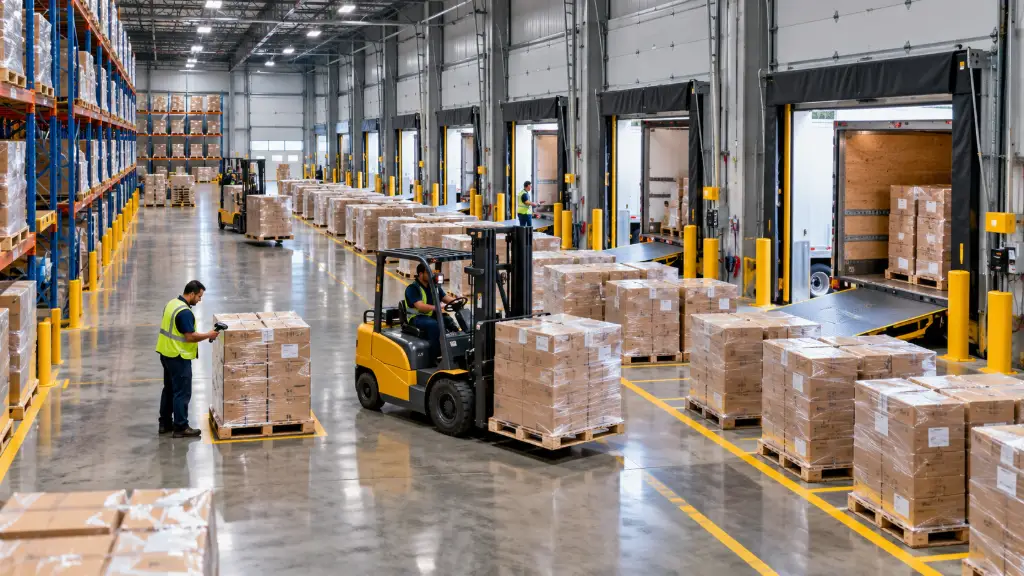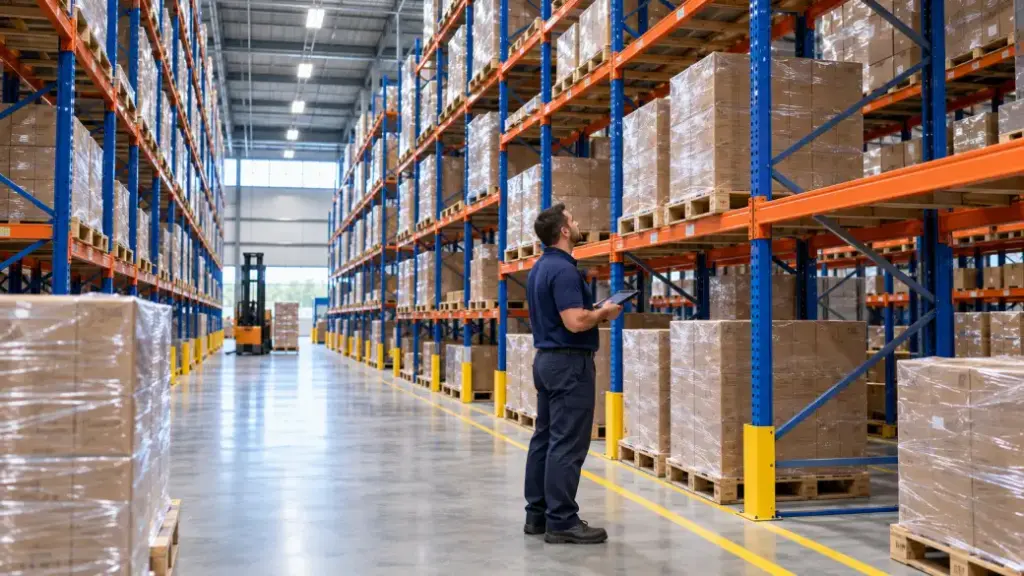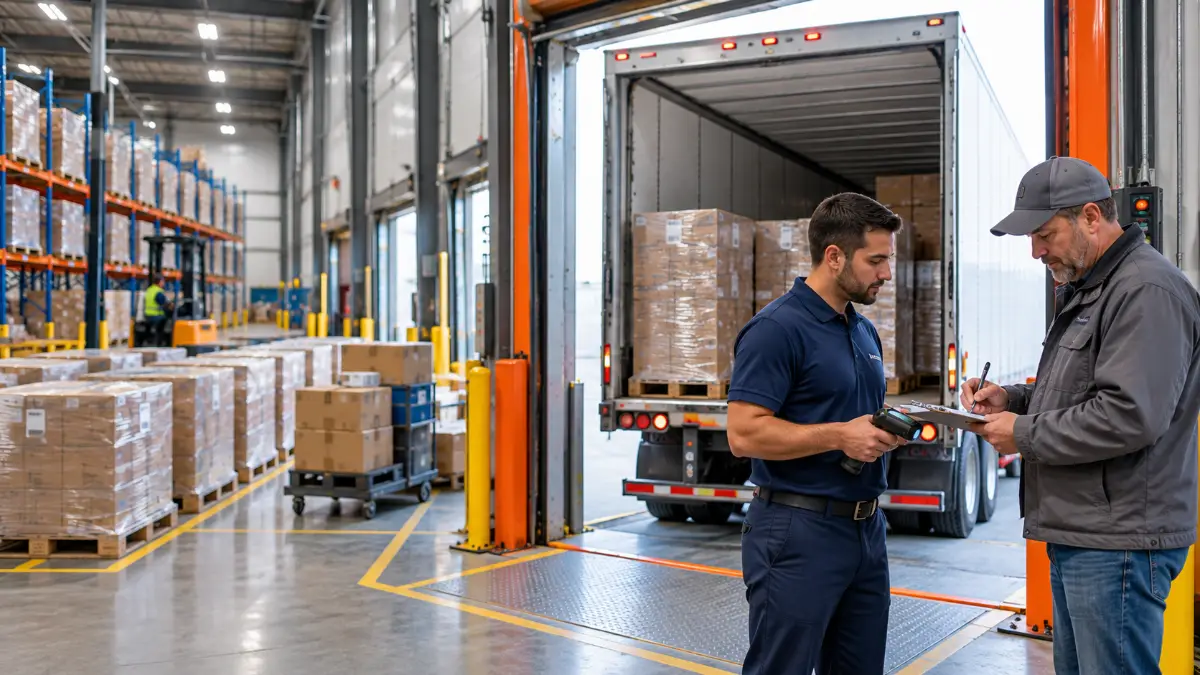

Supply chain visibility is the ability to track inventory, orders and shipments in real time at every stage. That runs from supplier and inbound freight through warehousing to final delivery, so everyone working from the data sees the same position at once.
Without it, problems surface late. A missing shipment stops production, a wrong delivery upsets a customer, and nobody knows until the damage is done.
This guide sits alongside our overview of supply chain logistics. It covers the 5 types of visibility, the tools that provide it, the benefits and challenges, and 7 ways to improve it.
What Is Supply Chain Visibility?
Supply chain visibility means knowing where your products are at every step, from raw materials to final delivery. Data from sensors, GPS tracking, inventory systems and software platforms is combined into one view, so the business stays in control.
Take a brand that sells shoes. Raw materials come from one country, the shoes are made in another, and they ship worldwide. With visibility, the brand can track shipments in real time, check stock levels and fix issues quickly.
Why Does Supply Chain Visibility Matter?
Supply chain visibility matters because the cost of not knowing rises with volume. According to the U.S. Census Bureau, US ecommerce reached $340.2 billion in the second quarter of 2026. That was 17.1% of all retail sales, up 12.2% year on year.
Every additional order is another chance for the system record and the physical shelf to drift apart. Visibility is what catches that drift before it becomes a stockout, a late shipment or a lost customer.
What Are the 5 Types of Supply Chain Visibility?
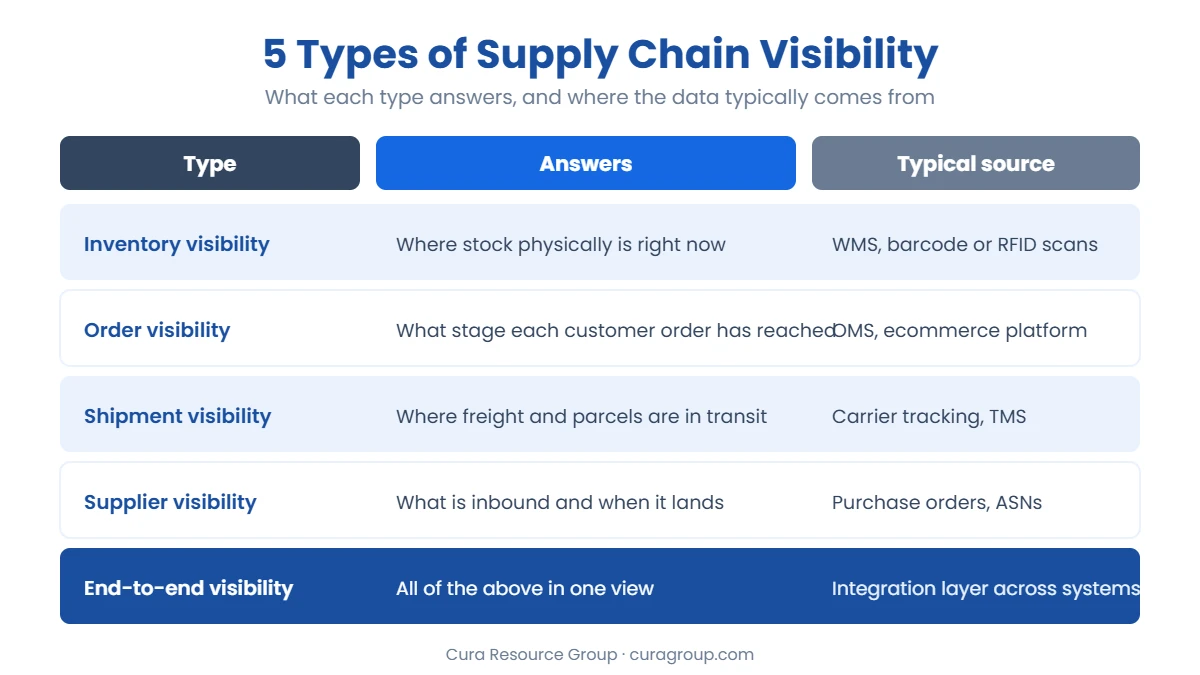
The 5 types of supply chain visibility are inventory, order, shipment, supplier and end-to-end visibility. The first four each answer one question from one system; end-to-end visibility joins them in a single view.
| Type | Answers | Typical source |
|---|---|---|
| Inventory visibility | Where stock physically is right now | WMS, barcode or RFID scans |
| Order visibility | What stage each customer order has reached | OMS, ecommerce platform |
| Shipment visibility | Where freight and parcels are in transit | Carrier tracking, TMS |
| Supplier visibility | What is inbound and when it lands | Purchase orders, ASNs |
| End-to-end visibility | All of the above in one view | Integration layer across systems |
Visibility also varies in speed and reach. Real-time visibility shows each update as it happens, which matters most during a disruption. Global supply chain visibility extends tracking across borders, where customs delays, weather and political changes add risk.
What Tools Provide Supply Chain Visibility?
Supply chain visibility tools work in two layers: capture tools that record where goods are, and software that combines those records into one view. Capture tools include GPS tracking, RFID tags, barcode scans and IoT devices.
- Supply chain visibility software: connects systems and shows shipment tracking, inventory monitoring, alerts and dashboards in one place.
- Cloud platforms: flexible, scalable systems that host the data as volume grows.
- Analytics and AI: turn raw data into insight, predicting likely delays and suggesting better routes.
What Are the Benefits of Supply Chain Visibility?
Better visibility brings 5 main benefits, namely faster decisions, fewer delays, higher customer satisfaction, lower costs and better risk management.
- Faster decisions: real-time data replaces guesswork.
- Fewer delays: problems are spotted early, before they grow.
- Higher customer satisfaction: accurate delivery times replace vague estimates.
- Lower costs: less waste, less overstock and fewer emergency shipments.
- Better risk management: risks surface before they become serious issues.
What Are the Challenges of Supply Chain Visibility?
Visibility is held back by 5 main challenges, namely data silos, outdated technology, cost, complex global operations and data security.
- Data silos: when each supplier or system uses its own format, the data does not match and gaps open up.
- Outdated technology: older systems cannot track data in real time.
- Cost: advanced systems can be expensive, especially for smaller businesses.
- Complex global operations: more countries and partners make every movement harder to track.
- Data security: sharing data across systems creates risk, so that information must be protected.
How Do You Improve Supply Chain Visibility?
The 7 steps are modern software, connected systems, real-time tracking, team training, partner data sharing, analytics and starting small:
- Use modern supply chain visibility solutions that connect your systems and track data.
- Integrate your systems so data silos disappear.
- Use real-time tracking so decisions rest on current data.
- Train your team to use the tools properly.
- Share data with suppliers and partners so each stage sees the same record.
- Use analytics to find patterns and improve performance.
- Start small with one area, then expand, rather than changing everything at once.
Cura Resource Group gives the brands it holds stock for the same live inventory view its own floor team works from, rather than a weekly report. Visibility that arrives after the decision has been made is reporting, not visibility.
What Does End-to-End Supply Chain Visibility Mean?
End-to-end visibility means seeing a product from raw material to the customer’s door, not just the stretch you control. Most businesses have visibility over their own warehouse and their outbound carrier, and very little upstream of that.
The gap is almost always the supplier tier. You know what you ordered and when it was promised; you often do not know whether it has been made, whether it has shipped, or what is actually in the container until it arrives. Closing that gap is a commercial negotiation before it is a technical one — suppliers share data when the contract says they will.
Downstream is easier. Carrier tracking, outbound logistics milestones and proof of delivery are usually available; the work is pulling them into the same view as everything else rather than checking three portals.
Supply Chain Visibility vs Traceability: What Is the Difference?
Visibility tells you where something is now. Traceability tells you where it has been. They use overlapping data and answer different questions.
Visibility is an operational tool: it drives today’s decisions about replanning, expediting and promising delivery dates. Traceability is a record: it lets you follow a batch backwards to its origin when a recall, an audit or a customs query demands it, and it is what trade compliance obligations usually turn on.
A system built only for visibility often cannot answer a traceability question, because it holds current status and overwrites history. If both matter to you, say so before you choose a platform — retrofitting batch-level history later is expensive.
Supply Chain Visibility Software: What to Look For
Supply chain visibility software pulls data from the systems that already hold it — your warehouse system, your carriers, your suppliers — and presents one current view. What separates tools is not the dashboard. It is how much of that data they can reach without someone rekeying it.
Five things decide whether a platform earns its cost:
- Coverage. Which systems and carriers it connects to natively, and what needs a custom integration you will pay for twice.
- Refresh rate. Whether data arrives as events happen or on a nightly schedule. A daily file is reporting, not visibility.
- Exception handling. Whether it only shows status, or flags the shipments that need a decision today.
- Granularity. Order, shipment, pallet or unit level — and whether that matches how you actually plan.
- Access. Who outside your business can see what, suppliers and customers included.
Most businesses do not need to buy a platform to get this. If your stock sits with a third-party logistics provider, their warehouse system is usually where the visibility already lives.
How Does Supply Chain Visibility Improve Planning?
Visibility improves planning by replacing assumptions about stock and timing with current figures. A planner working from last week’s report is ordering against a position that has already moved.
Three effects follow. Safety stock falls, because buffer exists to absorb uncertainty and less uncertainty needs less buffer. Delivery promises get more accurate, because dates come from actual transit performance rather than a carrier’s published average. And problems surface while they can still be fixed — a late inbound container seen on Monday can be replanned, while the same container discovered on Friday cannot. This is where visibility feeds directly into demand planning and forecasting.
What Supply Chain Visibility Looks Like With a 3PL
With a third-party provider, visibility comes from the warehouse system running your inventory rather than software you buy and integrate yourself. You see receipts, stock positions and outbound shipments as the operation records them.
That covers the stretch of the chain the provider touches: inbound receiving, warehousing and distribution, picking and the handover to the carrier. It does not reach your suppliers upstream, so a complete picture still needs their data alongside it.
Cura Resource Group gives clients a real-time view of inventory across the network, which is the practical form most businesses need before they consider buying a visibility platform.
Which Supply Chain Visibility Trends Should You Watch?
The 5 trends shaping supply chain visibility are AI and automation, blockchain, IoT growth, cloud-based platforms and sustainability tracking:
- AI and automation: predicting delays and demand, and automating routine tasks.
- Blockchain: a shared record that improves data security and transparency across systems.
- IoT growth: more connected devices collecting real-time data.
- Cloud-based platforms: flexible, scalable systems that are easy to adopt.
- Sustainability tracking: measuring environmental impact and reducing waste.
Final Word
Supply chain visibility is no longer optional. When a business can see its entire supply chain, it makes better decisions, reduces risk and gives customers accurate delivery updates.
Visibility is an input, not an outcome — it pays off only when it changes a decision. That is clearest in peak-season planning, and it depends on real-time inventory visibility at the stock-keeping level rather than dashboards alone. Both sit inside Cura’s supply chain solutions.
Want visibility that actually changes decisions?
Frequently Asked Questions
What does supply chain visibility mean in simple terms?
In simple terms, supply chain visibility is always knowing where your stock, orders and shipments are. A business with visibility sees a delay or a stock problem early enough to act. It can also give customers delivery times it can keep.
What does supply chain visibility require?
Supply chain visibility requires connected data from each stage of the chain. A warehouse management system covers stock and an order management system covers orders. Carrier tracking covers shipments, and purchase orders or ASNs cover inbound supply. An integration layer then joins them into one view.
What is end-to-end supply chain visibility?
End-to-end supply chain visibility is a single view of the whole journey, from raw materials and production through shipping to final delivery. It combines inventory, order, shipment and supplier data, so nothing is hidden between stages. A food company, for example, can trace ingredients from farm to store for quality control and faster recalls.
Which technologies make supply chain visibility possible?
The core technologies are GPS tracking, RFID tags, barcode scanning and IoT devices, which record where goods are. Visibility software and cloud platforms combine those records into one view. Analytics and AI then turn the data into insight, such as flagging a likely delay before it happens.
Why does real-time supply chain visibility matter?
Real-time supply chain visibility matters because problems surface the moment they happen. If a shipment is delayed, the business knows immediately and can inform customers, adjust plans and reduce losses. Without it, the delay stays hidden until the order arrives late.
How do you improve visibility in the supply chain?
Start by connecting the systems that already hold the data rather than buying a new one. Agree what each partner will share and how often, standardise how items and locations are named, then set alerts on exceptions instead of asking people to read dashboards. Most gaps are contractual and definitional, not technical.
What are supply chain visibility tools?
The common ones are warehouse management systems, transportation management systems, order management systems, carrier tracking feeds, EDI or API connections to suppliers, and control-tower platforms that sit above them. Most businesses already own several and have never connected them to each other.
Why is supply chain visibility important?
Because decisions made on stale data cost money in predictable ways: excess safety stock, missed delivery promises, and disruptions found too late to absorb. Visibility does not prevent problems. It shortens the gap between something going wrong and somebody knowing about it.
How does improved supply chain visibility improve the planning process?
It replaces estimates with current figures. Planners order against real stock positions rather than last week’s report, quote delivery dates from actual transit performance rather than published averages, and can replan a late inbound while there is still time to act on it.
Which supply chain visibility solutions predict delivery delays?
Predictive capability comes from platforms that combine live carrier telemetry with historical lane performance, rather than from tracking feeds alone. Ask a vendor what data the prediction is built on and how far ahead it flags a risk. A tool that reports a delay after it happens is doing tracking, not prediction.