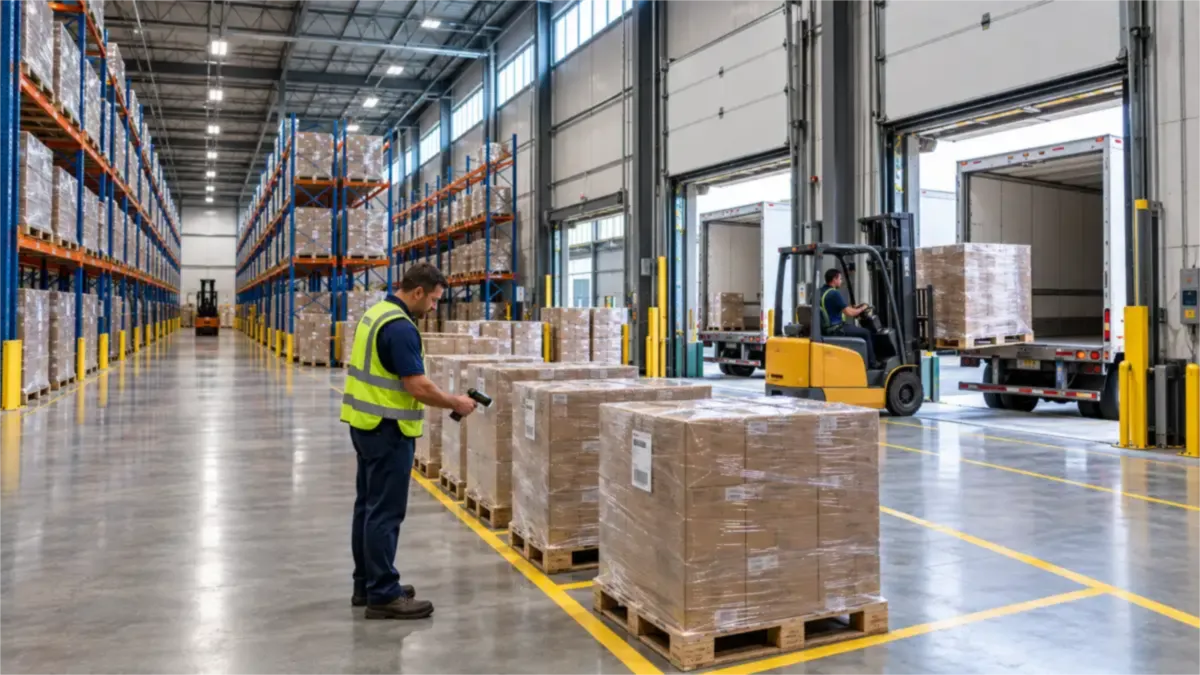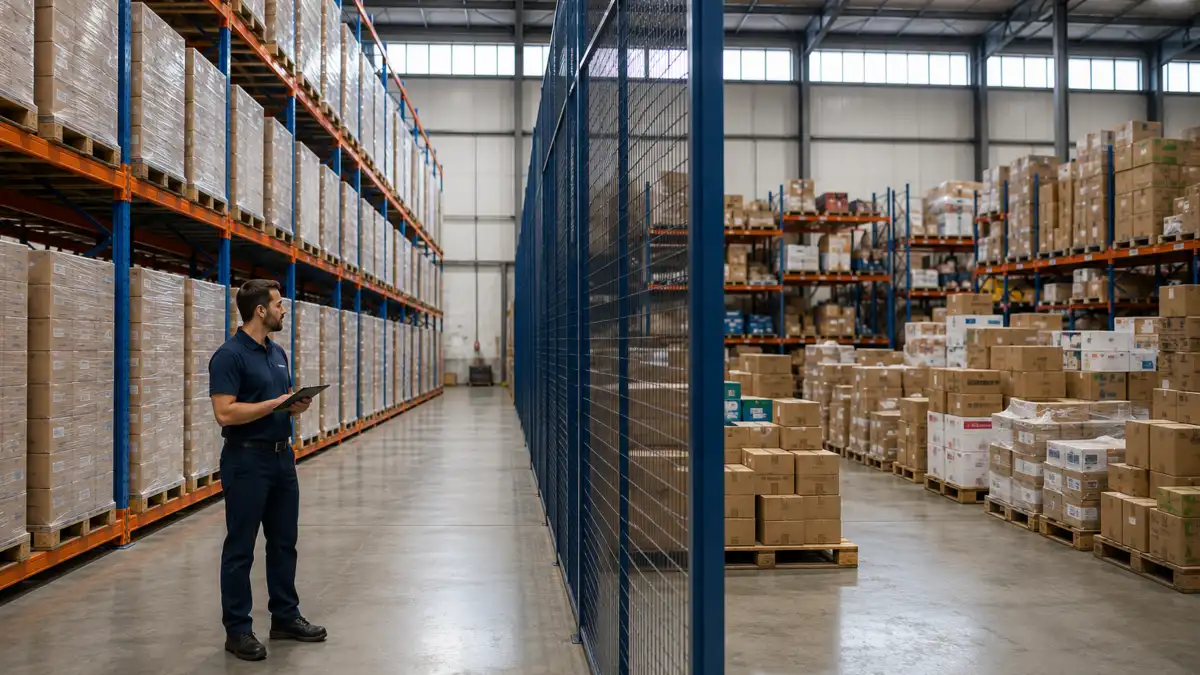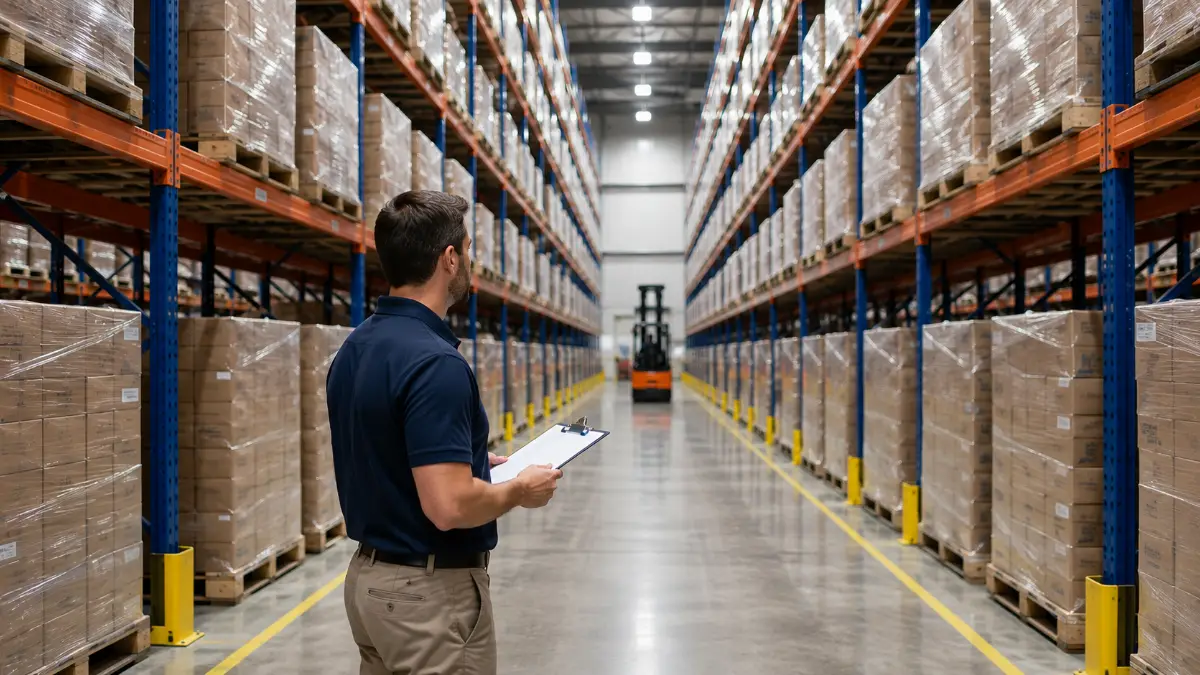
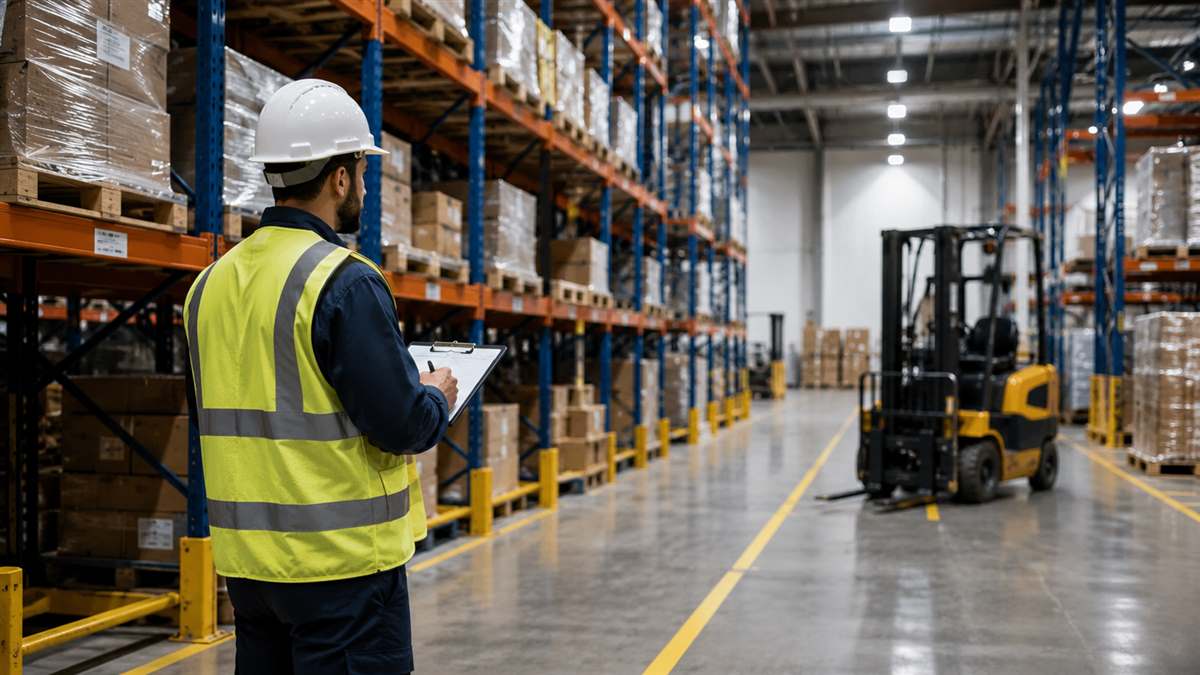
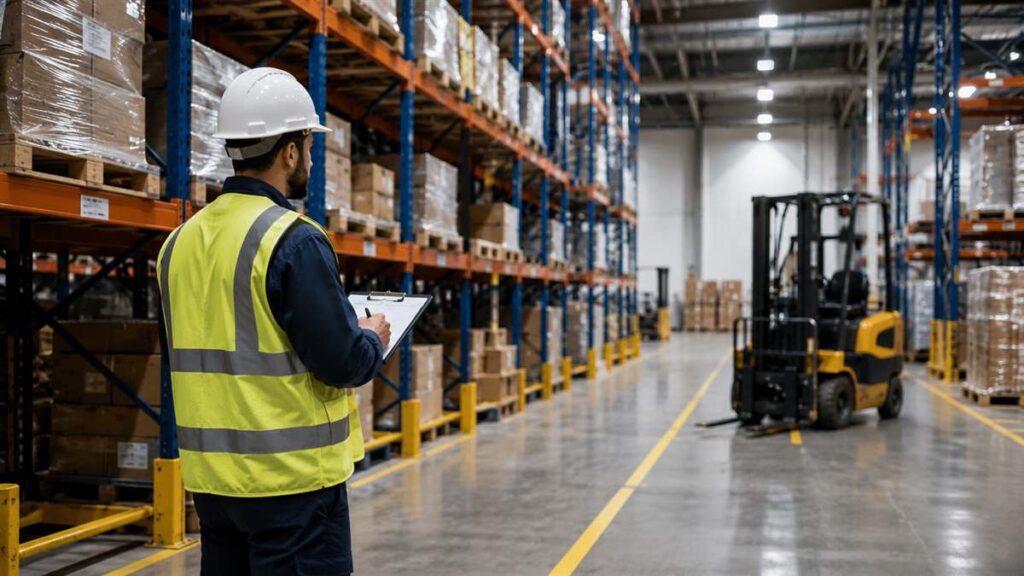

OSHA warehouse safety rules are the federal workplace standards that govern how a warehouse stores material, operates forklifts, marks aisles, protects workers, and handles hazards. There is no single “warehouse standard” — instead, a handful of general-industry rules apply, led by 1910.176 (materials handling and storage) and 1910.178 (powered industrial trucks), backed by the General Duty Clause. This guide explains which OSHA standards apply to warehouses, the most-cited violations, what the rules actually say about racking, temperature, aisle width, and lighting, and a practical compliance checklist you can work through.
This guide is an overview for warehouse operators, not legal advice. Always check the current text of the standards on OSHA.gov, and note that state-plan states may enforce stricter rules.
What Does OSHA Require in a Warehouse?
OSHA requires a warehouse to keep material stored safely and stably, operate powered industrial trucks with trained and certified operators, maintain clear and safe aisles and exits, communicate chemical hazards, provide the right protective equipment, and generally keep the workplace free of recognized hazards that could cause serious harm.
That last part matters. Where no specific standard exists, OSHA enforces through the General Duty Clause — Section 5(a)(1) of the OSH Act — which requires employers to provide a workplace free from recognized hazards likely to cause death or serious physical harm. It is how OSHA cites hazards like extreme heat or unstable racking even without a rule written specifically for them.
Which OSHA Standards Apply to Warehouses?
Several general-industry standards do the heavy lifting in a warehouse:
| Standard | What it covers |
|---|---|
| 1910.176 | Materials handling and storage: safe clearances in aisles, stable stacking and tiering, keeping storage areas clear of hazards |
| 1910.178 | Powered industrial trucks: forklift operator training and certification, pre-shift inspections, load capacity, safe operation |
| 1910.36 / 1910.37 | Exit routes: unobstructed, clearly marked exits and adequate egress |
| 1910.22 | Walking-working surfaces: floors and passageways kept clean, orderly and dry where feasible, with drainage where wet processes are used |
| 1910.28 | Fall protection: required where an unprotected side or edge is 4 feet or more above a lower level, with a conditional exception for the working side of a loading dock |
| 1910.132 | Personal protective equipment: hazard assessment and providing suitable PPE |
| 1910.1200 | Hazard communication: chemical labeling, safety data sheets, worker training |
| 1910.147 | Lockout/tagout: controlling hazardous energy during equipment servicing |
| 1910.212 / 1910.219 | Machine guarding, including conveyors and powered equipment |
| General Duty Clause | Recognized hazards with no specific standard — heat, ergonomics, rack stability |
What Is OSHA’s National Emphasis Program for Warehouses?
The National Emphasis Program (NEP) is an OSHA initiative that directs inspectors to run targeted, programmed inspections at warehouses and distribution centers rather than only responding to complaints. OSHA launched it in July 2023 and has since updated it — according to OSHA’s warehousing overview, inspections under the updated NEP began on July 31, 2026, and the program applies OSHA-wide.
Inspections under the program concentrate on the hazards that injure the most warehouse workers: powered industrial trucks, material handling and storage, walking-working surfaces, means of egress, and heat and ergonomic exposure. OSHA notes that the most common warehouse injuries are musculoskeletal disorders — mainly from overexertion in lifting and lowering — and workers being struck by forklifts and other materials handling equipment. For scale, the U.S. Bureau of Labor Statistics recorded 4.8 total recordable injury and illness cases per 100 full-time workers across warehousing and storage in 2024, which is the industry rate your own figure sits against.
The practical takeaway: if you operate a warehouse or distribution center, your odds of a programmed inspection are materially higher than they were before 2023, and the July 2026 refresh signals OSHA is not easing off. Plan for scrutiny rather than reacting to it.
How Does OSHA Check for Compliance?
OSHA checks compliance through workplace inspections conducted by compliance safety and health officers, and it does not announce them in advance. There is no certificate to apply for and no routine audit you schedule — an inspector arrives, and what they find on the day is what counts.
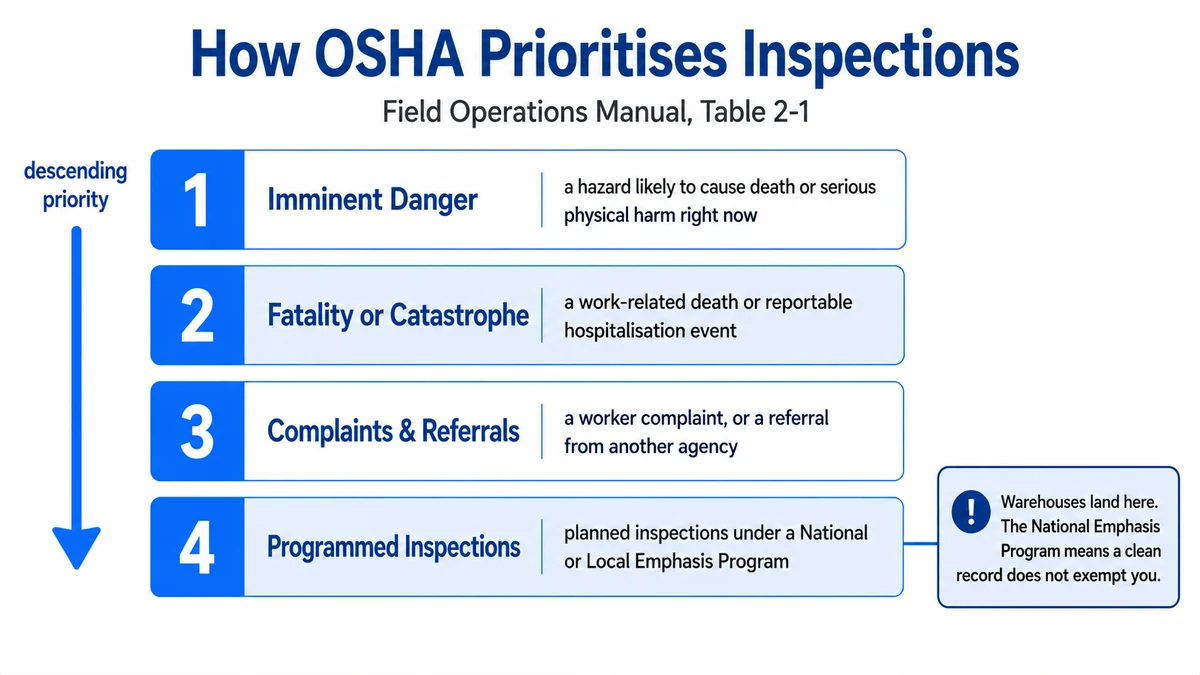
Inspections are not random. OSHA’s Field Operations Manual sets a fixed order of priority for how resources get assigned:
| Priority | Category | What triggers it |
|---|---|---|
| First | Imminent danger | A hazard likely to cause death or serious physical harm right now |
| Second | Fatality or catastrophe | A work-related death, or an inpatient hospitalization event you are required to report |
| Third | Complaints and referrals | A worker complaint, or a referral from another agency or an inspector |
| Fourth | Programmed inspections | Planned inspections under a National or Local Emphasis Program — this is the one that catches warehouses |
That fourth line is why the warehousing NEP matters so much. A warehouse with no complaints, no injuries and a clean record can still be selected for a programmed inspection purely because of its industry classification. A typical visit runs as an opening conference, a walkaround with employee interviews and records review, then a closing conference — and citations follow afterward, not on the spot.
What Are the Penalties for an OSHA Violation?
OSHA penalties are set per violation, and they are adjusted for inflation every January. For violations assessed after 15 January 2026, OSHA’s published penalty schedule sets the maximums as follows:
| Type of violation | Maximum penalty |
|---|---|
| Serious, other-than-serious, and posting requirements | $16,550 per violation |
| Failure to abate | $16,550 per day beyond the abatement date |
| Willful or repeated | $165,514 per violation |
The figure that hurts is rarely the headline number. Violations are cited per instance, so ten uncertified forklift operators is not one citation — and a failure-to-abate penalty accrues daily until the hazard is corrected. States running their own OSHA-approved plans must set penalties at least as effective as the federal levels, so operating outside federal jurisdiction does not lower your exposure.
Who Is Responsible for OSHA Compliance, and Is It Mandatory?
The employer is responsible, and compliance is mandatory — not advisory. Under the Occupational Safety and Health Act, employers have a legal duty to provide a workplace free from recognized hazards, and that duty cannot be delegated away by contract, outsourced to a vendor, or shifted onto employees.
This gets complicated in warehousing, where temporary staff, contractors and third-party operators often share one building. OSHA can cite more than one employer for the same condition: the company that created the hazard, the one that controls the area, and the one whose workers are exposed. If you use a staffing agency, both you and the agency carry responsibility for those workers’ safety and training.
For brands that outsource fulfillment, the practical question is not whether the duty transfers — it does not disappear — but whether your operating partner runs a facility that would survive an inspection. That is a question worth asking before you sign, not after a citation lands.
What Are the Most Common OSHA Warehouse Violations?
The citations that come up most often in warehouses are consistent and largely preventable:
- Forklift violations: operators without current certification, missing pre-shift inspection records, and unsafe operation — the single most-cited area.
- Blocked or unmarked aisles and exits: pallets and equipment left in walkways, or exit routes that are obstructed or poorly marked.
- Unsafe stacking and storage: loads tiered too high or not blocked and interlocked, so they can slide or collapse. Disciplined inventory control, with every pallet in a rated location, removes most of this risk.
- Hazard communication gaps: missing safety data sheets, unlabeled chemical containers, or untrained staff.
- Missing or unused PPE: no documented hazard assessment, or equipment provided but not enforced.
- Lockout/tagout failures: servicing conveyors or equipment without controlling stored energy.
What Are OSHA’s Warehouse Racking Requirements?
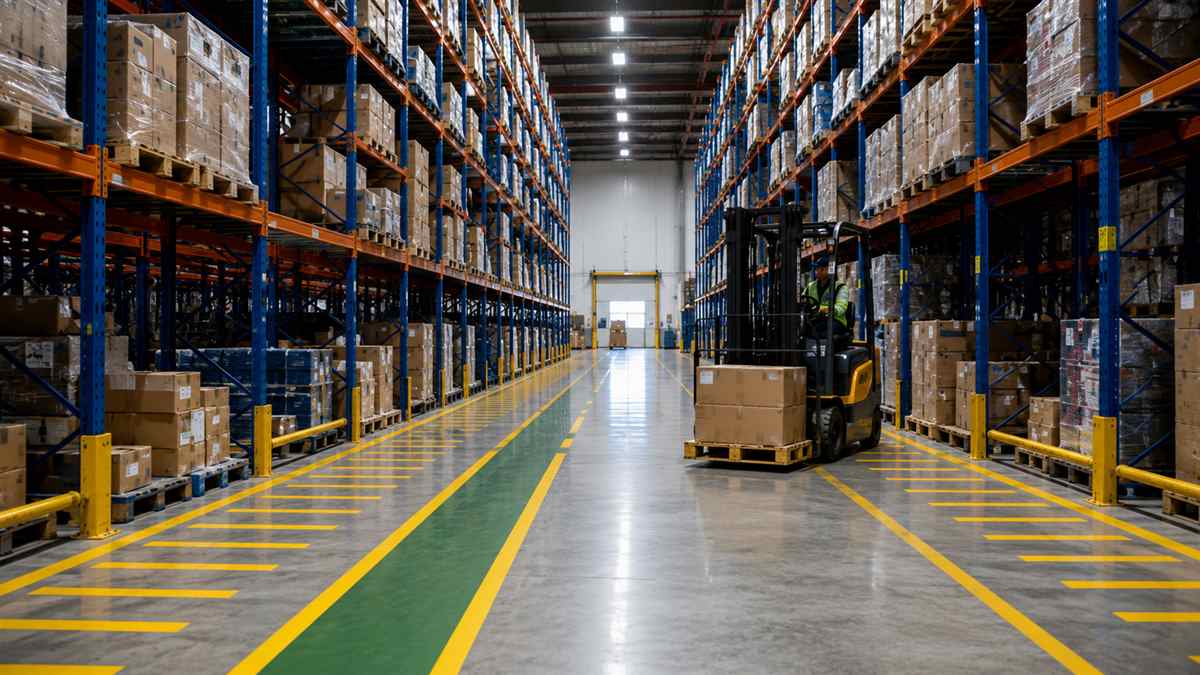
This is where many guides get it wrong: OSHA has no standard written specifically for pallet racking. There is no rule that states a rack inspection interval or a required capacity plaque. Instead, racking is enforced through 1910.176(b), which requires material stored in tiers to be stacked, blocked, interlocked, and limited in height so it is stable and secure against sliding or collapse — plus the General Duty Clause where a damaged or overloaded rack is a recognized hazard.
In practice, OSHA and inspectors look to the manufacturer’s specifications and the industry consensus standard, ANSI MH16.1 (developed by the Rack Manufacturers Institute), for what “safe” looks like. That means you should follow the rack manufacturer’s load capacities, keep capacity information available, inspect racks regularly for damage, and remove or repair damaged uprights and beams. Do that and you satisfy both the OSHA requirement and the consensus standard.
Does OSHA Have Warehouse Temperature Requirements?
No. OSHA does not set a required minimum or maximum temperature for a warehouse. There is no standard stating a warehouse must be kept at a specific number of degrees.
What OSHA does is address extreme heat as a recognized hazard under the General Duty Clause, and it has made heat illness a focus of warehouse inspections through its heat exposure guidance. OSHA also recommends a comfort range of roughly 68 to 76 degrees Fahrenheit with 20 to 60 percent humidity, but that is guidance, not an enforceable limit. For a warehouse, the compliance question is not “what temperature is required” — it is whether you are protecting workers from heat illness with water, rest, shade or cooling, acclimatization for new workers, and a plan for hot days.
What About Aisle Width, Lighting, and PPE?
Two more areas where the honest answer is “there’s no magic number”:
- Aisle width: 1910.176(a) requires “sufficient safe clearances” for aisles where mechanical handling equipment is used, and that aisles be kept clear and in good repair — but OSHA does not specify a width in inches or feet. Common practice is the widest load or truck plus about three feet of clearance. Aisles should also be permanently marked.
- Lighting: general industry has no numeric warehouse lighting standard (the numeric table applies to construction). Adequate lighting is handled under general duty and consensus guidance — practically, light every aisle, dock, and stairway well enough to work and walk safely.
- PPE: 1910.132 requires a documented hazard assessment, then providing and requiring suitable equipment. In most warehouses that means safety footwear, high-visibility vests where forklifts operate, and eye or hand protection based on the task. High-visibility clothing is not universally mandated by a single rule; it follows from your hazard assessment.
What Does OSHA Require for Floors and Fall Protection?
OSHA requires walking-working surfaces to be kept clean, orderly and dry where feasible under 1910.22, and fall protection wherever an unprotected side or edge sits 4 feet or more above a lower level under 1910.28. Slips, trips and falls are among the injury categories the warehousing emphasis program targets, and both standards sit in Subpart D alongside the housekeeping rules an inspector notices first.
Floors and passageways. Standard 1910.22 requires places of employment, passageways, storerooms and walking-working surfaces to be kept in a clean, orderly and sanitary condition, and each workroom floor maintained clean and, to the extent feasible, in a dry condition. Where wet processes are used, drainage must be maintained. This is the standard behind most citations for spills, loose banding, shrink wrap and pallet debris left in a walkway.
Fall protection. Standard 1910.28 requires fall protection where an employee works on a walking-working surface with an unprotected side or edge 4 feet or more above a lower level, which in a warehouse means mezzanines, open dock doors, pits and elevated platforms. This is where published guidance often overstates the rule: 1910.28(b)(1)(iii) permits work without a fall protection system on the working side of a loading rack, loading dock or teeming platform where the employer can demonstrate that fall protection is not feasible, subject to the conditions set out in the standard. The dock edge you load from is treated differently from an open door nobody is working at.
OSHA Warehouse Safety Checklist
Work through this as a self-audit before an inspector does:
- Every forklift operator holds current certification, with evaluations documented and refreshed at least every three years.
- Daily pre-shift forklift inspections are completed and recorded.
- Aisles are marked, clear, and wide enough for the equipment using them.
- Exit routes are unobstructed, clearly marked, and never blocked by stock.
- Loads are stacked stable, blocked or interlocked, and within height limits.
- Racks are undamaged, loaded within manufacturer capacity, and inspected on a schedule.
- Safety data sheets are current and accessible; chemical containers are labeled.
- A written PPE hazard assessment exists, and required PPE is provided and worn.
- Lockout/tagout procedures are written, trained, and followed on conveyors and equipment.
- A heat illness plan covers water, rest, cooling, and acclimatization.
- Required injury and illness records (OSHA 300 log) are maintained and posted when due.
- Emergency action plan and fire extinguisher access are current and trained.
- The OSHA “Job Safety and Health: It’s the Law” poster is displayed where employees can see it.
- Battery charging areas are ventilated, with eyewash access and no ignition sources nearby.
- Dock plates, wheel chocks or trailer restraints are used on every loading operation.
- Conveyors and powered equipment have guarding intact at every nip and shear point.
- Temporary and agency workers receive the same site-specific hazard training as your own staff.
- Training records name the person, the date, and the standard covered — an undated sign-in sheet is not a record.
How Do You Stay Compliant as You Scale?
Compliance gets harder as volume grows: more staff, more equipment, more stock in the aisles. The operations that stay clean treat safety as a routine, not an event — scheduled rack inspections, recurring forklift evaluations, daily housekeeping standards, and a documented paper trail for all of it. Most of this overlaps with running an efficient building anyway, which is why safety and productivity tend to rise together. Our guide to warehousing best practices covers the operational side, and a warehouse management system helps by keeping stock organized and off the floor where it would otherwise block aisles.
Outsourcing is the other route. A 3PL provider runs compliance as part of its core business — trained operators, documented inspections, and facilities built to these standards — so a growing brand gets a compliant operation without building the safety program itself.
Safety belongs on the same scorecard as throughput. Recordable incident rate is a warehouse KPI in its own right, and keeping it beside the picking and shipping numbers is what stops safety becoming a separate report nobody opens.
One distinction worth drawing: none of this makes you a candidate for an OSHA safety consultant. A consultant writes programs and audits paperwork. What a growing brand actually needs is a building that already runs to these standards every day — trained operators, maintained racking, documented inspections — so compliance is inherited rather than rebuilt. That is an operating question, not a consulting one, and it is one of the sharper ways to tell a well-run third-party logistics provider from a merely cheap one. Ask to see forklift certification records and the most recent rack inspection during your site visit; how quickly they produce them tells you most of what you need to know.
For Cura Resource Group this is not a policy question but an operating one: a facility that fails an inspection stops shipping, so the incentive to keep racking inspected and forklift certifications current is structural rather than aspirational. That is the difference worth probing when you tour anyone’s building.
Final Word
OSHA warehouse compliance comes down to a short list done consistently: certified forklift operators, stable storage, clear marked aisles and exits, communicated chemical hazards, the right PPE, and protection from heat. Where no specific rule exists — racking intervals, temperatures, aisle widths — the General Duty Clause and consensus standards fill the gap, so follow manufacturer specs and document what you do. With warehouses under a national emphasis program, the safest assumption is that an inspection is a matter of when, not if. Work the checklist above and you will be ready for it.
Safety compliance rarely sits on its own. The same discipline covers carrier, customs and contractual obligations, which is the wider remit of compliance and risk management.
Want fulfillment run in a facility built to these standards?
Frequently Asked Questions
What OSHA standards apply to warehouses?
The main ones are 1910.176 (materials handling and storage), 1910.178 (powered industrial trucks/forklifts), 1910.36 and 1910.37 (exit routes), 1910.132 (PPE), 1910.1200 (hazard communication), and 1910.147 (lockout/tagout). The General Duty Clause covers recognized hazards with no specific standard, such as heat and ergonomics.
What are OSHA’s requirements for warehouse racking?
OSHA has no standard written specifically for pallet racking. Racking is covered by 1910.176(b), which requires stored material to be stacked, blocked, interlocked, and limited in height so it is stable, plus the General Duty Clause. In practice, follow the rack manufacturer’s load capacities and the ANSI MH16.1 consensus standard, and inspect racks regularly for damage.
Does OSHA regulate warehouse temperature?
No. OSHA does not set a required warehouse temperature. It addresses extreme heat as a recognized hazard under the General Duty Clause and recommends a comfort range of about 68 to 76 degrees Fahrenheit as guidance. What matters for compliance is protecting workers from heat illness with water, rest, cooling, and acclimatization.
What aisle width does OSHA require in a warehouse?
OSHA does not specify a number. Standard 1910.176(a) requires sufficient safe clearance for aisles used by mechanical handling equipment, and that aisles stay clear, in good repair, and marked. A common practical rule is the widest load or truck plus roughly three feet.
What are the most common OSHA violations in warehouses?
Forklift issues lead the list — uncertified operators, missing pre-shift inspections, and untrained staff on powered equipment. After that come blocked or unmarked aisles and exit routes, unstable or over-height stacking, hazard communication gaps such as missing safety data sheets, absent written PPE assessments, and lockout/tagout failures on conveyors and dock equipment.
What is the OSHA National Emphasis Program for warehouses?
It is an OSHA initiative launched in July 2023 that directs inspectors to conduct targeted inspections at warehouses and distribution centers, focusing on forklifts, material handling and storage, egress, walking-working surfaces, heat, and ergonomics. It means these facilities face a higher likelihood of inspection.
How much can an OSHA fine cost?
For violations assessed after 15 January 2026, OSHA sets a maximum of $16,550 per serious, other-than-serious or posting violation, $16,550 per day for failure to abate beyond the deadline, and $165,514 for a willful or repeated violation. Citations are issued per instance, so identical problems multiply.
Do you need an OSHA certification to work in a warehouse?
No. OSHA does not certify warehouses or general warehouse workers, and there is no license to obtain. Specific tasks do require documented training — forklift operators must be trained, evaluated and re-evaluated at least every three years under 1910.178. OSHA 10 and 30 courses are voluntary, not mandated.
What are the 7S rules in a warehouse?
7S is a lean methodology — sort, set in order, shine, standardize, sustain, safety and security — not an OSHA requirement. OSHA never references it. It is a useful housekeeping discipline that supports compliance with standards like 1910.22 on walking-working surfaces, but adopting 7S does not by itself satisfy any OSHA standard.
What are the basic safety rules for warehouse workers?
Keep aisles and exits clear, never operate a forklift without current certification, stack loads stable and within height limits, wear the PPE identified by your site hazard assessment, follow lockout/tagout before servicing equipment, and report damaged racking immediately rather than working around it.
Sources & Further Reading
- OSHA — Warehousing Safety
- OSHA 1910.176 — Handling Materials, General
- OSHA 1910.178 — Powered Industrial Trucks
- OSHA 1910.22 — Walking-Working Surfaces, General Requirements
- OSHA 1910.28 — Duty to Have Fall Protection
- OSHA — Heat Exposure
- U.S. Bureau of Labor Statistics — Warehousing and Storage
- OSHA — Penalties
- OSHA — Field Operations Manual, Chapter 2 (Inspection Priorities)