
A distribution center is a building designed around throughput: freight in, sorted, and back out the door. Stock arrives, gets grouped by destination, and leaves again within days. The building is judged on how fast it turns orders around, not on how much it can store.
This guide covers what a distribution center does and how one runs, step by step. It also covers what separates it from a warehouse and a fulfillment center. Then where they get built, and when to use someone else’s instead of your own.
Demand for that speed keeps climbing. U.S. Census Bureau figures put US online sales at $340.2 billion in the second quarter of 2026, up 12.2% in a year. Every one of those orders passes through a building like this.
What Is a Distribution Center?
A distribution center, or DC, is a facility that receives goods in bulk and ships them out to stores, businesses or customers. Its job is flow. Inventory is a guest, not a resident.
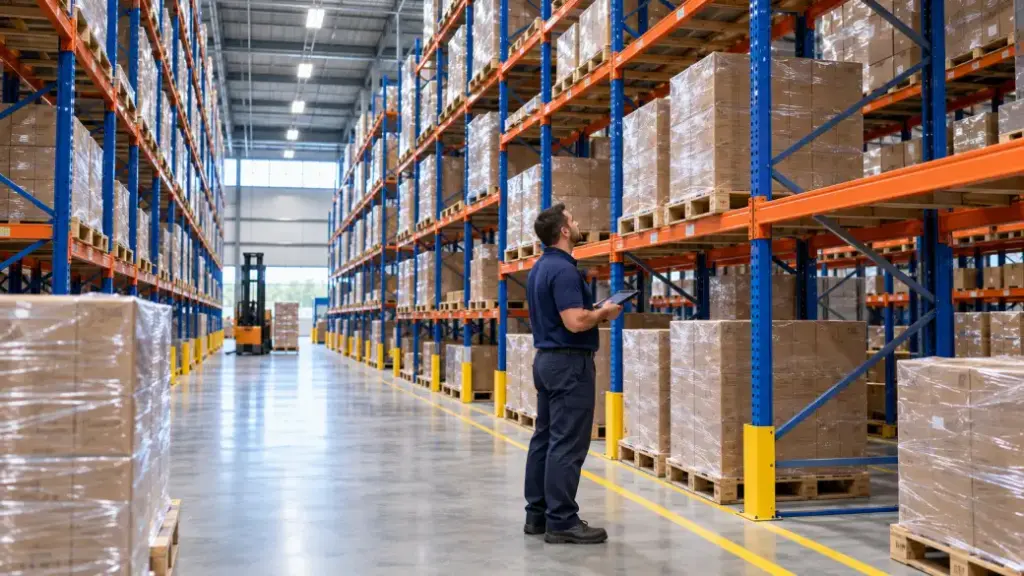
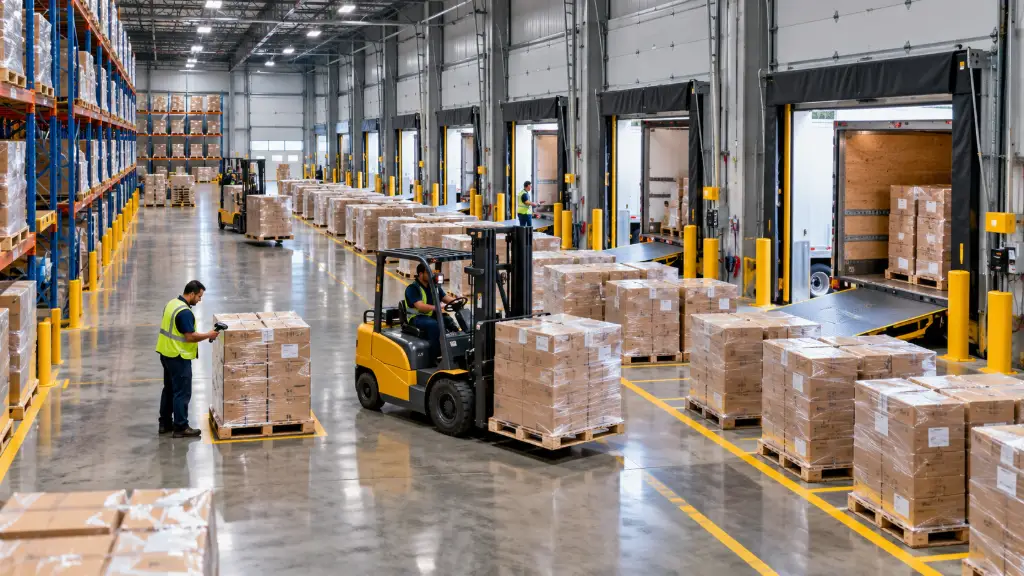
The layout shows the difference. A DC gives floor space to docks, staging lanes and sorting, where a storage warehouse gives it to racking that fills every foot of height.
Distribution is one half of the five stages goods pass through between inbound dock and outbound truck. A DC is the building where the moving half happens.
What Does a Distribution Center Do?
A distribution center does five jobs: receiving, short-term storage, order processing, sorting and outbound shipping. Some also add value-added work like labeling, kitting or repacking before goods leave.
- Receives bulk freight. Full truckloads, containers and pallets arrive from factories, ports and suppliers.
- Holds stock briefly. Goods wait in racks or staging lanes until an order or a store replenishment calls for them.
- Processes orders. Orders arrive from a retailer portal, an ERP or an online store, and become pick instructions.
- Sorts and consolidates. Items are grouped by store, route or carrier so each truck carries one clean load.
- Ships out. Loads leave by parcel, pallet freight or full truckload, with the paperwork attached.
The measure of a DC is how little time any of that takes. Space used matters less than orders moved.
Distribution Center vs Warehouse vs Fulfillment Center
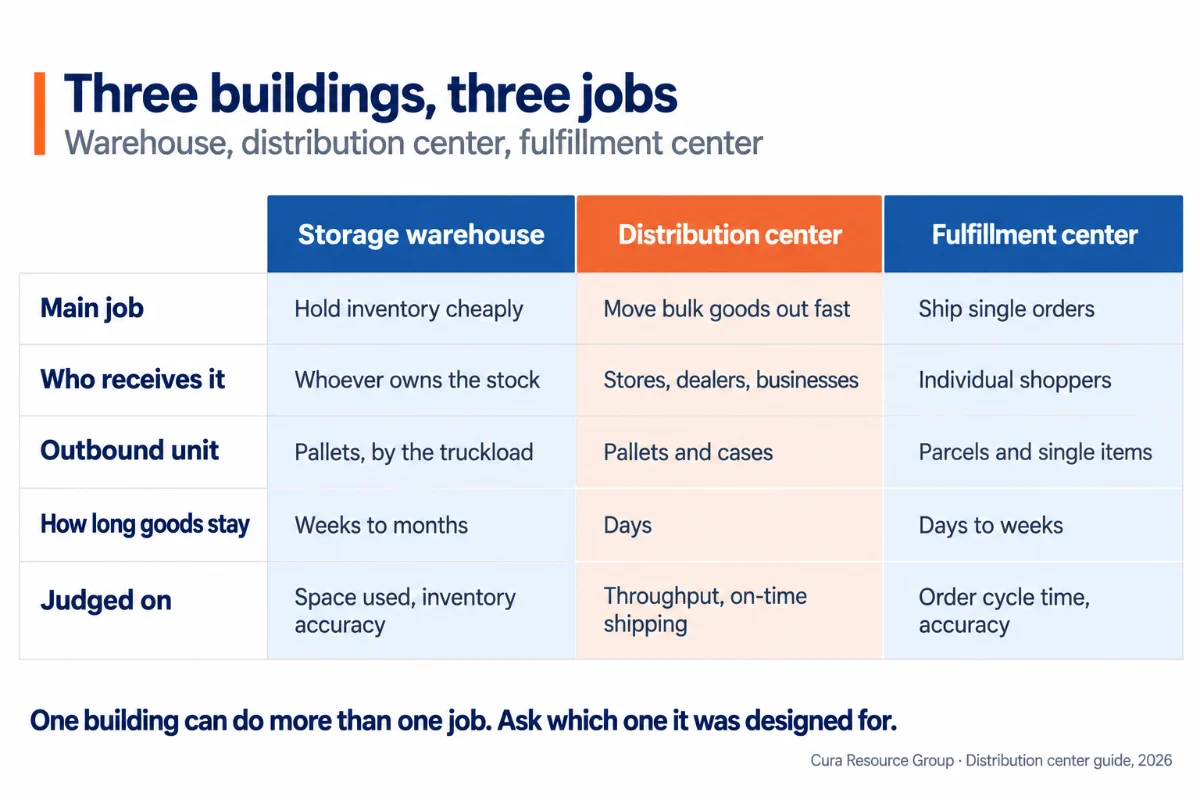
These are three buildings with three jobs. A warehouse holds goods, a distribution center moves them to businesses and stores, and a fulfillment center ships single orders to shoppers. Many sites do more than one, which is why the words get mixed up.
| Storage warehouse | Distribution center | Fulfillment center | |
|---|---|---|---|
| Main job | Hold inventory cheaply | Move bulk goods out fast | Ship single orders to consumers |
| Who receives the goods | Whoever owns them | Stores, dealers, businesses | Individual shoppers |
| Typical outbound unit | Pallets, by the truckload | Pallets and cases | Parcels and single items |
| How long goods stay | Weeks to months | Days | Days to weeks |
| What it is judged on | Space used, inventory accuracy | Throughput and on-time shipping | Order cycle time and accuracy |
The practical test is who opens the box. If a store receives a pallet, you need a DC. If a shopper receives a parcel, you need a fulfillment center.
The deeper comparison between the first two sits on our warehousing and distribution guide, which sets out the trade-offs across layout, systems and cost. If the question you are really asking is about consumer parcels rather than store replenishment, our breakdown of the eight differences between a warehouse and a fulfillment center takes that axis apart in full.
What Are the Types of Distribution Center?
There are five common types, and they differ by what happens to the freight inside rather than by the building itself. Most operators run a hybrid, but one pattern usually dominates.
- Regional distribution center. Serves stores or customers inside a defined radius, usually a day’s drive. It carries the full assortment for that region so replenishment orders ship complete.
- Consolidation center. Takes partial loads from several suppliers and combines them into full truckloads for one destination. The saving is in freight, not in storage.
- Break-bulk center. Does the reverse. One inbound container or truckload arrives and gets split into smaller shipments for many destinations, which is why these sit close to a port.
- Cross-dock facility. Freight arrives already sorted for its destination and leaves the same day without being put away. Dock doors matter more than racking here.
- E-commerce distribution center. Picks individual items rather than cases, which needs shelving, pack stations and a different labor profile from a pallet-out building.
The last two are worth separating carefully. Cross-docking is a technique any of the other types can use for part of their volume, and how cross-docking works and when it pays sets out the conditions it needs. An e-commerce DC that ships parcels to shoppers is closer to a fulfillment center than to the rest of this list.
How a Distribution Center Works, Step by Step
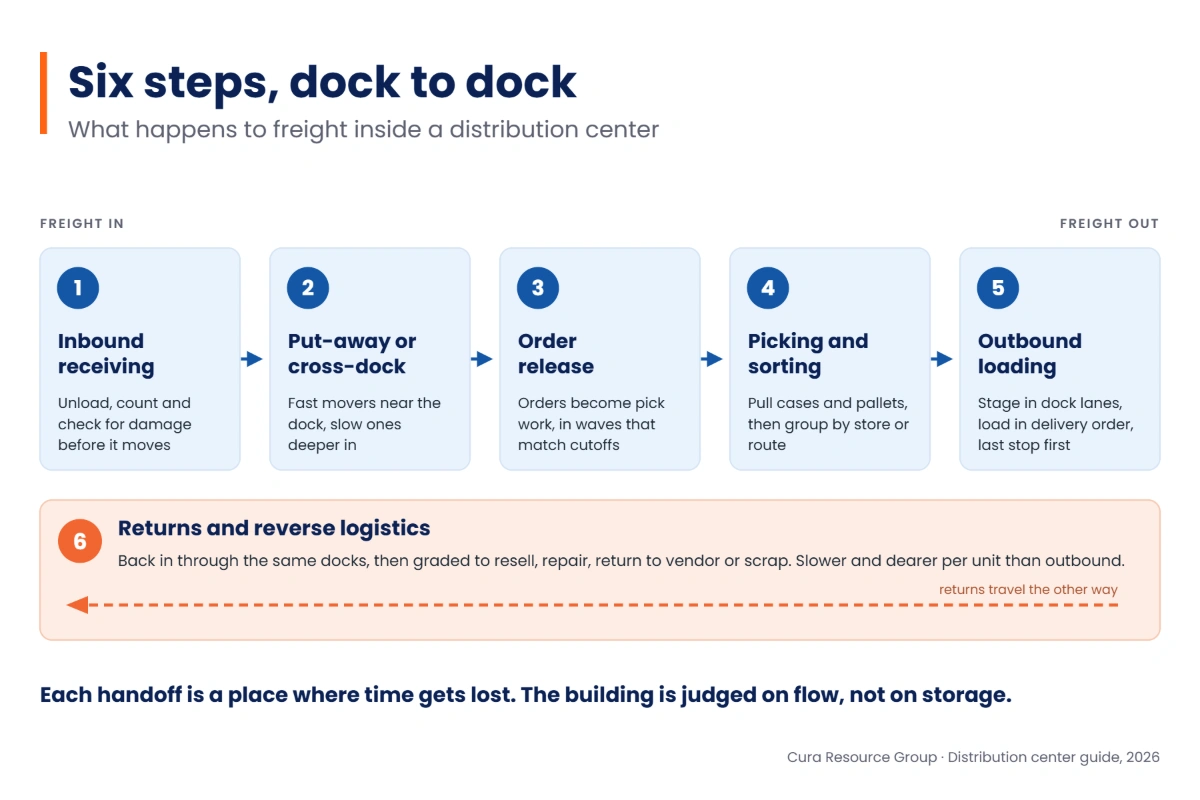
Goods move through a distribution center in six steps: inbound receiving, put-away or cross-dock, order release, picking and sorting, outbound loading, then returns. Each handoff is a place where time gets lost.
Inbound Receiving
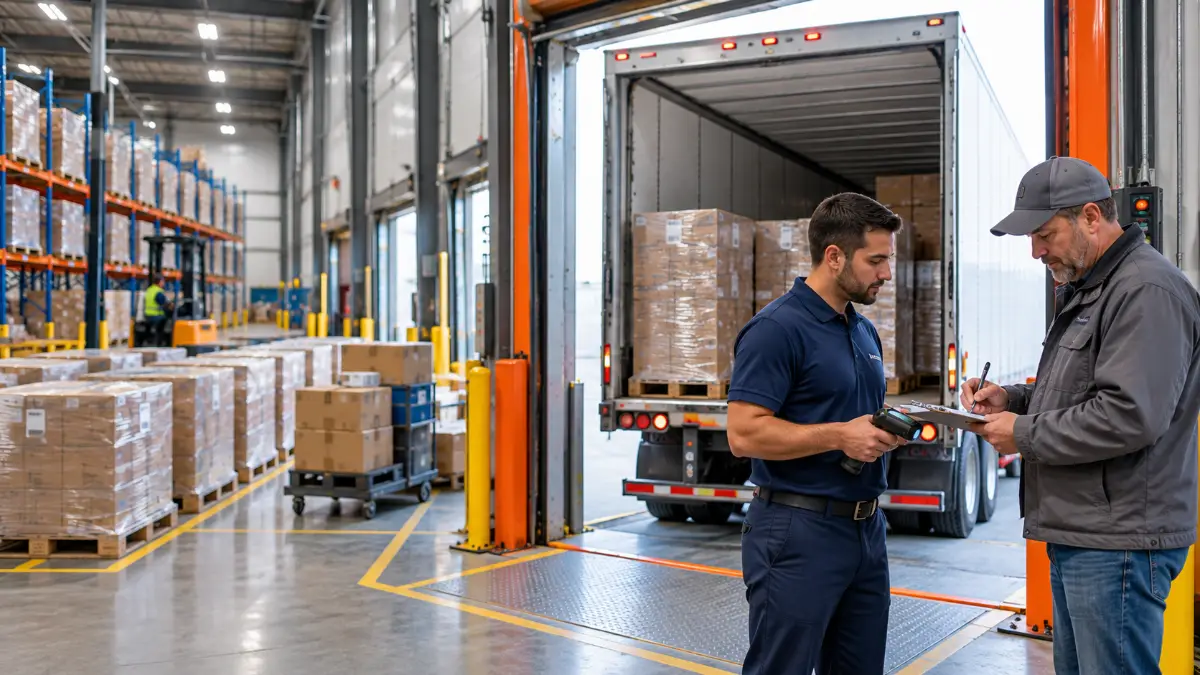
Receiving unloads the truck or container and checks what arrived against what was expected. Counts and damage get recorded before the freight moves anywhere else.
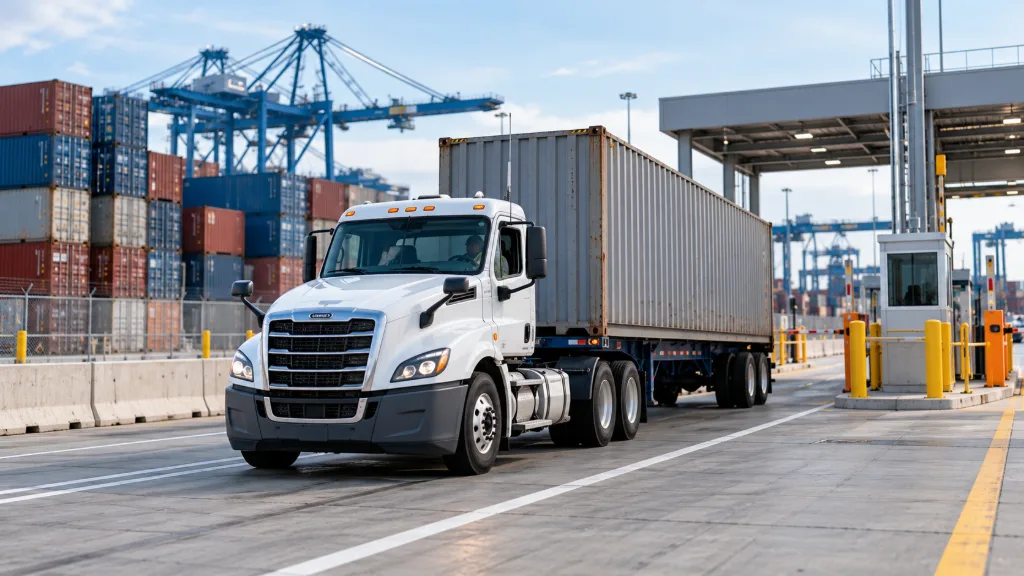
Imported freight reaches the dock by container, which means somebody has to collect it from the port or rail ramp. That short leg is drayage, and it runs on its own terminal clock.
Put-Away or Cross-Dock
Fast movers go to pick faces near the dock, and slow ones go deeper into the building. Freight already sorted for its destination skips storage entirely.
That shortcut is cross-docking, which moves goods from the inbound door to the outbound one without a storage step in between.
Order Release
Orders arrive from a retailer portal, an ERP or an online store, and the system turns them into work. Releases are usually grouped into waves that match carrier cutoffs.
Timing here decides everything downstream. An order released after the last pickup waits a day no matter how fast the floor moves.
Picking and Sorting
Pickers pull cases or pallets, and sorting groups them by store, route or carrier. Labor concentrates here, which is why it is the first place operators look to cut cost.
Retail orders add rules at this point. Each retailer’s routing guide dictates labels, pallet patterns and delivery windows, and breaking them means chargebacks.
Outbound Loading
Loads are staged in dock lanes and loaded in delivery order, last stop first. The paperwork travels with the freight, and the empty trailer or container goes back.
Everything after this point, from the bill of lading to proof of delivery, belongs to outbound logistics and its five stages.
Returns and Reverse Logistics
Returned goods come back through the same docks and get graded before anything else happens: resell, repair, return to vendor or scrap. That grading decision is what decides whether the unit recovers any value.
Reverse flow is slower and dearer per unit than outbound, because every item is handled individually and no two arrive in the same condition. A building that treats returns as an afterthought ends up with a corner of the floor filling with unsorted freight.
Retail programs add a wrinkle. Returns from a store network get consolidated at the DC and shipped back to vendors in bulk, which is a different job from processing one shopper’s parcel.
What Gets Stored in a Distribution Center, and How
Storage inside a DC is chosen for speed of retrieval rather than density. Four arrangements cover most of what you will see on the floor.
- Selective pallet racking. Every pallet reachable without moving another, which suits many SKUs and steady picking.
- Flow and push-back racking. Pallets roll forward as one is taken, keeping a pick face full without a forklift trip.
- Floor stacking. Bulk product stacked on the slab, cheap and fast for a few high-volume items.
- Case and piece shelving. Small quantities picked by hand for orders that do not need a whole pallet.
Space is still billed by what you occupy. If you are renting rather than owning, pallet storage is priced by the position and the rate depends on how long goods sit.
What Technology Runs a Distribution Center?
A warehouse management system runs the building, directing put-away, picking and stock counts. Everything else, from scanners to sortation, feeds it or takes instructions from it.
Scanning is the backbone. Barcode or RFID scans at receiving, pick and pack are what keep the system’s count and the shelf’s count in agreement.
Above the scanner sits the hardware that moves goods without a person carrying them. Conveyor and cross-belt sorters divert cases into the right lane at speed. Automated guided vehicles and autonomous mobile robots haul pallets and totes between zones. Goods-to-person systems reverse the usual arrangement by bringing the shelf to a fixed pick station, which cuts walking time to almost nothing.
Automated storage and retrieval systems go further, stacking product denser than a forklift can reach and pulling it back on demand. They buy height and accuracy, and they cost capital and flexibility in return, so they suit stable high-volume ranges rather than assortments that change every season.
None of it replaces the WMS. Every one of these systems takes its instructions from the same inventory record, and the building only runs as well as that record is accurate. Labor management and slotting software sit alongside, deciding who does what and where each SKU should live.
Visibility is the last layer. Order and inventory status has to reach the customer’s own systems through an API or EDI feed, or the DC becomes a black box between the purchase order and the delivery.
How those systems are configured, and which ones a provider should run, is covered in our warehouse management guide.
How Is a Distribution Center Measured?
A distribution center is judged on how fast and how accurately freight leaves, not on how much sits inside. Four measures carry most of the weight.
- Dock-to-stock time. How long from a trailer arriving to the goods being available to pick. Slow receiving starves everything downstream.
- Order cycle time. How long from an order being released to the load leaving the dock. This is the number a retailer feels.
- Pick accuracy. The share of lines picked correctly. Errors here turn into chargebacks, returns and lost points on a retailer scorecard.
- On-time shipment. The share of loads that make their scheduled departure. A missed carrier cutoff costs a full day, not an hour.
Cost per unit shipped sits underneath all four, and it is the figure that gets compared between sites. The full set, including how each one is calculated and what good looks like, is in our warehouse KPI guide.
Where Distribution Centers Get Built
Distribution centers get built where transport, labor and customers meet. The site decides your freight cost for as long as you keep the lease.
- Near ports and rail ramps. Short drayage legs cut cost and the risk of demurrage on imported containers.
- Near population. Distance to your customers sets transit days and the parcel zone you pay.
- Where labor exists. A cheap building with no workforce within commuting distance is not cheap.
- Where rent supports it. JLL put US industrial asking rent at $10.45 per square foot in the second quarter of 2026. That is a whole-building lease rate, with vacancy at 6.8%.
Cheap space far from demand is the most common mistake here. Compare rent, labor and outbound freight together, because the freight bill usually outweighs the rent difference.
How Long Do Goods Stay in a Distribution Center?
Days, in most cases, because the building is designed to keep freight moving. Stock that sits for months is doing warehouse work in a building priced for distribution.
A parcel that shows as sitting at the distribution center is usually waiting for the next scheduled departure on its route. The wait is a sorting and routing step, not a delay in the ordinary sense.
If your goods regularly sit longer than a week, the building is the wrong shape for them. That inventory belongs in cheaper storage space, with only the fast-moving part held at the DC.
How Many Distribution Centers Do You Need?
The answer comes from your delivery promise, not from your revenue. Work back from how fast you have told customers their goods will arrive, then count how many sites it takes to reach them inside that window.
One site can cover a large share of the country on a two-day ground promise. Pull the promise in to next day and the count rises quickly, because each site only covers the distance a truck can travel overnight.
Splitting inventory across more buildings has a cost of its own. The same SKU has to be held in more places, safety stock rises, and forecasting gets harder at every site. Adding a location is a trade between freight cost and working capital, and the right number is the smallest one that still hits the promise.
What Does It Cost to Run a Distribution Center?
Three lines carry the cost of a distribution center: space, labor and freight. Space is the one people quote, labor is usually the one that decides the number, and freight is the one your choice of site locks in for the length of the lease.
Space is priced per square foot per year. JLL put the US industrial average asking rent at $10.45 per square foot in the second quarter of 2026, with vacancy at 6.8%. That is a whole-building rate, and it swings far more by market than a national average suggests.
Labor is priced per hour and scales with volume rather than with floor area. Warehousing and storage wages averaged $26.74 an hour in July 2026, per U.S. Bureau of Labor Statistics data, before the recruiting, training and turnover that a seasonal peak adds on top.
Everything else splits into two groups:
- Capital costs. Racking, dock equipment, the material handling fleet, WMS licensing and implementation, and any automation. Spent once, then depreciating whether the building is busy or not.
- Running costs. Utilities, maintenance, packaging and consumables, insurance, property taxes where they pass through, and the IT that keeps the systems talking to each other.
Freight sits outside the four walls but belongs in the same sum. A site that saves a dollar a square foot and adds a hundred miles to every outbound route is not cheaper, and the inbound leg from the port counts too.
A third party prices the same costs differently. Instead of a lease and a payroll you pay per pallet position, per order or per hour of handling, which turns a fixed cost into one that moves with your volume.
Should You Build a Distribution Center or Use a 3PL?
Build your own when volume is steady, predictable and big enough to fill a site all year. Use someone else’s when it is none of those things.
The costs that catch people out are labor and time, not rent. Output per hour in the sector fell three years straight and then rose only 0.1% in 2024, per U.S. Bureau of Labor Statistics data.
Wages moved the other way, averaging $26.74 an hour in warehousing and storage in July 2026. Rising pay against flat output is a hard equation to fix in-house.
Outsourcing swaps that fixed commitment for a bill that tracks your volume. You pay for the space and labor you use, in a building that is already staffed and running.
Distribution Centers With Cura Resource Group
Cura Resource Group builds, operates and manages distribution centers positioned near airports, transit hubs and last-mile pinch points. Our warehouses in Memphis, Riverside and Carolina, Puerto Rico each run both roles: distribution and storage.
We also help decide the shape of the network, including how many sites you need and where they belong. Washington, Michigan is our corporate office rather than a warehouse.
For retail programs, our retail distribution services cover routing guide compliance, case and pallet picking and retail labeling. Clients see their stock in real time while it moves.
Tell us your order profile, your retailers and where your customers are, then get a quote for running it from ours.
Sources and Further Reading
- U.S. Census Bureau, Quarterly Retail E-Commerce Sales, 2nd Quarter 2026 — online sales and growth rate.
- JLL, US Industrial Market Dynamics, Q2 2026 — national asking rent and vacancy.
- U.S. Bureau of Labor Statistics, Warehousing and Storage: NAICS 493 — sector labor productivity and average hourly earnings.
Frequently Asked Questions
What is a distribution center?
A distribution center is a building run for flow rather than storage. It takes in bulk freight, holds it briefly, then sorts and ships it to stores, businesses or customers. Speed of throughput is the point, so inventory is expected to leave within days.
What does a distribution center do?
It does five jobs: receiving bulk freight, holding it briefly, turning orders into pick work, sorting goods by store or route, and shipping them out. Many also add labeling, kitting or repacking before goods leave, which saves the receiver from doing it.
What is the difference between a warehouse and a distribution center?
A warehouse is built to hold goods at low cost, with dense racking and long dwell times. A distribution center is built to move them, with more dock doors, staging lanes and sorting space. One is measured on space used, the other on throughput.
Is a fulfillment center the same as a distribution center?
No. A fulfillment center ships single orders to individual shoppers, usually as parcels. A distribution center ships pallets and cases to stores, dealers and businesses. The work looks similar from outside, but the picking, packing and carrier mix are different.
How long does a package stay at a distribution center?
Usually hours to a couple of days, while it waits for the next scheduled departure on its route. The stop is a sorting step rather than a delay. Longer waits normally mean a missed cutoff, a capacity backlog or a weather disruption upstream.
Where are distribution centers usually located?
Near the things that drive cost: ports and rail ramps for imports, major highways for outbound freight, and population centers for short final deliveries. Labor supply matters as much as the building, since a site nobody can commute to cannot be staffed.
How much does it cost to run a distribution center?
The three big lines are rent, labor and freight. JLL put US industrial asking rent at $10.45 per square foot in the second quarter of 2026, as a whole-building lease rate. Warehousing wages averaged $26.74 an hour in July 2026, and labor usually outweighs rent.
Should I use a third-party distribution center?
Use one when your volume swings, or when you are entering a new region. It also suits you when staffing a building is the part you do not want to own. Running your own only pays when volume keeps the space and the team busy all year.
What are the types of distribution center?
Five are common: regional centers that serve a defined area, consolidation centers that combine supplier loads into full truckloads, break-bulk centers that split inbound containers into smaller shipments, cross-dock facilities that move freight through without storing it, and e-commerce centers that pick single items. Most buildings run more than one pattern, with one dominating.
What happens to returns at a distribution center?
Returns come back through the same docks and get graded before anything else: resell, repair, return to vendor or scrap. Reverse flow costs more per unit than outbound because every item is handled individually and no two arrive in the same condition.