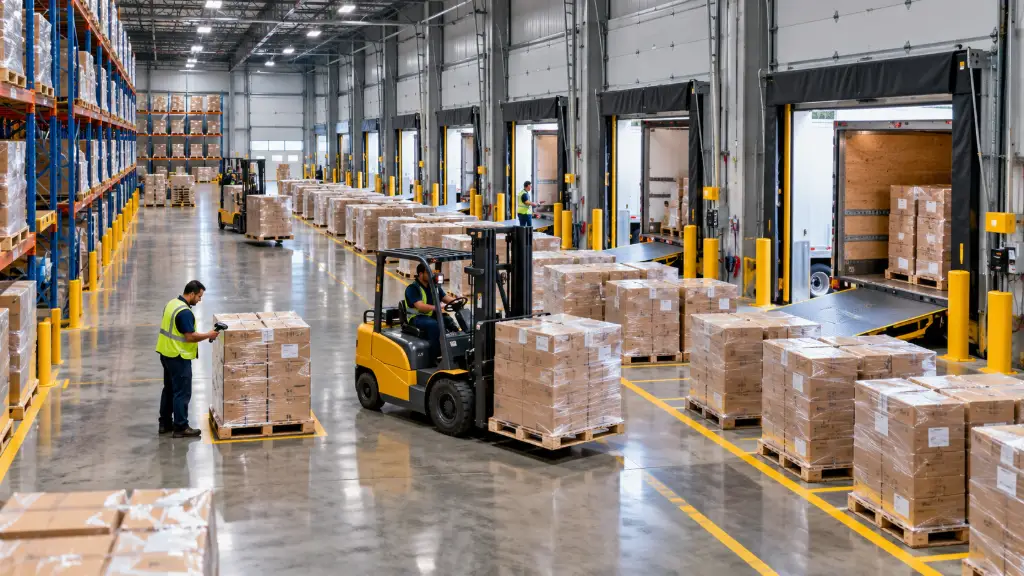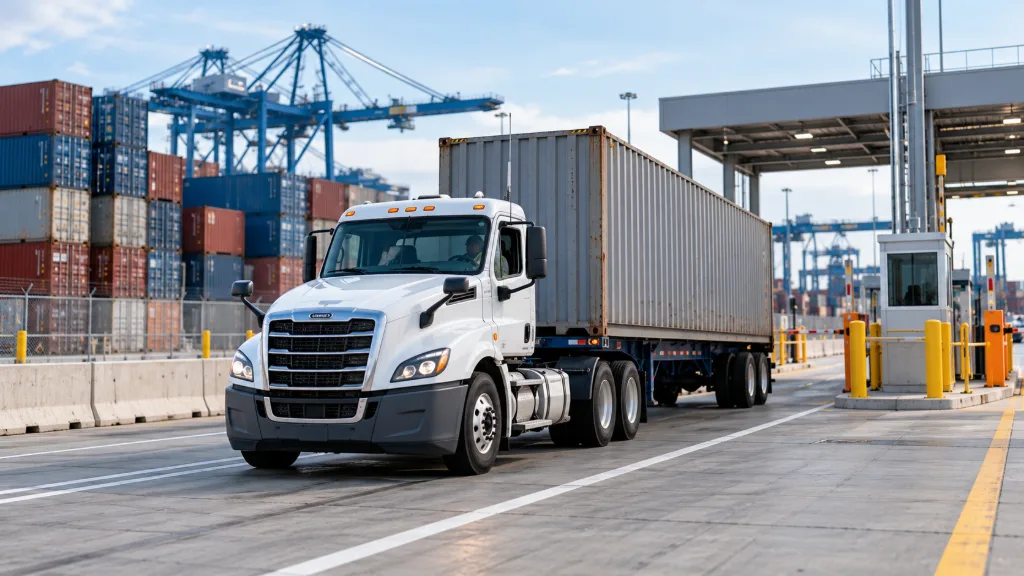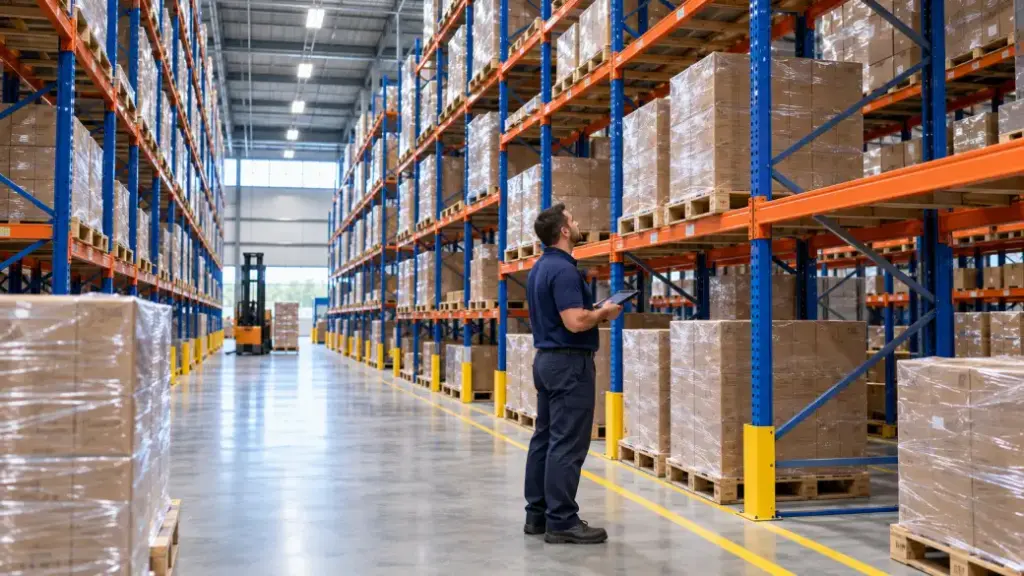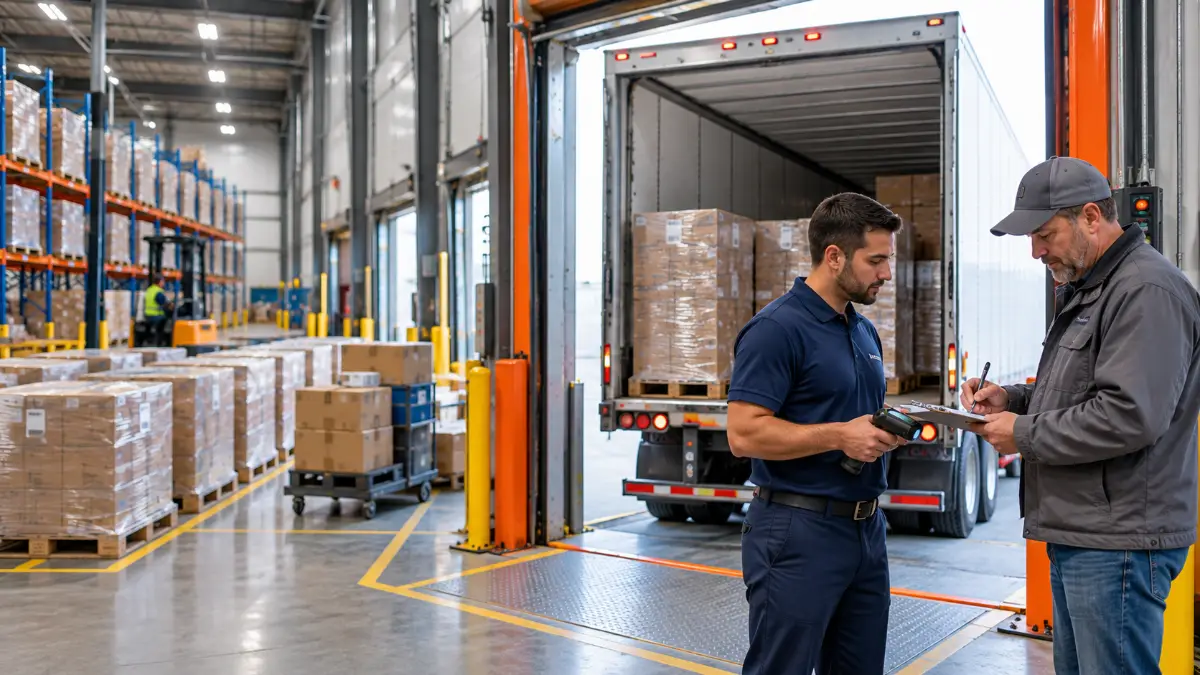
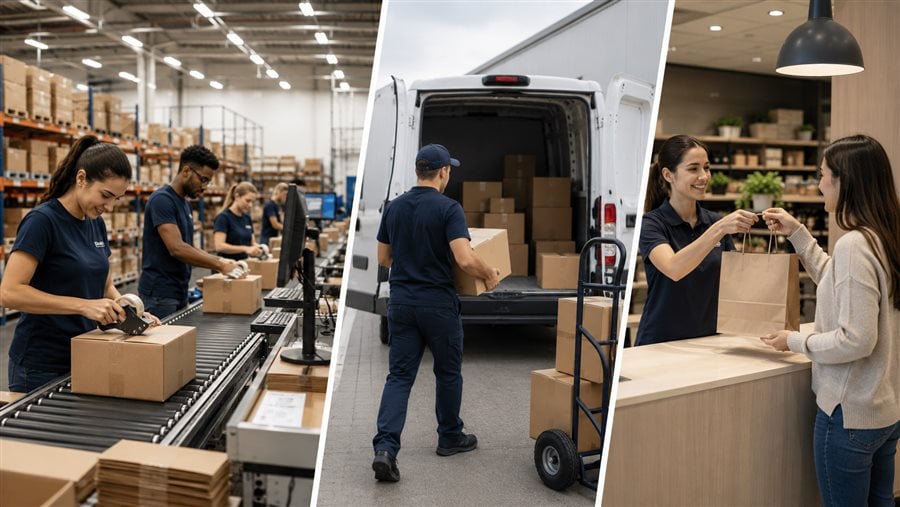

Omnichannel fulfillment is the logistics process of receiving, processing, and delivering orders from every sales channel using one shared pool of inventory. It’s the operational engine that makes omnichannel retail possible: when a customer orders online, in an app, on a marketplace, or in a store, omnichannel fulfillment decides where that order is picked, packed, and shipped from — drawing on a single, real-time view of stock across warehouses and stores. This guide explains what omnichannel fulfillment is, how it works, the methods and technology behind it, the challenges to avoid, and how a 3PL powers it. As customers move fluidly between channels and expect fast, reliable delivery from all of them, the brands that win are the ones whose fulfillment quietly keeps up.
The pressure behind this is measurable. According to the U.S. Census Bureau, ecommerce reached $340.2 billion in the second quarter of 2026 — 17.1% of all US retail sales, and 12.2% higher than the same quarter a year earlier. Channels also behave differently once an order ships: the National Retail Federation puts the overall retail return rate at 15.8% of sales but online returns at 19.3%, with 82% of shoppers saying free returns influence where they buy. One inventory pool has to absorb both patterns at once, and that is the problem omnichannel fulfillment exists to solve.
What Is Omnichannel Fulfillment?
Omnichannel fulfillment is an order fulfillment model in which all sales channels share one inventory pool and one order management system, so any order can be fulfilled from the optimal location regardless of where it was placed. Instead of keeping separate stock for the website, marketplace, and stores, the business pools inventory and routes each order to whichever warehouse or store can deliver it fastest and cheapest.
It’s worth separating two terms: omnichannel retail is the customer-facing strategy of a unified shopping experience, while omnichannel fulfillment is the behind-the-scenes logistics that delivers on it. Retail is the promise; fulfillment is how the promise is kept.
Omnichannel Order Fulfillment: How Does It Work?
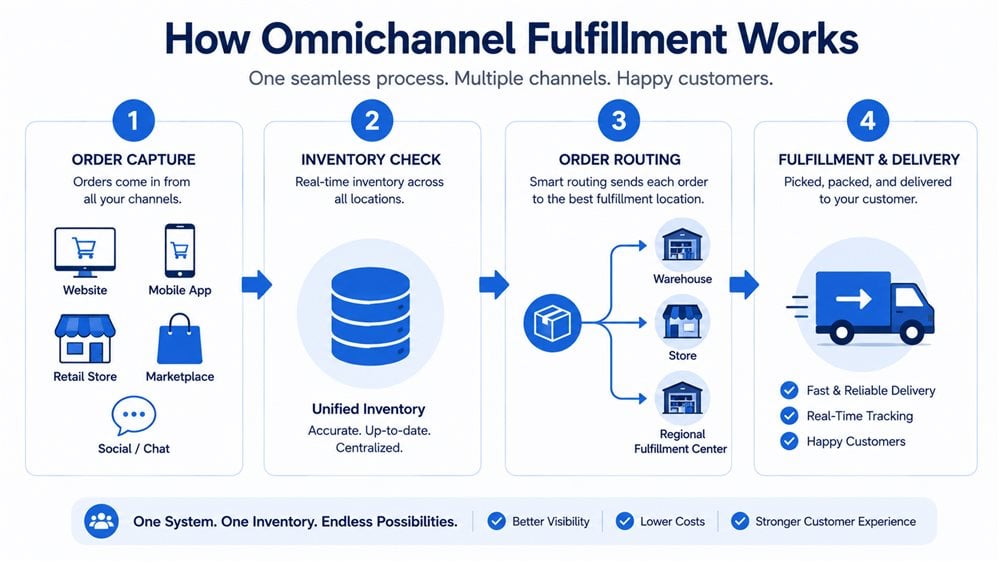
Omnichannel fulfillment works through order orchestration — automatically routing every incoming order to the best fulfillment location based on inventory, proximity, and cost. The flow runs in four stages:
- 1. Order capture: orders flow in from every channel — website, mobile app, marketplaces, and in-store POS — into one order management system (OMS).
- 2. Inventory check: the OMS reads a single, real-time inventory count shared across all warehouses and stores, so nothing oversells.
- 3. Order routing: the system assigns each order to the optimal location — a warehouse, a store for ship-from-store, or a partner — based on stock, distance, and delivery speed.
- 4. Fulfillment and delivery: that location picks, packs, and ships the order following the standard order fulfillment process, with tracking pushed back to the customer.
The thread tying it together is unified inventory: without one accurate, real-time stock count, order routing breaks and the omnichannel promise collapses.
What Are the Methods of Omnichannel Fulfillment?
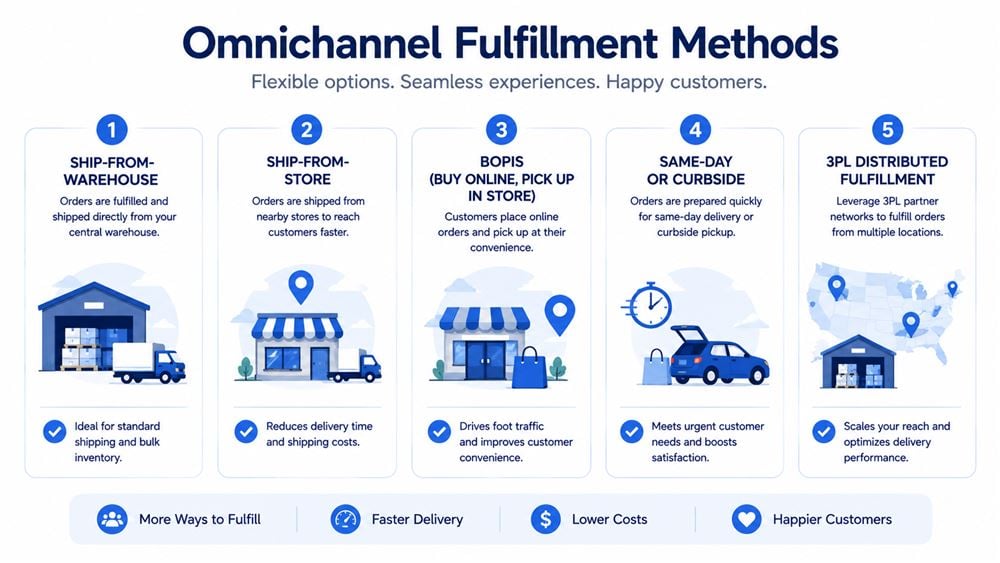
Omnichannel order fulfillment uses five delivery methods — ship-from-warehouse, ship-from-store, BOPIS, curbside and same-day, and distributed 3PL fulfillment — chosen per order to balance speed and cost:
- Ship-from-warehouse: the classic model — a central ecommerce fulfillment warehouse ships direct-to-consumer orders across all channels. Cura runs this model as an ecommerce fulfillment service.
- Ship-from-store: stores act as mini-fulfillment centers, shipping online orders from the location nearest the customer to cut transit time and cost.
- Buy online, pick up in store (BOPIS): the customer orders online and collects in store, often within hours.
- Curbside and same-day: local fulfillment enables curbside pickup and same-day delivery in dense markets.
- Distributed 3PL fulfillment: a 3PL holds inventory across multiple locations and fulfills every channel from the closest node.
The methods differ less in technology than in who does the picking and where the stock sits. This is how they compare:
| Method | How It Works | Best For | Main Constraint |
|---|---|---|---|
| Ship from warehouse | A central facility picks, packs and ships every online order | Predictable volume and a wide catalogue | Slower and dearer to distant customers |
| Ship from store | Store staff pick online orders from shop-floor stock | Fast regional delivery using inventory you already hold | Pulls staff away from selling |
| BOPIS (buy online, pick up in store) | Customer buys online and collects in person | Speed with no shipping cost at all | Fails without accurate store-level stock counts |
| Curbside pickup | Order is brought out without the customer entering | Convenience-led shoppers and bulky items | Staffing peaks are hard to predict |
| Dropship | The supplier ships direct to the customer | Long-tail SKUs you do not want to stock | Least control over timing and packaging |
| BORIS (buy online, return in store) | Online purchases come back through a store | Recovering value fast from the 19.3% that return | Adds restocking and reconciliation work |
The Technology Behind Omnichannel Fulfillment
Omnichannel fulfillment depends on two connected systems: an order management system (OMS) to decide where each order goes, and a warehouse management system (WMS) to execute it. Without both, unified inventory and smart routing are not possible:
- Order management system (OMS): the brain. It aggregates orders from every channel, maintains the single inventory view, and runs the routing logic that decides where each order is fulfilled.
- Warehouse management system (WMS): the hands. It executes picking, packing, and shipping inside each facility and feeds real-time stock levels back to the OMS.
Together, the OMS and WMS turn scattered inventory and channels into one coordinated fulfillment network — which is exactly what a capable 3PL already operates.
What Is an Omnichannel 3PL and How Does It Support Fulfillment?
An omnichannel 3PL is a third-party logistics provider that runs order fulfillment across every sales channel from one shared inventory pool. It supplies the distributed warehouse network, integrated technology, and trained labor that the model requires — without the brand having to build any of it. For most retailers, replicating a multi-location fulfillment network with a connected OMS and WMS in-house is too slow and too costly.
A 3PL that supports omnichannel fulfillment gives you inventory positioned close to customers across regions, an OMS/WMS already integrated with major ecommerce platforms and marketplaces, the ability to run ship-from-warehouse and same-day options together, and connected returns management across channels. The brand sets the strategy; the 3PL executes the logistics.
Cura Resource Group handles this by holding one pooled inventory position that every channel reads from, rather than splitting stock by sales channel. That single decision removes most of what makes omnichannel hard — the overselling, the phantom stockouts, and the reconciliation work at the end of every week.
Omnichannel Fulfillment Services: How to Choose a Provider
Compare omnichannel fulfillment companies on six things — channel integrations, distributed footprint, real-time inventory accuracy, fulfillment flexibility, scalability, and transparent pricing. The provider’s network and technology become your own capability, which is what makes choosing between omnichannel fulfillment services the highest-impact decision a growing retailer makes:
- Channel integrations: native connections to your ecommerce platform, marketplaces, and POS so orders flow in automatically.
- Distributed footprint: multiple locations to position inventory near customers and enable faster delivery.
- Real-time inventory accuracy: one shared stock count across all channels to prevent overselling.
- Fulfillment flexibility: support for ship-from-warehouse, BOPIS, same-day, and returns under one roof.
- Scalability: the capacity to absorb peak-season volume without service drops.
- Transparent pricing: clear per-order, storage, and value-added service costs.
Omnichannel Ecommerce Fulfillment: What Changes for Online Sellers
Omnichannel ecommerce fulfillment is the same shared-inventory model applied to a business whose channels are mostly online: your own store, marketplaces and social checkout. The routing logic does not change; the tolerances do.
Three things tighten. Marketplace delivery promises are stricter than your own, so the routing decision has to weigh speed ahead of cost more often. Returns come back through whichever channel suits the customer, not the one they bought through. And every listing has to publish from one pooled stock figure, or you oversell on the channel that updates slowest.
An ecommerce fulfillment partner running a single inventory pool across those channels removes the reconciliation work that otherwise lands on your team every morning.
Common Omnichannel Fulfillment Challenges
The five recurring problems are inventory inaccuracy, disconnected systems, ship-from-store strain, rising last-mile cost, and fragmented returns — and most of them trace back to systems that do not talk to each other rather than to bad strategy. The recurring challenges:
- Inventory inaccuracy: if channels don’t read from one real-time stock count, orders route to locations that can’t actually fulfill them, causing oversells and cancellations.
- Disconnected systems: an OMS, WMS, ecommerce platform, and POS that don’t talk to each other force manual workarounds and introduce errors.
- Ship-from-store strain: using stores as fulfillment nodes without the right tools and staff disrupts the in-store experience and slows orders.
- Rising last-mile cost: offering fast delivery from too few locations drives up shipping zones and cost.
- Fragmented returns: if returns aren’t unified across channels, restocking lags and inventory accuracy degrades.
Almost every fix starts the same way — unify inventory and connect the systems, or partner with a 3PL that already has.
Omnichannel Fulfillment Examples
Omnichannel fulfillment shows up wherever an order placed in one channel is delivered through the most efficient path. Common examples:
- An online order ships from the retail store closest to the customer instead of a distant warehouse.
- A shopper buys online and picks the order up in store the same day (BOPIS).
- An out-of-stock item at one warehouse is automatically fulfilled from another location with stock.
- A marketplace order and a website order are both picked, packed, and shipped from the same shared inventory pool.
- A customer returns an online purchase in store, and the item is restocked into the shared inventory for any channel to sell.
Benefits of Omnichannel Fulfillment
Done well, omnichannel fulfillment lowers cost and raises customer satisfaction at the same time. The main benefits: faster delivery by shipping from the nearest location, fewer lost sales because unified inventory prevents stockouts and overselling, lower shipping cost from shorter transit zones, and a consistent experience that builds loyalty across every channel. It turns fulfillment from a back-office cost into a competitive advantage. Crucially, these gains compound: the same unified inventory that prevents an oversell also shortens the delivery zone and feeds a returned item back into stock for the next order, so every part of the operation reinforces the others.
Final Word
Omnichannel fulfillment is the logistics backbone that makes a unified retail experience real. It runs on one shared inventory pool, intelligent order routing, flexible delivery methods, and connected OMS and WMS technology. Building that network in-house is rarely practical, which is why most growing retailers partner with a 3PL that already operates it. Get omnichannel fulfillment right and every channel ships faster, cheaper, and more reliably — turning your fulfillment operation into the reason customers come back.
One shared stock count across every channel is an inventory control problem before it is a technology one. Without an accurate count, channel-level allocation is guesswork dressed up as software.
Ready to power your omnichannel strategy with a fulfillment network built for it?
Frequently Asked Questions
What does omnichannel fulfillment mean in practice?
Omnichannel fulfillment is the logistics process of receiving, processing, and delivering orders from every sales channel using one shared pool of inventory. Any order — placed online, in an app, on a marketplace, or in a store — can be fulfilled from the optimal location based on stock, proximity, and cost.
What is the difference between omnichannel retail and omnichannel fulfillment?
Omnichannel retail is the customer-facing strategy of delivering a unified shopping experience across channels. Omnichannel fulfillment is the behind-the-scenes logistics — shared inventory, order routing, and flexible delivery — that actually executes that experience. Retail is the promise; fulfillment keeps it.
What happens to an order in omnichannel fulfillment?
Orders from every channel flow into one order management system, which checks a single real-time inventory count, routes each order to the optimal warehouse or store, and fulfills and ships it from there. Order orchestration software automates the routing based on stock, distance, and delivery speed.
How do 3PL warehouses support omnichannel fulfillment?
A 3PL provides the distributed warehouse network, integrated OMS/WMS technology, and trained labor that omnichannel fulfillment requires — without the brand building it in-house. It positions inventory near customers, connects to ecommerce platforms and marketplaces, and runs ship-from-warehouse, same-day, and returns across channels.
Which omnichannel fulfillment models can you use?
The main methods are ship-from-warehouse, ship-from-store, BOPIS, curbside pickup, dropship and buy-online-return-in-store. Most retailers run several at once and route each order by whichever option is cheapest and fastest for that customer, which is why a single real-time view of stock matters more than the method itself.
What is the difference between multichannel and omnichannel fulfillment?
Multichannel fulfillment keeps separate inventory and processes for each sales channel, so stock committed to one cannot serve another. Omnichannel fulfillment pools all inventory into a single view, letting any order ship from wherever makes most sense. The channels are the same; the difference is whether the stock behind them is shared.
What does omnichannel mean in simple terms?
Omnichannel means every place a customer can buy from you draws on the same inventory and the same information. Store, website and marketplace stop behaving as separate businesses. In practice that is one stock figure, one order record, and a customer who can buy in one channel and return through another.
What companies use omnichannel fulfillment?
Retailers and brands selling through more than one channel at once: a website, physical stores, wholesale accounts and marketplaces. It is not limited to large chains. Any business that ships from a store as well as a warehouse, or sells on its own site and a marketplace, is already running omnichannel fulfillment.
Can you give an example of omnichannel fulfillment?
A customer orders online, the system checks every stocking location, and the order ships from the store nearest the delivery address rather than the central warehouse. That same customer could collect it in store instead, or return it to a different branch. One stock pool, several routes.